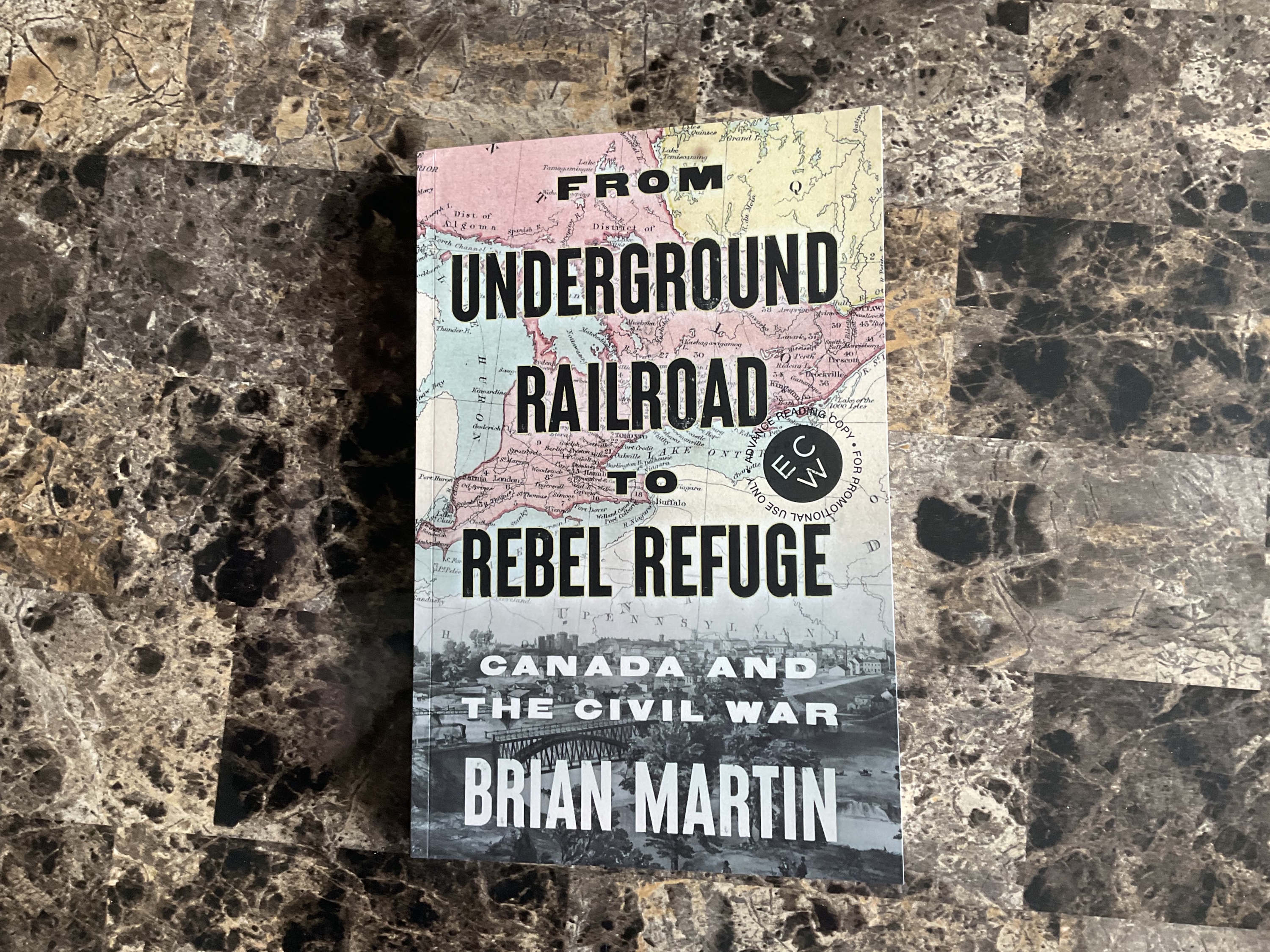
First a full disclosure. Whenever I am very disappointed on reading a book that has been given a rave review by persons unknown to me, I suspect that the review was written by a close relative or friend of the author, or worse, was paid for their praise. Such is the nature of marketing. The author of this history is an journalist/sports writer/biographer/historian, acquaintance of mine from my years in London, Ontario, and a friend on Facebook, but not a close personal friend. We both had previous book published by a small, now defunct Ontario publishing house. When I heard about this book to be published in October, I asked him if I could buy an advance copy for review, and the publicist at ECW Press was kind enough to send a free preprint ‘for promotional purposes only’. But I think I can still provide a relatively unbiased assessment of it. Hence this paragraph written before I even opened the gifted preprint.
Now my review.
All the 1850’s, 60s, and 70s Canadian and American history that we were never taught in high school or even in university, and should have been, is served up here in rich, scholarly, entertaining detail by the London, Ontario journalist/sportswriter/biographer/historian, extending the documentation briefly into the 1930s.
Far from passive bystanders watching the war from ‘America’s attic’ Canadians were intimately involved in far more complex ways than most of us heretofore appreciated. Before the war, Canadians were active participants in providing safe passage for escaping slaves to safety in the free north U.S. and southern Canada via the Underground Railroad. They usually settled in cities and towns close to the border, where they generally, but not always, were welcomed. Lucan, north of London, Ontario, was at that time named Wilberforce, after the British abolitionist.
The 1857 racist precedent-setting Dred Scott decision by the U.S. Supreme Court did much to precipitate the war. (Will another recent similar packed Supreme Court decision precipitate the next one?) Canadian adventurers, dedicated idealists, abolitionists, white supremists, many with American relatives and a few duped, drugged, or hijacked youths joined American forces on both sides and thousands of them never returned home. At least a few Canadian women disguised themselves as men to enlist on one side or the other to take up arms, probably unintentionally killing fellow Canadians. The border crossings, particularly at Detroit and Buffalo, became two-way thoroughfares with Canadians heading south to fight and thousands of Americans of various stripes, and for various reasons finding a usually friendly welcome in Canada. It was not just people who used this highway- farm produce from rich southwestern Ontario soil and fabric from its urban factories crossed the porous border with compliant, bribable guards to feed and clothe armies. Of particular interest to me was the arc of Bennett Young’s life from childhood poverty in Kentucky to Confederate soldier, to leader of a raid on St. Albans, Vermont from Lower Canada (Quebec) in an attempt to drag Britain into the war. He became a fugitive after the war living in Canada with clusters of former fellow Confederate bigwigs in sympathetic towns and cities. After education in Europe he then returned to Kentucky and a thriving law practice and founded Eastern Kentucky University where my daughter teaches theatre arts. Small world!
The various attempts by the Confederate forces to drag Britain into the war and open up a northern battlefront against the Unionist army fighting them in the south was a serious concern to Canadians in what was then pre-Confederation Upper and Lower Canada, as was worry about being annexed to the States at various times, a serious proposal endorsed by Lincoln’s Secretary of State, William Seward among others. Following the war, impoverished southern plantation owners deprived of their slaves, some of them former Ku Klux vigilantes (the forerunner of the KKK) found their way to Canada spewing hateful racist language, many of them setting in London, Ontario, where they thrived. Several families of them are buried under big monuments on Millionaire’s Row in Woodland Cemetery.there. Jefferson Davis, president of the Confederate State during the war, found temporary refuge in Montreal after it ended. John Wilkes Booth hatched his plans to kill Abe Lincoln in Quebec. The late attempts of a newer KKK to establish cells in Canadian cities succeeded briefly in the 1920s but floundered in part because the racist anti-Catholic Loyal Orange Lodge “had effectively cornered the market on bigotry…”
The book is divided logically into three parts covering the periods in the 1850’s just before the war to during it, and then after the war during Reconstruction. The writing is straightforward easy prose, and while there are far more names and places than I can possibly remember, there are also a surprising number that I am familiar with as many of the towns, streets and family names are common around southwestern Ontario.
I hope this enlightening book will become available in ebook and audiobook formats, as it can easily be widely appreciated even without the helpful photographs and maps.
This should be obligatory reading for serious Civil War, Canadian and international history buffs; I highly recommend it even for the Canadian and American general public as well. I learned a lot of unique Canadian history and enjoyed it immensely, something I cannot say about my high school history class.
⭐️⭐️⭐️⭐️

 The Passionate Reader