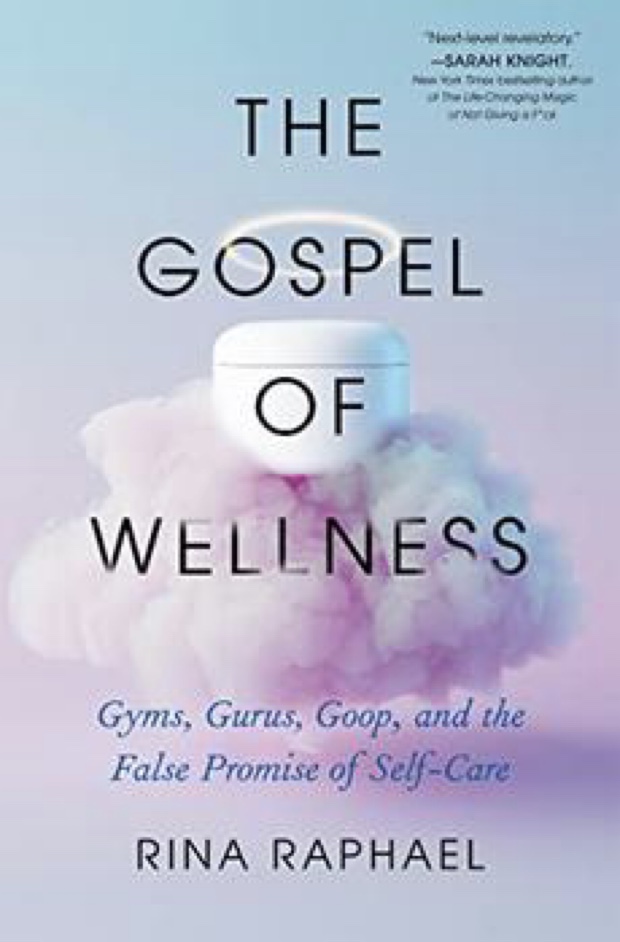
Almost exclusively addressing the part of the huge fitness industry aimed for women, this begins as a negative rant about what the author considers to be the misdirected modern trends in self-care and relieving stress, from yoga in all of its forms to jogging and meditation, not that these are harmful but because they are only partial solutions to underlying deep rooted uniquely American societal problems.
.
Exaggerating the stresses imposed on of modern young American women’s lives, Chapter 1 has a whining personal negative tone with almost no proffered solutions and a distinctly man-blaming undercurrent. It also conveys a anti-capitalist hint about the underlying societal causes of workplace stress.
Chapter 2 delivers an equally negative but more logically argued assessment of the multibillion dollar diet and weight control industry, largely promoted by market specialists with no nutrition expertise or celebrities with expertise limited to self-promotion. The unscientific body mass index comes in for justified scorn, based as it is on limited old data from studies of white adult males.
Chapter 3 focuses first on the huge recent industry devoted to looking after your skin with a huge array of products, then switches to express the many ambiguities and the false dichotomy between natural and chemical products. The author does not doubt the need for almost any skin care products, as does James Hamblyn in Clean.
In Gym as Church, details of the limitations of the entrepreneurial business model of charismatic stars such as Oprah of SoulCycle, pastors of exercise believers, strengthening faith muscles and replacing the older roles of religious communities are exposed. There are limits to how much exercise and meditation clans can relieve the loneliness of modern American society detailed in Robert Putman’s Bowling Alone, filled in the past by faith groups and institutions like the Women’s Institute in rural Canada, Britain, and South Africa (but not the U.S.A.)
Goop conferences, Gwyneth Paltrow and the huge unregulated alternative medicine industry get an uncritical hearing in A Plea to Be Heard, even as some of the practices are shown to be bizarre, ludicrously expensive, and totally unproven or even harmful. Their success is based on clever, but lucrative marketing and dissatisfaction with traditional medicine, more than any scientific evidence,(and on a regulatory failure to restrict false advertising). Voodoo witchcraft of rose quartz crystals under the hardwood floor seems harmless by comparison, even if a waste of money and resources. But the trashing of traditional medicine as a paternalistic, uncaring, misogynistic, male domain seems a little overdone, as now more than 50% of medical school students in the U. S. identify as female as do 37% of their practicing physicians. The vast gap in knowledge, research funding, and standards development between men and women is attributed solely to gender bias in the medical establishment, without acknowledging the unique challenges that potential pregnancy, pregnancy, cyclic hormone fluctuations, birth trauma, and lactation presents to those trying to design proper scientific trials.
The Nutritionmania chapter provides the best, most accurate, balanced information in the whole book, in my opinion. Ancel Keys in the 1950s probably did more than anyone else to throw confusion into the world of nutritional recommendations, and his advice remains influential. The resulting uncertainty opened the door for Big Food’s $14 billion advertising budgets and popular stars such as Vani Hari (Food Babe) with no nutritional science background to further pseudoscientific eating habits such as irrational avoidance of gluten by people without celiac disease and the shunning of GMO foods. For the huge supplements and health food industry, such terms as “clinically proven”, boosts, supports, enhances, renews, rebuilds, revitalizes, rejuvenates, and restores are exposed for what they are- meaningless buzz words but very effective marketing tools that prey on grocery shopper’s anxieties.
The chapter on the burgeoning new spirituality discusses the phenomenon of mostly young well-off white American women who feel unfulfilled indulging themselves from a menu of meditations, astrology, reiki energy cures, Christian Science, alternative medicine, and selective bits and pieces of traditional religions along with visits to psychics, mystics, and “Manifestation experts”. This must lead to fragmentation of societal cohesion and deepening of a selfish inner focus, as the author acknowledges. For me, these practices seem as zany as outhouse flies. But I do not have a magic formula to get people to become less self-centred and to refocus on bigger issues. The same shaming marketing strategies and the same self-focus outcomes apply to the numerous Fitbit-addicted “fitfluencers” providing “fitspirarion” toward deliberately set unattainable goals. Most of these are celebrities with no expertise in exercise physiology, but are expert at doling out a kind of toxic positivity of expectations with simplistic reductionist advice.
Some of the unscientific flashy “bio hacking” trends such as “atmospheric cell training” to “massage your cells from the inside out” seem totally whacky to me, but as Raphael points out, do give people a perception of control which has its own scientifically proven benefits. But do not count on these to delay your encounter with the Grim Reaper, and they potentially can delay or deny use of proven treatments that do just that.
Raphael points out in the closing chapters that scientist have historically done a very poor job of communicating facts about fitness and health and that that deficit leaves the advertisers and self promoting quacks free to fill the gap with nonsense. That needs to change. For my part as a scientist, my advice is accept that life is rife with unfairness and uncertainties, to exercise vigorously, monitor every body function, gobble supplements, restrict your diet, meditate etc, only if it gives you pleasure or is recommended by a knowledgeable health care expert. And don’t bother with the gluten free shampoo. (Yes, it is a real product sold in Walmart.)
It might seem from my negative comments above that I did not like this read, but I really did enjoy it. The writing is laced with humour, personal anecdotes and quirky metaphors as the author, a Los Angeles journalist, indulges in many of the practices she studies and tries to understand. She interviews many of the leaders of these and more scholarly academic experts.
Her approach combines insight into the psychology of the trends she studies with an open mind, although from a limited female American perspective.
⭐️⭐️⭐️⭐️
Thanks, Book Browse.

 The Passionate Reader