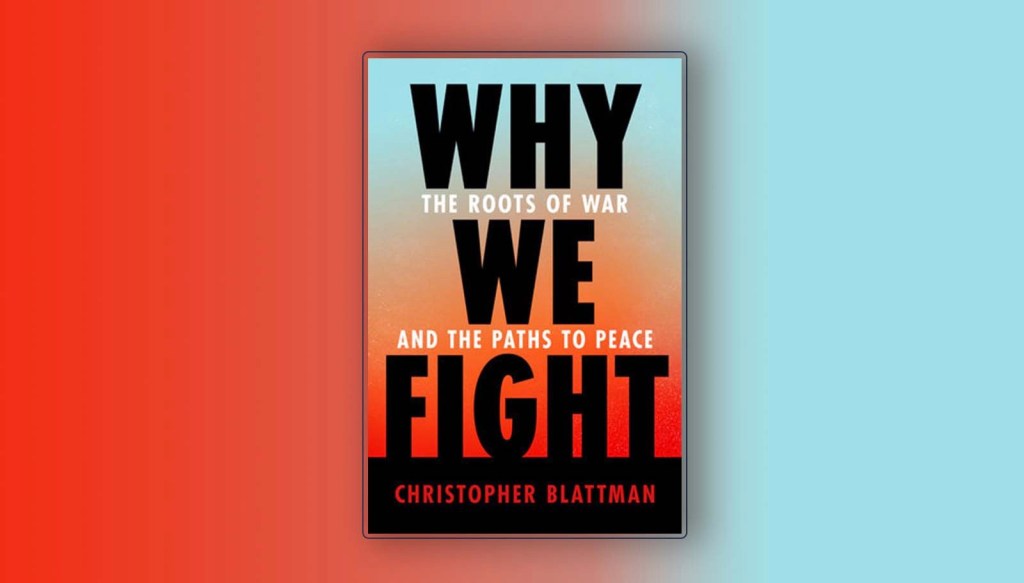
In the Introduction this explanted Canadian professor of Economics and Political Scince at the University of Chicago defines war very differently than does Richard Overy in Blood and Ruins. For him, war is any prolonged, violent, conflict between groups of people whether they be nations, religious sects, or Chicago street drug gangs.
In part I, he lists five factors which he sees as contributing to the likelihood of war- unchecked interests, intangible incentives, uncertainty, commitment problems, and misperceptions. Some of these rather fuzzy concepts are clarified by numerous examples from wars throughout history, by his observations from everyday life experiences, and from social science studies. The latter are often limited by inclusion of only unrepresentative undergraduate university students as subjects. His pie diagrams of two rival groups with a shifting bargaining space between them is used extensively but works best as a concept when there is rivalry only between two groups.
Chapter 5, entitled Committment Problems, purports to explain the reasons for the Peleponesian War (along with a very confusing map), WWI, genocides, the American invasion of Iraq, and the long Columbian civil war. It coveys a lot of factual information but I found it also vague and confusing.
Part II, titled The Paths To Peace, also comprises five chapters, discussing interdependence, checks and balances, rules and enforcement, interventions, and wayward paths to war and peace. In the latter, some myths about both the causes and the supposed benefits of war are exposed. The assertion that “….the solution to world peace is universal cognitive behavioural therapy.” seems like a gross oversimplification.
The concluding chapter titled The Peacemaking Engineer is composed of trite Ten Commandments for everyone on how to contribute in some small way to world peace that reads like common sense, which seems to be an uncommon commodity in the world of politics.
I am ambivalent about recommending this book for the general public but it will be of value to international diplomats and negotiators. There are interesting historical facts from around the world and some fresh concepts and perspectives. But there are also long barely relevant diversions such as the history of Henry VIII’s successors in an attempt to answer the question of whether women leaders are more or less bellicose than men- with the conclusion that we do not know. Almost none of the wars and potential wars he discusses are current such as that in Ukraine and the tension between America and China over Taiwan. And the writing style is unimaginative and bland; it is also much too wordy, and humourless.
⭐️⭐️
Thanks, The Economist.

 The Passionate Reader