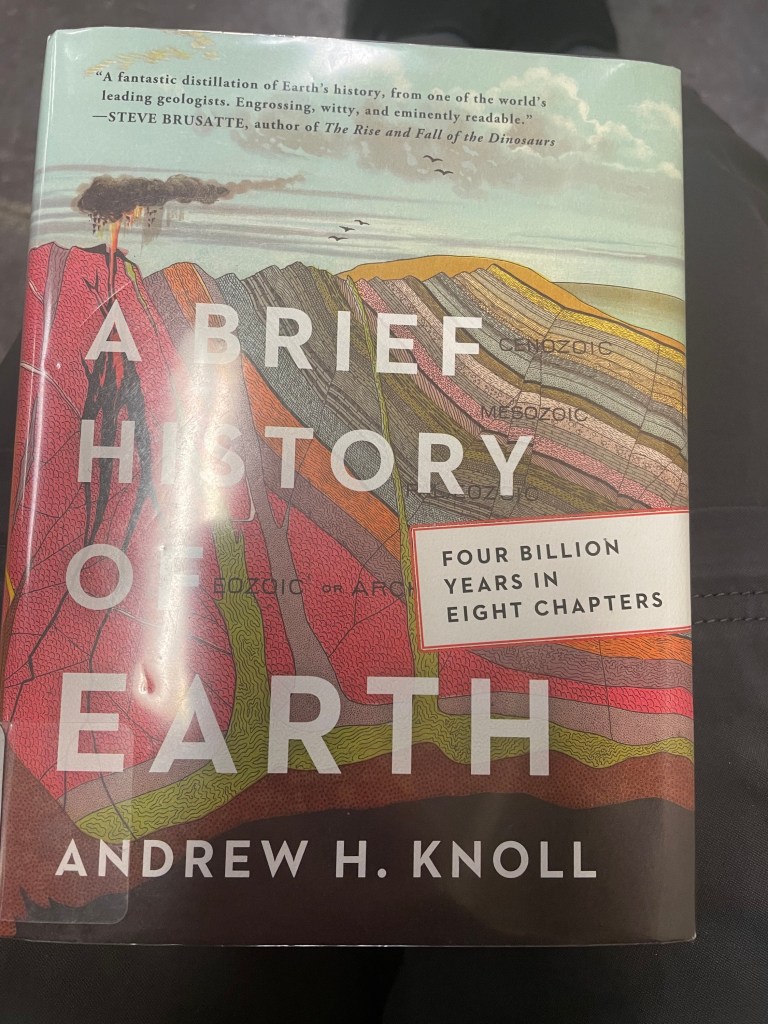
This is the definitive history of the earth’s evolution from the Big Bang to the present in eight chapters by a Harvard professor of Natural History. Scholarly and detailed but dense.
Neither the Oxygen Earth chapter on when the earth first acquired oxygen through the proliferation of Cyanobacteria nor that of Animal World about the first arrival of animals did much to enlightenment me. While obviously important their confusingly detailed and speculative nature is probably of little interest to most of the general public. Knoll scornfully dismisses the panspermia hypothesis that life on earth came first from another planet, which some other scientists take seriously, which just shows how little we really know for certain about where and how life started.
The distinctions between eons, eras, periods, and ages in the evolution of the earth are arbitrary and also impotant but I can never remember how far back one must go to make these distinctions, even after reading this book, and I doubt that I am alone in this.
Over 50 black and white photographs, many of fossils and and rock formations taken by the author do little to clarify details. The sparse charts are a bit more helpful.
The final chapter, Human World is a pessimistic but probably realistic recital of the ever accelerating damage we are doing to the earth since our arrival and proliferation but with an interesting addition I had not head of before. By citing analysis of carbon isotope ratios in earth’s atmosphere, Knoll claims that almost all of the carbon dioxide being added to the air since the onset of modernity comes from the burning of fossil fuels such as coal, oil, and natural gas, not other sources, a finding that, if true, deserves emphasis.
Emphasizing the ever changing nature of our home, there are abundant facts to cite at a cocktail party to impress someone, such as alligators once roaming the Arctic and the distance between Boston and London shrinking by an inch every year, but they hardly make up for the unfamiliar and forgettable names of species.
One memorable quote: “Earth writes it’s history with one hand and erases it with the other.”
Outside of to the rarified world of research natural scientists, encompassing cosmologists, geologists paleontologists, anthropologists and perhaps a smattering of general biologists, I cannot recommend this book. For the rest of us it’s chief redeeming feature is it’s brevity. (Too be fair, I am not sure the author wrote it with the general public readership in mind, in site of the reviewers comments)
⭐️⭐️
Thanks, Book Bub.

 The Passionate Reader