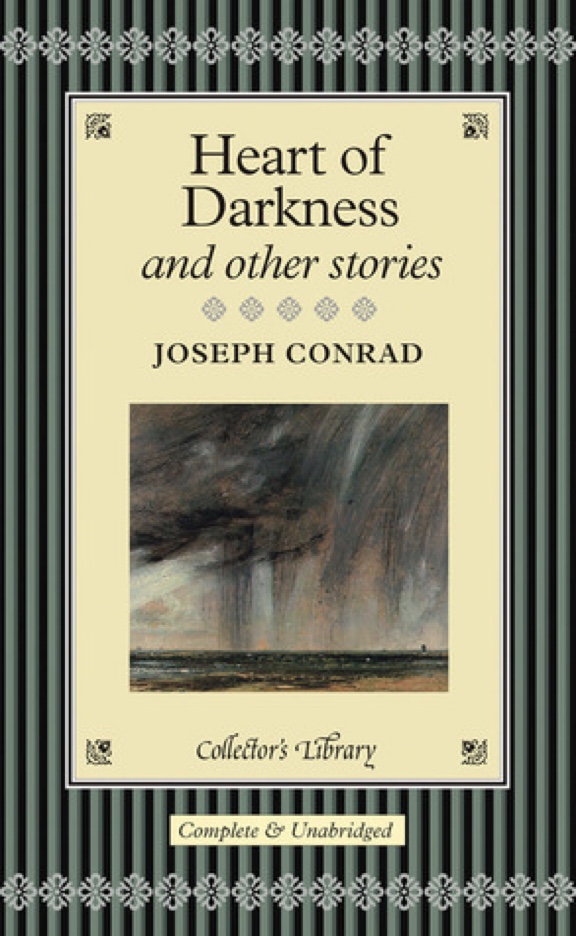
This is the most famous and durable of the prolific Ukrainian-born Polish/British novelist and short story writer’s works. The copy I borrowed is a 1996 edition in booklet form in inexplicably small print, accompanied by the earlier short story Youth, (also narrated by Marlow) and the later novel The End Of The Tether, with which it was published in a 1902 edition. It was not as popular as the latter two during Conrad’s life. I cannot recall who recommended it to me other than that it was lavishly praised in Salmon Rushdie’s memoir Joseph Anton.
The single-named seaman Marlow narrates the tale to his fellow adventurers as they await the high tide to sail down the Thames on their next adventure. He was somehow assigned to operate a steamboat for the Belgian “Company” between stations on the Congo River. After many delays including gun battles with shore-bound natives, and taking on cannibalistic natives as crew, he reaches the last station where the also single-named Kurtz has resided, trading in plundered ivory and murdering natives who nevertheless are in awe of him and worship him as a god. Marlow observes of his crew “Fine fellows-cannibals-in their place.” Kurtz also produces a document for the Company called “Suppression of Savage Customs.” His charisma is so overpowering that everyone seems to admire him. The ruthless plunder of the pristine land and the murder of native Congolese is described graphically but so is the allure of the uncertain and dangerous life in the jungle for single adventurous white men.
The plot has many twists but is not difficult to follow. For me, the beauty of the story lies in the vivid description of the characters, scenery, and cultures. A quote to illustrate this:
“ His head was as bald as the palm of my hand, but his falling hair seems to have settled on his chin, where it prospered, as his beard reached his waist.” As Marlow reaches Kurtz’s station, the latter is very ill and he dies en route with Marlow as they sail downstream to return to England.
The last few pages describe Marlow’s philosophizing about the nature of human loyalty and the meaning of his life. He sees both sides of Kurtz’s life but can’t help but admire him and feel some loyalty to his memory. A year later, on visiting Kurtz’s betrothed in London he describes him in superlatives and lies about his double life and his last words.
The primitive violent nature of the jungle natives is detailed but so are the horrors inflicted on them by the would-be white empire builders, with equal moral condemnation.
This tale has been loosely adapted to film three times including Apocalypse Now, starring Marlon Brando.
⭐️⭐️⭐️⭐️
.

 The Passionate Reader