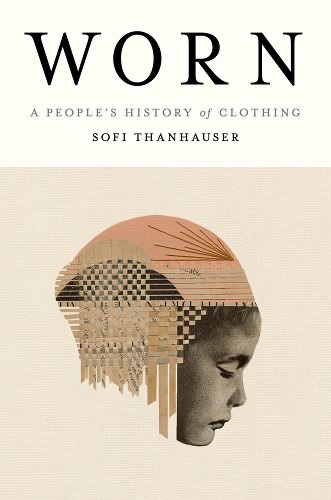
A young New England writer here documents the long and convoluted history of the clothing industry in four chapters named Cotton, Silk, Synthetics and Wool
I found the detailed documentation of the four-way back-and-forth tussle between India, Africa, Europe, and America, for domination of the growing, spinning, weaving, bleaching, knitting and dying with toxic chemicals, and marketing of cotton over 500 years a bit hard to follow. Cotton growing in the U.S. south was linked to slavery, then sharecropping, and moving west to Texas, it is now depleting soil and the Ogallala Aquifer that runs from North Dakota to the Mexican border. Growing the thirsty plants, and harvesting them with cheap largely undocumented immigrant labourers and with added chemical fertilizer, it is a major cause of the massive dead zone of algae bloom in the Caribbean Sea, all so that we can buy cheap, nondurable cotton clothing. The interrelationship between the massive Chinese cotton industry in the Xinjiang Uyghur west and the forced labor and human rights abuses there are carefully exposed. On startling claim that seems like hyperbole “….it takes twenty thousand litres of water to make a pair of jeans.” Much of that water becomes polluted in the process and not reusable.
The chapter on Silk was easier for me to understand as we have visited a silk factory in China and our guide explained the ancient process of growing the worms and extracting the finer from their larvae. Silk clothing has been used since prehistoric times to signal social status as best documented by Thorsten Veblen in his 1899 The Theory of the Working Class, one of my favourite old nonfiction books . The Veblen Effect or Veblen Choice effect relates to the phenomenon whereby raising the price of certain consumer goods beyond any possible utilitarian value will increase sales because of the signal it confers of social class. It applies not just to clothing but to jewelry, accessories household decor and even pets. Think of of Rolex watches, Hermes handbags, etc. Veblen is not mentioned here.
In Synthetics, only Rayon or viscose, and Nylon or polyamide, both twentieth century inventions are discussed in detail, but DuPont dominated in the production of both along with acetates, fluorocarbons, polyesters, Spandex, Lycra, Orlon, and Dacron, all derived from petroleum products or coal. Rayon production is based on plant fibres but involves extensive use of the very toxic carbon disulfide, also used in vulcanization of rubber, exposing thousands of workers to the risk of fainting, psychosis, and often death, especially in southern United States nonunion factories. The toxic exposure continues to this day, although the acceptable exposure limit of 20 parts per million in the U.S. has been lowered to 2 ppm in China, where much of the rayon industry has been outsourced to cheaper labourers.
In the Regan era, Taiwanese, South Korean and Hong Kong companies used Caribbean sweat shops paying below subsistence wages to produce garments for J.C. Penny, The Gap, Saks Fifth Avenue, Calvin Klein, Victoria’s Secret, Christian Dior, Eddie Bauer, J.Crew, Kmart and other American retailers. Those shops also pollute local rivers and seas with toxic dyes and massive amounts of microfibres, especially from polyester production. The same companies develop an ever-accelerating fashion cycle to stimulate unnecessary consumer demand a la Veblen effect. Meanwhile U. S. politicians, the World Bank, and USAID boasted of supporting the Caribbean economies and their right wing dictators through the tariff-free Export Processing Zones, while insisting that they use only U.S. raw materials. The real agenda was usually to prevent any socialism or communism reaching the West. Such hypocrisy!
The chapter on Wool brought back fond childhood memories to me. One of my earliest memories is of my father dipping his Shropshire sheep and those of several neighbouring farmers one at a time in the sheep dip filled with green malodorous fluid, undoubtedly some toxic pesticide, holding them back from the exit ramp with a long crook and using it to immerse their heads. And I watched my uncle deftly holding a ewe between his legs as he sheared her and put the intact one fleece in a large bag. The assertion here that wool production is a net benefit for the environment with manure and wool sequestering carbon in the soil must be partially or completely negated by by the fact that sheep, being ruminants, belch and fart methane. The discussion of the cruel persecution of native Navajo weavers of rugs and tapestries while interesting, seems peripheral to the subject of clothing, and several other such digressions make the book much longer than it needed to be.
As a lifelong severely wardrobe-challenged senior, (possibly only outdone in that category by Gordon Lightfoot and Ronnie Hawkins who were known to host 1960s parties in their birthday suits) I enjoyed reading this well researched and very educational and thought-provoking book. In profound ignorance, I had not previously thought of textile workers and garment workers as separate forces, but this book shows how important this distinction is in history, demographics, skills, and location. The natural byproducts of rayon are often used to make sausage casing.The etymology of dozens of common words and phrases related to clothing is delineated.
Will reading this change my wardrobe choices in the future? Not in the least. My wardrobe committee (my wife) often vetoes my choices and if I get a new piece of clothing, I always discard or preferably donate an equivalent piece to a charity.
⭐️⭐️⭐️
Thanks,
The Atlantic, The New Yorker.

 The Passionate Reader