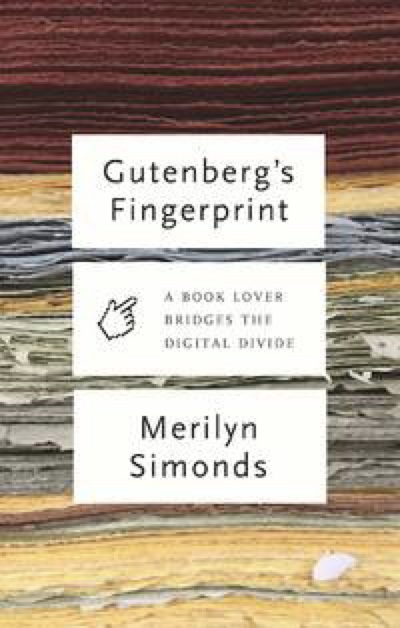
The peripatetic Canadian writer of various genres, now based in Kingston, Ontario addresses the whole history and evolution of paper, ink, printing, press, and reading from papyrus to eBooks and audio books. In chapters including experiments in making paper in her home, trying to mimic ancient methods of typesetting, the history of ink, the press and books, her enthusiasm for the whole process shines through.
I thought the process of attempting to produce paper in her home from various bits of vegetable matter was the most obscure, tedious, confusing and useless information any reader might seek until I read the 57 page second chapter on typesetting and formatting. Although I recognize the importance of choosing an appropriate paper, print size, typeface, spacing and layout of a book, I always left those details to my expert design lady, copy editor and proofreaders. I cannot even remember what fonts were chosen for my books and I doubt that many potential readers choose to buy a book based on the font of the text. I would like to, but can’t blame the layout, margin sizes, or font for my poor record of book sales. But apparently to a subset of professionals immersed in the business, certain fonts are a turnoff and others are magnets. In future blogs I may experiment with different layouts and fonts just for fun- there are hundreds to choose from.
The chapter on inks is a bit more interesting, but still loaded with trivia. I care about the aesthetics of written material whether a book cover, a magazine article or a letter, to the point that I at one point bought a very expensive Montblanc fountain pen which I used almost exclusively for my signature on consultation notes. I don’t know where it is now. It may be important to some fanatics that the ink used in eBook production is organically different than that for paper editions of the same book, but for whom? One bit of interesting trivia- the background in Facebook is blue because Mark Zuckerberg is colourblind and blue is easiest to read for blue-green colourblind men.
The author’s widowed, obviously greatly admired friend and co-worker, Hugh Barclay seems to be the epitome of an eccentric poster child for obsessive compulsive disorder, although she and her son could compete for second prize in that category and she would easily take first prize if there was one for hoarding. Still, most of this chapter and much of the book is taken up by obscure and confusing details as they try to publish a book from scratch using only materials and methods they themselves control, much of it antiquated. Much of the description of this process was like a foreign language to me, e.g “The forms was moved into the chase and furniture and reglets fit all around it to position the text exactly on the page, with proper margins all around. When everything was tight and true, the quoins were tightened with the quoin key, locking up the chase.” (Quion would be a valuable word for Scrabble.)
The chapter titled Books was the most interesting to me as it details the numerous developments from serialization of books in magazines to the ingenious ways of modern promotion and marketing with elaborate gala book launches, to the ways to achieve bestseller status that could be considered almost a scam. I have experience with the vagaries of marketing of books- the sole publicist for the publishing house of my first book went on compassionate leave the day it came out so I got no help promoting it, and the publishing house for my second closed shop after contracting to publish it, leaving me on my own. And I am not a natural self-promoter. Writing a book is the easiest and most fun part of the business.
Although I read a lot of books of various genres in various formats (hardcover, paperback, ebook, or audiobook) the intricate details of the dozens of ways they are produced and the materials used in their production are of little interest to me. Gutenberg’s Fingerprint provides more of those details than I could possibly understand -or care about.
I thought that John C had recommended this poorly organized disjointed book to me, but on checking after struggling through all but 35 pages of it, it seems it was his wife Pat who was as confused as I was by it and hoped I could and would explain it to her. Alas, her faith in me is unfounded and I am sorry to disappoint her.
⭐️

 The Passionate Reader