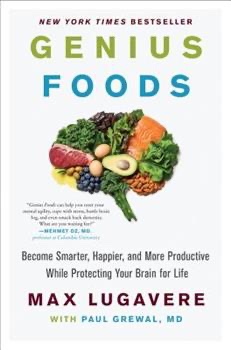
In this book, a New York millennial upstart with a background education in the film industry, on discovering that his mother has developed dementia, becomes an almost instant expert in neuroscience and nutrition, advising the whole world on how to avoid that fate, mostly by careful dining, exercising, and sleeping. He recruits a media-hungry private practice New York internist as coauthor to give his wild claims and generalizations some veneer of legitimacy (and presumably to share the revenue from the book sales). And he dresses it up with passing reference to such true experts as Robert Lustig and Nina Teicholz.
From this introduction, one could reasonably conclude that I did not find much to like here. But I really do enjoy books on controversial science subjects and none more than those related to uncertainties in nutrition science. Contrarian viewpoints that challenge what John Kenneth Galbraith called conventional wisdom always interest me and this book contains an abundance of iconoclastic assertions. The authors dish out distain for the conventional dietary recommendations of the medical establishment and governments which admittedly have an unenviable patchy track record in doling out poor nutritional advice that at times has proven to be completely wrong and harmful.
But once a reader sees through the wildly exaggerated claims asserted with certainty, there is abundant food for thought (pardon the double entendre) and a veneer of truth here. There are some exaggerated claims that will confuse readers, e.g. “Epilepsy, Alzheimer’s, Parkinson’s, MS, autism, and even depression are all conditions in which oxidative stress runs rampant in the brain, propagating the disease process.”
Convincing analogies of biological mechanisms to human decision-making and colloquial comparisons abound although some of them miss the mark. Brain-derived neurotrophic factor is described as “the brain’s natural anti-oxidant Miracle Gro”. Attributions of purpose to blind physical and chemistry processes are often difficult to conceptualize. Many social science studies claiming to improve cognition with this or that intervention are never replicated. There is not a word about the ecological consequence of the processes used in producing our foods, which is and should be a major and growing consideration. The recommended lean beef from grass-fed cattle only comes from ruminants belching and farting methane into the atmosphere.
The discussion of the need for an adequate consistent amount of quality sleep echoes what Matthew Walker has written in Why We Sleep, and that of skin care products and the importance of the skin biome that of James Hamblyn’s Clean. But to even suggest that we should reduce our use of anti-microbial hand cleansers now in the midst of a pandemic seems just plain foolish. And his view of our livers and intestinal tract’s susceptibility to injury seems grossly exaggerated as does the harm attributed to gluten in people without celiac disease. Many of the physiological mechanisms proposed for phenomena will no doubt prove erroneous with further research, and rest on correlations and plausible mechanisms without proven causes. But it is refreshing to see the reputations of dietary cholesterol, red meat, dark chocolate, butter, salt, and limited amount of whole milk at least partially restored.
The detailed regimens recommended to get on to the Genius Plan to fully protect your brain from dementia seems needlessly complex and the recipes at the end are arbitrary ones the authors like. Nevertheless, this book contains an abundance of good advice and information that makes it unwise to dismiss it as just another fad diet endorsement like the Adkin’s, Scarsdale or South Beach diets.
In the ebook edition, it was annoying that throughout, the many internal cross-references were all missing with only: “(see page.)”
Perhaps the worst takeaway message from this book is the suggestion that we are entirely in charge of our cognitive fate and not subject to the quirks of fickle nature- a ‘blame the victim’ attitude which is all too prevalent in many fields. I doubt that my significant cognitive decline over the last 18 months is entirely because I do not follow the detailed dietary, exercise and sleep regimen recommended here but the conclusion from this book is that I have brought it on myself by not doing so. I hope it is related instead to chronic neuroborreliosis which I almost certainly acquired by pure chance18 months ago due to a hostile encounter with Borellia burgdorfi, the agent of Lyme disease. It appears to now have set up shop in my cerebrospinal fluid.
Will my eating habits change after reading this book? There may be some tweaks around the edges, but certainly no major overhaul. Remember the adage about old dogs?
⭐️⭐️
Thanks, Book Bub

 The Passionate Reader