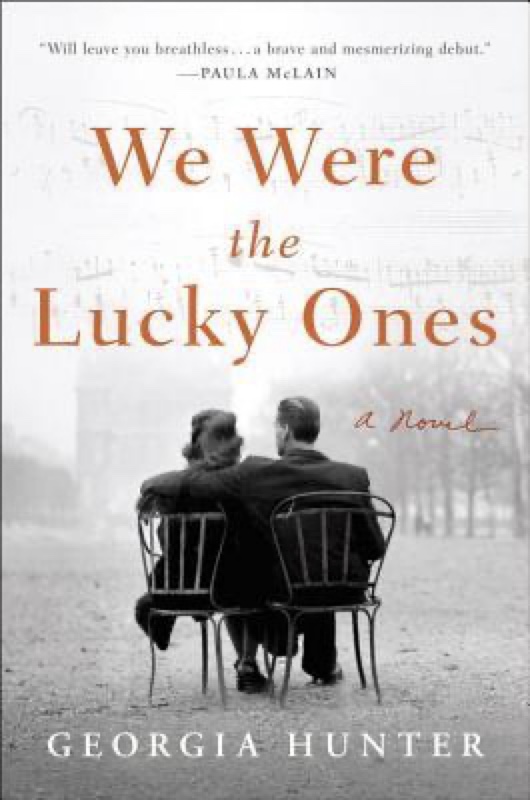
Based on extensive interviews with two generations of her fore-bearers and their friends, and extensive research, this historical account of an extended Polish Jewish family scattered around WWII Europe spans from early 1939 to 1947. It thus joins hundreds of what are labelled historical novels of WWII. But this one is, by all accounts, more embellished family history than novel-on the spectrum of History-Novel, it is definitely on the History side. As Naziism grips more and more of Europe, the members of the family become scattered even further around the globe from Siberia to Africa, Palestine and South America losing all of their possessions. For years they are unable to contact each other or determine whether any of the others are alive. Describing unconscionable acts of cruelty and killing, the Connecticut author does not spare readers the details of inventive cruelty, but the inspirational stamina and determination of the family members shines through. After the war, thanks in large part to the crucial role of the International Red Cross, the new United Nations Rescue and Rehabilitation Agency, and various Jewish organizations, all the members of the immediate family are able to reunite, first in Rio De Janeiro and later in the United States. But they also learn of many other friends and relatives who did not escape death by starvation, disease, Nazi bullets or gas chambers, including many of the spouse’s families.
The description of the geography, the real battles in Italy and the precarious travel conditions are vivid and realistic. For Gentile readers, the details of the Jewish family rituals surrounding Passover and Hanukkah are enlightening.
It is difficult to exaggerate the inhumane horrors that Jews experienced in the Holocaust, but some of the physiologic responses described here are exaggerated or impossible for humans to experience. Some animals raise the hair on their necks when angry- humans do not; our neck veins do not throb, unless we are recumbent or in heart failure; it is not possible to deliver a fist blow to the esophagus; our corneas do not change colour in response to emotions; the skin manifestations of scurvy are inaccurately described. I encounter such anatomical and physiological impossibilities in novels so often that I would suggest that aspiring novelists should take short courses in human anatomy and physiology, and perhaps psychology. There are imaginative embellishments that seem to this reader to be obvious attempts to amp up the suspense that do perhaps do just that for readers who like suspense novels, but did little to enhance my enjoyment. Unless a reader pays close attention or perhaps takes notes to refer to, it can be difficult to keep track of the many family members and their spouses and children.
This tale compares favourably in my estimation with the limited number of other historical war novels of the era that I have read including Heather Morris’ ‘The Tattooist of Auschwitz’, Anthony Doer’s ‘All the Light We Cannot See’, and Kristen Hannah’s ‘The Nightingale’. Of them all, it seems to tack closest to truth.
⭐️⭐️⭐️⭐️
Thanks,
Goodreads and Williams Court Book Club

 The Passionate Reader