The Connecticut-based journalist with The New Yorker expands and updates the extensive data from his article in the April, 2017 issue of this weekly. The prevalence of deafness and the resulting social isolation and misunderstandings are increasing, in part because of noise pollution everywhere.
The first part details the epidemiology, comparative anatomy, physiology and even evolution, with discussion of the different frequencies of sound waves audible to different species (about 20-20,000 hertz for humans), echolocation used by bats, owls, and some blind people and the asymmetric anatomy of owls’ ears assisting them to accurately pinpoint where a sound is coming from.
A chapter on tinnitus relates the peculiar remedies that have been advocated throughout history, most of them dubious at best, and none subjected to double-blind controlled trials, the gold standard for proof of efficacy. The very subjective nature of this common symptom was made obvious to me on reading about it. As I read this chapter, the very high-frequency ringing I had experienced years ago, but that my auditory cortex had finally learned to ignore returned to torment me for the last several days.
The hearing aid industry is marked by very effective lobbying by the audiologists to maintain strict licensing requirements, and exclude other entrepreneurial outfits, securing a massive monopoly with unconscionable profit margins.They also seldom do not recommend aids as they self-serve as both tester and treater, like a doctor prescribing drugs from the pharmacy he or she owns, without ever acknowledging any conflict of interest The author predicts that these alternative researchers will be able to mass market their very useful products by 2022. (Peculiarly the book’s Copyright is shown as 2019, but in the text the author relates an episode of his experience in 2020.) The “Beyond Conventional Hearing Aids” chapter showcases several of these devices but in places reads like a infomercial for Bose’s Hearphones.
Denial of the damage done by exposure to loud sounds is not limited to the military and industrialists but includes the whole music industry, and that damage can include such settings as busy city streets, sports venues and motor car racetracks. The Occupational Health and Safety legislation in the U.S. at both national and local levels set the threshold for protection far too high, and those standards are seldom enforced unless there are complaints.
The description of the intricate micro-infrastructure of the human hearing apparatus was impossible for me to visualize in three dimensions, even with my medical background. A page or two of reference sketches would have been helpful. There is no discussion of such phenomena as other sensory modalities compensating for hearing loss, synaesthesia where sensory inputs get crossed and people hear colours and see sounds, or taste sights. Or my granddaughter’s peculiar affliction of misophonia, where certain common sounds, such as hearing others walking on gravel triggers a panic attack or anger and aggression.
There is a lot of irrelevant detail in this rambling U.S.-centric book. E.g: “If you are traveling on the Red Line, get off at the stop closest to the Charles River, which is the stop for both the Mass. Eye and Ear and the Massachusetts General Hospital, and if you are early for an appointment at either place, you can hang out in the lobby of the Liberty Hotel, which is right between them. You can sit on a comfortable couch with a cup of coffee from the big urn over by the stairs and read the newspaper on your phone. Nice washrooms too.”
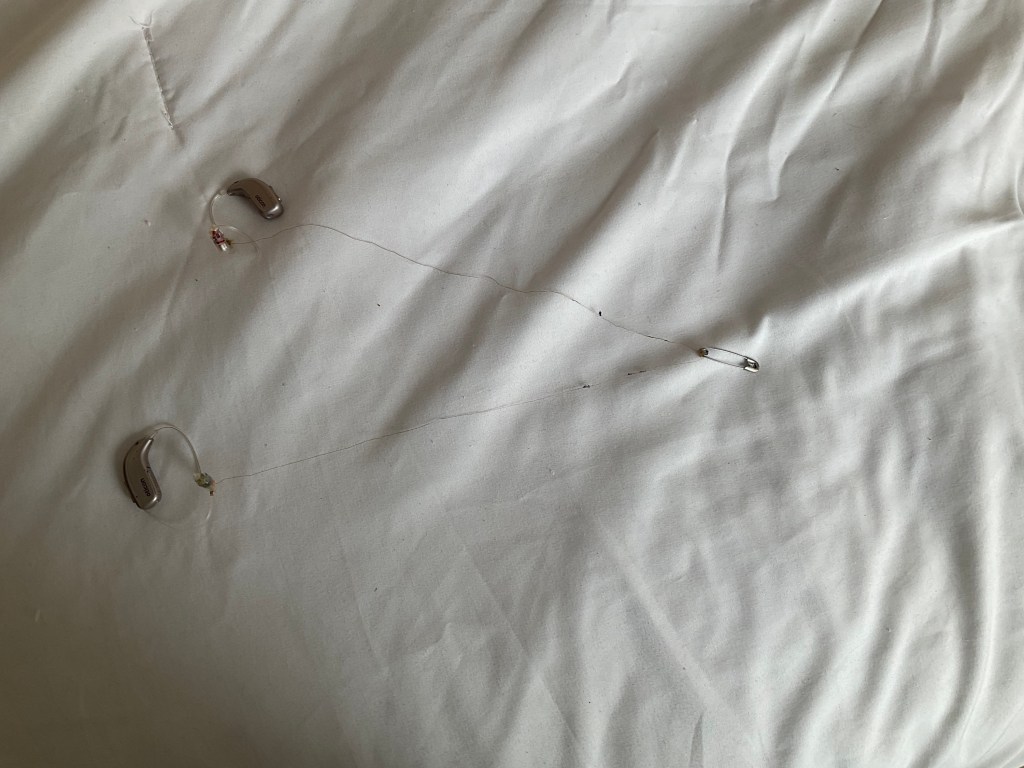
Now a brief note about my experience with hearing specialists and aids. At an unspecified age, 19 months ago, I went to a local audiology outfit, was tested and fitted with a pair of small Oticon rechargeable aids, for almost $6,000. When I asked the audiologist if improving my hearing would slow the progression of my subacute galloping brain rot, she said the evidence was iffy. I then lost one aid three times in six months- they often fall out when removing a mask, hat strap or sunglasses. So for $30, I bought a plastic cord that would attach then to my collar from the audiology shop: that fell apart within two weeks. So I devised my own anchor, a thin thread tied from the arms of the aids to a small safety pin I attach to my collar (photo attached). I have not not lost one since.
I cannot recommend this book. Most readers interested in this important subject would be better off to read the author’s more concise article in The New Yorker. Because it was a gift, I felt obliged to read to the end, but I’m not obliged to enjoy it. It will now be regifted.
⭐️⭐️
Thanks, Andra.

 The Passionate Reader