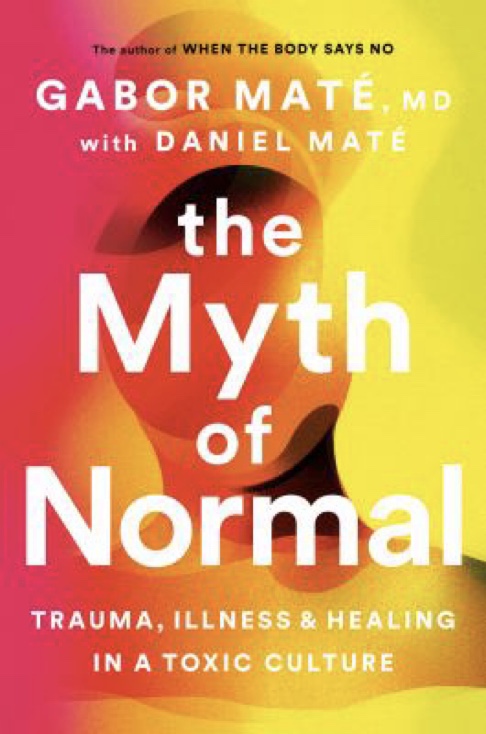
This is the very iconoclastic rant of an Hungarian Jewish physician and prolific writer and speaker working with the downtrodden population of lower east side Vancouver, mostly with drug addicts. His previous books and his film “Trauma Awareness” have been very well received and apparently are sort of background material for this one. (I have not read or seen these.) He shows throughout the book distain for the capitalistic, consumerist ‘toxic culture’ of the subtitle but only gives some tentative suggestions for society-wide changes needed in the last half hour of this read, including changes in educational institutions, medical and legal training and in so-called correctional institutions. His disillusion with communism in his youth, with American atrocities in Iraq, and with Israel’s cruelty to Palestinians no doubt colour his current opinions.
(Sorry, Dr. Mate, my iPad refuses to enter the diacritical e in your name) Mate’s definition of trauma as an internal response rather than external events that we have little or no control over is a little peculiar and leads to dissection of emotional responses to physical events ad nauseam. His definition of addiction is also complex and makes everyone fit in as an addict to something, but he counterintuitively relates it mainly to early childhood adverse events that fit with his definition of trauma. He does not indulge in the debate about whether or not there is such a thing as a mind, soul, or spirit separate from the molecules in one’s nervous system, as many philosophers do endlessly, but uses the word bodymind as a unity, not a dichotomy, and as an intricately interconnected entity. Later chapters suggest that he accepts that there are such entities as a soul and a spirit separate from the body, but what they are is vague at best, and no specific religion is endorsed, with just a hint of praise of Buddhism.
The modern biologic sciences are not neglected and he discusses subjects such as the effects of stresses on telomere shortening, epigenetic expression of genes and inflammation as a mediator of all kinds of diseases, often originating in changes in neuronal wiring and transmitters from trauma. Surprising observations such as that only 25 % of the increased longevity in Canada over yeas is attributable to health care interventions, that no genes for addiction have been found, and that loneliness is as big a public health crisis as devastating as the obesity epidemic seem to rest on solid evidence. Other accepted assertions based on social science association studies may suffer from the common problem of equating correlation with causation, and anecdotal observations e.g. that patients who develop ALS share a distinct personality, though not easily dismissed, are on shaky ground and not statistically analyzed at all.
There is a great chapter on the medicalization of childbirth and the need to revert to some more traditional practices in that field. At the same time, while critical of much of mainstream medical care practices, in this field and many others, He is careful to include disclaimers about not totally dismissing them and about not blaming victims who develop diseases that he believes are caused by their unwitting compliance with expectations of a ‘toxic culture’. The child rearing industry also comes in to severe criticism and the proliferation of parenting advice is referred to as the “parenting industrial complex”.
In chapter 23 rampant misogyny in a patriarchal society is alleged to explain gender discrepancies in incidence and severity of almost all debilitating diseases -but that, I note does not explain why women on average outlive men. In the next chapter, the author’s remote dissection of both Donald Trump’s and Hilary Clinton’s psyches is interesting but the conclusion that their personas are entirely explained by their childhood traumas as he defines trauma seems a bit simplistic. His penchant for analyzing the rich and famous without any need to meet them extends to our last two Canadian prime ministers and predictably he cites childhood trauma as the reason for most of their actions and beliefs. He seems to think that no one has had a happy childhood, and if they claim to have had one, they must be suppressing memories of abuse. The suppressed memories phenomenon is real but probably rarer than claimed by many writers. (What memories have I suppressed to recall mainly happiness and little ‘trauma’ in my childhood?)
Robin Williams’ suicide is traced to his insecurity, loneliness and bullying as a child even though he was aware that he was losing his mind and the autopsy showed that he had Lewy Body dementia, a disease that has never been linked to any mental stress or trauma. It is sporadic and labelled as idiopathic, a medical term for something of unknown cause. But almost nothing is of unknown cause if one follows all the links created here, mostly to childhood trauma.
This author shows a disturbing distain for and demeaning of mainstream medical advice, practices, and prognostications with selective documentation of miraculous recovery from apparently terminal illnesses. It seems odd that he never offers any opinion on the harm reduction strategies such as needle exchanges and safe injection sites for addicts, given his work environment.
Mate asserts that both higher than normal blood cortisol blood levels and lower than normal levels signal an unhealthy stress level, but ironically for someone whose book is titled “the Myth of Normal”, never questions how the margins of the normal or reference levels are set for this and many other ‘normal ranges’. One of my favourite beefs is when ‘normal’ is used wheree ‘average’ or ‘mean’ or ‘usual’ is the appropriate term as in weather reports of temperatures. For medical lab data, the normal or reference range is often set as what 95 or 98 % of what may be a highly unrepresentative population of hospital employees or university student volunteers has.
The therapeutic use of the ‘magic mushroom’ hallucinogenic psyllium is endorsed and he relates his use of it in a Peruvian ceremonial retreat. Yoga, meditation, and mindfulness practices are also praised. I will never condemn such practices, but they do not appeal to me.
In later chapters, healing, which everyone apparently needs, is described as a journey, not a destination. This leads to a long dissertation with fuzzy definitions of various mental exercises. Five levels of compassion are delineated with a lot of mystic opaque mumbo-jumbo and promotion of his own “Compassionate Inquiry” program that I found confusing.
Given the opportunity, there is no doubt that this author, on a panel to judge various phenomena, would invariably issue a minority opinion, rather than that of ‘conventional wisdom’ a term coined by the late economist John Kenneth Galbraith. But he provides sage wide-ranging counterintuitive and informative insights about our current economic, political, societal, and cultural milieu that made the read quite enjoyable and worthwhile for me.
⭐️⭐️⭐️
Thanks, Mike I. and Pat C.

 The Passionate Reader