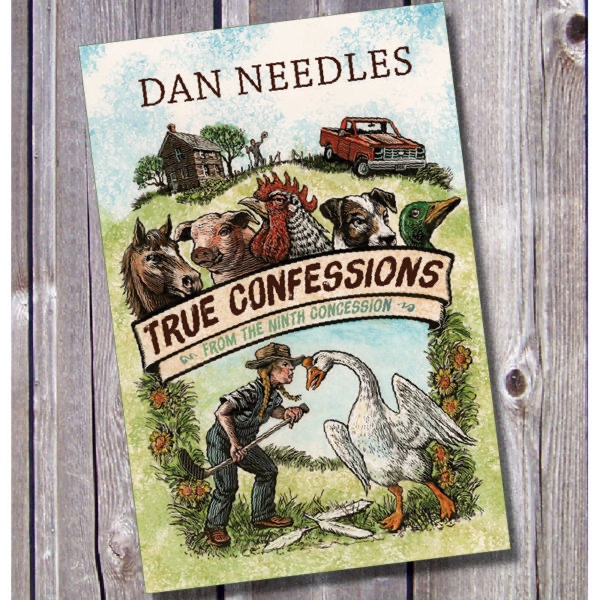
I don’t know how I missed this gem earlier, as Dan Needles is one of my favourite humour authors. I, my wife, and my parents all enjoyed his earlier books and plays featuring the fictional Wingfield Farm, and the town of Larkspur, in the equally fictitious Persephone Township. These were based, he reveals here, on his memories of spending summers on a farm in Nottawasaga Township while schooling in Toronto. I recall asking for one of his books in a London bookstore and being told that it would be in the Agriculture section!
In contrast, these 80 allegedly true short stories relate anecdotes from the author’s observations about rural life after he moved, at age thirty to an old farm house outside of Duntroon, not far from Collingwood, in 1977. This is only a short drive northeast from the farm where I grew up, and many towns, villages and townships he discusses are well known to me. This includes the Mount Forest Fur and Feather Show five miles from the Ghent farm, the Keady Livestock Market auction my father often took us to and Proton township where we visited my maternal relatives.
These musings about rural life were previously published in Harrowsmith or later ones in three other farm magazines. Although arranged in chronological order from June 1997 to March 2016, there is no need to read them in order, as each stands alone as a short fun read. They include discussion of a wide variety of topics, some serious and some hilarious. The menagerie of farm animals are attributed distinct endearing personalities that any farm youth could readily relate to: likewise the neighbours and the often antiquated farm equipment.
A couple of quotes will convey the quirky humour so unique to rural folks everywhere. After admitting that he could not predict weather very accurately: “Because I studied economics, I do have formal training into how to make incorrect predictions.”
“Pigs are a lot like teenagers. If something doesn’t suit them, they fight and kick and yell their heads off.”
The world of rural Ontario as described here now exists only in isolated small pockets, as big factory farms take over most of the arable land. Our loss, but we can and should preserve some of the helping community culture. Unfortunately, as Needles notes, they also tend to leave a hugely disproportionate carbon footprint. They also are almost exclusively white Christians of European descent and wary of other races and cultures. I never met an African American, Asian, Latino, or aboriginal Canadian until I moved to the city. Even Catholics were accepted somewhat reluctantly.
Perhaps in part because this revived so many wonderful nostalgic memories of my rural upbringing, I have to rate this book as
⭐️⭐️⭐️⭐️⭐️⭐️⭐️⭐️⭐️/10
Cam

 The Passionate Reader