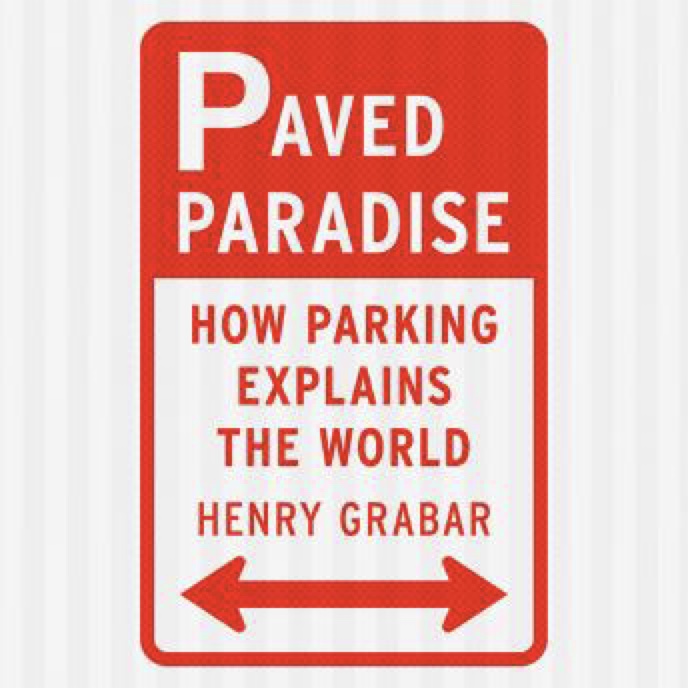
This screed was a loan from my real estate economist professor daughter who is visiting us this week. Often discussed as a source of frustration, parking is seldom the topic of an entire book but Grabar manages to make it interesting and informative. There is an entire history with major consequences for the way we live to accompany the paving over much of the world to “store” (the term Grabar prefers to “park.”) vehicles. The history is peppered with largely forgotten scandals. In 2009, Chicago mayor Richard Daley arranged a 75 year lease of all 36,000 of that city’s curb-side parking meters to Morgan Stanley, partly owned by the emirate of Dubai for $ 1.156 billion, although the value of them was independently estimated to be at least three times that amount. Organized crime syndicates were and still are major players in operating private parking lots in major U.S. cities. Many hours of productivity are lost, and millions of gallons of fuel are converted into atmospheric pollutants as people drive in loops looking for a place to park. Houston was devastated by Hurricane Harvey in 2017, in part or mainly because it had “ paved its way into an unmapped manmade floodplain” with little exposed topsoil to absorb the heavy rains and poorly anchored trees.o
Some progress is being made in certain areas where laws requiring a minimum number of parking spaces for new developments have been dropped, especially those close to adequate public transportation, but “By square footage, there is more housing for each car in the United States than there is for each person.”
I found some of the discussion of needed reforms a bit vague and confusing. ”Cars are a gateway drug to parking.” How can we be sure the relationship isn’t the inverse one – people use cars more where there is plentiful parking. But it is certainly true that “more parking means less housing, especially affordable housing “, the latter being my daughter’s topic for an address to the annual macroeconomics conference of the Bank of Canada as I write this.
One ancient foolish personal anecdote. In 1968, as a poor medical student, I required a car to get from one hospital to another in a timely fashion. But there was no place to park where I was boarding except on the sleepy dead end street, Wallace Avenue. The London inane bylaw prohibited street parking for any three consecutive hours between 12 a.m. and 7 a.m., which meant a patrol had to chalk mark the tires and curb and then return three or more hours later to stick a ticket on the windshield. I got a couple tickets every month, a bargain price for good parking. One night, studying late, I checked at 2 a.m. to find a ticket stating that I had parked from 12 a.m. to 3 a.m. I hopped into the car and handed the ticket to the sleepy clerk at the central police station at 2:30. He called the patrolman to reprimand him and tore up the ticket. Not a good move on my part. For the next month my tires were marked nightly, forcing me to take many nocturnal trips to the street to move the car.
⭐️⭐️⭐️⭐️⭐️⭐️/10
Thanks, Andra.

 The Passionate Reader