The Island Of Missing Trees. Elif Shafak. 2021. 347 pages. (EBook on CloudLibrary.)
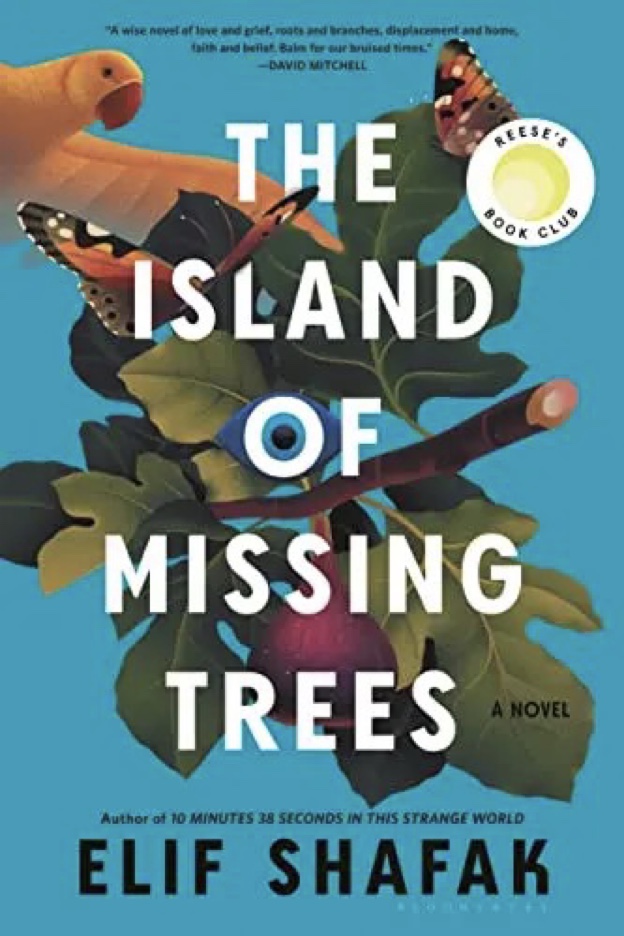
There are two memorable quotes in the first ten pages of this novel alone. Those stuck with me and assured me that I was in for a treat: “ …legends are there to tell us what history has forgotten.” and “Cartography is another name for stories told by winners. For stories told by those who have lost, there isn’t one.”
The Happy Fig Tavern in Nicosia, where an ancient fig tree is centred in the room, growing through a hole in the roof, figures prominently in the story. It hears all the human communications and communicates with them in English that somehow is made to seem realistic. But it also sees its surroundings, and talks to birds, butterflies, mice, and mosquitoes. As the Happy Fig says: “Just as trees perennially communicate, compete and cooperate both above the ground and below, so too do stories germinate, come into being and blossom upon each other’s invisible roots.”
Set in divided Cyprus between 1970 and modern times, the political upheaval is realistically portrayed with Greek, Turkish, and British soldiers everywhere and senseless killing. The characters are not difficult to keep straight, although who is a Greek Christian and who is a Turkish Muslim can be more challenging. A migrating Painted Lady butterfly reads the names of soldiers and children on the headstones in a cemetery.
The lyrical poetic writing style is delightful; the novel is all-encompassing-something for everyone. There is magic with trees, birds, humans, and even mosquitoes all talking to each other, politics with wars and mysterious deaths, ecological science with floods, heat waves, mass extinctions, and loss of biodiversity, and religion with different intolerant gods urging humans to commit senseless killings. There are myths and folklore, tender unlikely forbidden romances, mysteries that are hard to solve, and history uncovered by archeology. There is even some medical science in dealing with malaria, addictions, and mental illnesses. Much of the plant and tree science mirrors that in Suzanne Simard’s intriguing “Finding the Mother Tree”. All of the characters and plot mysteries come together by the book’s end.
A couple other great quotes among many: “… then again, anyone who expects love to be sensible has perhaps never loved.”
“Knowledge is nobody’s property.”
There is one apparent minor error. Nicosia, at an undefined time is described as the only divided city in the world. What about Berlin?
This novel should have universal appeal in any language. I was previously unaware of this Turkish Cypriot novelist who is self-exiled in Britain, but Vera is now engrossed in her “The Three Daughters of Eve.” after hearing about her from a bridge friend.
⭐️⭐️⭐️⭐️⭐️⭐️⭐️⭐️⭐️⭐️
Thanks Vera.

 The Passionate Reader