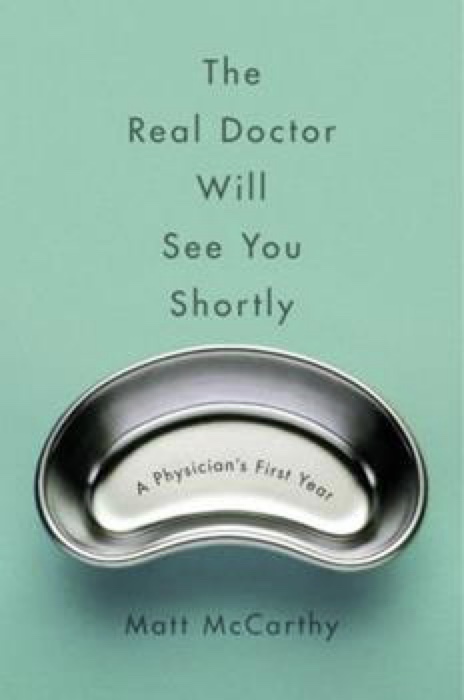
My sister recommended this book which details the author’s experiences as a medical intern, asking if it fit with my experiences as a budding doctor. In certain aspects the answer is ‘yes’; in others ‘no’. I was training in a different institution, (the old Victoria Hospital in London, Ontario), different country, and much earlier era, 1970-71, than in 2008-09 at Columbia University in Manhattan. The military style team hierarchy for bedside rounds -medical student, intern, junior resident, senior resident, chief resident, and consultant has apparently endured, sometimes with a fellow included. The role of the chief resident as the mental health monitor of the less senior staff was not part of my chief resident’s duties and no one monitored my mental state, although I later did so for trainees in an informal mentoring program. The timing and sequence of when we did similar rotations through surgery, internal medicine, paediatrics, surgery, obstetrics, psychiatry and neurology as third or fourth year students or later as interns and residents were different. But after briefly mentioning those rotations, and surgery, McCarthy never mentions paediatrics, obstetrics, psychiatry, or neurology again, limiting the narrative to his experiences in one year year as an intern in internal medicine. My internship was also ‘straight medicine’.
I certainly often experienced the same sense of panic and inadequacy that the author describes and the overpowering fatigue of sleeplessness for more than 30 hour stretches. There are now restrictions or at least guidelines on how many consecutive hours surgeons and trainees can work, but as a resident, I was sometimes on call from a Friday morning until Monday night, catching sleep and eating in any lull between calls. One anecdote: checking on inpatients with the head nurse at 7 a.m., on a Monday, I noted that old Joe, who was clearly dying, was not in his bed. When I asked about him, she laughed and said that the night nurse told her that I had come from the call room three hours earlier and pronounced him dead. I had absolutely no memory of that visit.
There are also remarkable differences in experiences. I never had to deal with HIV infected patients during training, while the author spends over 70 pages in learning about this, and even more after he accidentally jabs himself with a needle undoubtedly infected with it.
His actions and the adjectives he uses to describe his sense of inadequacy and uncertainty, and the resulting emotional rollercoaster ride that he shares with colleagues, patients (and now with readers) are beyond anything I ever experienced-at least the sharing part. Stoicism ruled supreme in the family I grew up in and in the training in medical school-we were expected to not show strong emotions at all, especially not to patients. But on one occasion as a student that advice failed me. A woman in her thirties who had been trying to get pregnant for years came in with a full term haemorrhage. The same night she was informed that her husband had died of a pulmonary embolus in another ward having been admitted with a heart attack a week or so earlier. I helped, or rather just watched the obstetrician deliver her stillborn in the deadly quiet delivery room. This was on my first day of obstetrics rotation. That was a time to share tears with a patient, as I and everyone in the room did freely. I could not visit her in the postpartum ward.
Soured on obstetrics forever by this, bored in surgery, and catching constant infections from sick children in paediatrics, I decided to abandon plans for family medicine training and switched to internal medicine.
There are negatives with this count. I question the cause-and-effect relationship that McCarthy makes between emotional shock and a heart attack in a young woman. In one case the author persuades the daughter of a brain-dead woman to withdrawal of life support, but no one seems to consider asking for organ donation. The emphasis on attending cardiac arrests seems designed to overdramatize medical training which was and I suspect still is often just learning hundreds of facts and dull routines day after day. At one point I recall an intern going through the dull routine of relating the history of a patient which we all knew, at his bedside. He realized that no one was listening so, in a monotone, inserted “and then his left arm fell off.” No one except the patient and the attending caught this as the intern droned on.
Ethics is only briefly addressed and largely discussed only by presenting hypothetical scenarios. The issue of how much to disclose to patients and relatives when an error has been made is avoided entirely. In an earlier era it was common practice to completely avoid discussing your errors or those of other doctors, if at all possible. Gradually legal advice has shifted to encourage disclosure and frank discussion. The wisdom of this is illustrated by an anecdote from my later practice. In a review session with a late patient’s wife and daughter, I confessed that I and several others, including at least two cardiologists, had completely missed the very treatable constrictive pericarditis (found at autopsy) that had caused his death from cirrhosis. That was there at the bottom of my differential diagnosis list of causes of cirrhosis, but I just did not think of it. My secretary heard them as they left, muttering that they could sue me but would not because I had been so honest with them.
This sensationalist account is entertaining but grossly over melodramatic with crisis after crisis presented as the norm. That may increase it’s appeal to a general readership but distorts reality.
⭐️⭐️⭐️⭐️⭐️/10
Thanks, Lois

 The Passionate Reader