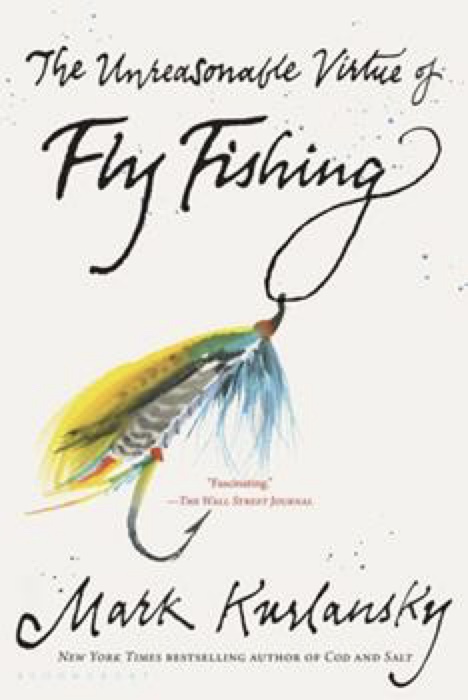
The peripatetic New Yorker provides a surprisingly detailed history of fly tying and fly fishing in this book which will no doubt not appeal to many who have never experienced the joy of this form of fishing. Once used by the ancients and North American indigenous people as a serious means of obtaining food, it has for at least three centuries been used as a leisurely form of recreation, initially by the British aristocracy, now by commoners like me as well. Of the many comparisons of fly fishing to spearing, spin casting, netting or commercial trolling, I like my fly fishing pal’s analogy the best: “Fly fishing is to other methods of fishing what love-making is to copulating.”
The book is divided logically into thirteen chapters wedged between a short prologue and an epilogue covering aspects such as the history, rods, reels, flies, lines and wading, but curiously, nothing about the several different casting techniques for different conditions such as strong winds or overhanging trees, perhaps because the roll cast or double haul cast are best demonstrated rather than described. Many of my flies now decorate riverside trees. Nor is there anything about the dozens of intricate knots used in fly fishing.
“Flies are designed to please humans, not fish” and this is nowhere better illustrated than in the engaging book The Feather Thief, which he cites and I greatly enjoyed reading. It documents the theft of thousands of feathers from the British Museum by a fly fisherman, who sold them for display in the homes of British aristocrats, not for fishing.
The author makes careful distinctions between stream fishing and still water fishing on a lake, dry flies and wet flies, imitator flies and attractor flies, and shore bashing and wading or fishing from some watercraft.
A great quote: “It can be said without irreverence that to celebrate Opening Day on the Beaverskill is like observing Christmas in Bethlehem.”
On the deception of fish: “I am the crooked salesman offering bad merchandise. If they take what I cast, they will be sorry.” The author devotes a short chapter to the moral dilemma of inflicting pain on a fellow creature for our pleasure, but offers no concrete solution. As a humanist, I like to think that any pain or terror I cause to a fish on a hook is balanced by the relief it must experience in being released, as I usually practice catch and release fishing. Is this more cruel than the fate of most creatures, including flies, of being eaten alive?
My introduction to fly fishing could not have been more delightful. The late Dr. H. Miller (Bud) McSween, a colleague in Fredericton, invited me to spend a week with him and his friends fishing for Atlantic Salmon at the Logie pool on the Southwest Main Mirimachi River, owned by the Irving family of Atlantic provinces oil and gas fame. My first grilse was marched into the cabin from the barbecue accompanied by a haunting tune on a bagpipe. I was “hooked” forever.
One quibble. The peculiar word Unreasonable in the title doesn’t quite fit with the content of this book. A better adjective, in my opinion, would be ‘unacknowledged’ or ‘unique.’
⭐️⭐️⭐️⭐️⭐️⭐️⭐️⭐️/10
Thanks, Maria.

 The Passionate Reader