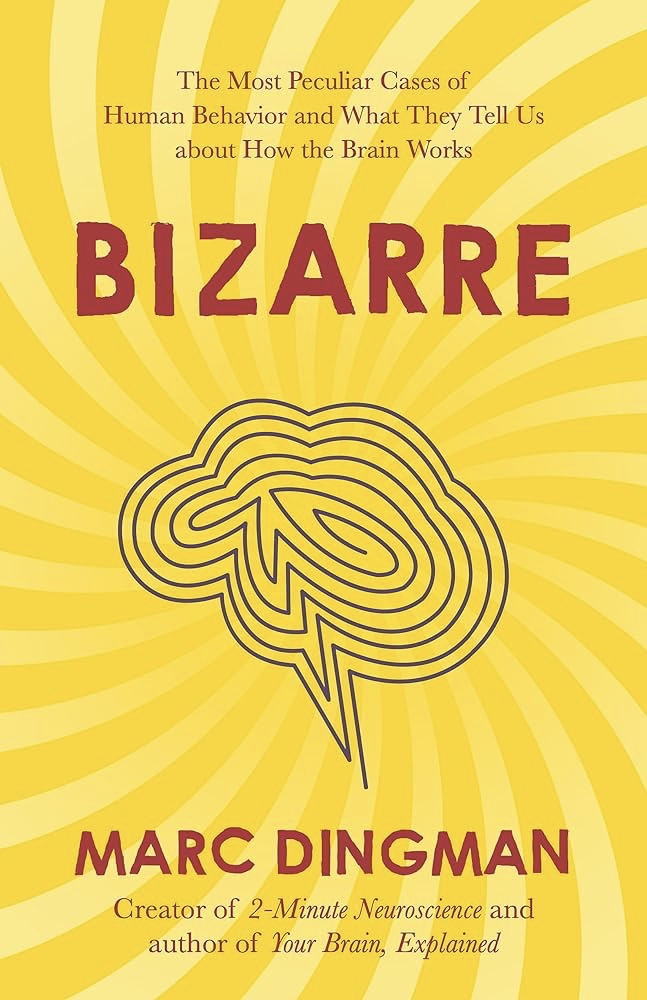
A professor of neurosciences at Pennsylvania University tries to make sense out of some of the weirdest documented actions of human beings by relating them to specific regions and functions of the brain. He does not hesitate to point out the many areas where there are simply no explanations or where the ones which neuroscientists offer are highly speculative and only provide partial explanations.
There are a wide variety of conditions discussed. For example, in Cotard’s syndrome, sufferers become convinced that they are dead, due to a failure of the brain’s ‘plausibility recognizing system’. In Capgras Syndrome sufferers believe relatives have been replaced by strangers and those with it may not recognize themselves and fight with their own image in the mirror. In Body Integrity Identity Disorder, sufferers may seek amputation of a perfectly healthy limb because they find amputees sexually attractive. In the chapter on obsessions, the author discusses being attracted to inanimate objects.
In lycanthropy people firmly believe they have transformed into another animal. Gerstmann Syndrome is characterized by an inability to write, to calculate, to recognize and use fingers appropriately and an inability to distinguish right from left. In Charles Bonnet Syndrome , visually-impaired people experience vivid visual hallucinations as do most others when subjected to prolonged sensory input deprivation. With Alice-In-Wonderland syndrome, people suddenly sense body distortions, becoming minuscule or enormous.
Hemispatial neglect and body schema disorders with weird Latin and Greek names such as somatoparaphrenia, anosognosia, and apotemophilia, are included in the term Body Integrity Identity Disorders. OCD, Savant Syndrome, objectophilia, agnosias, synesthesia, fetishism, Zoophilia, paraphilia, dissociative identity disorder (better known as multiple personality disorder), functional neurological disorder, aphasia, apraxia, aphonia, and alien hand syndrome, are other topics illustrated with examples here. The discussion of the placebo and nocebo effects is enlightening.
The book is logically divided into twelve chapters covering such topics as suggestibility, beliefs, and reality. The author avoids direct discussion of the question of free will which has kept philosophers debating for millennia. Do we have any agency over what we do, believe, and say? He discusses shared delusions, as in folie a deux and marginal religious cults but avoids any suggestion that such mainstream religious beliefs as the virgin birth, the resurrection of the body, and Hindu reincarnation may be shared delusions that represent a failure of the brain’s ‘plausibility recognizing system’. Perhaps this is to avoid offending the many readers with these shared delusions. In places he suggests that the brain is an almost entirely independent organ that tries to integrate and make sense of diverse inputs of information, but in other places emphasizes its integration with the body.
Ever since I had one of my earliest coauthored academic papers published delineating the localization of lesions causing aphasia, I have had an interest in neurosciences. This was reinforced by seeing patients with early hepatic encephalopathy who appeared to be normal but whose spatial apraxia was exposed only when they were asked to write something and would sometimes write in the air above the paper. But one need not be an academic of any sort to understand and appreciate this clearly written book.
A delightful, though-provoking read.
⭐️⭐️⭐️⭐️⭐️⭐️⭐️⭐️/10
Thanks, Bob McDonald of Quirks and Quarks.

 The Passionate Reader