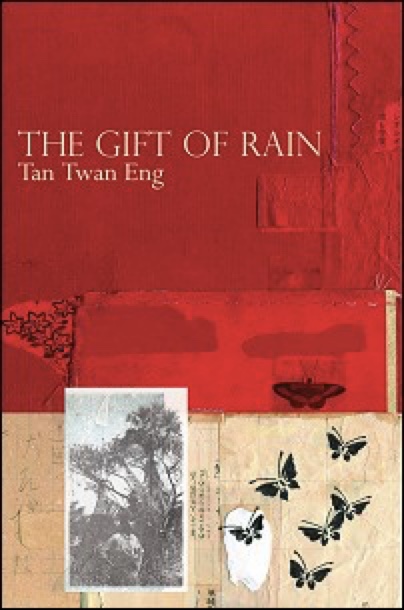
This rambling historical novel spans the period of more than eighty years beginning in the 1920s. It is set in Southeast Asia, chiefly in Panang, Malaya, a British colony until it gained independence as Malaysia in and narrated in the voice of Philip Hutton, the mixed race Chinese-British aristocrat whose family businesses in mining, rubber and timber have thrived and made him very rich. Some of the earlier family history is related to him by his grandfather who worked in the Ching Dynasty’s Imperial Court in the early 20th century. This gives readers a vivid view of the disastrous effects of the Opium Wars and the Boxer rebellion as well as the coinciding paranaoid backstabbing within the Chinese court.
There are many legends, mystical religious rituals to honour dead ancestors, and detailed descriptions of the marital arts that Philip has become expert at, thanks to his seemingly pacifist expat Japanese sensi (martial arts teacher) Endo-San. The anxiety throughout all of the surrounding peoples about Japanese militaristic expansionism and brutality in that era is detailed in Book I, and is fully justified by the gruesome details of the deeds of the Japanese invasion forces revealed in Book II. The invasion took place on December 8th, 1941, the day after the Pearl Harbour bombing. Not for the queasy, the details of the tortures, killings, and ritual suicides are hard to stomach, and are not confined to the Japanese. Still, Philip and Edno-san continue to meet and declare mutual love, raising the speculation among book reviewers about the two single men being gay, although there is no real hint of that in the text. But there is no subtlety to the revelation that at least one of the conquering Japanese Resident Counsellors is a predatory gay man.
The title comes from the likening of his life to the gift of rain by a fortune teller in his youth, and he notes, in his old age, that “ Like the rain, I had brought tragedy into many people’s lives, but, more often than not, it also brings, relief, clarity, and renewal.”
In discussion with his grandfather about the theology of a sixteenth century heretical monk who proposed that our salvation lay in exercise of free will, Philip remarks: “The fact that only certain choices are presented to us, does that not indicate that our options have already been limited by some other power?” The philosophical question of what degree of control we really have over our thoughts, beliefs, and actions recurs throughout the tale.
The writing flows beautifully with no characters unaccounted for and there are many memorable quotes:
“Anger and sorrow walked with me, joining hands with guilt- the three walls of my prison”.
“I have always felt a greater affinity for the sea at night. It is magnificent during the day, the waves strong and loud, slamming onto the beach, propelled by the force of the entire ocean behind it. But when night comes, that force is spent, and the waves roll to the shore with the detachment of a monk unfurling a scroll.”
“It only takes one letter of the alphabet to change reason to treason.”
I found it somewhat difficult to keep all the characters straight, with their foreign names and their shifting loyalties throughout the war, as double agents and betrayals abound. But as an introduction to twentieth century southern Asian history, cultures, geography, and people, this novel is hard to beat. The author has just published a new novel titled The House of Doors, which is now on my list of books to read
⭐️⭐️⭐️⭐️⭐️⭐️⭐️⭐️/10
Thanks, Neil.

 The Passionate Reader