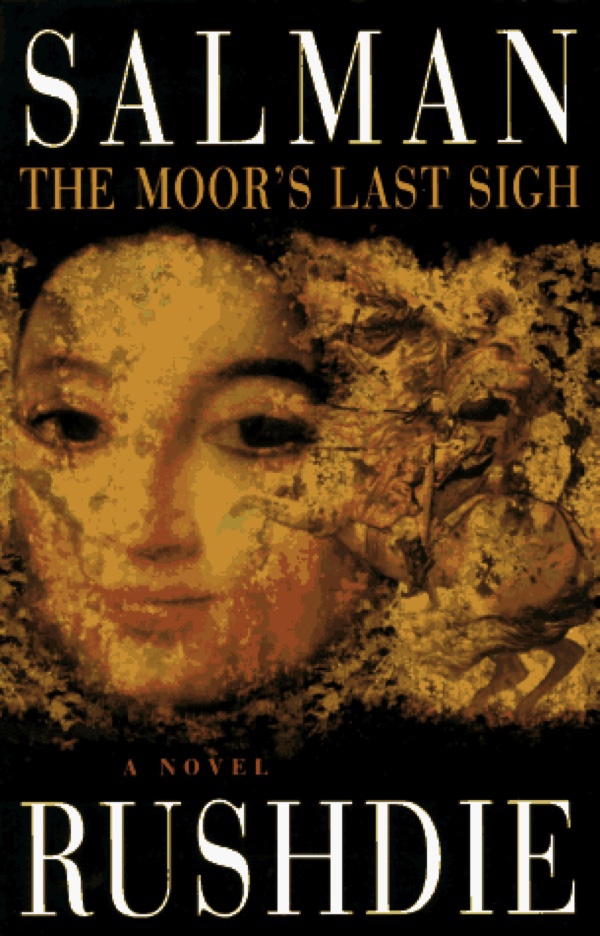
This tale is narrated from the historical perspective of the latest descendent in a dysfunctional family of Indian spice merchants in the latter half of the nineteenth century and through the 20th. It is not clear to me how much of this is autobiographical. But the era and place (Cochin, India) of the birth of the Moor of the title roughly mimic Rushdie’s. (I have read and quite enjoyed Rushdie’s 2012 autobiography Joseph Anton, but I can’t recall many details of it.)
Coverage of the three way conflicts between the brutal British rulers of India, the followers of Mahatma Gandhi, and those of Jawaharlal Nehru and the Congress Party is disjointed and scattered throughout the first half of the book.
The short family tree in the front is a very helpful reference but by the time I got to the following description of the first meeting of the author’s Christian mother and his wealthy Jewish father, I decided that I would have to take a break. “Way up there near the roof of Godown No 1, Aurora da Gama at the age of thirteen lay down on the pepper sacks, breathed in the hot spice-laden air, and waited for Abraham. He came to her as a man goes to his doom, trembling but resolute, and it is around here that my words run out, so you will not learn from me the bloody details of what happened when she, and then he, and then they, and after that she, at which he, and in response to that she, and with that, and in addition, for a while, and then for a long time, and quietly, and noisily, and at the end of their endurance, and after that, until…phew!” I suppose this is preferable to a vivid description of sex with an underage girl.
The author is Moor, his named sometimes shortened to Moo, born after Eney, Meeny and Miney, as a cute play on words, but his shortened gestation of only four and one half months but with a birth weight of ten pounds, is biologically impossible. He has syndactyly (fused fingers) of his right hand and accelerated aging, looking and feeling old at 36, this feature being repeatedly emphasized in the subsequent narrative. (There is a real genetic syndrome called progeria but he lives longer than those with those with this and has none of the associated features.) This may have been included as some kind of allegorical reference to a fast-paced life, but I am not sure of its meaning. Equally allegorical is the Sigh of the title, which is supposedly based on the painting of Moor’s famous mother, a domineering portrait artist and descendent of the Portuguese explorer Vasco da Gama. “A sigh isn’t just a sigh. We inhale the world and breathe out meaning.” There are also echos of Lear and Shylock with bargains with a Jew for a pound of flesh. There are other allegorical references and some of the magic realism that made Rushdie’s The Satanic Verses famous or infamous depending on your viewpoint. Many misinterpreted that book; others condemned it without reading it.
There are several unrealistically beautiful women and girls lacking any virtue or intelligence, who nevertheless hold complete control over the males and cause feuds among them. The narrator’s adopted crooked brother Adam Zogoiby, deals in arms and illegal financial schemes and is caught, leading to revelations of widespread corruption in high Bombay society and the downfall of the family business. The real independence riots of 1992 are outlined in detail and lead to Moor’s flight to Spain.
One interesting timely quote about religious conflicts: “There comes a point in the unfurling of communal violence in which it become irrelevant to ask ‘Who started it?’…..both sides shed the right of virtue.”
The run on sentences lasting for a third of a page, and the foreign names and phrases made it difficult for me to enjoy this tale and I found it impossible to keep the long list of peripheral characters straight. In the penultimate chapter, as Moor, in Spain, attempts to find and take back his late mother’s stolen famous The Moor’s Last Sigh painting, there are far more sentences ending with question marks than with periods. Even in the last chapter a new character is introduced but quickly dispensed with via a pistol shot.
I give Rushdie full marks for originality, developing unpredictable plot twists, and symbolism, but this was too wordy and foreign to my experience to be very enjoyable.
My gifted copy has found it’s way to my granddaughter’s front yard lending library.
⭐️⭐️⭐️⭐️⭐️/10
Thanks, Alana.

 The Passionate Reader