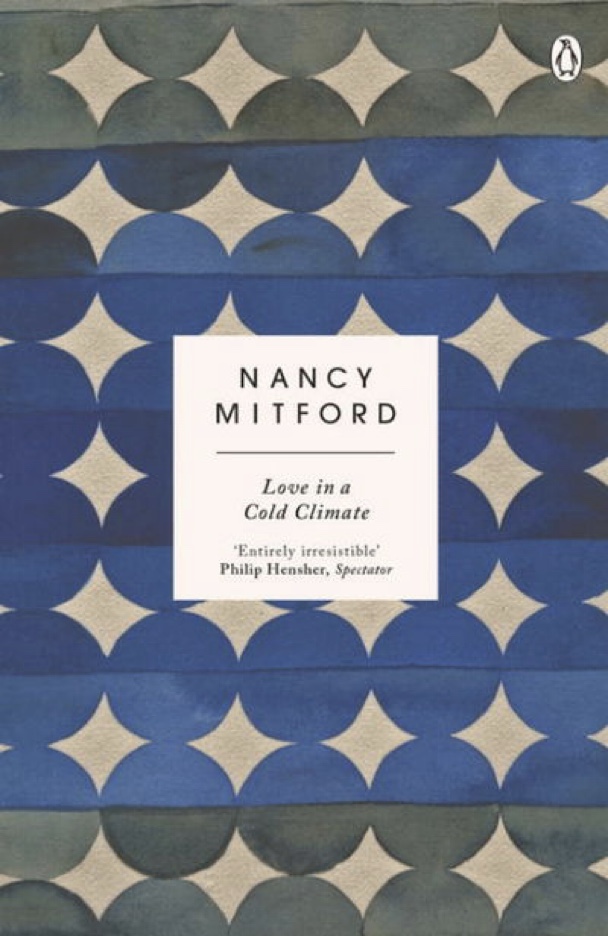
Someone in our William’s Court Book Club 2 got this old novel about the shallow insular lives of the British aristocracy in the post-war 1940s on the list for this month. In the paperback edition I borrowed, there is no information about the author at all, except for a list of her books. When did providing ´About The Author’ information become popular with editors and publishers? I had to search online to find any info about the author, and discovered that this story is described as being semi-autobiographical.
Narrated by a young girl in an initially somewhat obscure relationship to complex, elite and confusingly interrelated British aristocratic families, she clearly presents their superficial, snobbish, and racist attitudes and lives of leisure and power. Almost every character lives in a world of hired maids, butlers, cooks, groundskeepers, and chauffeurs. It seems that most of them also have several lovers, often shared. The main obsession of parents seems to be to get their daughters married off before they turn 20- but only after ritualized courtship when a carefully assessed and approved suitor shows up. It is a world I have never known and cannot relate to.
The engagement of a young debutante to her much older widowed playboy uncle-by-marriage, who was also her mother’s former lover, gets tongues wagging furiously, particularly that of the girl’s very opinionated domineering mother, Lady Montdore. There also seems to be extensive inbreeding in the elite classes.
Part Two switches from Hampton to Oxford, where the author has become the poor wife of an Oxford don, although Lady Montdore, the grand dame of Hampton, is still featured, spouting her self-centred opinions about everything, on her frequent visits. Canadians are said to be unpolished bush-dwelling creatures, in the conversation with Lord Montdore’s long-estranged effeminate nephew from Nova Scotia via France, when he comes for a visit (and to be included in the Lord’s will in place of their now ostracized daughter). It seems obvious that he is a flaming gay, but this is never directly acknowledged.
At the end, the fate and fortune of several characters is left to the reader’s guesses. All the characters are grossly exaggerated caricatures. I suppose one could consider this story a parody of the British aristocracy of the era, but I don’t know whether or not the author, who was a member of that class, intended it as such.
⭐️⭐️⭐️⭐️/10

 The Passionate Reader