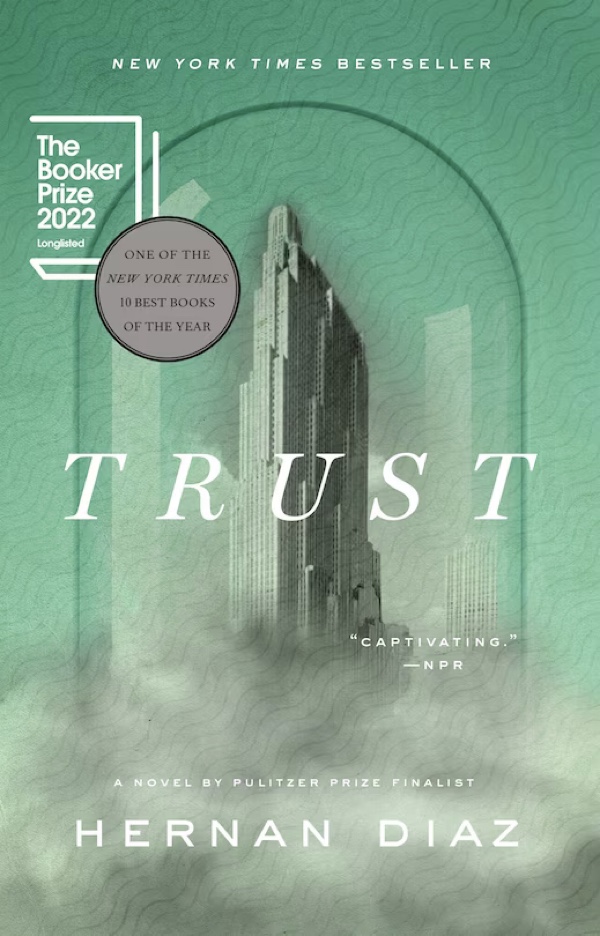
I am unsure what to say about this 2023 Pulitzer Prize winning modern novel by the Swedish-Argentinian writer as it is in a most unusual format with different narrators and very different themes. Most of it is a detailed analysis of the complex workings of the American economy from the 1920s to the 50s as seen through the eyes of various people. An independent novelist, named Harold Vanner, Andrew Bevel, a Wall Street mogul, his ill and very clever but aloof wife, and his secretary all contribute what are really four novellas.
The narrator of the first 78 page novella by Harold Vanner, titled Bonds features Benjamin Rask, an ultra-rich reclusive and introspective New York bachelor tobacco baron who invests in bonds, and is clearly modelled after Andrew Bevel, featured in the next novella. He marries an equally hermitic, very eccentric, brilliant, high-society girl from Syracuse during WWI, giving the title a double meaning as they fail to bond with each other or anyone else. Today, they would both probably be labelled as having moderate autism, although she, like her father, later also suffers from a serious and ultimately fatal mental illness with paranoia and hallucinations. The elusive couple became despised in New York society because of his business dealings in spite of her philanthropy. Myriad financial dealings before the 1929 crash allowed them to avoid any need to interact with others except in business dealings.
The second book-within-a-book is a 54 page early, partly point-form, draft of a fictional autobiography by that same Andrew Bevel, and includes a four-generation family genealogy of Bevels, all financiers. Scattered notes remind the narrator about what to include. He is a reclusive tobacco baron, businessman, and stock market manipulator who claims to have been dedicated to the public good, and firmly believes the old adage that what is good for business is good for America. He claims credit for the widespread prosperity and stability of financial markets of the 1920s with plausible arguments for a Reaganite supply-side free market economy. He calls the Federal Reserve a “blundering machine” that “through artificial, ill-conceived and poorly timed actions that only managed to hurt legitimate investors.”
These very right-wing economic and political beliefs may or may not reflect Diaz’s positions as the third novella presents the very different political beliefs of his secretary, the anarchist daughter of an American communist. She describes money as a fiction but becomes fond of Bevel. She is hired to finish ghost-writing his autobiography based on his previous draft, extensive interviews with him, and tours of his Manhattan mansion, and muses about this experience decades later in the 1980s.
The final story is written, again in draft form, by Bevel’s sickly reclusive wife, who dwells on their strained cold relationship and reveals some of his nefarious methods of cheating other investors and beating the markets to become incredibly wealthy.
Some interesting quotes.
Andrew Bevel: “Intimacy can be an unbearable burden for those who, first experiencing it after a lifetime of proud self-sufficiency, suddenly realize it makes their world complete. Finding bliss becomes one with the fear of losing it.”
and
“Most of us prefer to believe we are the active subjects of our victories but only the passive objects of our defeats. We triumph, but it is not really we who fail—we are ruined by forces beyond our control.”
His wife: “…what is choice but a branch of the future grafting itself onto the stem of the present”
and
“Nothing more private than pain. It can only involve one.”
Only in retrospect could I begin to put these disparate pieces together, but that is probably just a reflection of my limited ability to juggle many different themes at the same time.
⭐️⭐️⭐️⭐️⭐️⭐️⭐️/10
Thanks, The Atlantic, Goodreads.

 The Passionate Reader