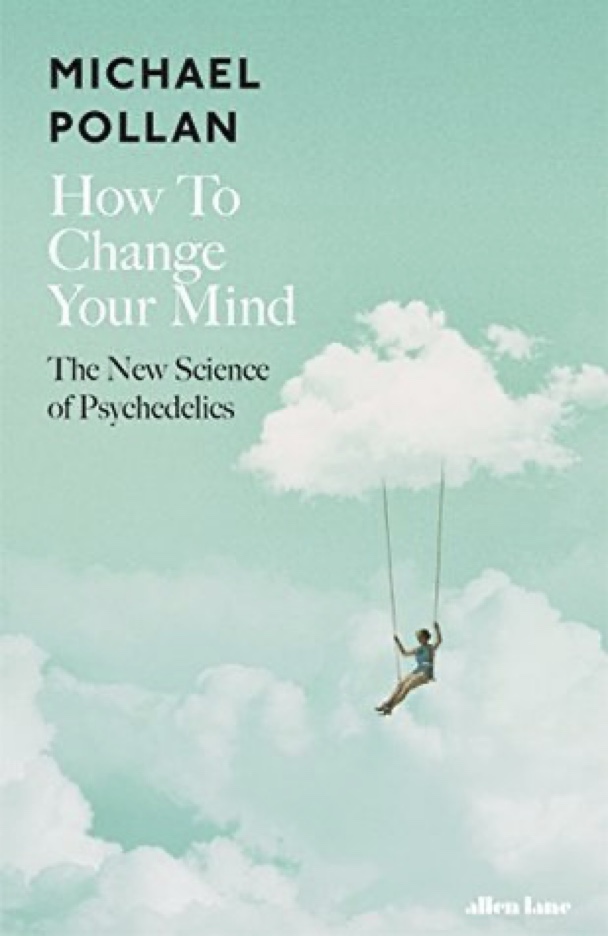
I usually avoid books whose titles feature “How to” as they tend to either promote simplistic generalizations or complicated instructions that I cannot possibly follow. However, an acquaintance recommended this science-based very erudite neurochemistry discussion and I previously somewhat enjoyed Pollan’s This Is Your Mind On Plants, with some reservations. At the heart of this one is detailed discussion of the mysticism and life-changing experiences of people under the influence of psychedelic drugs. But much of this is confined to controlled experiments under medical supervision, unlike the experiences reported in the 1960s before most such drugs were banned (in the U.S. in 1970). It is not confined to experimental treatment for defined illnesses, but also as a life-enhancing additive for normal people, if such creatures exist.
Of the seven chapters, the first three deal with the long and almost universal history of use of ‘trips’ including meditation, shamans, and psychedelics in religious rites and various ceremonies. This included widespread uncontrolled use of magic mushrooms, and various other mind-altering drugs before they proliferated in the counterculture of 1960s America. They were studied by the CIA, as possibly useful for mentally traumatized soldiers and as chemical weapons. This discussion of their effects on many notable people includes Aldous Huxley, Ethyl Kennedy, wife of RFK, Carey Grant, Dylan Thomas, and Alan Ginsberg. The Canadian psychiatrist and mystic, Dr. Richard Maurice Bucke, in London, Ontario in the 1890s with Walt Whitman promoted the zany theory of ‘cosmic consciousness’ as documented in in the biography of Bucke by my late colleague, Dr. Peter Rechnitzer. Later the notorious doctors Humphrey Osmond and Abram Hoffer treated patients with a wide variety of mental illnesses with LSD in the small Saskatchewan town of Weyburn in the 1950s. With the advances in neurochemistry and neuropharmacology, the concept of cosmic consciousness no longer seems so crazy.
“People feel they have been let in on a deep secret of the universe, and they cannot be shaken from that conviction.”
The chapter detailing the author’s personal trips (purely in the interest of science, of course) on LSD, psilocybin derived from mushrooms a bizarre molecule called 5-MeOT-DMT from the poison glands of a rare toad and plant-derived ayahusasca make fascinating reading, as do the following chapters on what is known and not yet known about the neurochemistry and the modern use of such drugs for treatment of addictions, schizophrenia and depression. The default mode network in the brain with its controlling ego or self as the centre of consciousness and its dissolution under the influence of psychedelics resulting in broadening of neuronal connections was an entirely new and intriguing concept to me.
It is not necessary to believe in any religion or an afterlife to benefit from the the ‘spiritual’ experience of a psychedelic trip. The author is a firm agnostic as are many trippers, even as they describe the experience as a spiritual journey to meet with God or become one with the whole universe. But the word spiritual has become so vague as to be almost meaningless.
It seems to me that there are linguistic inadequacies in describing the complex effects of psychedelic drugs just as there are in explaining the complex interconnectedness of everything in nature, but I have never felt the need for a boost from a drug to be totally awed by this “Oneness”. The documentation that plants, animals, and insects possess something akin to our decision-making consciousness leaves me in awe whenever I think of them. Pollan avoids any detailed discussion of whether or not we have minds capable of making decisions separate from our chemically-wired brains, but it seems clear that he does not. And he wisely points out that enthusiasm for any new therapy usually wanes as it is used in broader contexts.
In describing the experience of people getting high on mushrooms: “Even the most secular among them, come away from their journeys convinced there exists something that transcends a material understanding of reality: some sort of ‘Beyond’.
Two other good quotes:
“Our brains are prediction machines optimized by experience…”
“There is an infinite time to be dead.”
This is a carefully researched exposition of the purported modern medicinal benefits of use of a variety of psychedelic compounds. It also details the long history of their use in many cultures before they were hijacked by the 1960s counterculture, then banned and driven underground by an inept FDA in 1970. I am convinced that they have legitimate uses in modern medical practice, but, perhaps because of their condemnation until recently, have never been tempted to take even one dose of any of them. The etherial and spiritual descriptions of their effects is totally foreign to my linear and concrete ways of thinking and the dependence of their effects on the setting and expectations defies explanation other than, at least in part, as placebo effects. But if I am given enough warning about my approaching expiry date, I might be tempted to take a high dose of pure psilocybin as one of its reported effects in 80 percent of dying cancer patients is a complete and lasting loss of the existential distress of knowing you are about to die. However, I would much prefer to be given no such advance notice and be struck by a meteorite or shot in the head by a mistaken jealous husband- when I am over 95.
Longer, but with a much broader international perspective than his earlier book on mind-altering compounds, this is a much better book. I learned a lot.
4.5/5
Thanks, Allan M

 The Passionate Reader