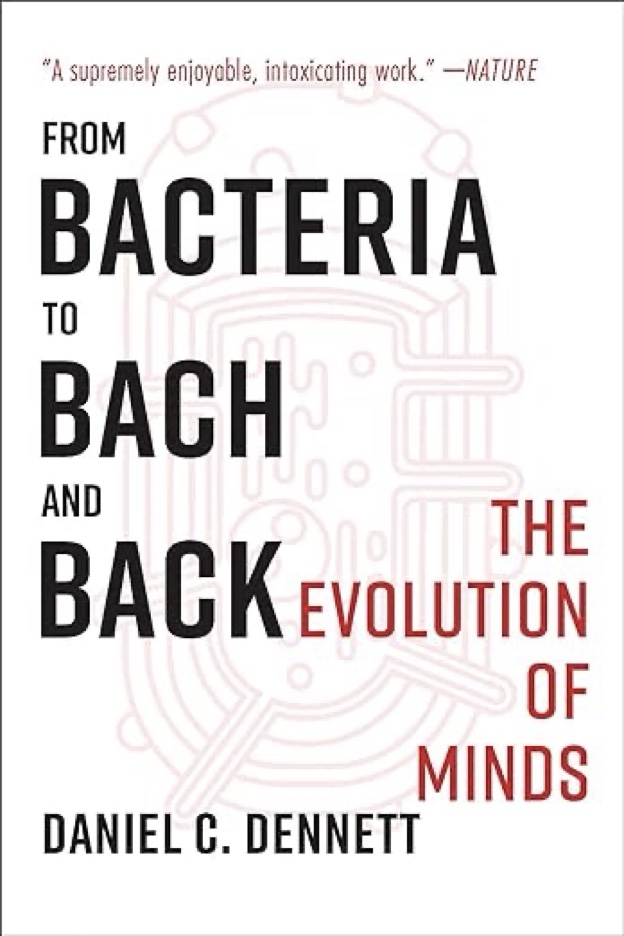
The prodigious Tufts University professor of philosophy is part of the four horsemen of atheist philosophy that includes Sam Harris, Richard Dawkins, and the late Christopher Hitchens. Here he expounds on the circuitous path of evolution that leads to what we call the human mind.
In Part I, the discussion centres on the Darwinian principles of physical evolution of the human brain over millions of years. The driving force of human progress is described as the bottom-up Darwinian evolution of brains over millions of years that act as cranes to produce “intelligent designer” humans. This is the reverse reasoning to that of a God sky hook that came first and created human brains. The author’s emphasis on competence without comprehension, mentioned in numerous places, makes a mockery of attributing anthropological reasoning, knowledge and comprehension to some animals, as in the book What an Owl Knows. An owl or a bat does not need to comprehend or know the physics of echolocation to use it competently in hunting for food.The killdeer does not need to even identify the approaching fox as a predator or comprehend why she deploys the broken wing deception to lead him away from her nest; she just needs to use this deception competently, a process that has been fine-tuned by evolutionary changes in hundreds or thousands of her ancestors; those who did not undergo those mutations were less likely to survive and reproduce. I do not need to understand Faraday’s law to plug in the EV or a tea kettle. Nor does anyone need to understand how the code to operate an elevator was developed to ride one.
Part II is devoted to the more rapid process of cultural evolution with detailed analysis of memes, a word first coined by Richard Dawkins in The Selfish Gene, to describe “ a way of behaving or doing, internal or external that can be transmitted from host to host, by being copied.” This may be an oversimplification of memes, a word subject to broad interpretation, but the details of much of this section, particularly in the chapter What Is Intelligence? werebeyond my comprehension. And the same can be said for much of the whole book, as when, for example Dennett discusses three-wheeled Martian iguanas as an metaphor (I think) for AI. Linguistic hair-splitting is prevalent throughout; nowhere is this more obvious than in the chapter on words, the existence of which some philosophers dispute since they have no mass, consume no energy, have no chemical composition and occupy no physical space, even as those same people use words to make this assertion. Once one goes down that rabbit hole, it seems to me, the whole concept of language and communication becomes meaningless. Is it any wonder that I find the works of most philosophers confusing?
Unlike Sam Harris and Richard Dawkins, but in line with Christopher Hitchens, Dennett tries to reconcile a belief in human free will with his atheistic belief in the absence of an immaterial soul or mind separate from one’s brain, although he seems to waffle a bit in stating that we need to live as though free will exists, even if it doesn’t. If one really adheres to the belief of no free will, a lot of words such as choice, justice, facts, fairness, duty, and morality become meaningless. But in Part III, Dennett strives to reconcile the possible absence of free will with moral responsibility and accountability. The most dogmatic denier of free will of all philosophers was seventeenth century Baruch Spinosa, at least as his writing was later interpreted.
In Part III, evolution of physical and cultural traits are brought together to explore the nature of consciousness, self-awareness and self-analysis in very erudite language with such words as heterophenomenolgy, quale, qualia, and blurt (as a noun), that perhaps someone out there understands but I certainly do not. As an example: “We won’t have a complete science of consciousness until we can align our manifest-image identifications of the sub-personal information structures and events that are causally responsible for generating the details of the user-illusion we take ourselves to operate in.” Duh.
In the last chapter, a fairly easy to understand discussion of machine learning, and AI and the risks to our future that some see in this modern development is presented. Dennett does not predict our extinction by these programmed machines that may exhibit competence exceeding our own in some fields, but without the comprehension that is characteristic of at least some Homo sapiens. I can only hope he is right about this.
One great quote: “A neuron… is always hungry for work; it reaches out exploratory dendritic branches seeking to network with its neighbours in ways that that will be beneficial to it.”
The writing is opaque, dense, erudite, and humourless and while I learned a lot, I only really understood a small fraction of what the author was trying to convey to readers even with rereading portions of it. For a more more understandable and shorter discussion of consciousness and its neurological basis, I would recommend Patricia S. Churchland’s more concise Conscious. The Origins of Moral Intuition.
2.0/5.
Thanks, Harpers.

 The Passionate Reader