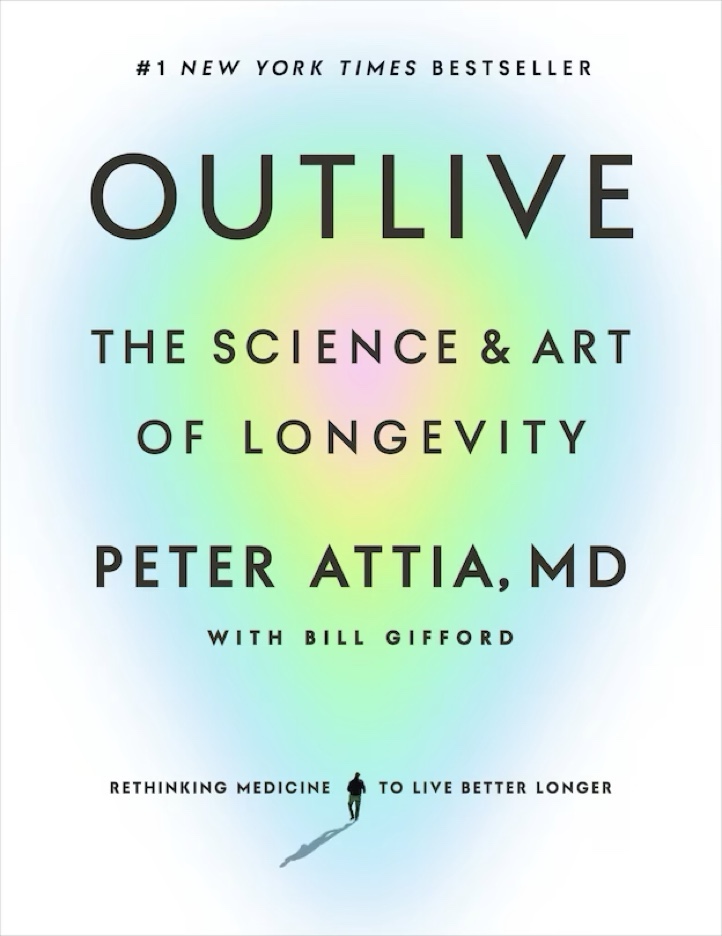
This former oncology surgeon left medicine to work in the world of financial risk assessment for a time, then returned to some form of medical practice and writing. He distinguishes Medicine 1.0, as it was unscientifically practiced until the mid-twentieth century, Medicine 2.0, as it was then practiced until the present, and Medicine 3.0, his particular vision for medicine of the future with a heavy emphasis on prevention, public health, and prolongation of your years of healthy living and shortening of the period of morbidity at the end. These are certainly laudable goals. In a chapter on centenarians, Attia accepts that the record-holder for longevity is 122 year old Jeanne Calment, although some others have asserted that her identity was assumed by her daughter when she died at a much younger age.
In the first half of the book, the modern public heath problems of the metabolic syndrome, heart disease, cancers, and dementia and the physiologic mechanisms underlying them are discussed in great detail, perhaps too much detail for some readers.
In discussion of his goals in light of the recent rising rates of obesity, diabetes, hypertension, and nonalcoholic fatty liver disease, constituting the metabolic syndrome, he identifies rapamycin and metformin, as possibly geroprotective, i.e., increasing ones healthspan into old age. The discussion of this syndrome does not credit my former fellow trainee at Yale, Dr. Denis Miller, whose forgotten paper in the mid 1970s was one of the first to describe many of its features. Typically, as a young surgeon on opening an abdomen and finding a cirrhotic liver, the author assumes that the patient must be a heavy drinker, apparently unaware of the many other causes of cirrhosis, including nonalcoholic steatohepatitis (fatty liver) from this metabolic syndrome. He sees a case of our modern evolutionary adaptations being too slow to accommodate our modern dietary and environmental changes in our loss of the enzyme uricase long ago when we did not need it, leading to hypertension and obesity from modern excess fructose ingestion. Attia goes all out in advocating for early, extensive and frequent screening with expensive blood tests and frequent imaging studies to detect the early stages of this metabolic syndrome. His advocacy for screening for almost all cancers is even more extreme. I cannot argue with a former oncology surgeon on such matters, but my hunch is that some screening such as testing for the calculated derivatives of the PSA for prostate cancer, full body MRI screening for all adults, and more frequent screening colonoscopies beginning at a younger age will find a lot of “incidentalomas” that do not need to be treated, and tip the risk/benefit balance toward if not fully into interventions that do more harm than good. Most older men die with prostate cancer, not of it. The relationship between sun exposure and skin melanoma development is weak and far less straightforward than is presented here and we need some sun to produce adequate levels of vitamin D if our diets are deficient in it.
Although the author downplays the contribution of genes to the development of atherosclerosis, he then advocates testing everyone for the ApoE gene variants, the lipoprotein LDL concentration of cholesterol, and for the LD(a) lipoprotein, although he admits that there is nothing that can currently be done to alter the concentration of the latter. Why test for a factor that you cannot alter? The routine expensive imaging of hearts for coronary calcification with exposure to ionizing radiation that he advocates also seems to me to be of unproven benefit. He has exposed himself to three CT angiograms with not just ionizing radiation but iodinated dye and considerable expense purely to relieve his anxiety about the possibility of dying a sudden cardiac death, a common occurrence in his family. In the section of exercise he also advocates measuring bone mineral density every year on all of his patients, exposing them to an admittedly small doses of ionizing radiation. The greatest dangers of spending a lot of time and energy trying to fend off a sudden cardiac demise are, it seems to me, increasing anxiety and the increasing time toward your end in declining health, something he strives to avoid, and decreasing the enjoyment of whatever time is left to us. We all must go and there are worse ways to exit than to drop dead doing something you enjoy, at least if your will is kept up to date.
In the second half, Attia and Gilford offer many helpful suggestions to deal with these modern problems, including exercise, sleep, nutritional regimens, and means of maintaining good mental health.
I came to appreciate the huge benefits of regular exercise in my seventies, after a scary bout of meningitis from early disseminated Lyme disease left me with an unsteady gait and brain fog. However, one day recently I returned from my daily routine workout at the well-equipped gym in our apartment complex only to discover that my routine was all wrong according to this self-styled expert on everything. But I am not about to change in any major way from what my exercise guru marathon-running daughter taught me. Nor am I likely to ever measure my VO2 Max with fancy machinery, buy a lactate meter or implant a Continuous Glucose Monitor as the author does and advocates for all adults. I am always disappointed with the low numbers of calories I have burned on the elliptical or the recumbent bike, barely even enough to allow me an extra butter tart, and many fewer than my ancestors would burn in a day of hard farm labour. My lactate meter is just the degree of muscle pain as I exercise. And I certainly will not be doing toe yoga, nor taking selfies at the gym to figure out what I am doing wrong, as advocated here. Somehow I have been breathing successfully for more than 78 years without the five pages of advice that Attia provides on how to do it properly.
In the chapter on nutritional biochemistry Attia is skeptical about much of the published literature and advice, and I have to agree with him. In some ways it reminded me of Gabriel Mate’s The Myth of Normal, Max Lagavere’s Genius Foods, Robert Lustig’s Fat Chance, and Helen Bishop McDonald’s The Big Fat Misunderstanding. However, apart from insisting on adequate quality protein intake to maintain muscle mass, he is less dogmatic in the advice in this chapter unlike the aforementioned authors.
The discussion of the importance of adequate sleep covers not only the health benefits but strategies and tactics that are helpful in assessing and improving one’s sleep hygiene. These are dealt with in more detail in Matthew Walker’s Why We Sleep.
In a book about living longer and better and avoiding premature deaths, it is a big oversight to never dwell on two big killers of young Americans – the opioid epidemic that kills more than 100,000 Americans each year, and the unique American gun culture which killed more than 40,000 in 2022. He does provide some interesting advice on how to reduce deaths in motor vehicle accidents which amounted to about 42,000 in 2022.
In the final chapter, on mental health, Attia relates his personal struggles with suicidal depression, and self-loathing which he relates to childhood abuse. He also discusses his own ways of dealing with this including two inpatient stays, frequent psychotherapy sessions and at least occasional use of the psychedelic drugs MDMA and psilocybin that Michael Pollan advocates in How To Change Your Mind. I hesitate to break the Goldwater Rule and attach a psychiatric diagnosis to someone I have never met, but I would bet more than equal odds that the writer fulfills DSM-5 criteria for OCD.
In places, the advice doled out in this book is more in keeping with what one would expect from a life coach or a personal trainer than from a medical practitioner. Still, suggesting a boxing workout to treat/delay the cognitive decline accompanying Parkinson’s Disease is not something I would expect from any doctor or trainer who should know about the high risk of developing dementia pugilistica which that “sport” produces.
Having been indoctrinated into and having worked in the world of what Attia calls Medicine 2.0 treating people with established disease, (although I did incorporate what preventive measures I could with vaccinations and counselling), I had difficulty with some of the basic premises of the approach that this book presents. In thinking about this, my concerns boil down to three: the economics, the generalizability and the blame game. The costs that extra prevention regimes entail might be offset by decreasing needs for treatment of established diseases such as diabetes, heart attacks, or orthopedic treatment of broken bones, but this would apply to only or mainly in rich western countries. A youth in Nigeria will be unlikely to afford MRI scans, a gym membership, or a healthy diet. Finally, if I spend the last few years of my life drooling in diapers in the locked ward of a nursing home, unaware of my surroundings, Attia could blame me for not following his detailed prevention schemes. Such ‘blame the victim’ attitudes are cruel and unjustified and ignore the major role that chance usually plays in determining how long and how well we live.
Having been very critical in this review, I feel obliged to acknowledge that this book provides a ton of good advice, an interesting and unique perspective that should be taken seriously, and the results of a lot of research. I kinda, sorta enjoyed reading it.
3/5
Thanks, Sarina and Ian.

 The Passionate Reader