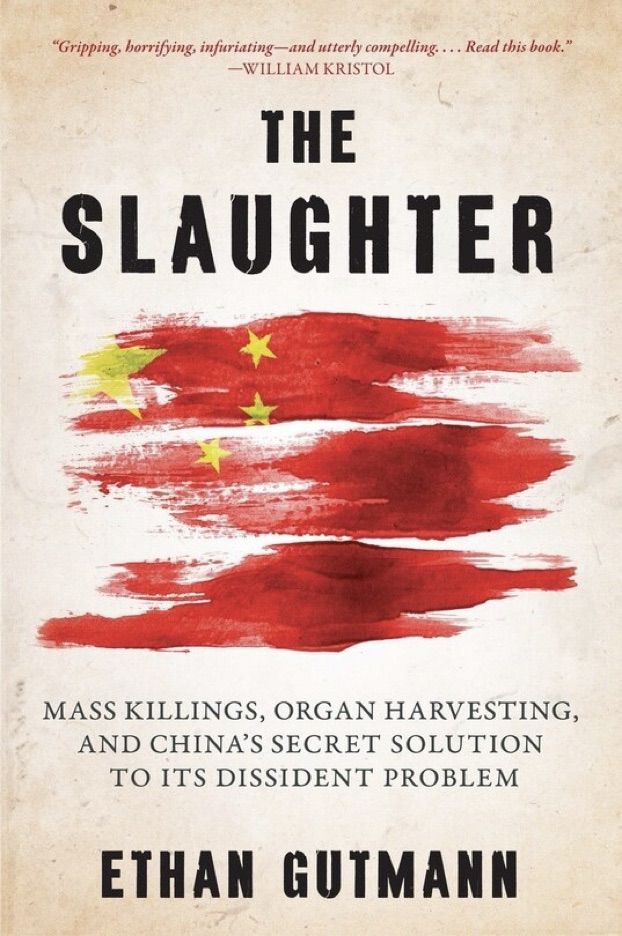
I found this book by a British China watcher abandoned in the mailroom of our apartment complex. With ‘Organ Harvesting’ in the subtitle I thought it might interest me. The first chapter describes gruesome executions of the ethnic Uyghur Muslims of Xinjiang province to retrieve organs for transplantation. The next chapters detail the history of Falon gong, a quasi-religious practice of exercise and meditation derived from Buddhism with bits of traditional Chinese medicine, Confucianism, and Taoism thrown in. They are proponents of nonviolent pacifism with an emphasis on truthfulness, compassion, and forbearance, hardly threatening tenets to any authorities. It was founded in 1992 by Li Hongzhi who became the hero of the ‘cult’, and it was banned by the Chinese Communist Party in 1999 when it’s domestic practitioners reached an estimated 70 million. The following chapters are devoted to documenting the brutal attempts to eliminate the practice by the Chinese government. It is now practiced around the world, including in Canada, but only secretly in China. Dedicated to it to the point of risking torture and death, thousands of Chinese practitioners openly practiced it and were incarcerated, subjected to very inventive means of torture, and killed by the state apparatchik. One survivor recalled that she was spared because she was blood group AB negative, making her a suitable organ donor for less than 3 % of the population. (Recipients with that blood type can receive organs from any donor.)
By 2002, the battle was in the airwaves with cyber-attacks from both the Communist government and Falon gong leaders. At one time, the latter highjacked state TV stations to announce that the ban was lifted. Foreign communists espionage agents and Falon gong leaders were also hacking, but few western governments got involved.
David Kilgor and David Matis, two Canadian investigators concluded that 41,500 Falon gong practitioners in China were executed for their organs between 2000 and 2005. By the time of the 2008 Beijing Olympics, they and the author put that number at 64,000 Falon gong ‘prisoners of conscious’ murdered for their organs.
In the late 1990s, during a short locum in a small Middle East emirate, I was presented with a healthy Arab youth who had just returned from having a liver transplant somewhere in China a few weeks earlier. Although we trained several Arab transplant hepatologists, none were from that country and his compatriot physicians had no idea how to treat him. I was able to give them some guidance in their care of such patients. As per ethical standards, we never inquired about the donor, although I was vaguely aware of controversies concerning Chinese organ donors, and use of executed criminals as donors for a very profitable international market. How much did that patient or his government pay for that transplant? The legitimate ethical controversy surrounding payment for voluntary donation of a kidney or a liver segment by some poor resident anywhere is never addressed.
In 2012, my wife and I did a three week tour around China. I was naively unaware of even the existence of Falon gong, Uyghur dissidents, and banned House Christians or the controversy about their persecution and frequent use as retail donors of organs in a thriving international marketplace. We were taken to places and events that the government wanted to showcase to the world. But the ‘harvesting’ of organs from executions of innocent people persists and deserves condemnation of the Communist government and the participating doctors by the international community.
Included in this book are several not very helpful photographs and too many foreign names of people and places that no western reader would be able to keep straight.
This is an exhaustively researched, very enlightening documentation of an important aspect of international relations and organ transplantation. Not for everyone, but as a former transplant physician, I appreciated the discussion.
4/5
I found this book by a British China watcher abandoned in the mailroom of our apartment complex. With ‘Organ Harvesting’ in the subtitle I thought it might interest me. The first chapter describes gruesome executions of the ethnic Uyghur Muslims of Xinjiang province to retrieve organs for transplantation. The next chapters detail the history of Falon gong, a quasi-religious practice of exercise and meditation derived from Buddhism with bits of traditional Chinese medicine, Confucianism, and Taoism thrown in. They are proponents of nonviolent pacifism with an emphasis on truthfulness, compassion, and forbearance, hardly threatening tenets to any authorities. It was founded in 1992 by Li Hongzhi who became the hero of the ‘cult’, and it was banned by the Chinese Communist Party in 1999 when it’s domestic practitioners reached an estimated 70 million. The following chapters are devoted to documenting the brutal attempts to eliminate the practice by the Chinese government. It is now practiced around the world, including in Canada, but only secretly in China. Dedicated to it to the point of risking torture and death, thousands of Chinese practitioners openly practiced it and were incarcerated, subjected to very inventive means of torture, and killed by the state apparatchik. One survivor recalled that she was spared because she was blood group AB negative, making her a suitable organ donor for less than 3 % of the population. (Recipients with that blood type can receive organs from any donor.)
By 2002, the battle was in the airwaves with cyber-attacks from both the Communist government and Falon gong leaders. At one time, the latter highjacked state TV stations to announce that the ban was lifted. Foreign communists espionage agents and Falon gong leaders were also hacking, but few western governments got involved.
David Kilgor and David Matis, two Canadian investigators concluded that 41,500 Falon gong practitioners in China were executed for their organs between 2000 and 2005. By the time of the 2008 Beijing Olympics, they and the author put that number at 64,000 Falon gong ‘prisoners of conscious’ murdered for their organs.
In the late 1990s, during a short locum in a small Middle East emirate, I was presented with a healthy Arab youth who had just returned from having a liver transplant somewhere in China a few weeks earlier. Although we trained several Arab transplant hepatologists, none were from that country and his compatriot physicians had no idea how to treat him. I was able to give them some guidance in their care of such patients. As per ethical standards, we never inquired about the donor, although I was vaguely aware of controversies concerning Chinese organ donors, and use of executed criminals as donors for a very profitable international market. How much did that patient or his government pay for that transplant? The legitimate ethical controversy surrounding payment for voluntary donation of a kidney or a liver segment by some poor resident anywhere is never addressed.
In 2012, my wife and I did a three week tour around China. I was naively unaware of even the existence of Falon gong, Uyghur dissidents, and banned House Christians or the controversy about their persecution and frequent use as retail donors of organs in a thriving international marketplace. We were taken to places and events that the government wanted to showcase to the world. But the ‘harvesting’ of organs from executions of innocent people persists and deserves condemnation of the Communist government and the participating doctors by the international community.
Included in this book are several not very helpful photographs and too many foreign names of people and places that no western reader would be able to keep straight.
This is an exhaustively researched, very enlightening documentation of an important aspect of international relations and organ transplantation. Not for everyone, but as a former transplant physician, I appreciated the discussion.
4/5

 The Passionate Reader