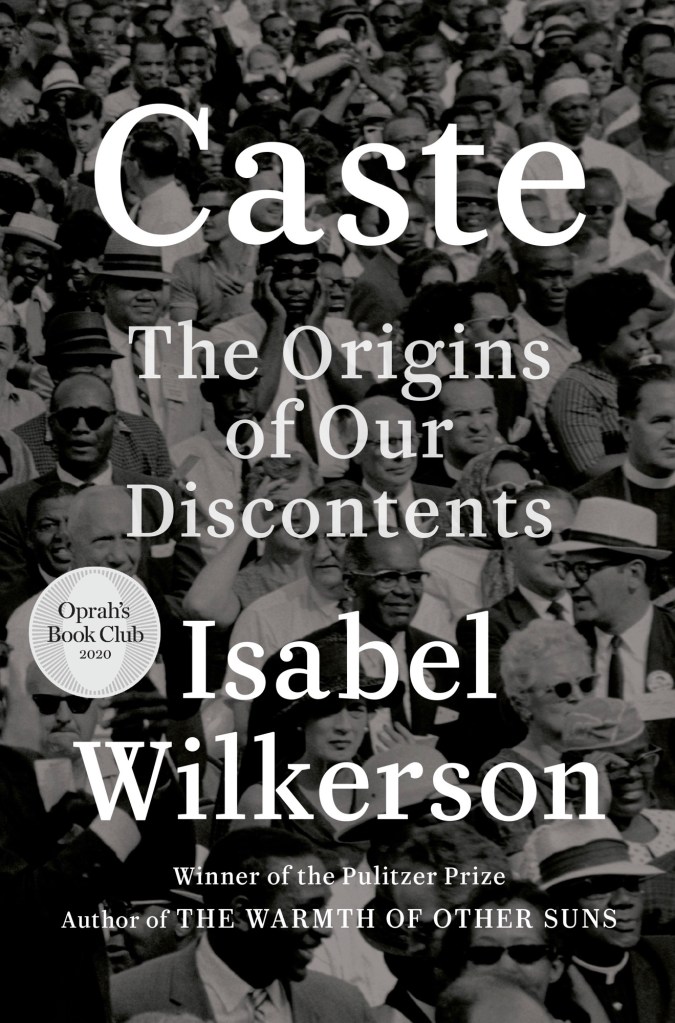
The acclaimed American journalist makes a clear distinction between racism and a system of castes, pointing out that there is no biological basis for the existence of race. There are no blacks in Africa as almost everyone is black, so the skin colour is irrelevant. But there is a strict caste system designed to keep people in their place, determined by birth, particularly in India. Eugenics, U.S. miscegenation laws, mixed mythology of the origins of Hindu castes, and impregnating slaves for profit with the black womb becoming a profit centre, are all discussed. Eight identified pillars of caste and the consequences of them take up 64 pages as the author discusses examples of each. What surprised me most was how recently these pillars have endured, extending well into the modern era. All of these topics may seem unrelated until suddenly they are pulled together and united.
It seems somewhat ironic that after convincingly showing that there is no biologic basis for the existence of race, the rest of the book deals with it as a fact. But it is not binary with many variations although usually only two are reported in the surveys cited in the book.
The author shows that the loyalty to Donald Trump is in large part an attempt to maintain the domination of the white caste and that it is particularly strong in white men and evangelicals. In a litany of eleven ways in which the U.S. compares unfavourably with other countries, she concludes that the legacy of slavery and maintenance of caste dominance is largely responsible. However, while in 2020, when the book was written, it was possibly true that the highest mortality from covid was in the U.S. the same cannot be said for later in the pandemic, when secretive China probably won that dubious distinction.
The chapter on the health effects of stress resulting from the caste system is less than convincing, with surrogate markers such as telomere shortening used as a substitute for lifespan.
In a late chapter, Wilkerson contrasts the contrite actions of post-Nazi Germans who erect memorials to victims and compensate survivors with those of Americans who erected memorials to the Confederate soldiers, and often still practically worship them.
There came a point in reading this book at which I realized that I could never say a word in the company of diverse individuals without risking offending someone. At the very least, any value-judgment comment about the action of others could be considered as a form of caste narcissism. Although the dozens of examples of grossly inappropriate comments and actions cited are shocking, a few are less obvious. Perhaps that is the point. If a traditionally lower caste subject, say a black female, can intimidate a traditionally higher caste individual by taking offence at whatever is said by, say, a white male, into silence, the caste system comes under threat, and reacts to maintain the status quo. Any criticism of this book whatsoever in my review will likely be seen as racist and an attempt to restore the hierarchy, but that will not stop me.
We would like to think that this is all irrelevant to us as Canadians, and bits of of it are, but not as much as we would like to think. And living beside the behemoth, we can’t afford to ignore it. There is now a movie loosely based on this book, but I suspect that Hollywood will have made it very violent; I don’t want to watch it.
I was at a loss to give this book a score, at some points willing to consider 4/10, but I became so impressed with her insight, intelligence, and sincerity that I ended up giving it
8/10
Thanks, Rhynda and Tony.

 The Passionate Reader