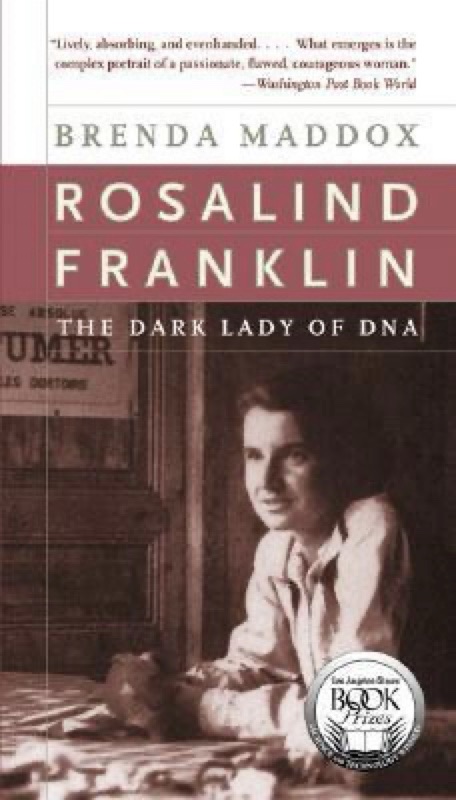
This biography of a Brit by a Brit is on the list for our book club next month; I don’t recall who got it there. I was very familiar with the character, having enjoyed the fictionalized version of her short life in Marie Bennett ‘s Her Hidden Genius, where she is portrayed as having been cheated out of fame and a Nobel Prize by misogynist undeserving James Watson, Francis Crick, and Maurice Wilkins. This very detailed biography certainly confirms that viewpoint. The fierce competition in science is hardly new, and I have experienced this as well, on an obviously much less important scale. (My first major research paper was sent for review to the two people whose earlier report I was directly refuting). Sometimes professional jealousy overpowers or interferes with good science.
There is no doubt that Roselind Franklin was brilliant, but also “very attractive, very bright, very impatient, and very opinionated.” Prickly and difficult would also seem to apply.There is also little doubt that had Watson and Crick not basically used her data without acknowledgment that she or someone else would have solved the mystery of the structure of DNA within a few months in 1953, although that structure was not accepted by all in the field as correct for years because of other possibilities. It is a tribute to her integrity that she never expressed any complaints about being excluded; her focus was always on science, not personal glory. She remained on friendly terms with Watson and Crick right up th her death at age 37 in 1958. That was almost certainly related to her careless disregard for radiation exposure. In keeping with the usual practice at that time, she was never informed about the hopeless prognosis and it was never discussed, at least in any detail.
The book adequately documents that breakthroughs in science are almost always collaborative or competitive, not due to the brilliance of any one individual. (The theory of relativity may be a rare exception.)
The praise for this book is ambiguous at best. On the back cover, it is variously described as “a meticulous biography”, a “balanced biography”, and “coolly trenchant” which could well be interpreted as damming it with faint praise. I do not claim to understand (nor feel a need to understand) more than a small portion of the science presented in great detail, to appreciate the very human story of a wrong that should be corrected. I doubt that I am alone in this. The reviews seem to confirm that others feel the same way as I do about this book- it is needlessly detailed and erudite, insuring a very limited audience of basic scientists.
Of the three people who won the Nobel prize in 1962, the young James Watson (still alive at 95) seems to be the leader in snubbing Franklin’s contribution, never even mentioning her in his Nobel address, and minimizing her vital role in his best-selling book The Double Helix.
In contrast, the fictionalized story Her Hidden Genius, delivers much the same message in a very readable and even entertaining way. There is little to be gained in reading this book that cannot be more easily and enjoyably obtained from the fictional version.
4/10

 The Passionate Reader