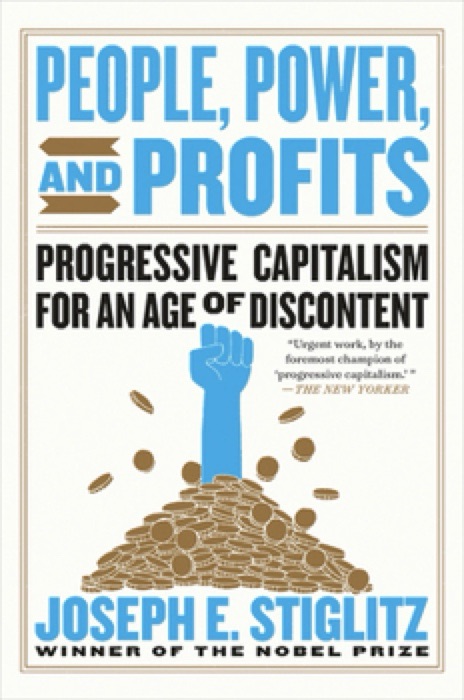
This book written in 2019, was obviously published before the looming 2020 election, and is therefore somewhat dated, but will, or should, have a lasting impact on future U.S. politics. I am nor sure if it had any impact on the looming 2020 election but I doubt that any Trumpist would ever read it. Keynesian vs Friedman’s Chicago school of economics is discussed in detail, and it is clear that the author favours the former.
The author is no slouch: he was the Chief of Bill Clinton’s Council of Economic Advisors, and Chairman of the World Bank, a Nobel laureate, and a professor at Columbia University.
In this tome, he expresses somewhat contrarian views about a wide variety of ills in the modern U.S. economy, from worsening income inequality, exploitation and market monopolies, globalization, new technologies, the financial crisis, and the proper role of government regulation. In spite of his banking background, banks come in for particular scorn. There is a truly international perspective with comparison of the U.S. with many other countries in a variety of measures, debunking the widespread belief that the U.S. is the greatest country in the world.
The best examples of monopoly power that are familiar to me are the drug company Valient increasing the price of Syprine, used to treat Wilson Disease by 3000 % because they were the only manufacturer and had the monopoly on it in the U.S. and academic publishing with a few companies charging authors to publish papers that are the result of research funded by the government.
In Part II, some solutions that would benefit all are offered, chiefly a greater role for government. He discusses government inefficiency and claims that it is generally no less efficient than the private sector. Some of the measures advocated seem unrealistic to me.
In spite of having a Ph.D. economics professor daughter, little knowledge of the intricacies of macroeconomics ever rubbed off on me. I have never claimed to understand much about economic theory, and when I read The Economist, I often skip the more complex discussion of markets. When they start writing about derivatives and credit default swaps my eyelids sometimes interfere with my reading or I move on to the next story.
The bottom line from this convincing treatise is that (at least it seems to me): he envisions a United States that would become more like a socialist state like some Scandinavian countries, and fears that it may be impossible. Another conclusion is that anyone who believes that the United States is a true democracy is deceiving themselves.
The writing is very convincing, but dry and wordy.
6.5/10.
Thanks, Tony and Rhynda.

 The Passionate Reader