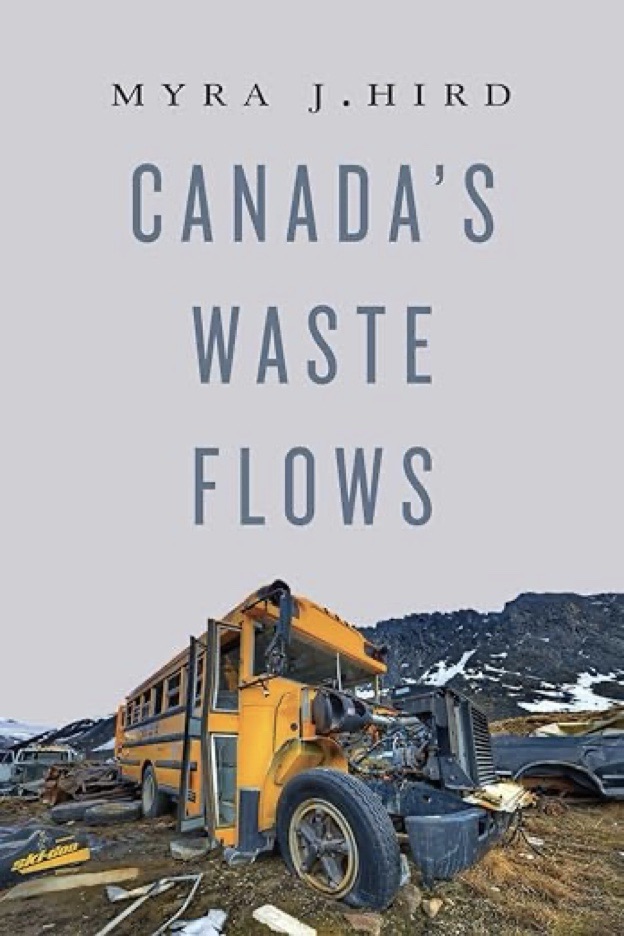
A few weeks ago, I listened to a talk at our weekly Friday Luncheon Discussion Club by this Queens University Environmental Studies Professor on the problem of microplastics, and was sufficiently impressed that I requested this book from the OPL.
In the first few pages alone, the reader learns several startling counterintuitive and iconoclastic facts such as that more than 98 percent of municipal waste comes, not from households, but from the manufacture of goods for those households, and that Canada leads the world in municipal waste production at more than two tons per capita annually. And that is just the starting point.
The example of Kingston’s waste management is used extensively to great effect, as it is representative of a bigger problem. When they recycle, much of it travels to North Bay via fossil-fuel burning trucks, where it is compressed, and from there to Korea; much of it is then delivered to landfill sites or made into such consumer goods as picture frames and then shipped back to Canada. This has lead to what she refers to as the recycling cult. Recycling paper involves using toxic chemical like chlorine to remove the ink, which contaminates the water and paper can only be recycled once or twice. It also produces “sludge that it more difficult to remove than paper.” One of my books is on recycled paper. Several private companies make a handsome profit along the way, while emitting greenhouse gasses to transport it with perverse incentives to increase rather than than decrease the supply of garbage to be recycled.
A long list of chemicals is listed as the legacy of the DEW (Distant Early Warning) military establishment in the far north when they began to close sites over many years, and that contaminated manny rivers and lakes. Most notable are high concentrations of PCBs. The Giant Gold Mine near Yellowknife produced 237,000 tons of very toxic arsenic trioxide that is still just sitting there, leaking into groundwater. But the author does not provide much advice about solving this problem. And while the treatment of the native Inuit culture and their animals, is deplorable, it doesn’t fit easily into any discussion of the big picture when it comes to waste management.
In the next section, Hird waxes philosophical with a metaphysical discussion of landfills and other forms of waste in the bigger picture of the Anthropocene era, and our relationship to bacteria and other forms of life. This left me feeling even more insignificant than usual. The later part of this chapter left me, as a concrete thinker, confused, puzzled, and scratching my bald head.
In the penultimate chapter, Hird returns to Iqaluit for a very enlightening discussion of the spontaneous fire at the overfilled local landfill; that spewed dioxins and furans into the atmosphere and Frobisher Bay in 1995. There is a unacceptable double standard for those in the north with levels that are considered safe twice as high as in southern Canada. Throughout the book there is harsh criticism of a” neoliberal, capitalist economic and political system” and experts such as public health authorities and fire chiefs.
Years ago, I read somewhere that there are several practices that we should give up. One was mandating bicycle helmets because it leaves the impression that biking is dangerous and therefore fewer people take up biking. Another was curb-side recycling, pointing out that the city of Houston has only one truck pick up garbage, (once every two weeks) with workers doing the sorting at the dump or landfill; one fossil-fuelled truck rather than three prowling the streets. But even that is a minuscule solution to the bigger problem of ever increasing upstream overproduction of consumer goods.
In the Epilogue the author remains pessimistic but emphasizes that to meaningfully at least reduce the problem, we need to address the upstream capitalist efforts to forever increase production, accept zero or negative economic growth, and pay more attention to how what we really need is packaged.
This book is full of insights that run counter to everything that we are taught by governments and private enterprises alike. Parts of it are superb, but in other places I was completely lost.
8/10

 The Passionate Reader