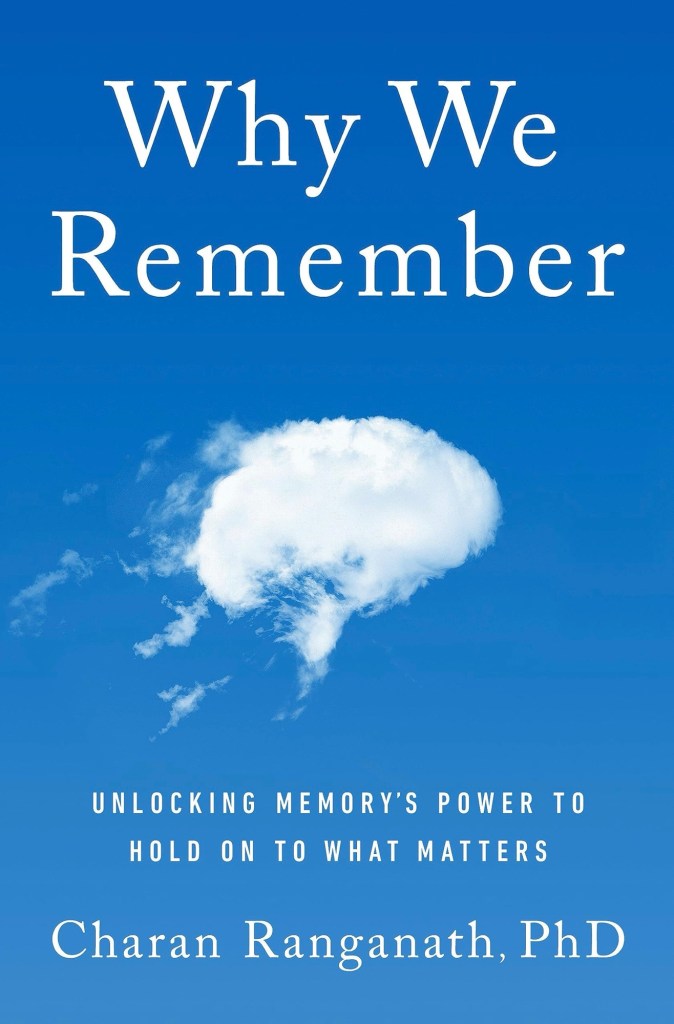
The University Of California, Davis, Professor of Philosophy and Neuroscience, weaves personal stories of his trips to his homeland of India, and as a parent, an amateur surfer, and musician, into this attempt to explain why we remember. From my perspective it would be more appropriate to title it How We Remember, as there are intricate details of neuroanatomy, neurochemistry, and neurophysiology that are shown to be involved in our often faulty attempts to remember. At times he skates close to the deeper philosophical question of whether or not we have free will. He never addresses this question directly but certainly seems to take a mechanistic view of the problem of remembering (and forgetting), as though there is no mind or soul, separate from the brain.
The difference between episodic and semantic memory, the role of the prefrontal cortex, the hippocampus, and the cingulate gurus, H. M of damaged hippocampus fame, contextual setting, infantile amnesia, the reminiscence bump, event schemas, the Default Mode Network, reality monitoring, synesthesia, collaborative facilitation, and social contagion are all detailed. In some of these, a researcher making an observation in experiments on college undergraduates, often using functional magnetic resonance imaging, comes up with a new name for the phenomenon as though that is sufficient to explain it. In forensics, a note of caution is sounded with examples of the falsely convicted based on faulty memories. This is hardly news. There is an excellent discussion of the brain’s busy schedule in prioritizing memories as we sleep.
Although the day-to-day examples of problems with memory that we all can relate to are great, there is more neuroscience here than most readers need or could appreciate.
6.5/10
Thanks, Goodreads, and The New Yorker.

 The Passionate Reader