I listened to this novel as an audiobook for three hours, (90 pages) before deciding to borrow the hardcover edition from the OPL.
The 14 year-old son of a widow, his father, a Korean musician, having died in an accident while stoned, begins to act strangely and hears voices.To him, everything is connected, and he is diagnosed as having a prodromal schizoaffective disorder. The ironing board likes the sheets and the iron. The books choose their readers. In his mind, inanimate objects think, speak, and have strong emotions. The library quietens his voices. He carries an old happy spoon and tastes the delicious flavours of what it had once conveyed to others. The fly on the wall hears him and understands his emotions.
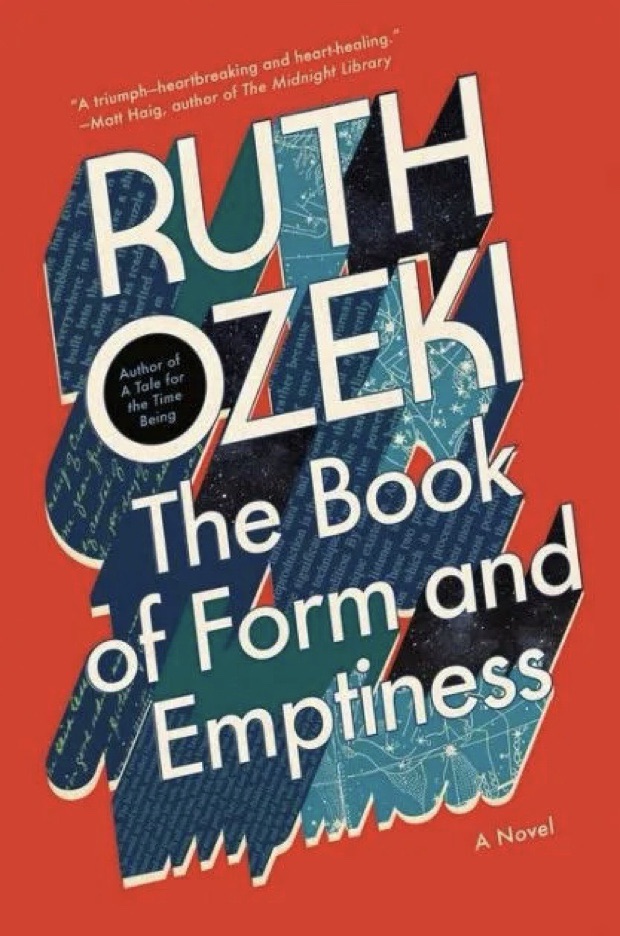
The 14 year-old son of a widow, his father, a Korean musician, having died in an accident while stoned, begins to act strangely and hears voices.To him, everything is connected, and he is diagnosed as having a prodromal schizoaffective disorder. The ironing board likes the sheets and the iron. The books choose their readers. In his mind, inanimate objects think, speak, and have strong emotions. The library quietens his voices. He carries an old happy spoon and tastes the delicious flavours of what it had once conveyed to others. The fly on the wall hears him and understands his emotions.
But it is not just the psychotic boy who has strange beliefs and experiences. His mother, a pathological hoarder, seems to adopt some of his strange beliefs. She then discovers the Zen Buddhism teachings of Emptiness and liberation, and reluctantly, under threat, begins to clean up and get rid of things.
The routines of the psychiatric hospital in the modern age, when he is admitted, are described vividly and seem to have changed little since I became acquainted with them almost 50 years ago. The challenges and special talents of someone with schizophrenia, (I have interacted with many) are described realistically, and sympathetically.
But is not just the psychotic boy who seems weird. His mother, seems to adopt some of his beliefs. She is a compulsive hoarder, but discovers the teachings of Zen Buddhism and reluctantly, under threat, finally starts to get rid of things.
« And what about the troublesome question of more? For most humans throughout history «more » wasn’t even an option. Enough was the goal and by definition was enough. The Industrial Revolution changed all that, and by the early 1900s American factories were pumping out more goods than ever before, while the newly empowered advertising industry used its forked tongue to convert citizens into consumers. »
There is no exact setting as to time and place but it must be mostly in 2020 as there is an election with widespread violence following it and from the Library scenes, it seems to be in Los Angeles.
Some of this story is what western readers would consider to be magic realism, but Zen Buddhism would consider to be standard teaching.
I struggled through this book and enjoyed parts of it. However I am probably too far removed from it culturally to fully appreciate it, though the strange plot will be hard to forget.
The 3.5/5
Thanks, Andrea?

 The Passionate Reader