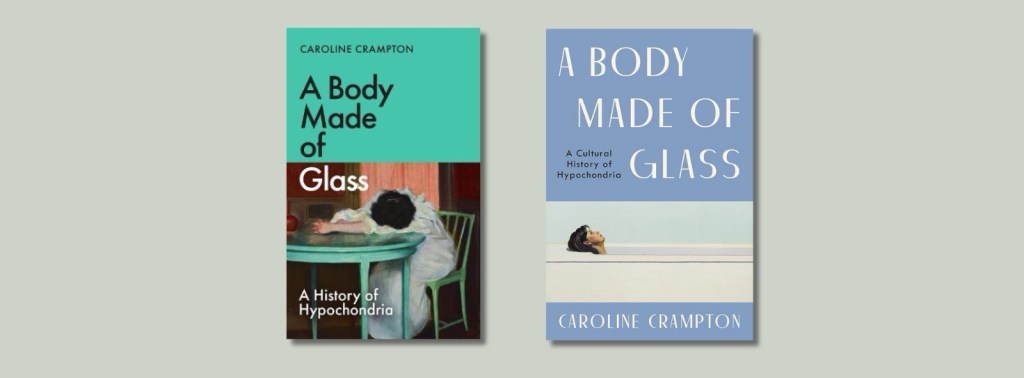
Recurrent Hodgkin’s lymphoma in her late teens, ultimately treated with a stem cell transplant taught the author, a London U.K. native too well to pay close attention to her body, resulting in what she later recognized as hypochondria. “It feels at times like having cancer for real was the training I went through so that I could have a dozen other illnesses in my imagination. I am now very good at being unwell. I’ve had a lot of practice.”
The list of sufferers from hypochondria as she defines it is long and includes John Donne, Lord Byron, Glen Gould, Charles Darwin, Phillip Larkin, Elizabeth Barrett Browning, Howard Hughes, James Madison, Virginia Wolfe and Susan Sondheim among others. The long chapter on the history of hypochondria was, for me, unhelpful and wordy with quotes from Donne and Robert Burton’s poems, that I just found confusing.
The World Health Organization has replaced the word “Hypochondria” with “health anxiety” emphasizing the arbitrariness of many diagnoses. Although the author uses “hypochondria” throughout the book, she recognizes the fuzzy borders and the significant overlap with obsessive compulsive disorder and hysteria, now known as conversion reaction. I do not know when talking about concern about health issues becomes excessive and becomes a disease. I do know some close relatives who move in the opposite direction, concealing a serious debilitating disease, fearful that they may be considered disabled.
The ease of finding information about diseases in the Internet age has probably contributed to all kinds of health anxiety, that I can readily relate to. When my phone tells me that I walked less this week than last week, it would be easy to convert that into anxiety if I had no better explanation ,such as fewer trips to the library.
The 40-page chapter “The rise and rise of the Quack” makes for very interesting reading about the ability of someone with a superior bedside manner to cure or at least treat effectively the diverse illnesses of the hypochondriac, and the past and somewhat still present ability of medical boards and regulators to weed them out. I once was caught in this deception by a man purporting to be a physician, albeit in the relatively harmless field of pathology.
I do not know what is the right balance between anxiety-Inducing health-seeking behaviour and relaxed nonchalance.
This wordy text is interesting but I cannot relate at all to parts of it.
3.5/5
Thanks, tithe New Yorker

 The Passionate Reader