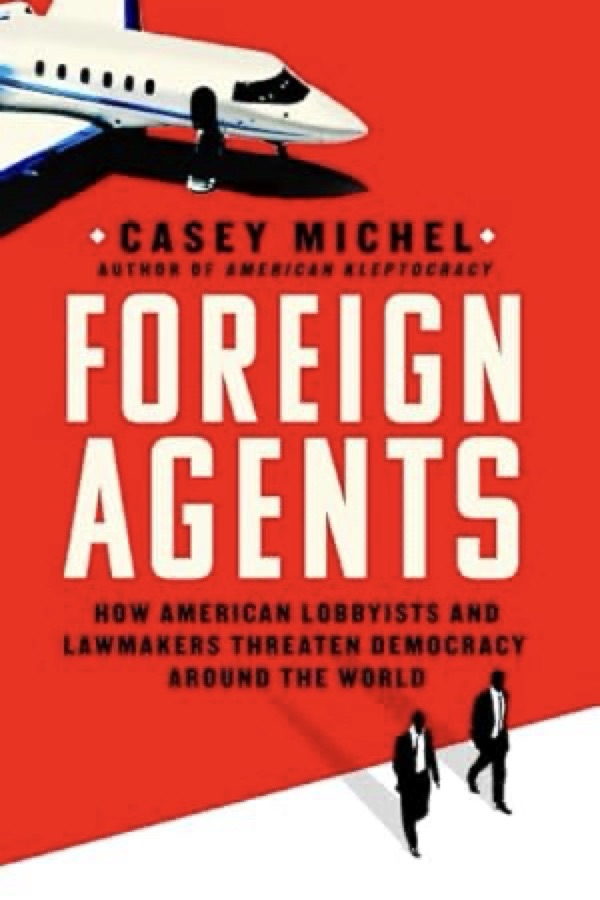
This book by the Human Rights Foundation author bears some resemblance to the spy stories I have been immersed in lately. But the characters are not mostly cloak and dagger spies but well known public figures. It is the paper trail of who is footing the bill that is kept secret.
The book starts with the story of Ivy Lee who in the 1930s was paid handsomely to dress up the opinion of the new Nazi regime in Germany within the U.S. The resulting Foreign Agent Registration Act was good on paper but has a long history of weak to totally absent enforcement. The book proceeds from there to the long and checkered history of Paul Manafort, as he worked to install Yanukovych at the behest of the Kremlin to lead anti-democratic Ukraine; among many other countries, he worked for Guatemala, the Philippines and some Arab states; the money was often filtered through shell companies and third parties.
No one escapes the scorn of the author for double dealing, including the Clinton Foundation and the late Robert Dole, but Manafort, Trump, and many of his cabinet members come in for the harshest assessment. It is enough to make one question whether there are any true charities. I once was invited to speak at a pan-Arab conference in Doha, Qatar and did a short locum there. On returning I praised the apparent impartiality of the journal Al Jezerra, without realizing the despotic cruel dictatorship they represent. But I was paid a pittance compared to the millions paid to foreign agents touting the virtues of Qatar. When we set out to establish on a charity as a tax break, we decided to call it the Ghent-Simon Foundation, with all revenue directed to Doctors Without Borders, which seems to be safely nonpolitical, although where they decide to work may be influenced by political factors.
The foreign agents featured include many universities which are paid handsomely to burnish the reputation of despotic foreigners, NGO charities, and notorious Washington think tanks that have a constant revolving door of former government officials working for them, without revealing how they are funded. And at least two senators were found to be on the payroll of foreigners.
Completely banning foreign agents has been thought to be unconstitutional by the U.S. courts, but enforcement of registration needs to be greatly beefed up.
This book made me despair of the fate of democracy, with few workable solutions suggested to counteract the allure of secret money.
4/5
Thanks, The Economist.

 The Passionate Reader