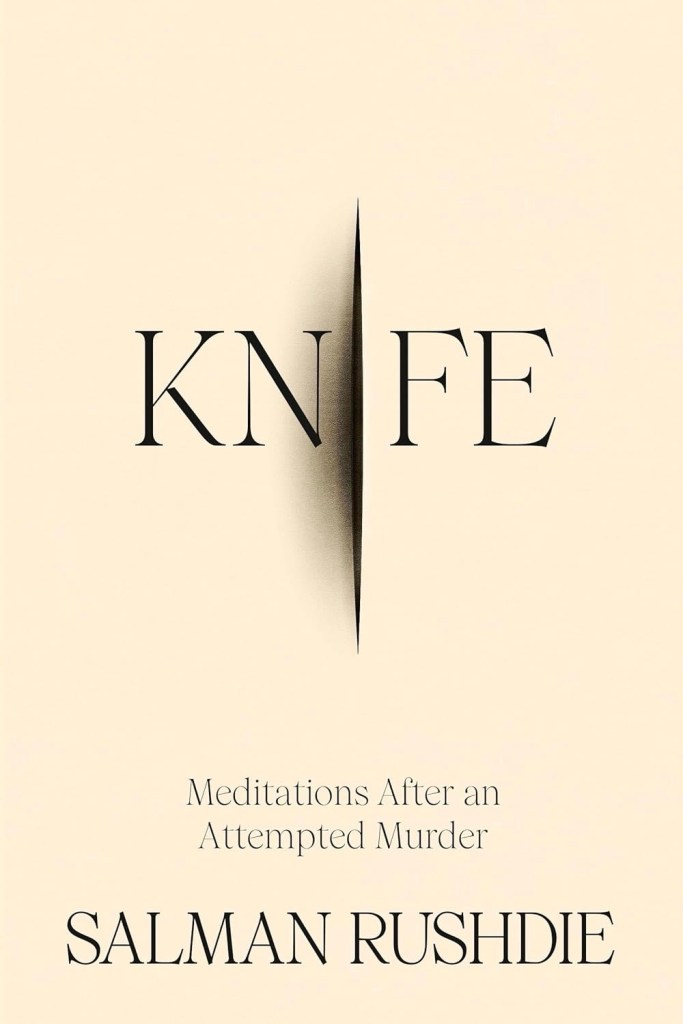
This recounting of the nearly fatal stabbing of the famous author is the latest of his fifteen books, mostly novels. I have only read one, The Moor’s Last Stand, and found it confusing with a lot of magic realism. But I enjoyed reading his earlier autobiography Joseph Anton, which documentshis early life in India, then in England and the United States, and the trails and threats, he endured after the1988 publication of The Satanic Verses. He has long been a vocal advocate for free speech, an atheist, and a critic of all religions.
On August 12th, 2022, a young radical Muslim stabbed him 15 times in front of ten thousand people in Chautauqua, New York, blinding him in one eye and leaving him critically injured. This book traces his life from that point, with a flashback to when he met and married his faithful new wife in 2021, the latest of five.
The book is full of reminiscences of how the attack changed him, with many references to literati friends that I had never heard of and to literature that I was equally ignorant of. But his views of religion and politics seem to largely reflect my own humanist instincts (for religion, believe whatever you want in private, but do not impose those beliefs on others) and are laid out very specifically. The wounds and their complicated treatment are described in detail from a medial viewpoint, and seem realistic, even if described in convoluted sentences, some going on for half a page. His surgical treatment was flawless, but some problems seem to have been needlessly over-investigated.
There are several good quotes: “If you are afraid of the consequences of what you say, then you are not free.”
“A poem will not stop a bullet. A novel will nor defuse a bomb, Not all our satirists are heroes.
But we are not helpless. Even after Orpheus was torn to pieces, his severed head, floating down the river, Hebrus, went on singing, reminding us that the song is stronger than death.”
The imagined conversation with his assailant is, in my opinion, the weakest part of this gruesome documentary.
3.5/5.0
Thanks, The New Yorker

 The Passionate Reader