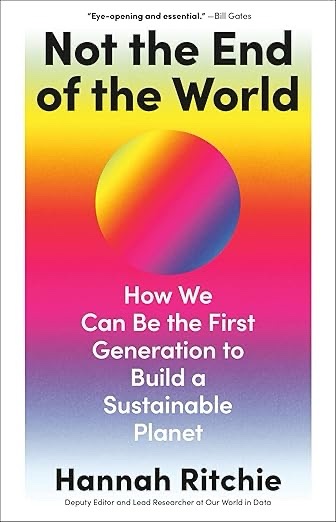
This Scottish environmentalist and head of Our World in Data, has written the most upbeat book on the environment that I have ever read. Loaded with literally hundreds of counterintuitive facts and clear graphs, along with scholarly references, she has me convinced that the world is not doomed. At the same time she does not deny the serious challenges we face with such problems as air pollution, deforestation, food production, climate change, loss of biodiversity, and depletion of fish stocks, but offers safe and effective solutions.
The air we breathe is the cleanest it has been in at least 1000 years and we can do even better with modern technology to capture pollutants at source.
Food production to feed 9OO million people requires better crop yields, distribution and a change in diets with less waste. That requires some judicious use of fertilizers and pesticides, not more land for agriculture.
The Amazon rain forest actually contributes almost nothing to the atmospheric oxygen concentration, and burning stubble to produce land for palm oil production is less of a problem than the substitute production of some other oils including olive oil.
Of the 460 million tons of plastic waste produced annually only a small fraction ends up in the Great Pacific Garbage Patch. Most of that comes from the fishing industry. Much of the waste plastic can be safely stowed in sealed landfill, which is much more economical than trading it around the world or recycling it. Or it may be possible in the future to break it down chemically in an ecologically friendly way.
I occasionally do some volunteer work at a local small-scale ecological farm and research facility that religiously avoids all pesticides, insecticides, weed-killers and fertilizers other than mulch. It claims that it can match or exceed crop yields of industrial farms, but is labour intensive. Perhaps avoiding all fertilizers and pesticides is not really necessary, according to this author.
This is the best book about scientific ecology that I have ever read, bar none. A much more detailed update to Michael Berners-Lee’s great How Bad Are Bananas? The Carbon Footprint of Everything. Deserving of some prize.
5/5
Thanks, Book Browse.

 The Passionate Reader