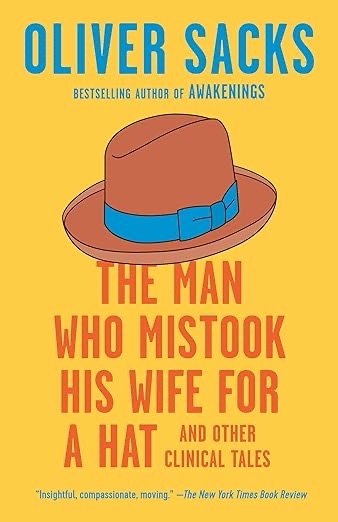
The late New York professor of neurology clearly had a knack for the short story. His wide-ranging curiosity for hidden talent in what appeared to be hopeless cases of a wide variety of neurological impairments and his deep humanity shine through in all of his writing. From phantom limbs to autistic artistry he saw the potential benefit in every ailment.
Most of the stories relate to the people he encountered in long term care facilities. The investigations were limited by today,s standards without CT scans or MRI. I was intrigued that he mentions meeting and discussing prosopagnosia with Dr. Andrew Kertez, a professor at Western with whom I researched and co-wrote my first academic paper. I was intrigued by the complexity of temporal lobe seizures that may have contributed to Dostoyevski’s writing talent and Shostakovich’s music. It has been suggested elsewhere that temporal lobe epilepsy caused St. Paul’s sudden conversion.
The most astounding pages relate to the profoundly “retarded” twins with a totally unexplained ability to tell the day of the week for every date for hundreds of years in the past, among other numerical phenomena.
The comparison and contrast of Tourettes’s Syndrome and Korsakoff’s, was confusing to me, but the Korsakoff patients he discusses seemed much more complex than any I ever met.
There are a host of medical terms that most people will not be familiar with, and some hair-splitting differences in terminology that can be confusing, at least to me
4/5
Thanks, Andra.

 The Passionate Reader