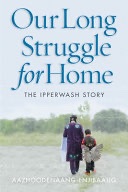
The author of this book is not the unpronounceable name cited on the cover, which is a collective word for the twenty some families, manly Nishnaabe natives, who contributed their stories. The real author or at least the person who pulled all of the stories together is Heather Menzies, a white Ottawa professor at Carlton University, of Scottish descent, as revealed only in the six page Afterword.
The camp on the shore of Lake Huron was expropriated by the Army from the Nishnaabe First Nations supposedly on a temporary basis in 1942, to be turned back over to the natives when the war was over.
As I spent one whole summer at Camp Ipperwash as a teenaged army cadet (Alpha Company), I probably have more interest in this story than most. But I was completely unaware of any of the tragic history, although I recall the geography reasonably; that will be more confusing for readers who have never been there. The army continued to use the camp and the adjacent Ipperwash Park to train cadets until 1994, and then continued to stall about turning it back over to the natives because of alleged concerns about unexploded ordinances, the same concern we were warned about 64 years ago as we prowled the camp and the adjacent Ipperwash Park.
When the frustrated natives justifiably confronted the army, the politicians and the police and seized control of the site in 1995, the result was a violent confrontation with Dudley George being shot and killed and many other natives injured. The first hand account of the police cruelty leaves no doubt that they were racially motivated.
The story is definitely lopsided with almost no criticism of the natives, who were certainly not united or blameless, and the narrative is short on the police perspective. This is not to condone or justify any of the horrendous and ongoing racist actions against the natives.
I did not understand why the white car with a flat tire was driven to Strathroy Hospital as Dudley George was dying in the back seat as there are much nearer hospitals in Chatham, Tilbury, Windsor and Sarnia.But the narrative is selective, at times incoherent and incomplete.
As a potent reminder of the widespread shameful and continuing mistreatment of our First Nations brothers, this book deserves wide readership, but a bit of balance should be added to avoid it being dismissed as just an unjustified native rant.
3.5/5
Thanks, Mike.

 The Passionate Reader