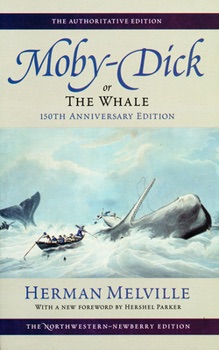
This edition was published in 1967 ten years or so after the first of several movie adaptations of the old classic story by the American novelist. I found it on my book shelf but I am not sure how it got there, and I realized I had not read it. I will not be seeing any movie with this story.
The preparation for a whaling trip out of Sag Harbour and Nantucket, takes up a quarter of the book as the narrator, Ishmael, outlines his reasons for joining the three year expedition on the Pequoid in search of valuable sperm whales for their oil, used mainly for lighting. The Viking invention of the crows nest outlook post and the myth of Jonah is included. The narrator is Ishmael throughout and women are barely mentioned.
Moby Dick, the unique white albino whale that has already removed one of Captain Ahab’s legs on a precious encounter, is introduced first only on page 176, and not seen again until thirty pages from the end. Captain Ahab’s obsession with getting revenge makes him miserable and angry. This reminded me of the great science book The Science of Revenge, even though in this case the perpetrator is nonhuman.
Of the 135 chapters there are several of utter gibberish uttered by sailors of different nationalities, that to me seem to have nothing to do with whaling or even sailing and containing far too many exclamation marks. There are many full page sentences. For example there ten dense pages of musing about the meaning of whiteness in history and cultures, written in old English.
Ahab’s single-minded determination to get revenge on Moby Dick, even as he walks with the assistance of whale bone prosthesis, eventually removed by Moby Dick results in his demise along with all of the mottled crew of the Pequot except for Ishmael, the narrator of this dreamy unrealistic tale.
One quote worth pondering: There are certain queer times and occasions in this strange mixed affair we call life when a man takes this whole universe for a practical joke, though the wit thereof he dimly discerns, and more than suspects that the joke is at nobody’s expense but his own.”
I’ll admit to learning a lot about the ancient whaling industry, the anatomy of the differing species, the reproduction of whales, and primitive navigation at sea but that does not adequately compensate for the many pages of utter unrealistic nonsense in old English.
2/5
This edition

 The Passionate Reader