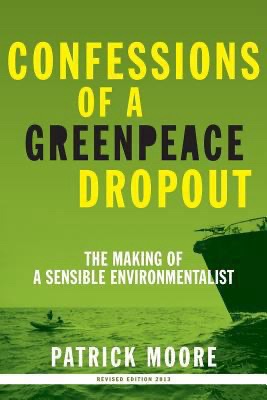
My wife picked up this abandoned dated autobiography by a controversial Vancouver environmentalist who split with Greenpeace in 1986 only to join the Fraser Institute, a well-known right-wing think tank. This led me to be careful about some of his assertions, although he is very scholarly, and convincing. However, my skepticism was reinforced when I read Rudy Juliani’s endorsement of him and some assertions such as that solar panels are ten times more costly than nuclear power plants or hydroelectric dams in producing electricity, even with the concrete needed to produce the latter.
He left Greenpeace, acrimoniously, as it had morphed into a very unstructured protest for the sake of protest movement incompatible with his very erudite approach, with a Ph.D. in ecology.
The 30-page vigorous defence of fish farming in chapter 12 is very convincing as a sustainable form of development but then I was already a fan, and he became heavily invested in this industry. But some of his scathing remarks about opponents in Greenpeace including some of his previous collegues seem unnecessarily harsh.
His defence of the diverse B.C. forest industry is a little less convincing, but still powerful. His comments about the limitations of solar electricity, such as « it will take between 45 and 290 years to pay for these systems » and «It doesn’t take a genius to realize that solar power is a waste of good money on the grid” have been proven dramatically wrong since this book was written as now they produce electricity cheaper than coal does and account for 99% of the increase of electricity production and start to provide profits for installers within 2 to 5 years in most areas, albeit with variable small rebates of installation costs from governments. The owners of our large apartment complex recently installed blanket solar panels on the roofs of 3/5 buildings and they are certainly not naive about finances.
The same lack of foresight applies to his scornful predictions of the demise of wind power, and his enthusiasm for hydroelectric power generation ignores the cost of building and repairing dams, and the initial human displacement. His long and very detailed defence of nuclear power is very educational and insightful. Less compelling is his half-hearted endorsement of Alberta’s oil sands, often denigrated as tar sands.
With his obvious love of iconoclastic bombast, it is not surprising that he advocates for liberal use if inorganic fertilizers, insecticides and pesticides, although the ecological farm where I volunteer avoids these and produces abundant delicious crops. They claim to match production by industrial farms on a per acre basis, if one avoids the very wasteful use of the products by feeding livestock.
His vigorous defence of genetically modified crops is spot on although perhaps a bit exaggerated with no acknowledgement of the corporate interests involved.
The long penultimate chapter on climate change left me confused. On one hand he seems to think that carbon emissions have little to do with atmospheric warming and welcomes global warming, and on the other hand does advocate for alternatives to nonrenewable resources like coal, favouring hydroelectric and nuclear sources for power.
I admire his far-ranging knowledge, but throughout the book there is more than a whiff of smug self-congratulatory arrogance with no thought that he could ever possibly be wrong, as some developments since the book was written have proven.
3/5

 The Passionate Reader
3/5 seems generous given his many blatant errors
LikeLike