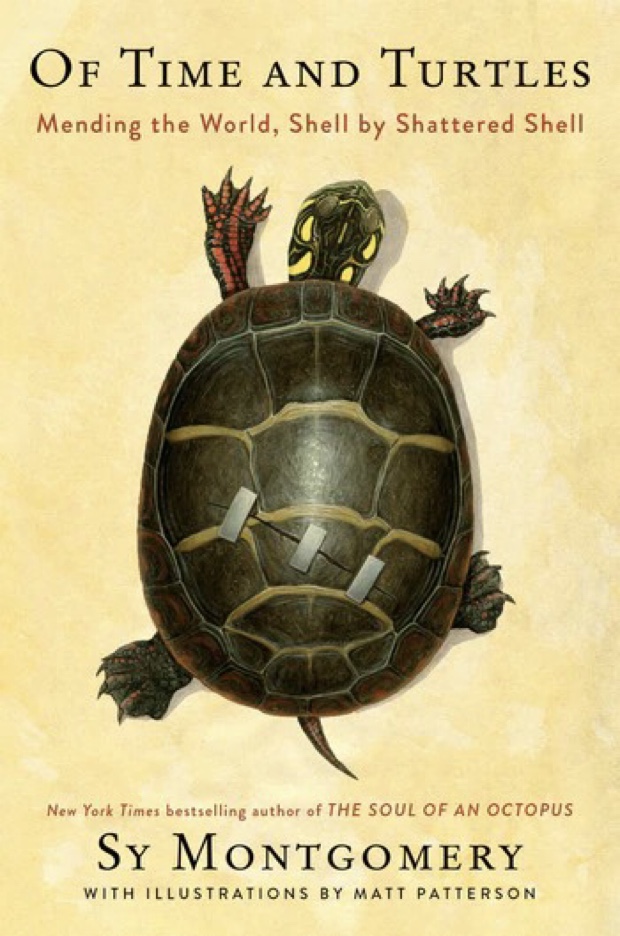
This prolific New Hampshire science writer of more than thirty books usually picks a single species, order, or family and documents their amazing feats. Prior to this her latest book was on octopuses. In this newest one, she enlightens readers about one of the most neglected and endangered reptiles and weaves into the story their importance to all of us and many other forms of life.
There is a very lucrative multimillion dollar illegal trade in all kinds of turtles, usually sold into China as pets, for food or for medical concoctions of unproven utility. This has endangered the survival of numerous species of turtles.
There is very educational information about how we differ from turtles in the way we experience the world, with very different modalities of sensory input. Turtles use two different senses of magnetism to assist them in navigation. Some land-based Musk turtles climb trees! The wintering-over of turtles called brumation, when they bury themselves in the mud in the bottom of a frozen lake or river was new to me. Some paraplegic turtles with completely severed spinal cords can regenerate nerves and regain normal mobility. The lengths the rehabilitation teams go to save injured turtles, such as constructing turtle wheelchairs, seems to know no limits.
The author weaves into the narrative some interesting scientific and philosophical musings about the concepts and the physics of time, which turtles which can live hundreds of years clearly must experience much differently than we do.
Some chapters, while enlightening, have little to do with turtles and deal more with emotional burnout in their human caregivers, brain plasticity, Covid-19, and anxiety about American elections. Two of the turtle rehab women finally come out to the unsuspecting author as transsexuals, but this fact seems peripheral to the thrust of the book.
I am not sure that the author and her fellow dedicated and enthusiastic turtle rescuers have fully thought through the potential longterm effects of their admirable enthusiasm for rehabilitating injured turtles. To keep them from them becoming roadkill or human food seems noble but protecting them from natural predators may harm other species who then suffer from a man-made distortion of the balance of nature. Turtles or turtle eggs are part of the diet of some frogs, fish, birds, raccoons, mink, skunks, foxes and even sharks. Are those turtle lovers interrupting that delicate food chain when they supply turtles with food and resources that many starving human beings desperately need? When they import foreign species of turtles from Asia or South America, are they not risking introducing a foreign species that is destructive to the native ones, (and potentially to us)? Are they oblivious to the harmful environmental effects of travelling long distances by car or plane to rescue a single turtle? We often intrude into the balance of nature without consideration of the knock-on effects. Will this author’s next book bemoan the blight of some other species deprived of their diet of turtle eggs?
Before reading this book, I had occasionally noticed several small snapping turtles in the nearby ponds on my daily early morning walks, but only after reading about their nesting behaviour did I notice the mounds of fresh soil beside the path, with the small round holes beside them, where the hatchlings emerge to return to the pond.
⭐️⭐️⭐️⭐️⭐️⭐️/10
Thanks, Goodreads.




 The Passionate Reader