It takes a lot skill and imagination to make a chubby, lazy, promiscuous weed-smoking, gay man in his sixties lovable, but this British author succeeds doing that in this debut novel. But the main character of the story, set somewhere in a fictional decrepit small town in New England, is a restless, single, uneducated, stubborn woman whose relatives are reshaping the town with massive suburban housing developments. She resists their attempts to buy her out of the derelict house she has inherited from her deceased parents standing in the way of their plans and tries to wreck the house to achieve a better bargain from them -with a deadline to complete it between September, 1977 and March, 1978. There seems to be a nebulous subplot of escape from a troubled past into anonymity for several of the characters.
The only (rather weak) attempt to develop any suspense is in relation to to question as to whether or not she will succeed in completely tearing down the house and moving all the junk to the other side of a pond, in the face of multiple unforeseen obstructions, some from her relatives, and some from nature. I will never tell.
The prose is chronologically straightforward, sprinkled with bits of wry humour and lively, eccentric characters whom readers will have no difficulty in keeping straight. But I have no sense of what genre label would best fit this story. Certainly not suspense thriller, fantasy, romance, young adult, crime, humour, horror, or mystery.
There are a few good quotes about sleepy small town life that I can relate to, having grown up outside just such a town. “Some families had already placed wreaths on their doors. It was only November. They probably had to leap from holiday to holiday to holiday because waiting to die in a town like this was so incredibly dull.”
First a note about page numbers in various versions of books. The e book of this one is listed as 1012 pages, but that includes 344 that are not text, and they are really only half pages so I imagine the real number is about 322. The Libby Library says I took 17 hours and 13 minute to read it.(It seemed longer.)
No novelist could ever conjure up a family as dysfunctional as the author alleges her Southern U.S. extensive clan was and still is. This family is replete with rabid racists, religious extremists, people with schizophrenia (in keeping with Weijun Wang’s advice in The Collected Schizophrenia, I’ll avoid using the derogatory word schizophrenic as a noun), criminals, misogynists, eugenicists, sexual predators, pedophiles, and suicidal depressives. No one, including the author, could remotely be considered entirely sane and rational at least by modern psychiatric standards. But then again, could anyone? This leads the author to research and muse extensively about the age-old dilemma of nature vs nurture, from the views of Aristotle to those of current day geneticists and philosophers.
The discussion on epigenetics is up-to-date, detailed and the best exploration of all the uncertainties and controversies surrounding its importance and heritability that I have read. The hazards and false claims of connections between specific genotypes and character traits and disease susceptibility are discussed in detail.
There is a thorough discussion of the very long history of genealogical searches, and their ties to ancestor worship in many ancient and some modern cultures. The very confusing chapter on her searches on such sites as 23andMe and AncestryDNA exposes a thriving industry preying on people’s desire for connection to their remote ancestors and assigning them to dubious arbitrary geographic groupings. Many of us tote around some Neanderthal genes and that is, after all, a compliment as 60,000 years ago they were at least as intelligent as Homo sapiens, and perhaps more so.
In spite of the family history, or perhaps because of it, in 2019 the Brooklyn author built an altar to worship and pray for her long-dead ancestors and has what can only be described as harmless schizophrenic delusions and hallucinations as she connects with ancestors from the first century A.D. At least that is the label modern western psychiatrists with their DSM-V bibles would apply.
The assertion that “In terms of DNA, we are no more related to most of our ancestors than we are to people around us on the train or at a baseball game.” Is seemingly contradicted a few pages later when she acknowledges after discussing some relatives “These are my relatives, Of course, I am crazy.”.
This story is wordy with far too much speculations about the lives of relative she knew only from searches in various archives going back to the 1600s. As you can imagine, the names, activities and relationships of relatives over four centuries are impossible to keep straight and of borderline importance to the story. Her drunken grandfather’s ten short marriages and divorces and many failed enterprises take up more than 30 pages in the paper book or double that in the ebook. And the details of every trinket and piece of jewelry she inherited from distant relatives will interest few readers, although there may be some mystic symbolism in rings.
This is really two books in one: a scholarly overview of modern concepts of genetics and connectedness and a rambling, boring, introspective account of her own troubled family history, (minus any details of her own marriage and offspring.)
I have resisted learning about distant long-dead relatives lest they include, for example, horse thieves, bank robbers, and illegitimate children, perhaps from slave women.
In this detailed autobiography, the 72 year old very talented Hamilton-born comedian, singer, writer, and actor provides an unabashed portrait of his life among an endless string of pop culture stars, almost all of whom he claims as best friends. His career started in Improv in Toronto, progressing to Second City TV, then to a great variety of roles in entertainment including writer and actor on Saturday Night Live and then in film and TV movies, on Broadway, and later as a celebrity touring comedian.
The characterization of dozens of volatile, insecure, and explosive personalities in the entertainment world, all seeking publicity, fame, and wealth gives readers an rare inside glimpse into the shallowness that plagues the whole entertainment industry. The very prevalent substance abuse and promiscuity are acknowledged, but not in any judgemental tone. It strikes me that the necessary itinerant lifestyles, flitting around the world from one engagement to another and associating and working transiently with glamorous idols must contribute to these problems. And a hugely disproportionate number of the entertainers in Hollywood and New York, like the author, are Canadian-born. Why does Canada continue to export most of our best talented entertainers? The lure of wealth, fame, and a luxurious lifestyle in the U.S. seem irresistible to these exported Human Resources .
His devotion to his native country is perhaps best demonstrated by his continuing to vacation at a cottage north of Toronto on Lake Rousseau where his late wife’s ashes are scattered.
His Nine Categories for weekly self-evaluation provides more useful self-help advice in 14 pages than Arthur C. Brooks does in 224 pages in From Strength to Strength.
His public persona is balanced by unusually philosophical reflections and a rare devotion to his family. His grief from the 2010 death of his longtime wife uncovers a depth of emotion and character well hidden from most of his fans.
Never a fan of the inane slapstick comedy that he is famous for nor of most over-hyped Hollywood productions, I found the endless name-dropping of famous entertainers that he assumes readers will know all about a bit confusing. I never pay any attention to the Credits of any productions, so most of the names of behind-the-scenes workers that he acknowledges were unfamiliar to me.
My daughter must think that I am in need of advice on how to live my life after retirement, and perhaps she is right. But I have a deep-seated distrust of self-help books, with a firm, perhaps misplaced, belief that I alone am best qualified to determine what is most likely to make me happy, productive and useful at any and all ages, so I approached this book she gave me with a fair degree of scepticism.That scepticism was strengthened when I realized that the author was until recently the president of the influential conservative American Enterprise Institute, a Washington think tank funded to the tune of many millions by corporate America, including Exxon Mobile and the billionaire, Charles Koch, and he is still listed as on their staff. There is something ironic about a rich professional in that capacity advocating the abandonment of the striving corporate culture of always acquiring more material goods, money, power, or prestige. As an aside, I am not sure if nonprofit think tanks, like America’s Heritage Foundation or Canada’s Fraser Institute are a net positive influence on societies, but, in the age of mass misinformation, one needs to know their background and funding to interpret their prodigious output of data and opinions accurately.
This Washington,D.C. social scientist and writer addresses the common problem of how to maintain happiness, a sense of purpose, relevance, and usefulness to society after you have passed your best before date, or the time when your skills in your primary occupation begin to decline, which he claims comes earlier than most people believe, particularly for high achievers.
The whole premise of this advice is based on the 60 year old distinctions made by the psychologist Raymond Cattell between fluid intelligence used in early careers and crystalline intelligence after the inevitable decline of those, and his resultant fuzzy two curve model of the trajectory of everyone’s life, as though everyone’s life Is neatly divided into two discrete time frames each with exclusive priorities and needs. Where do many modern workers who careen through several different careers fit into this model?
I don’t want to disparage everything this author has to say and he dispenses a lot of good advice that would have been helpful to me years ago, when I struggled with the doldrums that commonly plague the adjustment to retirement. What valuable advice there is would seem to me to apply mainly to executive and professional workers and not to, for example, Newfoundland fishermen, African subsistence farmers or Asian factory workers who have little choice about the trajectory of their lives. But much of it is simple common sense which is apparently in short supply and may be more abundant in those Newfoundland fishermen than in corporate CEOs and striving professionals. And if someone deliberately decides to follow Dylan Thomas’s advice to “Rage, rage against the dying of the light”, to slide into the grave shouting “what a helluva ride” rather than even trying to adjust to inevitable limitations of aging, should they be judged harshly? There is no one-size-fits-all model of what constitutes a life well lived.
The chapter on spirituality is doubly confusing, combining the author’s rigid Catholicism with an admiration for Tibetan Buddhism, meditation, and an Indian Hindu guru’s version of ashram which divides life stages into four phases, rather than two. There is no mention of the horrors, incredible cruelty, and the millions who have died over many centuries because of religious zealotry, nor the religious intolerance currently ripping Indian society apart.
This book illustrates almost everything I dislike about the self-help genre, not only in literature but on social media and television (think Dr. Oz) and in the growing industry of self-appointed life coaching: far reaching generalizations from temporally limited social science surveys of populations that may not be representative, artificial distinctions, foregone conclusions that fit the writer’s biases, trite aphorisms, uncritical acceptance of unduplicated and possibly biased studies and surveys, endless psychobabble, and, in spite of proclaimed humility, a self-appointed supposition that the author knows how everyone else should live their lives, i.e just like he does.
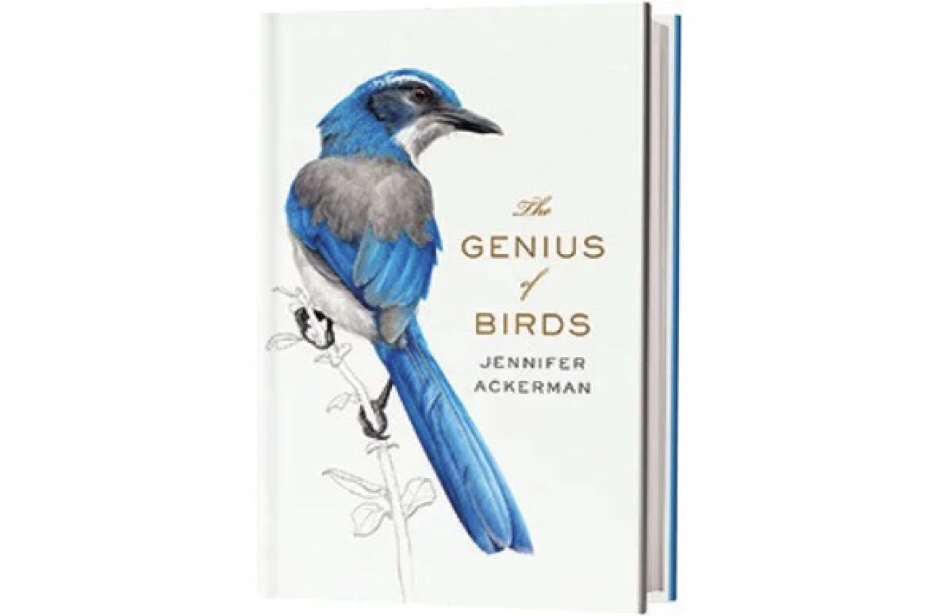
In this incredibly detailed, erudite, and scholarly treatise, (30 pages of notes and a 10 page index) the Maryland author presents a crash course that could be called Ornithology 101. Everything from bird evolution, anatomy, tool making, social and sexual proclivities, songs and communications, neuroanatomy and neurophysiology, and navigational skills to their interactions with other species, is reviewed and discussed. Many of the findings are from academic ornithologists and laboratory scientists from around the globe, but some comes from the observations of that eclectic human subspecies called the Binocularis Homo sapiens avis.
It seems that there are more theories and speculations than proven scientific facts in this rarified world, particularly when it comes to explaining the astounding navigational skills of birds. The 42 pages on migration and navigation includes theories about following clues from stars, magnetism, odours, sound or light frequencies that humans cannot detect, with dozens of ingenious studies failing to explain all of the observations.
There may be no skill left that is entirely confined to humans as one by one they have been discovered in other species, including birds and insects. Perhaps Ernest Becker was right in arguing that human’s only unique trait in all of biology is our awareness of and ability to deny our own mortality, but how do we determine that other species do not share this mental feat of cognitive dissonance?
Fuzzy social science debates about the nature of intelligence and distinctions without a difference between cognition and intelligence highlight our linguistic limitations in describing the amazing complexity of natural phenomena. There are some instances of conflating correlation with causation, and laboratory studies of captured birds may not be duplicated in the wild. The fallback explanation of ‘instinct’ is really no explanation at all, a coverup for our ignorance.
One longish insightful quote: “Many bird species are highly social.They breed in colonies, bathe in groups, roost in congregations, forage in flocks. They eavesdrop. They argue. They cheat. They manipulate. They kidnap. They divorce. They display a strong sense of fairness. They give gifts…. They pilfer from their neighbours. They tease. They share….They may even grieve.”
There is a circularity to the arguments about the relationships between avian intelligence or cognition, adaptability, and survival advantage that I found to be confusing and unhelpful.
I am neither an ornithologist nor a Binocularis Homo sapiens avis but I did help feed and train a great horned owlet for two months. (We had unintentionally scared her from the high nest before she could fly.) And I was fascinated by, on several spring evenings, observing the interactions of a pair of osprey designing and building their giant home on the tall centre outfield light stand of a baseball diamond.The city, to their credit turned off the lights for the season to avoid frying the eggs. As the one, presumably the male, picked up sticks and twigs from the park in his talons and beak, he would invariably do a fly by around his mate perched on the left outfield light stand, then either dropped his cargo and go back for a different load or take it to incorporate it into the nest. I was never able to discern what if any signal she gave him for approval or disapproval, but she would seemingly randomly stand up and spread her wings.
This avian discourse is unparalleled in its detail and the author’s obvious love of her subject and the awe it inspires is infectious. A great read.
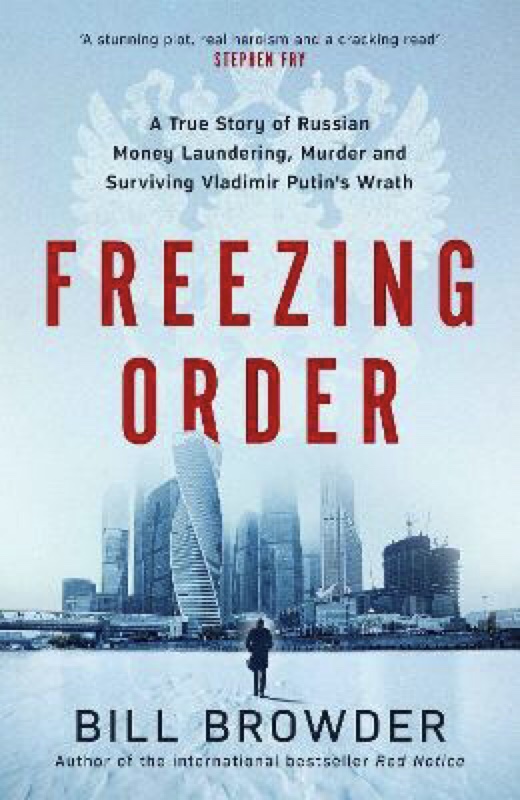
Born into privilege in the U.S, the now-British author continues the account of Russian high finance maleficence, international money laundering and murders that he first exposed in his 2015 book Red Notice. There is some overlap with the information in that book, so that it is not entirely necessary to have read the earlier work to understand this one.
Browder is the CEO of Hermitage Capital, a remarkably profitable international hedge fund that invested up to $4 billion in Russian enterprises in the 2000s following the collapse of the Soviet Union. However when he exposed massive fraud and money laundering schemes reaching to the highest levels of Putin’s regime, he became persona non grata in Russia, was harassed and eventually expelled from Russia, and his Russian lawyer, Sergie Magnitsky was jailed, tortured, and murdered in November 2009. A string of other murders and attempted murders of Russian dissidents and workers exposing the corruption, several being friends of Browder, followed and Browder was arrested on trumped up charges through a Russian filing with Interpol.
The most frightening aspect of this scary tale of international intrigue is the extent to which the Russian campaign of disinformation was successful in casting Browder as a criminal, often accepted in the highest levels of the United States government while he was working tirelessly to get a Magnitsky Act passed to freeze the foreign assets of the real criminal money launderers. (Hence the name of this book.) This was particularly harsh after Donald Trump became president; at one point at a Putin-Trump summit in Helsinki, the Putin proposal to extradite Browder, a British citizen, to Russia in exchange for release of 12 Americans held in Russian prisons was taken seriously by Trump.
Browder also had the bad luck of facing a demented U.S judge who could not comprehend the issues being argued and ruled against him. The international law firm BakerHostetler seems to fit the popular image of ruthless mercenary unscrupulous parasites; they delegated the same fittingly named amoral lawyer, John Moscow, who had defended Browder earlier, to later argue against his interests. But should we be surprised by this action by the firm that also had a constant revolving door relationship with the Trump’s administration?
In relation to passage of the Canadian Magnitsky Act in October, 2017 Browder notes: “The Canadian Magnitsky Act was a major milestone…..Many nations are either too proud or too anti-American to follow the United States, but there is no such thing as being anti-Canadian. I knew this move would open the floodgates and that a cascade of other countries would soon adopt Magnitsky Acts of their own.” (As they did, a total of 37 countries as of the time of writing). A flood of fuzzy pride filled me on reading this praise for Canada until I reflected that my being a Canadian is simply a matter of chance.
Readers like me will have some difficulty following the money trails documented here: they are as impossible to follow and serpentine as the disinformation trails laid down by Putin’s Russian oligarchy. The many foreign names that this monolingual anglophone found difficult to pronounce and remember added to my confusion. Nevertheless the story is compelling and frightening, reading like an international spy thriller novel. I found no reason to doubt Browder’s version of events and I greatly admire his courage and integrity, even though I have a hardwired distrust of anyone working in the murky world of international high finance.
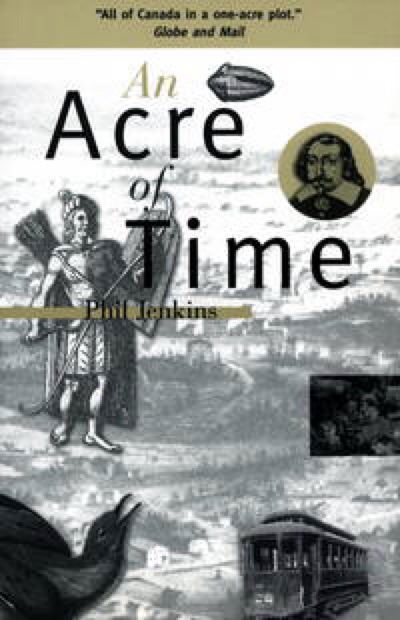
What a peculiar title for a book! But this is also a very peculiar book, encompassing geology, geography, archaeology, anthropology, philosophy, and most notably, embarrassing history, all as they relate to one acre of land measured out by the Gatineau author in downtown Ottawa. Although it’s history goes back to antiquity, he researched this over a three year period between 1993 and to 1996.
In delightful quirky prose loaded with apt similes, metaphors and analogies, in early chapters Jenkins regards humans as minor pesky destructive latecomers in the long history of the acre situated in what is now known as LeBreton Flats. In the first section, he traces the ancient origins of the underpinnings from the core of earth to the surface, some layers migrating from as far away as the equator. In later sections he shows due respect for the Algonquin’s claim to the land, but notes that human ownership of land is a legal myth, at best a lease that can be sold and one that is subject to the whims of natural events.
The details of what has happened to this acre over its long history are stunningly complex and are documented by very careful research from archives and from interviews of diverse surviving former denizens. The site chosen for the title must have been carefully selected in advance as few other places on earth’s surface could match it in controversy and the complexity of its history. The controversies continue to this day and endless plans for the development of LeBreton Flats have been proposed and abandoned in the twenty five years since the book was published.
Among the dozens of insightful quotes: “Heads of state, mayors, multimillionaires, and capital city planners tend to get Pavlovian about empty acreage. When they look at something like the acre, they see a bad case of arrested development and get all determined to build their sandcastles on it.”
The wind is described as “airmailing” dust and moisture onto the acre to provide nourishment for the soil.
Although I have lived 21 k from the acre for the last five years and have been by it many times by car or bicycle, I found the the map at the start confusing and resorted to having expandable and contractable Google Earth open beside the book for orientation, at least to its present state.
There a whiff of perhaps justified scepticism and preachiness in places, and there may be more geographic errors than the one I found. ( A trip from London, Ontario to Stratford is described as going down the Thames River.) To be picky, I found one nonsensical sentence that a proofreader should have caught – “Two policemen also drove up but they were not, and headed back uptown.”
This is a valuable history lesson, perhaps most appreciated by Ottawa residents and historians, but an enjoyable read for anyone.
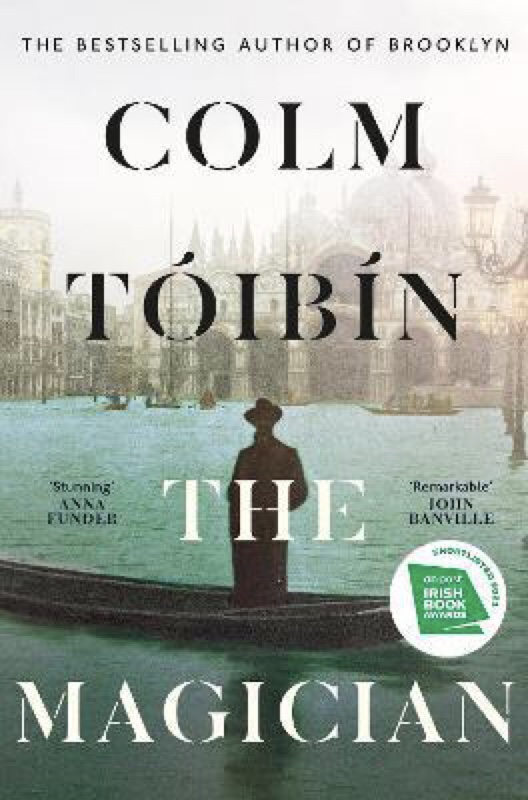
Pick a well-known historical figure, study up on him or her and major events of the era, then embellish and write a greatly expanded account of the life and times he or she lived-and remember to call it a work of fiction and not a biography. That is what the Irish novelist has done in this new rambling account of the globetrotting early twentieth century German writer/activist Thomas Mann, the 1929 literature Nobel prize winner, between 1891 and the early 1950s. It truly is fiction in that it is spiced up with trivial imagined interpersonal conflicts, long detailed conversations, travel plans that go wrong, encounters with other famous figures and endless secret or open sexual liaisons. The latter seem to lack much concern for the gender, age discrepancies, or marital status of the bodies providing the orifices or appendices deployed to satisfy their desires. Many pages are devoted to the imagined effects of what classical music had on Mann’s emotional state and writing.
In the first few chapters, Mann’s tentative and secretive introduction into the world of clandestine gay encounters are featured. In real life, this is also a feature in his novels as well, probably both reflecting the early life experiences of the gay Irish author. It was an era when gay men and lesbians often married for the sake of public appearances and acceptance.
A constant parade of prominent writers, artists, musicians, politicians, and academics including, in no particular order, Christopher Isherwood, W.H. Auden, Bertolt Brecht, Albert Einstein, Richard Wagner, Gustav Mahler, Arnold Schoenberg, and Eleanor and Franklin Roosevelt are included as they interact with Thomas Mann and his dysfunctional family, including his part-Jewish wife, Katia, and their six children scattered around the world.
The diverse characters can be difficult to keep straight as there are three Klaus’s, and several generations of Mann’s relatives on four continents. Mann’s cowardly failure to denounce Hitler early on for purely mercenary reasons (to facilitate sales of his books in Germany) is balanced by his latter leading role as a vocal anti-Nazi activist once he was safely ensconced in the United States. But his late return to Europe in 1950 and a life of luxury in Switzerland hint at the limits of his willingness to sacrifice for moral principles.
I have read enough novels with writers as the main character to be tired of that scene and this one extends that sequence even further as a gay writer writes about a gay writer, who writes about fictional gay writers.
Although the writing is as smooth as silk and the characters are portrayed realistically, I did not enjoy this story nearly as much as the only other Toibin novel I have read, Nora Webster.
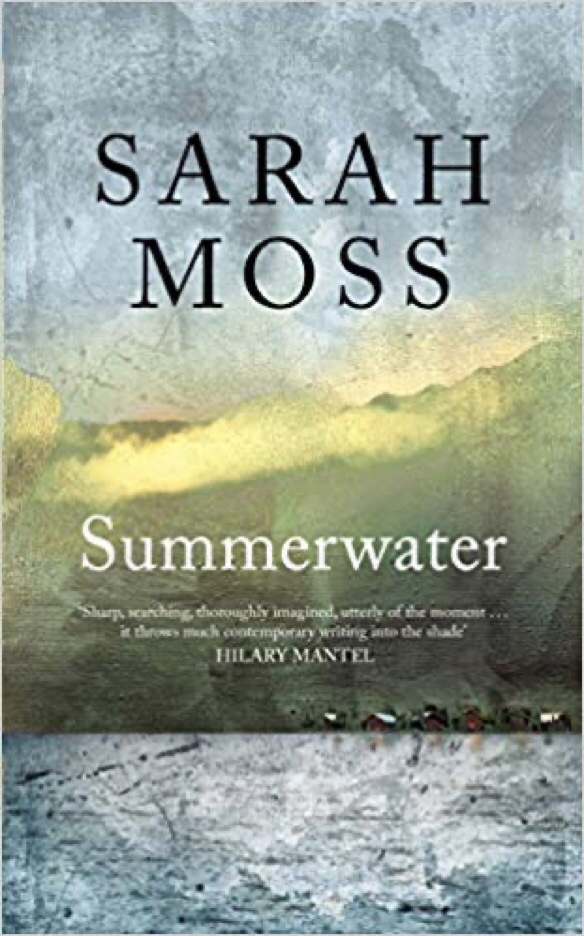
This lilting poetic novel by a young Scottish writer lacks any consistent plot but makes up for it with the sometimes humorous, and sometimes profoundly deep reflections of the diverse interesting characters. They are thrown together in cottages on the edge of a Loch that may be Loc Ness or Loch Lomond on an unusually cold and rainy summer sometime in the recent past. All of them seem to be deeply disappointed by the situations they find themselves in. Even the deer, bats, and fish are disturbed by a loud nocturnal boisterous party at one of the cottages.
The title is apparently derived from an obscure dark and forlorn poem by Scottish poet Sarah Bridgin.
I may be beginning to sound like a puritan prude, but there is far more obscenity and foul language than needed, and that must turn some readers off and, at the very least, cause some adult teachers to keep it away from their young precocious readers. She observes that “The Scottish sky is better at obscenity than any human voice.” and then seems to try to outdo even the Scottish sky. One couple take ten pages to tell readers, in great detail, about how they have worked hard (forgive the pun) together to synchronize their orgasms.
Another great quote among many: “… getting married is like voting in that whatever you choose, the outcome will be at best mildly unsatisfactory four years down the line.”
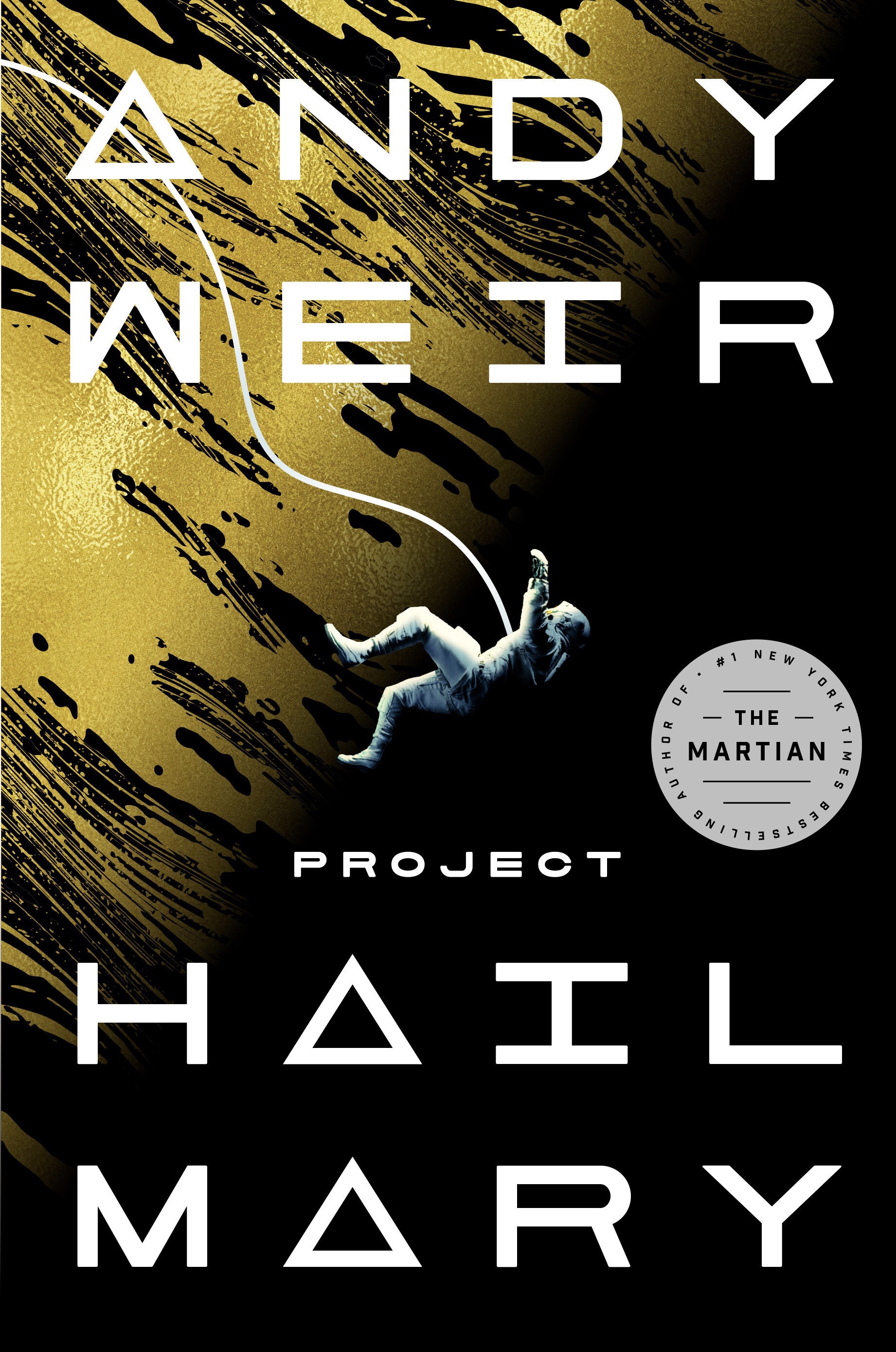
I seldom read any science fiction, but recognizing that much of what would fit into that genre 30 or 40 years ago is now phenomena that we take for granted, (think of Google searches or IVF), I decided to have a go at this one recommended by a friend.
The protagonist, Ryland Grace a British middle school science teacher, comes out of a coma in a space ship named Hail Mary in some foreign solar system. A mysterious set of microorganisms called astrophage (never written in the plural) are eating solar energy at an astronomical rate causing the sun to cool rapidly, endangering not just life on earth, but the existence of the planet. In alternating first person singular narrative sections he is either on earth in captivity undergoing compulsory training or on the Hail Mary space ship on a one-way trip to Tau ceti to determine why it seems immune to infection with astrophage. He alone survives the trip but meets a peculiar spaceship from 40-Eridani with an intelligent five-armed sole pilot that he painstakingly learns to communicate with, using only musical notes without lyrics, and navigating by echolocation. As their friendship deepens, they realize that they are both on the same mission, i.e to save their home planets from complete destruction by the astrophage.
There is a lot of hocus pocus “science” which is the hallmark of science fiction, and the plot with encounters with alien life forms and grandiose themes of saving humankind from certain annihilation must have some broad appeal. In this one the plot is rather ingenious with lots of unpredictable twists and also incorporates many principles of relativity, true science, time warps, and the theory of panspermia to account for the evolution of life on multiple planets.
Much of the science is beyond my ability to understand (even the mechanics of Foucault’s pendulum and Fortran data conversion) or to refute, but some basic impossibilities stand out. For example, Ryland is able to carry on a long conversation even with an endotracheal tube in his trachea.
There are some great insights such as “Broadly speaking, the human brain is a collection of software hacks compiled into a single, somehow-functional unit. Each “feature” was added as a random mutation that solved some specific problem to increase our odds of survival.”
My limited capacity to suspend belief in the possible makes it difficult for me to enjoy this tale, even though I admire the expansive imagination of the author.
Having renewed and reaffirmed my dislike for the sci-fi genre with this read, I will avoid it for my remaining years without feeling guilty.
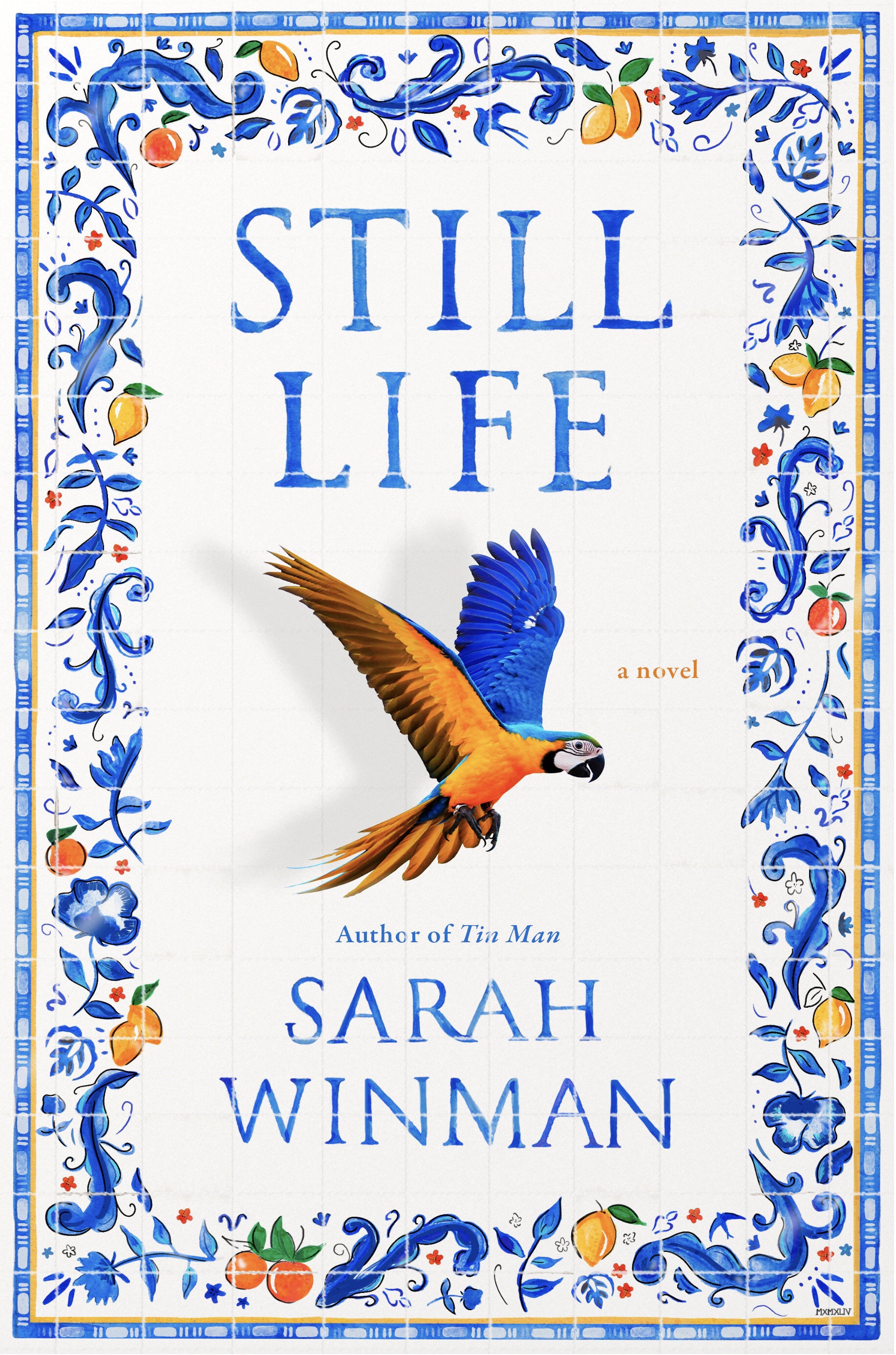
This new rambling incoherent novel by a British author alternates scenes between London and Florence and between the liberation of the latter by the Allies in the Second World War and the early 21st century. It does provide readers with a detailed knowledge of the geography, history and culture of Florence.
Much of the focus is on hundreds of painters, sculptors and museums as interpreted by a knowledgeable British art historian who spends much of her time in Florence seeking to find art lost in the Tuscan hills during the war, and an eclectic group of English itinerant visitors, some of whom settle in Florence. There are endless discussions of hundreds of artists that I had never heard of and of their works. Amateurish spontaneously generated forgettable poetry is spouted by boozy would-be poets. Interspersed Italian words and phrases had me frequently looking up their meanings.
In places the narrative borders on magic realism as a parrot with an extensive and foul (forgive the pun) language dispenses advice, and quotes Shakespeare. One character talks to trees and gets advice from them.
Many of the characters are aspiring artists themselves and there is an over abundance of lesbians and gay men, even considering the known over representation of those in the creative artistic world. One elderly nymphomaniac couples with anyone she can still seduce. The sexual exploits are described in unnecessary detail -there is a lot to be said for leaving something to the reader’s imagination- and foul language prevails not only in the parrot’s talk but in the narrative of the characters who might be expected to have a limited vocabulary and in that of the author whose vocabulary one should think need not include vulgarity. The author seems to regard quotation marks as unnecessary grammatical nuisances and their absence makes the narrative of the characters difficult to distinguish from that of the author.
There is a distinct undercurrent of early feminism and societal acceptance of lesbianism. A perceptive nine year old girl asks why all the Florentine statues are of men.
There are many loose ends left dangling. I doubt that I am the only reader who waited in vain for some explanation of who the dead body buried on top of another body in a park by the boozy clients frequenting an East London pub in the 1950s was, or why he was killed and by whom.
There are a few interesting philosophical quotes:
“ A meager stain in the corridors of history, that’s all we are.”
“All artists are tortured by all they’re not, and by art that’s not theirs.”
I have no accurate estimate of the length of this novel as the Cloud Library book I downloaded has very unreliable pagination, but it must be over 550 pages judging solely by how long I took to struggle through it.
In spite of laudatory online reviews by others, I cannot recommend this novel for anyone except perhaps dedicated Renaissance art enthusiasts or art historians.
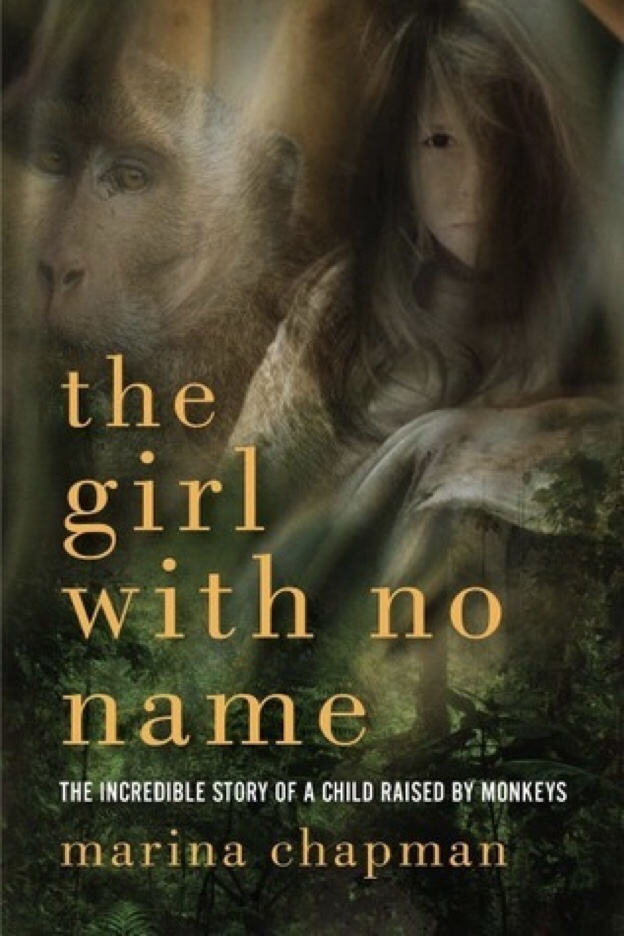
Although written in the first person singular voice of the girl, the note of the ghostwriter Lynne Barrett-Lee, makes it clear that most of the material came from copious notes scribbled by Chapman’s daughter Vanessa during endless hours of mother-daughter interviews. Lynne Barrett-Lee, to her credit, has converted it into the easy conversational prose of the teen narrator.
Sometime shortly before her fifth birthday, in the early 1950s, a girl was abducted from her home somewhere in rural Columbia or possibly northern Venezuela and, drugged and blindfolded, dumped in the jungle. No one came to rescue her but she survived, learning from a colony of monkeys that gradually befriended her. She also learned to communicate with them, and grew to think of herself as one of them. When she made contact with humans again, probably at least five years later, she had no name, no clothes, no language skills except body language, no sense of how old she was or how long she had lived in the jungle and almost no memory of her previous life as a human. She then went through a series of horrific experiences as a slave labourer locked in a brothel, then in a criminal gang house, and later still in a convent in the city of Cucuta. In between these stints she lived as an accomplished homeless street thief in that city. When the kindly neighbourhood woman who had delivered her to the convent continued to show affection for her after her escape, realizing the danger she was in and showing her the only affection she had any memory of except for that of the monkeys, they arranged together to get her to a safe family home in faraway Bogotá. This is where the story ends, but there are hints that a sequel will document her life from there to her present life as a Bradford, England housewife and mother of two.
This is by far the weirdest, most unlikely autobiography that I have ever read. It is so bizarre that some British so-called experts have claimed that it is a work of fiction rather than a true life story. But for me the details are so convincing that it seems even more unlikely that anyone could have imagined the developments she relates happening, though there may well be some faulty memories, the plague of all memoirs, and some embellishments woven in. And even if it were fiction, it would still be a helluva novel. But if anyone doubts the authenticity of the story, the matter-of fact interviews the very unassuming Chapman and her daughter give on Youtube should satisfy you that the basic facts are true. Still unconvinced? Watch the video of her as a an old woman gleefully, speedily, and seemingly effortlessly, like a monkey, climbing to the very top of the forest canopy, a feat no trained arborist would ever try.
I find it hard to believe that any sequel documenting Chapman’s later life or the 2014 TV film (I couldn’t find it) could possibly be as mesmerizing as this debut gem.
This is the first of now more than 20 international spy novels by a Memphis writer, some of them with Tom Clancy, and it is now a film on Netflix with Ryan Gosling and Billy Bob Thornton, released in Feb. 2022.
The young Gray Man hero of the title is a former CIA agent who then branches out on his own as an assassin-for-hire to do whatever dirty work anyone will pay him to do, whether it is to off politicians or to silence those about to expose corrupt acts of corporate bigwigs and government agents.
By a third of the way in, I found myself unrealistically hoping someone would succeed in killing him off early so I would not have another 250 pages to read. After 200 pages, I had had enough and finished him off myself by stopping reading about him (in spite of being given the book as a gift). I’ll admit to some curiosity at that point about how much sillier the story could get so I scanned through the remaining pages only to find more of the same senseless cruelty, and violence. The Gray Man’s feats in escaping capture by equally unscrupulous government and corporate security forces are unrealistic to the point of being silly. Dozens of killer squads from around the world with endless supplies of various lethal guns and grenades cross international borders unimpeded. The tight time lines of his many narrow escapes are features of numerous thriller novels, designed to build tension in readers to keep them engaged, but here they are particularly weak and transparent.
I realize that many readers enjoy this James Bond-ish flavour of fiction just as many enjoy unrealistic murder mysteries on TV or streaming services, but the only way I could get as far as I did with this one was to consider it as a spoof of the whole spy thriller genre. I generally avoid novels that turn violent villains into heroes, unless it is realistic historical fiction. There is enough violence and cruelty to deal with in the real world aftermath of history and present day world events to never have to expand it into the fantasy world of fiction.
Pursuing somewhat similar lines of research as that which Suzanne Simard details in her Finding the Mother Tree but in different ecosystems around the world, this British mycologist provides a masterpiece of science that is bound to change the way you think about fungi and a lot of other things. It shines a wider light and more global perspective on them, ourselves, and all living matter rather than the sharp focus on their relationship to trees in Finding the Mother Tree.
Wide-ranging is too narrow a description of topics Sheldrake covers. From our philosophical definitions of the self, consciousness, brains, thinking, decision-making, bargaining, and intelligence, and the dualism of mind and body, he challenges readers to reconsider what they believe. Lichens composed of interdependent fungi, algae and some bacteria and even viruses invite reconsideration of the definition of a species and the boundaries of the self.
The list of astounding abilities of fungi cited is long. Here are a few. Kerosene fungi thrive in the fuel tanks of airplanes! Fungi are being used commercially to manufacture leather, furniture, clothing, packing and building materials stronger than concrete, from dead wood that otherwise would rot and emit carbon dioxide. Antiviral and antibiotic compounds manufactured by fungi include penicillin and are used to kill the virus largely responsible for bee colony collapse disorder. Many fungi can alter their metabolism to break down toxins we send into our environment, including plastics, cigarette butts, petroleum products, pesticides, and herbicides like glyphosate (Roundup). They appear to bargain and negotiate with plants in what by analogy looks like buying and selling on a stock exchange. They may have been involved in the origin of life on earth via panspermia of spores from other planets. Some destroy the back half of cicadas, infect the remaining body and drop spores as the cicadas continue to fly around. They have systems of electrical signalling that somewhat resemble brain messaging. By producing alcohol and the universally available hallucinogen psilocybin they can kill or control the behaviour of insects and historically have altered human history and cultures. These are just a few of the surprising facts presented. Yet most people think of fungi only as mushrooms from grocery stores, as nuisances that spring up overnight on the lawn, or as the agents for domesticated decomposition of sugars for making alcohol, bread and cheese and the rotting of wood structures, if they think of them at all.
“Imagine the puzzlement of an extraterrestrial anthropologist who discovered after decades of studying modern humanity that we had something called the Internet. Its a bit like that for modern ecologists.”
Sheldrake cites another astonishing finding that is discussed in relation to the navigational abilities of fungi. Flatworms who have learned to navigate a maze, but have then had their heads severed regrow a new head and can still “remember” how to navigate the maze. He asks more questions about fungi than he answers, but his infectious enthusiasm for learning more about them will rub off on the reader of this book. He seems to recognize the boundaries of our linguistic descriptions in characterizing their complexity.
Charles Darwin is quoted as defining intelligence as the ability to adapt to the environment so as to ensure survival. By this perhaps flawed definition, Homo sapiens is a far less intelligent species than most fungi.
I have only one minor criticism although I may well have missed other problems. He cites the discredited Canadian psychiatrist Abram Hoffer as one of many experts he relies on for information, but I am not sure if the information attributed to him is problematic or not.
The only reservation I have in recommending this eye-opening book for everyone is that it may be a bit of a struggle for some with no background science education, but if so, it would still be a worthwhile struggle. I rate it as one of the best science treatises I have ever read, if not the absolute best.
My daughter generously sends me a couple books every month from an online subscription site called Cratejoy. They have a great variety of products from clothing, food baskets, and kitchen gadgets, to tools and craft hobby kits. I gather that you can subscribe for variable time periods and have the products sent to anyone. I have no idea who decides what books I get or what criteria are used in selecting them so it is always a surprise when they arrive. But they are never recent publications by famous authors so I suspect that they are chosen from a list of discounted books that publishers want to clear from their overstocked warehouses. In recent years publishing houses have moved to an on-demand business model, reducing the need for warehousing space, but older books still take up shelf space. I think she just sends them a list of book genres that she knows I like. This interesting arrangement exposes me to cultures and books that I would otherwise never look twice at and I appreciate that. This scholarly erudite history from an American anthropologist arrived along with a similar vintage fictional international spy espionage thriller.
More than a little laudatory about the early thirteenth century Mongolian warrior and his conquest of vast areas of the world, there is far more detail about the man and the primitive tribal culture of the time than most readers would ever want or need to know. At one point his descendants ruled an area larger than North America and western Europe combined, stretching from Moscow to near Vienna to the Arab peninsula and most of East Asia and China. It is perhaps appropriate to praise his brilliant and innovative military tactics, his treatment of vassals, levelling of hierarchies, and his tolerance of divergent often primitive religious practices including Buddism, Hinduism, Taoism, Judaism, Muslimism, and Christianity. One such strange practice was the peculiar divination practice was scapulancy in which divine guidance was provided by “reading” the shoulder bones of sheep. It is harder from this distance in time to appreciate the culture of endless tribal plundering and slaughter. Women were treated as little more than slaves, sex toys used for bargaining, and the source of offspring, although in later generations, women became placeholder regents of the homeland while the men fought and plundered on distant frontiers.
I got totally confused in the middle chapters in which his sons and grandsons with unfamiliar names cruelly raided ever greater areas with equally unfamiliar names, killing thousands of the natives in cruel ways. Despite feuding with each other over the title of Great Khan, they did maintain some of the old man’s positive innovations such as instituting widespread use of paper money to facilitate commerce, and universal primary education for all children. And the most famous grandson Khubilai Khan, immortalized by Samuel Taylor Coleridge’s poem as Khubla Khan, conquered most of China, Tibet, Vietnam and Korea, but was inept at sea and failed to take Japan. He is also described as fat, gouty, and self-indulgent, with long episodes of drunken debauchery. All of the Khans were prone to this vice usually drinking fermented mare’s milk to celebrate their conquests and some added hashish and opium from their loot in Afghanistan. Although the Mongolian Empire survived for another century after Khubilai Khan’s death, it ceased to expand and depended increasingly on peaceful coexistence and international trade with its neighbours. It gradually shrank when the epidemic of the plague disrupted their trade routes and travel to loot, and the families split into murderous warring factions vying for the title of Great Khan.
In the last section, much of the basics for later western cultural development from astronomy, law, mathematics, architecture, finance, communications, agriculture, and even music is attributed to the Khans, perhaps with some dubious connections. Marco Polo, following in the footsteps of the Mongolian Empire, did much to capitalize on the groundwork in international commerce that the Khans had established, but is barely mentioned.
The details provided in this book can be overwhelming. I don’t really care that 1219 was the Year of The Dragon, 1221 the Year of The Horse or a dozen other “Year Of The…” designations. Although I admire the dedication and scholarship of the author, his attempts to make Genghis Khan into a hero are not entirely convincing, even if some rebalancing of the historical perspective is needed. There are bits of interesting history here, but I have trouble believing that anyone except perhaps occasional history professors or Mongolians keen on researching their past would enjoy this deep, dark, detailed and incredibly dry book.
This short, selective memoir by a middle-aged Connecticut novelist, teacher, and screenwriter is a collection of disconnected philosophical musings about her past life, marriages, travels, family life, and interactions with others, including several well-known entertainers and other writers. With no chapter divisions, it is divided into retrospective reflections mostly only one to four pages long.
There is nothing very profound here, but there is an abundance of quirky wise observations delivered in flowing conversational prose that is easy to read. As I read on, however, I was struck by the excessive nostalgia, self-analysis, doubts, and introspection that seems to a common feature of autobiographical writing of creative artistic types. This is the author’s fourth memoir, which speaks volumes about the emotional roller coasters that such literati apparently enjoy riding and sharing. Who in the twenty-first century keeps volumes of daily journals unless they expect to exploit them for commercial gain or in a vain solipsistic hope to be remembered forever?
One typical quote: “It may be that when we no longer know what to do that our real work begins and that when we no longer know which way to go that our real journey begins.” This one reminded me of one attributed to John Lennon: “Life is what happens while you are planning something else.”
The title of this long novel by the late Rodney William Whitaker (aka Trevanian) refers to an other-worldly tranquil mystic state of mind that defies accurate description in any language, something which some people experience temporarily and unpredictably. Nicholas Hel, a Russian/German stateless youth aspires to and experiences this ineffable state which he describes as like becoming one with the grass and the yellow sunlight, growing up in China at the end of WWI, then living in Japan during and after WWII. He eventually becomes an international pariah assassinator-for-hire and a champion GO player. GO strategies become a metaphor for life.
The unique combination of talents and insights that the polyglot (six languages) Nicholai Hel acquires seems totally unrealistic, if reflected upon, but is somehow made to seem quite possible and even natural. He teaches himself the Basque language in three years of solitary confinement, in Japan from a dictionary and a children’s book. He also develops a paranormal proximity sense to allow him to sense who or what is nearby without any other sensory input. But the Naked/Kill weapons made from everyday household items do seem a bit too gimmicky and Bond-ish. Many of the international dark schemes also have a distinctly Ian Fleming flavour with Nicholai Hel as a James Bond. Considered in one way, the whole story could be as a sendup of the James Bond genre or perhaps that of Robert Ludlum’s Jason Bourne series. Hel even treats sex with his numerous lovers as a competition of wills to see who can hold off orgasm the longest.
The graphic description of postwar deprivation, starvation, and desperation in Japan along with unique perspectives on the superficial and snobbish attitudes of the occupying forces which totally lack any elements of this oriental Shibumi are written in beautiful insightful prose.The description of the horrors of the American carpet bombing of residential areas of Tokyo is unmatched by any pacifist rant and not likely to be included in most western history texts.
The description of the complex world of underground terrorist groups with flexible loyalties made me go back and check a few times to determine who was working for whom. The overriding control of groups and governments seems to lie with The Mother Country, allegedly part of the CIA, but in fact controlled by OPEC. No politicians are discussed by name, but the intrigue includes the Palestinian-backed Black Septembrist’s assassination of Jewish athletes at the 1972 Munich Olympics, the PLO, the Camp David Accord, and earlier postwar conflicts between Russia, China and the U.S. in Japan. Above all, apparently deeply compromising documentation about the JFK assassination is the ace card held by Nicholai Hel as he blackmails the Mother Country people.
Hel seems to view almost all cultures except for the traditional Chinese and perhaps that of Basque revolutionaries as primitive and shallow and heaps scorn on American and most European and Russian world views.
There are many memorable quotes: “…he learned that, in diplomacy, the primary function of communication is to obscure meaning.”
Of a Russian prison guard in Japan: “He was sure this man was no common Russian soldier, despite his appearance of Slavic intellectual viscosity.”
I found the 65 pages of description of dangerous, technically demanding spelunking of Hel and a flamboyant, uninhibited, lewd Basque separatist poet near the Spanish/French border very confusing and unrealistic.
The author uses the techniques of time shift and of geographic shifts around the world from the post-WWII orient to the 1970s Europe and America to great effect in bringing convergence and unity to the story. The description of powerful computers that keep track of everyone and everything with no allowance for privacy is prescient, considering that the book was published in 1979.
This is not my favourite genre of fiction, but the very inventive prose and unique insights kept me engaged if not riveted to the end. 3.5 stars.
Set in lawless Manhattan in 1845, shortly after a fire destroyed much of the lower island, this is a carefully researched thriller/murder mystery by a native New Yorker. A cadre of untrained and corrupt rogues is recruited as New York’s first police force. They have poorly defined job descriptions and little oversight, amidst the influx thousands of starving Irish during the potato famine. A 10 year old street vagabond tells the narrator, the newly-minted cop, Timothy Wilde, endless lies about why she was covered in blood when he found her. Multiple murders, dark political intrigue involving the Boss Tweed/Tammany Hall Democratic machinations, brothel owners, child prostitutes, narcotic addicts and animosities between Protestants and drunken Irish Catholic immigrants complicate the very complex plot.
The twisted period dialect and lingo in short meaningless conversations between too many characters to keep track of makes the going difficult for most of the story. Strange names such as Deadeye, Fang, Ninepin, Matchbox, Hammer, Zelenograd the Rat, Bird, Silkie Marsh, Valentine, Moses Dainty, and Hopsrill abound.Young do-gooder Mercy Underhill does not seem to fit in with the other debauched characters until her dark side is exposed in Chapter 21 of 27.
There are some notable quotes. “Riots are farmed, and when they bloom, the farmers get to smash their fists into an entire city.”
“For God to make something young and perfect and then crush him. Why go to the trouble? Stupid people imagine God thinks like they do….but I cannot believe that God is stupid.”
The absence of any virtues in any of the devious lying characters, even the clergymen, seems unrealistic. Many injuries in street brawls that should be fatal appear to never impede the characters’ ability to continue fighting. The bodily reactions to various emotions, except possibly for facial expressions, defy anatomical or physiological explanations.
As in many tales in this genre, oblique hints and false leads will confuse readers until late in the story when the most unlikely characters are revealed as the the mysterious child murderers.
This is the first of three novels featuring Timothy Wilde, clearly modelled after Sherlock Holmes. I have not read any of the sequels, but I can predict that Mercy Underhill will return to New York and hook up with Timothy Wilde in one of them.
Fans of this genre will enjoy this tale. Me, not enough to read the others in the series. Two stars.
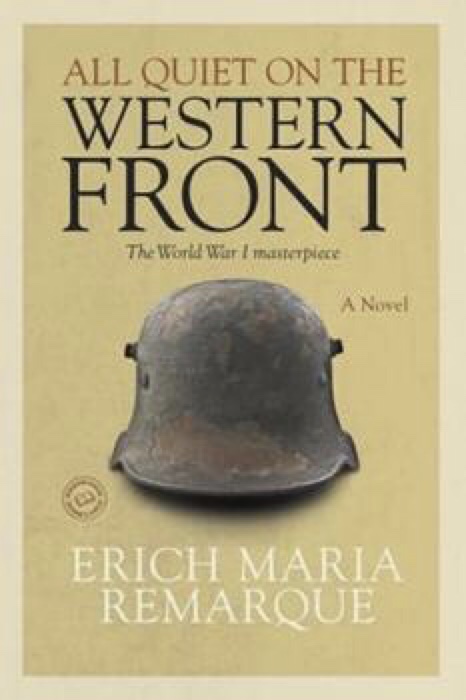
I would never have read this novel were it not to be discussed at our book club next month. Narrated in the first person singular by a fictional 18 year old German recruit, it is set on the front line at an unspecified site somewhere in France in 1917-18, as the Allies were slowly overpowering the German forces. It seems, in part, to be based on the author’s real-life experiences in those trenches where he was wounded in 1917.
There is heart-wrenching pathos as the narrator tries to console his comrade, the dying Franz Kemmerich with what they both know to be lies. Discussions of battles with rats and lice and the disadvantages of killing the enemy with bayonets vs spades only covey a small part of the horrors of war. One after another of his compatriots dies a horrible death from wounds, infections or exposure, while almost starving and dreaming of going home and courting girls.
On leave, the narrator discovers that his mother is bedridden with cancer and that he will never see her again after he returns to the front. The observation, first attributed to Aeschylus that “In war, the first casualty is the truth” is borne out in many places, most notably when the narrator swears to the mother of one of his fallen comrades that her son died instantly and painlessly. The observations made by many that surviving soldiers can never discuss with civilians the horrors they have seen and experienced in battle holds true here as the lies about the conditions at the front pile up. Perhaps the biggest lie of all is the German high command report late in the war that the title is based on.
Some of the reflections about war revealed in the narrator’s musings about captured enemy soldiers are truly profound: “A word of command has made these silent figures into our enemies. A word of command might make them into our friends. At some table some person whom none of us knows signs a document and then for years together that very crime on which the world’s most severe condemnation and severest penalty falls, becomes our highest aim….Any noncommissioned officer is more of an enemy to a recruit, any schoolmaster to a student, than they are to us. And yet we would shoot at them again and they at us if they were free.”
The writing flows smoothly in short pithy sentences and phrases. Although written from a German perspective, the narrative is not biased and is loaded with universal truths. Even though the descriptions of the horrors of war are the most graphic of any that I have ever read, I found the story magnetically engaging and enjoyed reading it. I will long remember it. But I have no desire to see the movie adaptation of 1930 or the TV one of 1979.
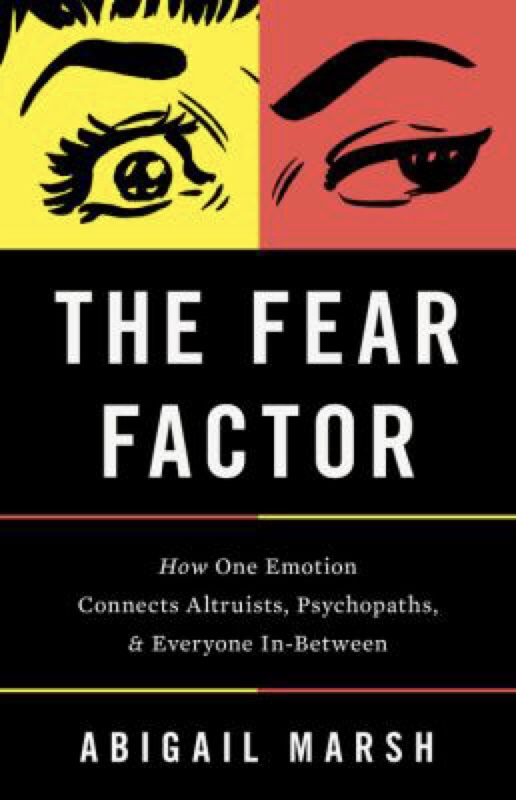
I have long been interested in neuroscience, so when my dear friend and former colleague at Western, Al Driedger, posted an article about mirror neurones, those clusters of brain tissue that facilitate development of empathy, at least in humans and bonobos, on his Brianworms site, which covers anything and everything scientific, Iasked him if he knew of any studies of them in psychopaths. He referred me to this book by a Georgetown professor of psychology and neuroscience.
After personally experiencing both acts of incredible altruism and of satanic cruelty at the hands of complete strangers, she switched her studies as an undergraduate in medicine to the world of psychology to research these extremes of human behaviour. She reviews ad nauseum the familiar problematic studies of Stanley Milgram at Yale and Philip Zimbaldi at Stanford demonstrating the ease of inducing cruel behaviour in some but not all normal volunteers in experimental situations given some incentives and authorization (and authority in the form of a uniform in the later case). We did not need these studies as real world examples such the unapologetic defence raised by Adolf Eichman at his Jerusalem trial already existed. It is a tribute to the increased oversight by Institutional Review Boards now that no such questionable studies would now be allowed on any campus in Western Europe or North America. Yet such cruelties, and worse, persist with the help of seemingly unsupervised government agencies such as the CIA.
In later reflections on theses and other studies, however, Marsh points out that unlike Eichman, many participants in these studies expressed anxiety and remorse about the doling out of what they thought was torture to strangers. Many volunteers distressed by watching others being tortured even volunteered to take their place. Thus, sadism and altruism are shown to both be alive and well. Generic and environmental factors influencing where people fall in this spectrum are then explored with a review of twin and adoption studies. Distinctions are made between psychopathy and psychosis, and reactive aggression and proactive aggression, the latter being characteristic of psychopaths and much more determined by genetic influences.
After reviewing the arbitrary, often-changing and subjective points-based DSM criteria that are nevertheless necessary for researching psychopathy and for developing research and treatment guidelines, she moves on to the studies showing that teens with psychopathic tendencies lack the ability to experience fear or identify it in others. This is associated with distinctly smaller and less metabolically active deep brain structures called amygdalae that may be the site of those mirror neutrons, on functional magnetic resonance imaging, although she never mentions ‘mirror neurones’ as such. Thus my question to Al was partially answered. And these anatomical abnormalities in turn are largely genetically determined, and not just correlated with psychopathic behaviour, but appear to be causative in that they are absent in those reactive violence-prone sensitive individuals who nevertheless experience fear, identify it in others, and express remorse and guilt.
I seemed to attract psychopaths in my professional past. I vividly recall one very charming rogue who had the courtesy to call to cancel his upcoming appointment without rebooking, only to hear his name the next day in the news-a Canada-wide warrant had been issued for his arrest, for attempted murder if I recall correctly.
The author devotes 30 pages to review the evolution of mothering care and alloparenting with the species variability from loggerhead turtles with no maternal behavior whatsoever to some mammalian species with maternal behaviour only for their biologic progeny (sheep) to rats with maternal care for other rat’s offspring, to dogs who adopt and fiercely protect babies of other species, to humans like the author who care deeply about even abandoned baby turtles on a Florida beach. I was reminded of my summer of care and feeding of a young Great Horned owlet that my brother and I had unintentionally scared out of the nest, raising her, feeding her and giving her aviation lessons from greater and greater heights until she took off from the peak of the barn roof, over the horizon, never to be seen again, leaving us saddened.
Evolution and multiple unique functions of oxytocin in modulating behaviour in mammals and the differences in altruistic anonymous kidney donors’ and psychopaths’ brain anatomy and physiology come next. The dedicated altruists, acting on instinctive compassion are shown to have larger and more metabolically active right amygdalae than average. What goes on in the left amygdalae?
The last two chapters largely forsake the detailed scientific brain imaging and chemistry studies doled out earlier to discuss and recommend possible ways of increasing individual and group altruism- no less interesting and with great insights, but more nebulous. She quotes two of my favourite writers and thinkers in this section-Stephen Pinker of The Better Angles of our Nature, and the Australian philosopher Peter Singer.
This is a fascinating well-organized and informative book that I greatly enjoyed reading.






 The Passionate Reader