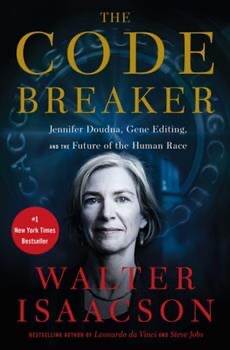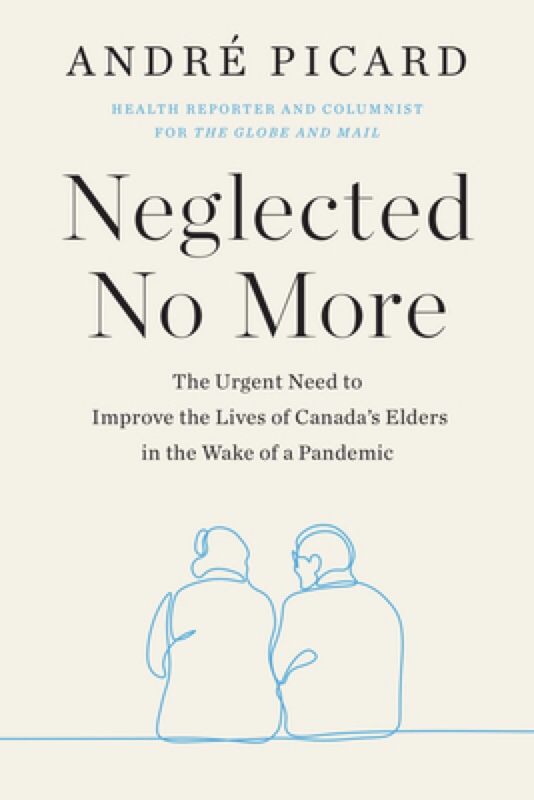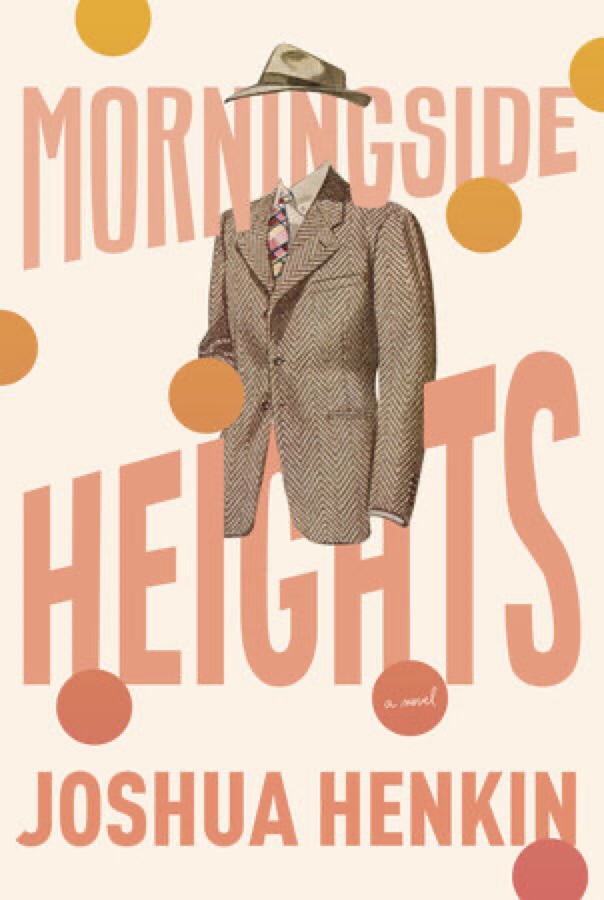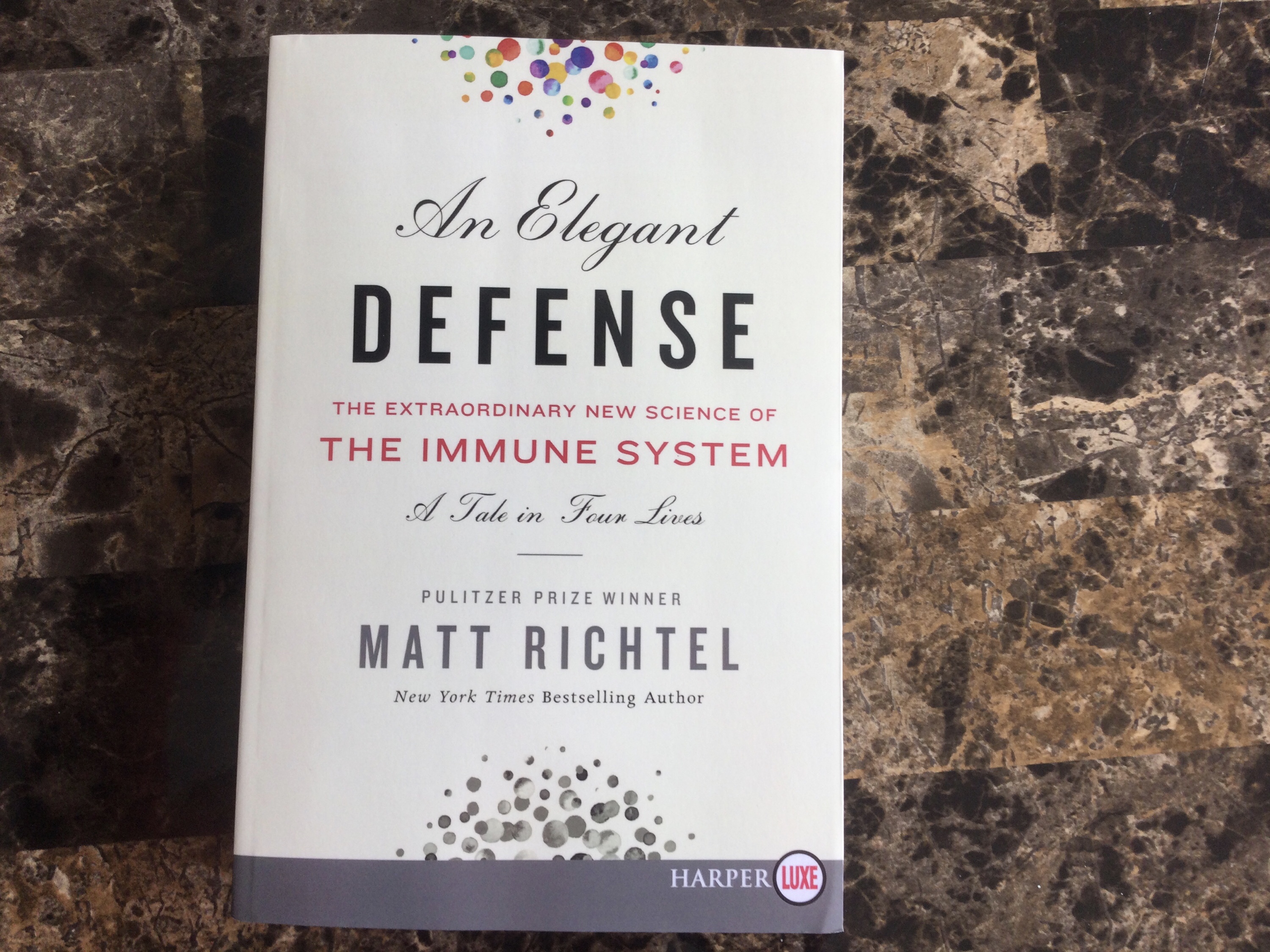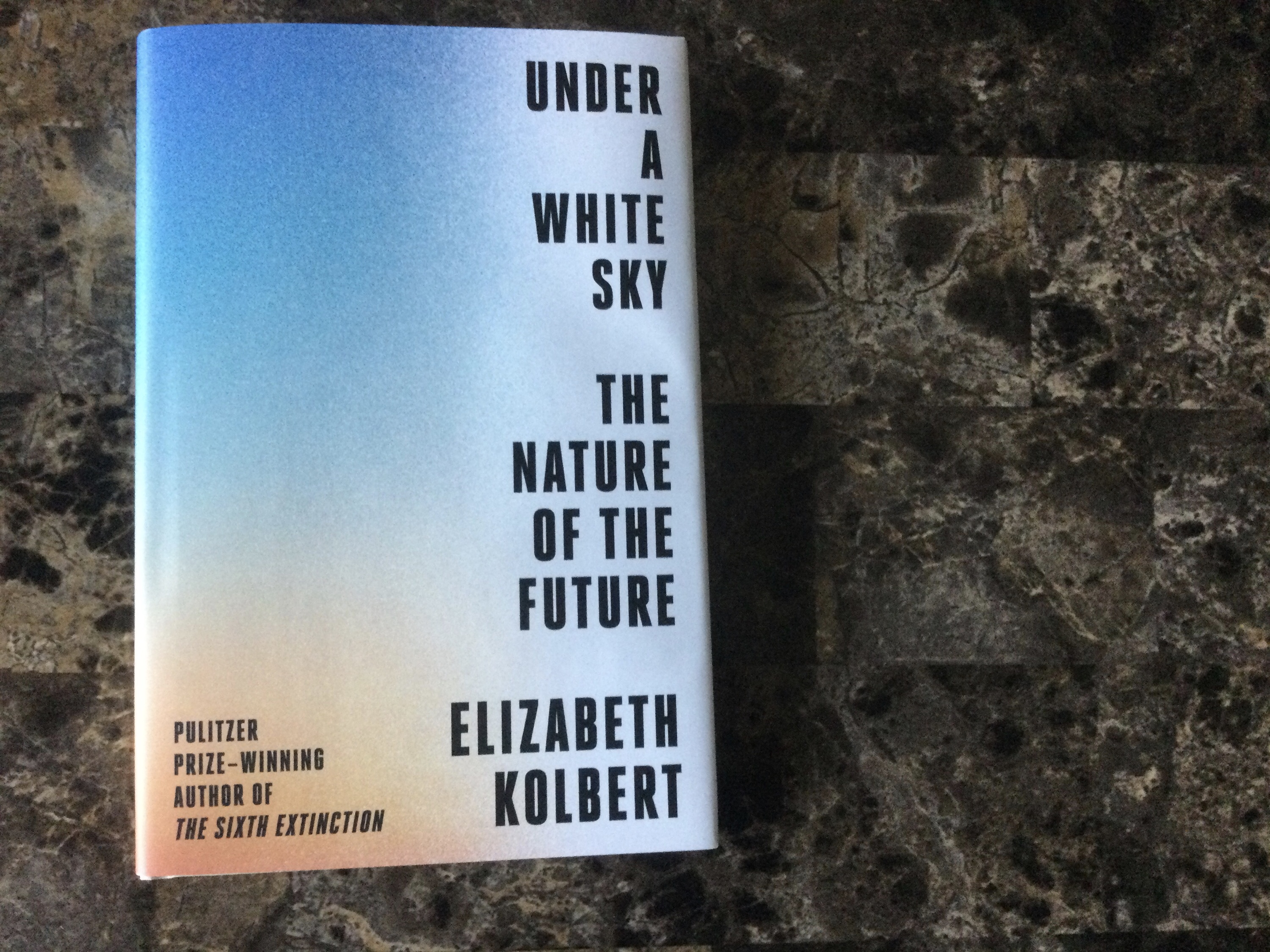
Under A White Sky. The Nature of the Future. Elizabeth Kolbert. 2021. 201 pages.

This is, as the New Yorker staff writer author says, “a book about people trying to solve problems that people trying to solve problems have created.”

From the unintended disastrous consequences of reversing the flow of the polluted Chicago River, the ever-increasing costly efforts to save New Orleans and the Mississippi delta from inundation, the futile efforts to save the Devil’s Hole pupfish, the importation of predators to deal with unwanted imported predators, and the genetic engineering attempts to preserve coral reefs, humankind’s well-intentioned undertakings to interfere with natural processes have been fraught with unforeseen worse consequences.

Yet, in the current situation with the human-made crisis of climate warming, not intervening in nature in any way is not an option if Homo sapiens is to survive on this planet, having already created a potentially lethal situation. Kolbert globe-trots to interview scientists who are proposing or instituting a wide variety of possible methods to mitigate this pending disaster, including those working on carbon capture and storage, geo-engineering of the atmosphere, (thereby creating the white sky of the title) and solar engineering. Along the way a wealth of information and widely divergent perspectives are discussed.

The wring is in the typical NewYorker straightforward informative style I have come to expect from their writers. At first I was a bit disappointed that Kolbert never takes a stand on any of the conflicting possible courses of action. But, on reflection, as a journalist with no formal training in sciences, she is probably wise to avoid endorsing any one proposed course of action, just laying out the possibilities and strongly implying that no one solution will by itself be adequate. Yet she strongly suggests that some tech-heavy proposals will likely worsen the damage we have already caused; in particular, the case for abandoning New Orleans and relocating everyone from the Mississippi delta over a few decades and leaving it to nature’s remodelling seems compelling, irrespective of the high short term costs.

This is a very well written informative but somewhat disturbing assessment of the current challenges we all face, that can be read as bleak or upbeat, depending on your mood.

Thanks,

Andra.

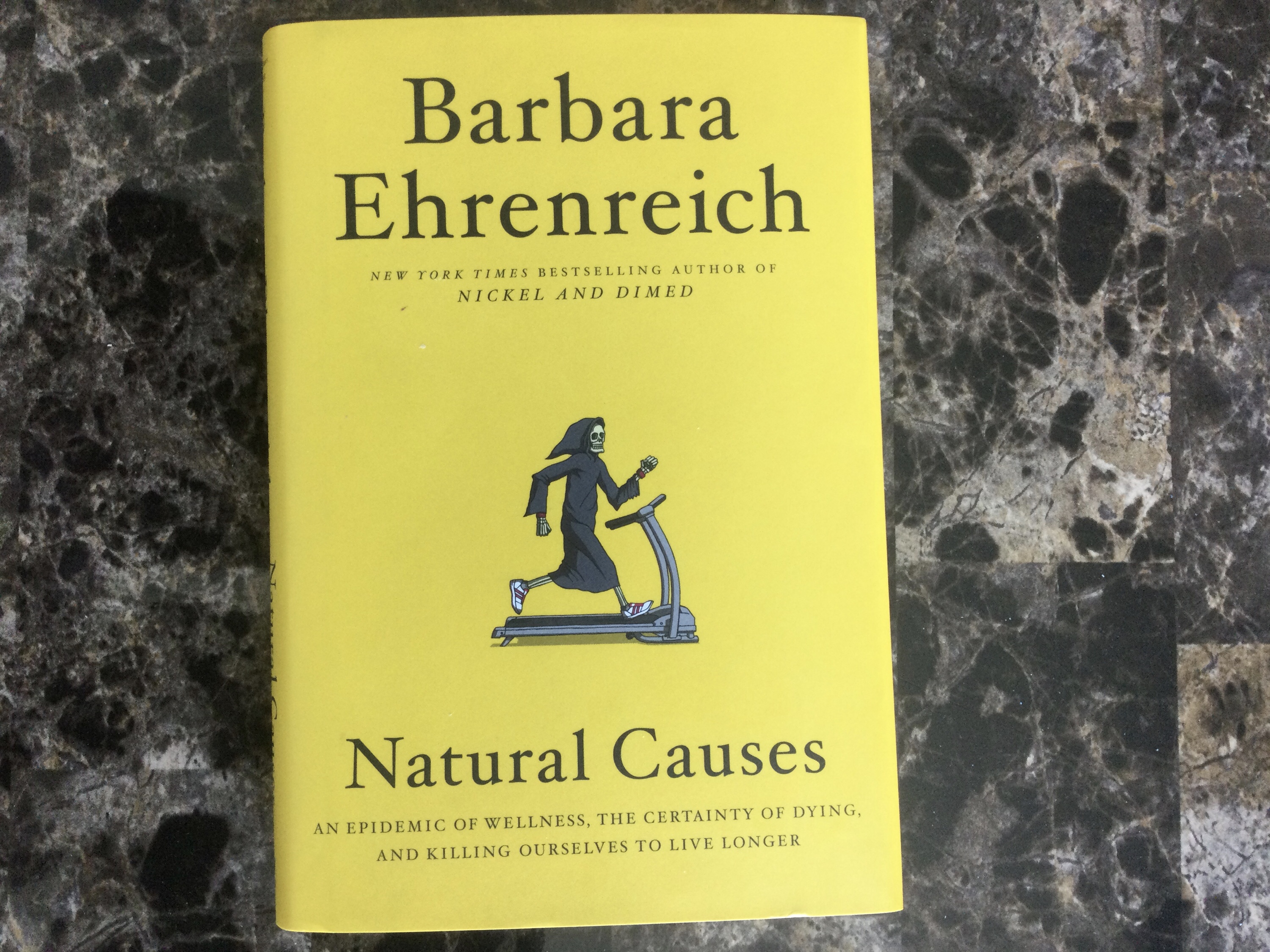
Natural Causes. Barbara Ehrenreich. 2018. 217 pages.

I discovered this book of wide-ranging reflections about life on our bookshelf recently and have no idea how it got there -did I buy it and then forget it, or was it an unacknowledged gift?

The Virginia-based cell biologist, socialist, social critic, and prolific writer, of my vintage provides a delicious dose of uncommonly well-thought-out common sense with a kind of skeptical or even cynical analysis of many trends in modern western culture, sciences, and even philosophy. The roots of the ritualistic modern medicine physical examination are compared with those of perhaps equally beneficial rites of tribal shamans and witch doctors. I feel obliged here to reveal one trade secret – I often did ophthalmoscopic examinations, not because I suspected any eye problems, but because it facilitated surreptitiously getting close enough to sniff the patient’s breath for alcohol or fetor hepaticus, the telltale odour betraying the presence of severe liver disease.

Her scorn for routine health examinations and screening for a variety of illnesses, including many cancers, echos that of Dr. Gilbert Welsh in Overdiagnosed and Less Medicine, More Health, and some of the concerns expressed in my Medicine Outside The Box. But her keen exposure and dissection of trends of questionable value extends to fads in fitness routines, diets, brain exercises, yoga, mindfulness and meditation routines.

Ehrenreich’s background in cell biology leads naturally into later discussion of the functions of various cell types, most notably those of the immune system, but this never gets bogged down in medicalese. The conundrum of immune system cells within us that go rogue and assist cancer cells to grow and spread raises all sorts of issues about agency, the independence of parts of us from other parts, intentionality, etc, and the philosophical debates about free will. Attributing free will to all matter down to the level of subatomic particles seems preposterous, but Ehrenreich makes the case for it convincingly. However, after considering this, it seems to me that this degenerates into a reductio ad absurdum, since molecules moved by writing or speaking this assertion would then be capable of denying it.

Later chapters delve even deeper into philosophical matters as she discusses meaning in life and death, our connections to other creatures and matter, and the nature of self. One great quote: “…with the introduction of ‘self-knowledge’ and ‘self-love’ one enters an endless hall of mirrors. How can that self be known to the self? And who is doing the knowing?”

The book is organized logically and the writing is unerringly interesting with startling metaphors and analogies, and not excessively technical. I only found one very minor possible error. Jeanne Louise Calment is cited as having set a longevity record, in spite of being a sedentary lifelong smoker, dying at age 122. But much later evidence strongly suggests that she died at age 59 with her daughter assuming her identity thereafter to avoid taxes and then dying at age 99.

This is an engaging and informative good read with unique perspectives. Four stars.

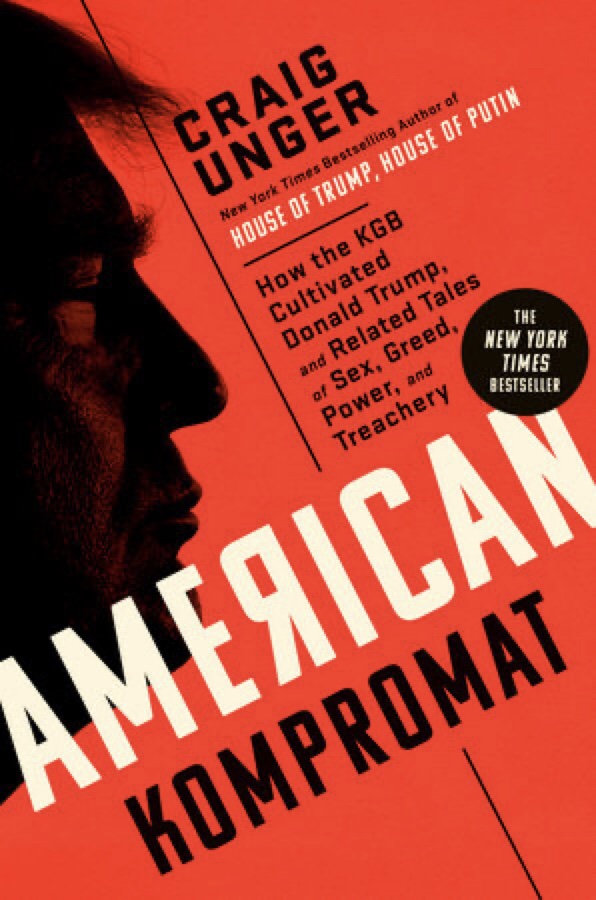
American Kompromat Craig Unger. 2021. 12.5 hours (audiobook)

A detailed account of the serpentine connections between Donald Trump and a host of shady rich Russian and international autocrats, this richly documented story of global political shenanigans by a well-known American investigative reporter is frightening.

The interconnected world of rich decadent aristocrats discussed here include the international media mogul Robert Maxwell, thought to have been murdered perhaps by Israel’s Mossad, in 1991 because he knew too much, and his despicable daughter Ghislaine, who fed Jeffery Epstein’s insatiable pedophilia by procuring girls as young as 13 from around the world for him. Both Maxwell’s were known to be Soviet (and later Russian) informants. The list of Epstein’s friends and guests at his various luxurious hangouts include many household names and world leaders including Prince Charles, Arab sheiks, an Israeli prime minister, the Clintons, Bill Gates, George Soros, and the international arms smuggler Adnan Khashoggi. And of course, his Florida neighbour, Donald Trump. Even if some of them were not fully aware of Epstein’s Russian connections and his pedophilia, at the very least, associating with him reveals questionable judgement. Here, Epstein’s cause of death in prison from suicide is questioned because of too many peculiar features surrounding it- Unger makes a convincing case that he may well have been murdered.

Even as early as the 1970s, Trump was selling hundreds of TVs from a KGB- fronted store in Brooklyn to Soviet millionaires and laundering the enormous profits through various corrupt banks. And in return, the Russian Alpha Bank and Deutsch bank later bailed Trump out of some of his bankruptcies.

Soviet moles Robert and Bonnie Hansen, within the highest ranks of the FBI, were spared execution for treason for mysterious reasons, perhaps because they were pious members of the secretive multilayered right-wing Catholic prelature Opus Dei, along with an astounding number of Trump loyalists such as his Attorney-General Robert Barr, Kenneth Starr and Anton Scalia, the Supreme Court Justice. Opus Dei arose originally to support the Spanish fascist Francisco Franco and is a secretive society approved by the Vatican, itself not exactly a bastion of democratic principles.

More than 200 lawyers from Kirkland and Ellis LLP were appointed to the Justice department during Trump’s reign, many also defending Russians interests, Alpha Bank, Deutshe Bank, and Epstein, who was defended by Kenneth Starr, the prosecutor of Bill Clinton at his impeachment trial. Starr has been disgraced recently for failing to act on allegations of sexual abuse at Baylor, where he was president. All these appointed men (vey few were women) were dedicated to the goal of establishing a unitary executive form of government with unlimited presidential powers.

One good quote: the KGB recruitment of Donald Trump was “like throwing spaghetti against the wall and seeing what would stick.”

The frightening close scrape with dictatorship to our south has been somewhat relieved with the election of Joe Biden. But lest they (and we as their neighbours) lapse into complacency, consider this: why is Donald Trump still golfing and planning for his presidential return in 2024, rather than languishing in a federal prison?

A scary true story and a must-read for anyone interested in the world of modern politics.

Thanks

Leslie.

All Families Are Psychotic. Douglas Coupland. 2001. 333 pages.

‘Bizarre’ is the best word to describe this novel by the Vancouver- based author, discussed by a friend who shall remain nameless. Set largely in Florida leading up to the launch into space of an adult thalidomide girl lacking a hand, her entirely evil relatives congregate to celebrate, knowingly spreading HIV infections far and wide with their indiscriminate sexual conquests. Even the married girl astronaut is unscrupulous, planning to conceive a baby by the married NASA mission commander while circling the earth.

There are endless time shifts even within chapters as the debauched characters reflect on their past lives. I constructed a mental family tree to try to keep the characters straight but the tangled relationships remained blurred. There are innumerable highly improbable chance encounters and the characters all survive after being shot, abandoned in alligator- infested swamps, and kidnapped by equally evil international drug dealers and baby abductors. At times the plot was so improbable as to resemble magic realism.

I persisted to the end, hoping for some memorable lines and a unifying theme but found nothing either enlightening or memorable except this ambiguous quote: “… blame is just a lazy person’s way of making sense of chaos.”

Novels often benefit by inclusion of rogues, but here they abound and are not even likeable. John Irving’s rogues, such as Ketchum with his repeated exclamations of Holy constipated Christ! in Last Night in Twisted River, are at least realistic and endearing, but here they are just the incarnation of evil.

This is trashy pulp fiction at its worst. The only feature that could make it worse is graphic descriptions of the abundant sex. I cannot recommend it to anyone.

Red Notice. Bill Browder, 2015. 390 pages. (ebook)

The author of this autobiography, at least in his early career, could be the poster child for the workaholic type A, American capitalist on Wall Street, reliably clueless when it came to social graces. With a Stanford MBA, he defied his family background as leaders of the American Communist Party, and became the prototype capitalist setting up his own hedge fund investing in undervalued Russian assets. His Hermitage Fund became one of the fastest growing profitable investment portfolios in the world, worth more than four billion dollars at one point -until he ran afoul of billionaire crooks in the post-Soviet Russia of Vladimir Putin.

This account of his conversion from a high-flying globetrotting financier to a dedicated human rights activist with connections to prominent politicians and media personnel, following the 2009 arrest, torture and murder of his friend and Russian lawyer, Sergei Magnitsky reads like a fictional international spy thriller, except that the events detailed are real, horrendously cruel, and not even now widely known.

Unable to forget the murder of his friend and the rampant corruption and ludicrous public statements about it in by Russian police, bureaucrats, and media, Browder effectively utilized his worldwide network of contacts and his considerable wealth to expose and reduce the prevalent human rights abuses in Russia.

In spite of his hard-hitting obsessive pursuit of profit early in his career, and of human rights and justice later, there is a very human tender side of the man. He moved Sergei Magnitsky’s widow and son to London, England, and shows great affection for his family, flying from Moscow to London every other weekend to keep contact with his son who is living with his ex-wife, even early in his career. He sobbed uncontrollably when the European Parliament passed a Magnitsky Act while he sat in the balcony with Sergei’s widow.

He admits, in the final chapter, that writing the book is in some respects a countermeasure to the ongoing threats to his life by the Putin oligarchs, well aware of the murders of other defiant truth-tellers. “I have to assume that there is a very real chance that Putin or members of his regime will have me killed some day.,,,,,I can’t mention most of the countermeasures I take, but can mention one: this book. If I am killed, you will know who did it.”

The one undisclosed aspect of his career is what has become of his relationships with his American communist parents and family.

I am in no position to pass judgement on Browder’s character or even all of his actions. Hedge fund manages are usually featured in the news when their greed, misappropriation of investor’s money, and shady tax evasions gets them into trouble with the law-think Bernie Madoff- so it is very refreshing to read about one who morphed into a hard-working effective human rights campaigner. And a man who repeatedly risked his life to find the truth, and expose the crimes of others has to be admired and taken seriously.

⭐️⭐️⭐️⭐️⭐️

Thanks, Beth and Vera.

Preventing the Next Pandemic. Peter J. Hotez. 2021. 161 pages.

A very bright and visionary Houston-based vaccine specialist presents a somewhat frightening overview of what he calls Neglected Tropical Diseases and their potential to spread around the world. The factors contributing to this potential disaster include political instability, internal displacement and human migrations, increasing urbanization, anti- science and anti-vaccine movements coupled with rising nationalism, and climate change which is in turn changing the range of various vectors.

The author is a globe-trotting advocate for science in general and specifically vaccine development and what he calls vaccine diplomacy- international cooperation, even among enemies, for vaccine development and distribution. He is the co-director of the Texas Children’s Hospital Center for Vaccine Development and the former U.S. science envoy for the Obama administration. His knowledge of the epidemiology and potential for disastrous spread of those Neglected Tropical Diseases is impressive.

There is little acknowledgment of the vast potential for the rapid deployment of the new mRNA technology to deal with new pandemic disease as they arise, preferring to tout the benefits of the traditionally-developed Covid-19 vaccine that his lab has developed. I doubt that he frequently even visits that lab, given his international visits, writing, speaking, and collaborations around the world.

The writing is interesting and informative from a medical science perspective but humourless and too centred on his own considerable accomplishments, which he does not hesitate to laud. And he seems to believe that his recommendations have the potential to solve most of the world”s current problems. He is certainly not lacking in self-confidence.

This went to press earlier this year, before any of the now deployed Covid- 19 vaccines were being widely distributed, so is already somewhat outdated with respect to the current pandemic.

An informative quick read.

Thanks,

The NewYorker

The Russian Job. Douglas Smith. 2017. 9.5 hours.

Neglected bits of history that are not taught in most classes have always been of interest to me-anything to enliven the memorization of politicians names and dates of battles that we were fed in school. The Vermont-based authority on all things Russian here provides a scholarly balanced account of a grossly neglected corner of history that I was completely unaware of.

Exactly one hundred years ago a drought and famine devastated a hugh portion of the fledgling Soviet Russia. The Americans, with the American Relief Administration, run by the future president Herbert Hoover, sent hundreds of workers and hundred of thousands of tons of corn, wheat and flour to save the lives of an estimated six million Russians in the affected provinces along with medical and dental supplies, vaccines, and infrastructure materials.This was funded in part by the U.S. government as they supported the Midwest farmers, and in part by private philanthropy such as the Carnegie and Rockefeller foundations and individual Americans. Those workers documented hundreds of cases of cannibalism, some adults murdering and eating their children, others raiding piles of frozen human corpses for meat. An estimated ten million Russian peasants nevertheless died of starvation over the ensuing three years.

The Soviet leaders at first welcomed the aid, but as accolades from the masses for the capitalist Americans grew, their appreciation waned. When, in 1923, the Soviets began exporting 400 thousand tons of grain, even as ten thousand of their own peasants were still starving, the ARA gradually withdrew from Russia. Lenin and later Stalin felt that the program threatened the stability of the Communist regime, and began a propaganda campaign to discredit the massive humanitarian campaign. Later Russian leaders tried to ignore the help they had been given, or characterize it as a disingenuous spy plot to undermine their Communist paradise.

The American workers in Russia almost all formed strong friendships with their hosts and interpreters in the provinces and most longed to go back after the program ended. They had been greeted as heroes working in deplorable conditions there, whereas they were soon forgotten in America. An estimated one in ten of the men married Russian ‘famine brides’, most of whom were former Czarist aristocrats working for the ARA. Inevitably, there were scandals as some Americans tried to smuggle treasures out of Russia and some criminals highjacked trainloads of food for personal gain.

There is brief discussion of similar, though smaller, programs of aid to America’s Russian allies during WWII, and after the fall of the U.S.S.R. in1991 when again many peasants in Russia starved to death. No living Russians will remember the ARA, and few will even be aware of its existence as this great humanitarian effort is still unacknowledged by Putin et al.

I detected no overt American bias on the part of the author of this important piece of largely forgotten history. Though it documents incredible human misery and debauchery, I appreciated it and learned a lot.

A note on the format of books. This was my first foray into audiobooks and it was probably not the best one to start with. I am a terrible speller and the hundreds of long foreign place and people names that are hard to keep track of on audio would, I suspect be easier In print. A map of Russia in 1922 would have been helpful but cannot be displayed in an audio book. I like the feel of a paper book in my hands, but I have become fond of the ability to define an unfamiliar word and the ease of flipping to and from a reference in nonfiction in ebooks. And in ebooks, it takes only a few keystrokes to copy a memorable phrase, sentence or whole paragraph into another document. The audiobook format does have the advantage of showing you exactly how long it will take to read through the book. I took 10 hours and thirty-six minutes to read this, what with breaks to search for word meanings and background facts. So what format do you prefer?

The Rose Code. Kate Quinn. 2021. 624 pages.

The California queen of historical fiction is back with another realistic and enlightening tale of the effects of World War II, this one based mostly in the now-famous top-secret British Bletchley Park where thousands of men and women tried to decode German military communications. As in The Alice Network, in a long author’s note at the back, she discusses what details of the story are real historical events and characters (a lot) and what were products of her vivid imagination. She has done her homework well and many of the events and characters are real and accurately portrayed including the life of the late Prince Philip of Greece as a sailor and philanderer before he snatched the HRH label by marrying Liz, Lord Mountbatten and the traitor who sold Enigma decoded information to the Soviets.

Three young troubled women, Osla, Mab, and Beth, from very different backgrounds, mature, become close friends and then fierce enemies as they work as decoders, cryptographers and translators, competing for the attention and affection of the scarcer male workers, all sworn to absolute secrecy. Their coworkers include Ian Fleming, Alan Turing, and Kate Middleton’s real life grandmother. They interact with royals, admirals, and various politicians, including Sir Winston Churchill.

The devastation and cruelty of wars have been a staple of historical novels since ancient times, but the randomness of the deaths of civilians is seldom presented as vividly as here in the effects of the bombing of London and Coventry.

The plot is complex and the twists are unpredictable. Short chapters detailing events a few days before the 1947 royal wedding are interspersed with longer ones from before and during WW II. Unique British idioms are captured realistically. Seemingly unconnected encounters and events are never abandoned and all fit in toward the end. There is lots of sex, but it is described more discretely than in The Alice Network. The convenient locking away of eccentrics who know too much in an insane asylum, with complicit doctors, and the barbaric treatment in those institutions is a stain on the history of medicine in that era.

My only quibble is that the tracking down and capture of the real traitor of Bletchley Park in the last few pages is embellished in a weak attempt to develop suspense, to the point of being very unrealistic.

One of the better historical novels of World War II of which there are dozens. In my estimation, it is better than The Alice Network, but not as good as Kristan Hanna’s The Nightingale, although perhaps more historically accurate.

Thanks, Yvonne and Vera

The Last Flight. Julie Clark. 2020. 585 pages, (ebook)

This suspense thriller is the first person singular account of Claire Cook’s planned escape into anonymity and the similar escape plans of Eva James. Claire is the abused wife of a prominent philanthropic New York City would-be U.S. senator, and Eva is a frightened single Berkeley, California drug dealer. The writer makes extensive use of critical time shifts, a staple of thriller novels, and readers need to keep track of the dates at the start of each of the 36 named but unnumbered chapters in order to follow the convoluted ingenious plot before and after the two women exchange identities and destinations at JFK airport to escape their past troubles.

The women in this novel have all been manipulated by cruel abusive misogynistic men, whereas the men are, with one exception, amoral ogres. The writing flows smoothly and the distress of the women is easy to relate to. In spite of many very different characters, there are no loose ends.

I am sure that many readers, at times of acute disappointment and stress, perhaps when trapped in abusive marriages or unfulfilling dangerous jobs, have fantasized about escaping into anonymity and starting over with a new identity in a new environment and can thus relate to this tale, but few will have developed the detailed plans related here. There are too many unlikely chance encounters and exaggerated characterizations for my liking, but then I have never been a big fan of this genre. Nevertheless, when I read a review of this story on the Goodreads website, I decided to borrow the ebook from the library, and in spite of my reservations, found it to be a quite enjoyable read. I have not read the California author’s only previous novel, The Ones We Chose, and am not inclined to do so. Small doses of this genre are enough entertainment to last a long time.

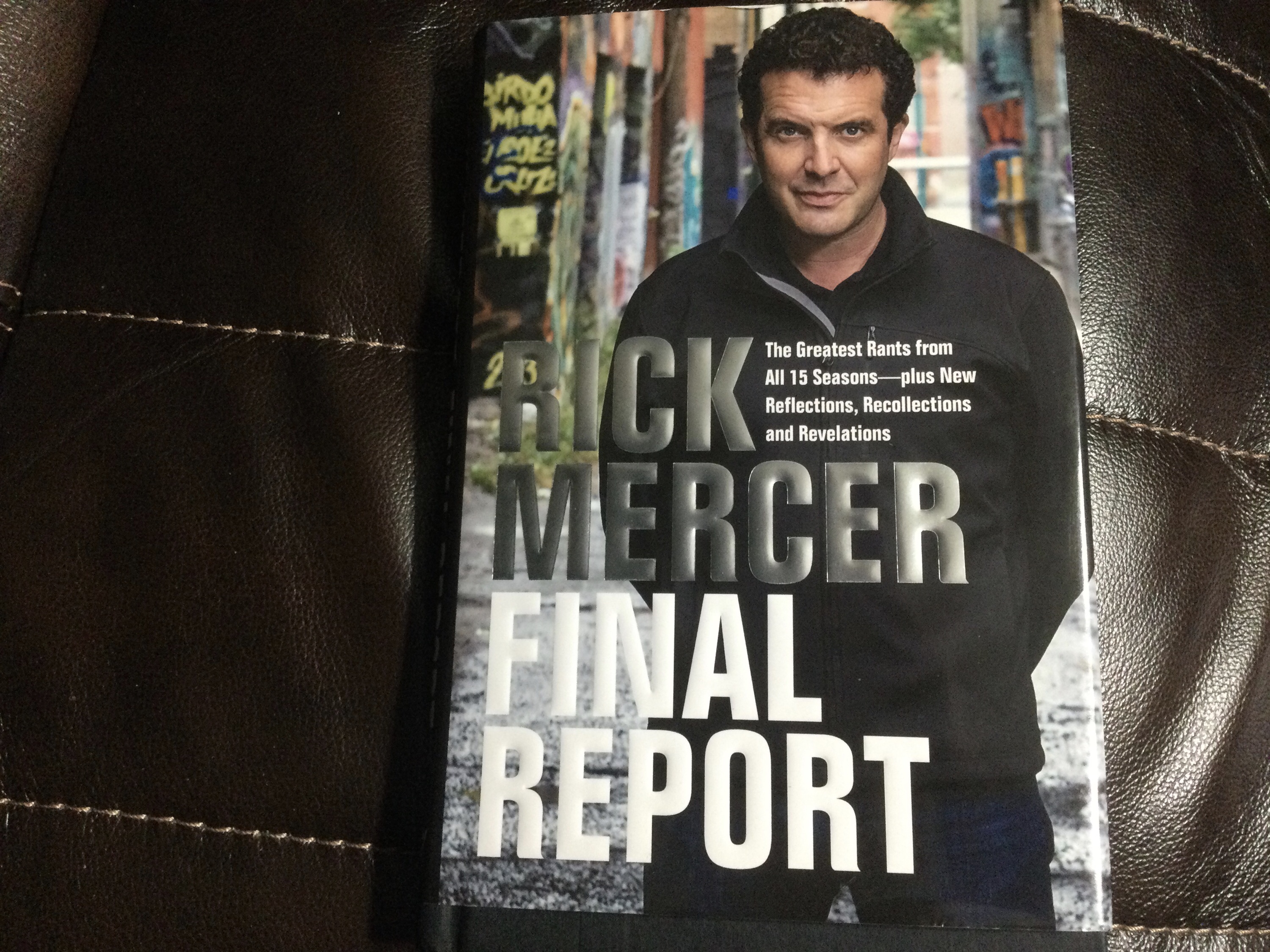
Final Report. Rick Mercer. 2018. 231 pages.

I had forgotten how much I enjoyed watching and listening to Rick Mercer on CBC television until I picked up this reprint of 130 rants and five new commentaries when I found it abandoned in the mailroom of our apartment building. Some of his adventures were silly or scary, but the weekly rants delivered in clipped sentences or phrases with biting sarcasm were always barbed and witty. They were also also great lessons in the often-forgotten minutia of recent Canadian history and political shenanigans.

In these carefully chosen rants from between 2004 and 2018, Mercer slings his sharpest arrows at what he seriously perceived to be the undemocratic, devious, and dangerous moves of Stephen Harper and company, but no politician or party escapes unscathed from his pointed criticism. His separate commentaries provide great insights into how the crew of the RMR worked.

This is a great read and an easy way to recall some of the highest and lowest points in recent Canadian politics. For those too young to have appreciated the CBC program, this and his three previous books based on the show or his equally acerbic dialogue in Talking to Americans would make great companion volumes to any course on Canadian history and culture of the era. Keep a copy of this in the rack in the guest loo. I miss his unique satire.

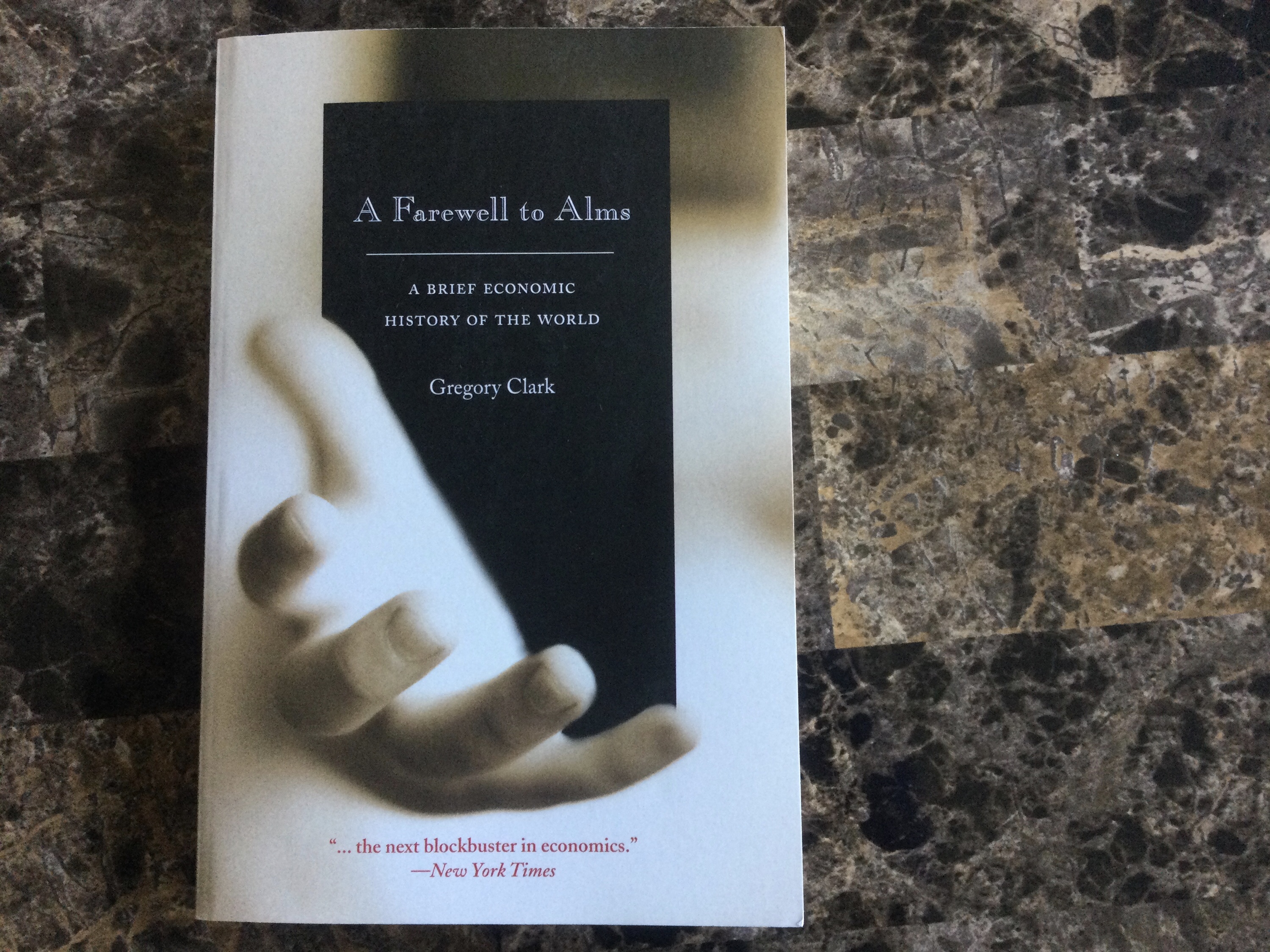
A Farewell to Alms. Gregory Clark. 2012. 377 pages.

Perhaps as a way to help the old man develop at least a rudimentary understanding of her chosen field of study, my Professor of Economics daughter sent me this book for my birthday. Or perhaps she just wanted to humble and torment me, knowing that I would read all of any gifted book. She succeeded if the latter was her intention, but not if it was the former.

The arrogant claim in the Preface to be as important as The Wealth of Nations, Das Kapital, The Rise of the Western World, and Guns, Germs, and Steel and the equally self-promoting wording on the author’s website ( “ I am a distinguished Professor..”) is off-putting, as is the very frequent references to his earlier publications in the footnotes.

If I even dimly understand where Clark differs from other economic historians it is in his emphasis on social Darwinism (survival of the richest) accelerating British fertility in leading to the Industrial Revolution, which was also much more gradual than commonly portrayed. And he lays claim to the assertion that it is primarily inherent inefficiencies in labor capital utilization that has lead to the modern great divergence in economies since the 1800s, with the attendant explosion of wealth inequality.

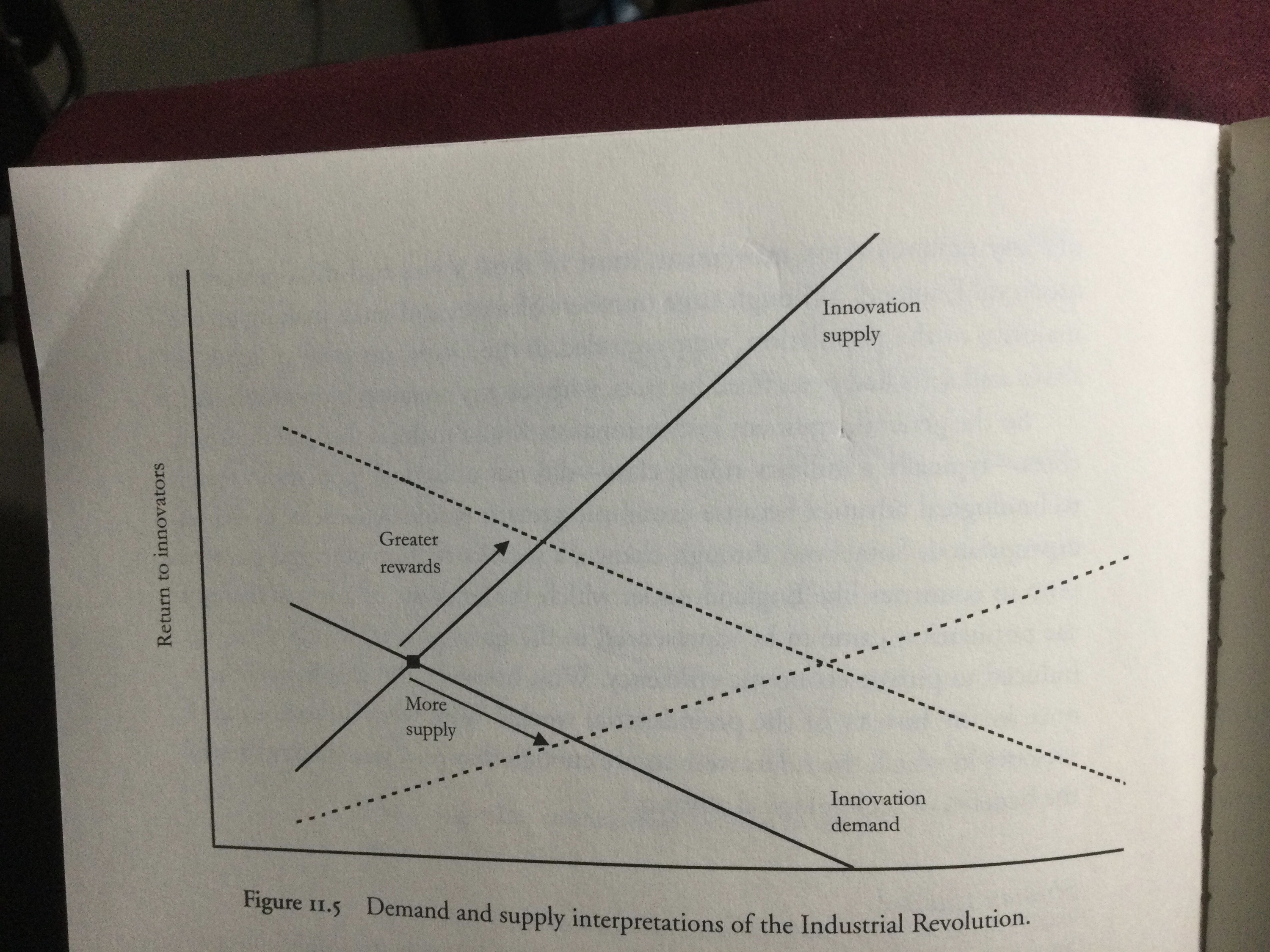
I have never been very adept at mathematics and never studied calculus, nor did I ever gain much understanding of actuarial science. When doing research I usually relied on professional statisticians to calculate statistical significance. But I recognize pseudoscience when I see it. Here I encountered dozens of charts and graphs that are purportedly important yet are unaccompanied by any measures of statistical significance, obviously equate correlation with causation, and were just plain confusing, as the one I chose to reproduce here shows.

What can this obfuscation possibly signify? There are apparently arbitrarily selected bits of sociological data from arbitrary time periods to reinforce what seem like arbitrary forgone conclusions.

Clark heaps scorn on the policies and actions of economists at the World Bank and the International Monetary Fund, apparently solely able to see the right way forward. And ironically his distain extends to academic economists although he is the Chair of the Department of Economics at USC, Davis. But like almost all economists, the holy grails that he never questions are the imperatives of productivity growth, consumerism, and ever more resource extraction, which is not compatible with our longterm survival in the age of global warming. GDP is apparently the only deity worthy of any worship.

For dedicated students of cultural anthropology, this could be considered a reasonable complementary document to Jared Diamond’s Guns, Germs and Steel, Noah Harari’s Sapiens, and Francis Fukuyama’s The Origins of Political Order, all of which I enjoyed reading, if it were not riddled with personal biases and criticism of previous works.

There are probably some profound insights and truths here that I failed to grasp, and it would be extremely presumptuous of me to dismiss this work entirely or to pretend that I understood most of it. To be fair, the references to other researcher’s findings is vast. The abundance of revelations of interesting, often counterintuitive historical facts was enough to keep me engaged. But I am sure that I flunked if this was my Introduction to Economics course.

Nuclear Folly. Serhii Plokhy 2021. 370 pages

By way of background for those youngsters who were not terrified by the newscasts at the time, in October, 1962, in the midst of the Cold War, the Americans discovered that the Soviets were secretly delivering missiles of all kinds, including nuclear ones, and setting them up all across Cuba, 90 miles from the coast of Florida. This frightening historical account by a Harvard professor of history was touted by The Economist book reviewer as the definitive account of that crisis and gives a detailed account of how close we came to being thrust into a world-ending nuclear war between the U.S.A. and the U.S.S.R. as a result. The author’s research is exhaustive, based in part on recently declassified archival material.

The details of how close we came to that mutual assured destruction are truly frightening. Over the course of four weeks, mutual distrust, paranoia, misinterpreted communications through intermediaries, and the blinkered world views of Nikita Khrushchev, JFK, and Fidel Castro all contributed to the dangerous brinkmanship. Some of the details of the eventual trade-offs that averted disaster were concealed for years.

Khrushchev, although verbose, mercurial and indoctrinated with Communist ideology, actually presented a strong case for setting up nuclear weapons in Cuba, pointing out that Americans and NATO allies had long had more powerful weapons of mass destruction poised on or near the USSR’s border in Turkey and Italy. Only the mutual recognition that pushing the nuclear button would destroy both nations and much of the rest of humankind prevented the tragedy, but both leaders came close to losing control of their decision-making to military hawks. At least two planes were shot down contrary to the explicit orders of superior officers.

Modern leaders cancelling the nuclear weapons limitation and test ban treaties seem to have ignored the lessons from this near disaster. The willingness of both superpowers to disregard the sovereignty of smaller nations such as Turkey and Cuba is striking, and has persisted.

I was struck by the vast number of precision weapons available at that time, and the hugh waste of resources in the building up of military forces and weapons. The delays in communication caused by manual translation and telegraphy through embassies don’t apply in the modern era, but instant communication among political hotheads does not necessarily reduce the danger and may increase it if emotions come to take precedence over slow deliberation.

For a civilian scientist, the most interesting story is the inadvertent wandering of an American U2 recognizance plane into Soviet air space in the far north because the pilot got lost. Unable to use usual navigation instruments between the magnetic and true North poles, he relied on old-fashioned sextant and stars but was led astray by a vivid display of the northern lights.

As a striking reflection of the times, no woman’s name appears among the hundreds of senior decision makers in America, Cuba or the Soviet Union. The only women even mentioned by name are JFK’s duped trophy wife, Jacqueline, his 19 year old secret lover Mini Alford (one of many), the wife of John McCone, the Director of the CIA who kept him away from an important meeting because they were on their honeymoon, and the terminally ill wife of a Soviet apparatchik. It may seem out of place for this western male, but I can speculate about what would have happened had half the players in this drama been female. The situation might not have developed into a crisis at all, and it would probably have been resolved more quickly and equitably.

There are hundreds of long, foreign, unpronounceable names of people and places, and military acronyms for fleets of ships and planes- sometimes as many as a dozen introduced on a single page-far too many for any casual reader to keep track of.

Dedicated historians, military planners, political leaders, and senior government bureaucrats may enjoy and benefit from reading this dry , account, but for ordinary citizens, it is best used as a bedtime sedative taken in small doses, although it might induce nightmares. But the relevance to our current situation with the risk of accidentally triggering a devastating nuclear war is undeniable as political leaders still deal with biased world views, missing or erroneous information, and irrational reliance on military might.

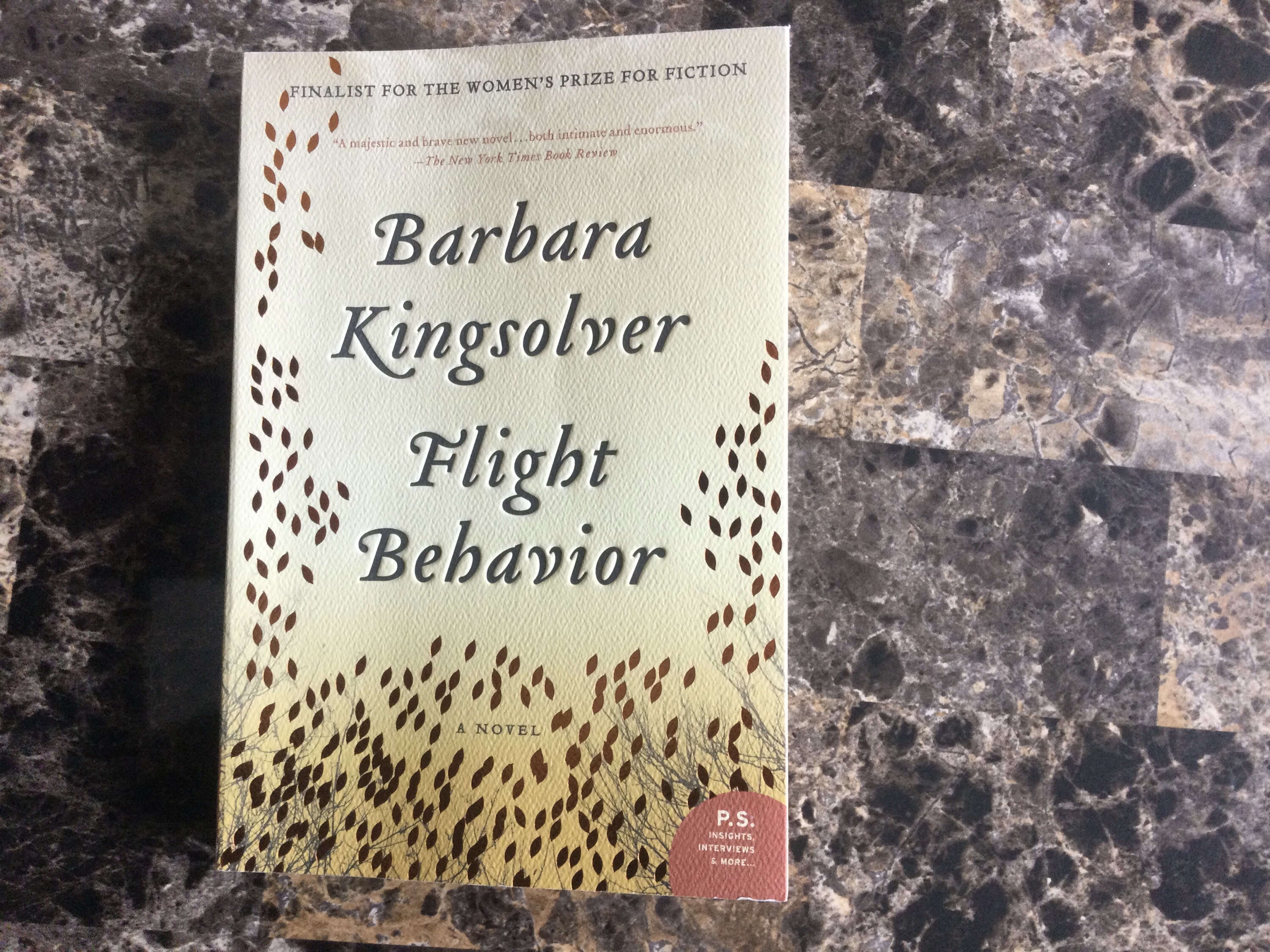
Flight Behavior. Barbara Kingsolver. 2012. 433 pages.

This beautiful novel can be interpreted in two ways. In one, it is a passionate, desperate plea from the author to every reader to take the climate crisis seriously and to do whatever one individual can do to reduce the effects of global warming. On another level, it is a charming fictional account of the life of a simple, impoverished, uneducated southern Appalachian Kentucky farmer and mother thrust into the world of ecological disasters by factors beyond her control as she discovers a huge collection of endangered Monarch butterflies who have gone astray because of global man-made changes to their migration routines.

Along the way there are important insights into the conflicts between commercial developments and ecological preservation and between a world view based on religious beliefs and that of a secular humanistic outlook. The turbulent family dynamics of the impoverished Turnbow clan, struggling to survive in the hollers of Appalachian Kentucky are typical of those in many disadvantaged southern states. The quirky characters are realistic and believable. The innate reproductive instincts of sheep, butterflies and humans are described in language appropriate for any ten year old.

The writing is lyrical (an overused word, but nothing describes it better) with hundreds of apt metaphors, similes and vivid descriptions of scenery, dialogues and interesting diverse characters.

One very nit-picky criticism. “ ….this was a living flow, like a pulse through veins”. Why do novelists insist on pulses in veins, rather than in arteries?.

I had previously read and reviewed Kingsolver’s Unsheltered, which is probably why my daughter sent me this one for my birthday. Although I enjoyed Unsheltered, this earlier nuanced fiction is a far better story. Highly recommended.

Thanks,

Alana

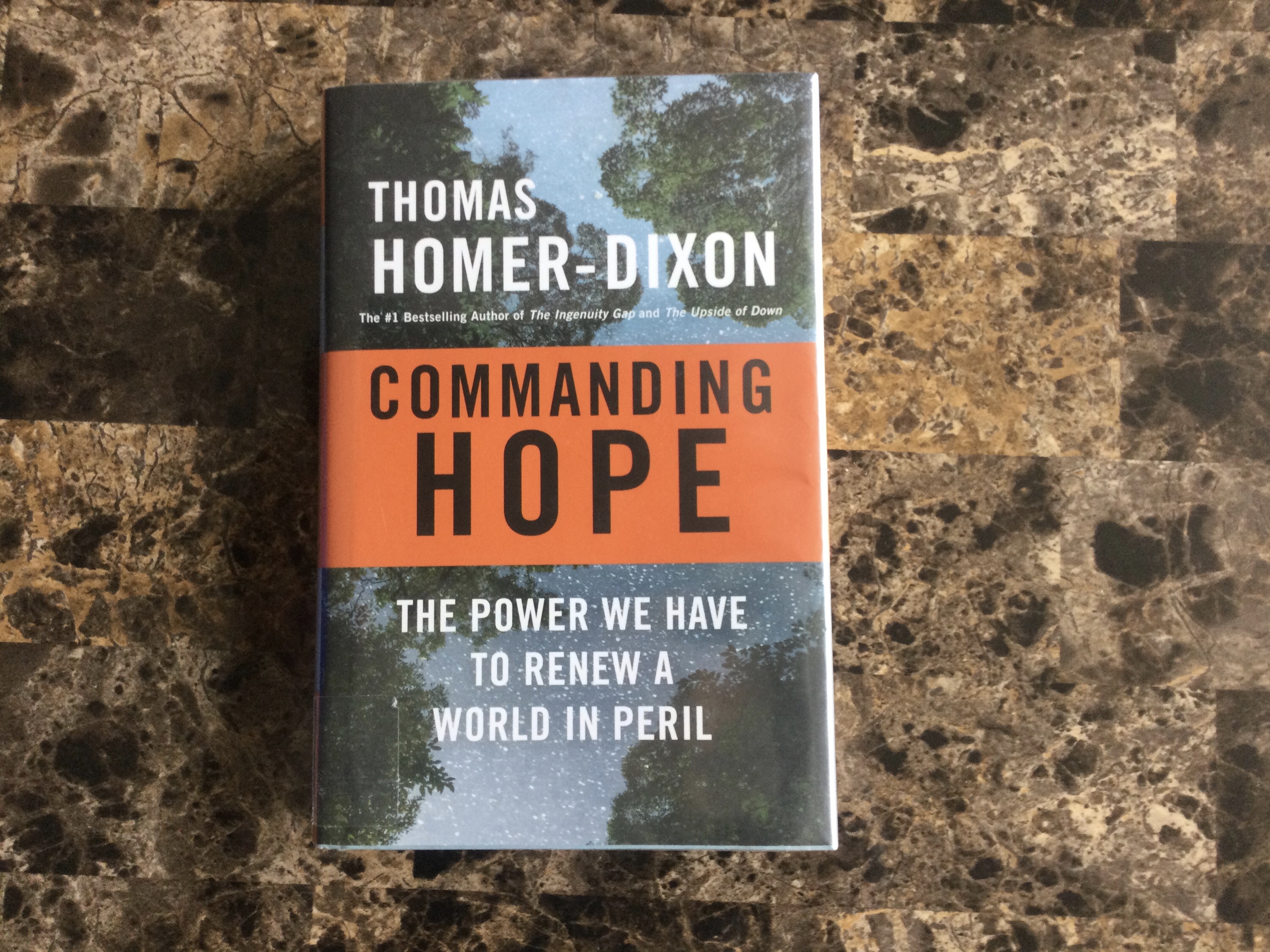
Commanding Hope. Tom Homer-Dixon. 2020. 374 pages.

Canada’s foremost deep thinker about global issues offers his unique take on the climate crisis, geopolitical instability, inequality, and our psychological adaptation to current threats, from his perch as a professor of Environmental Science at the University of Waterloo. He provides wide-ranging references to historical events, classic literature (his discussion of and analogies to J.R.R Tolkien’s Lord of the Rings are delightful), social science’s insights, and politics as well as environmental threats.The interspersed personal revelations about his past working in the oil patch and travelling throughout Europe, Asia and Africa and the sometimes profound questions of his young children are welcome diversions from the heady discussions. With collaborators, he has developed ‘tools’ such as the Worldview-Institutions-Technology loop, the ideological state-space concept, Mindscape, and the Cognitive-Affective Map to analyze our responses to various threats and what we can do as we face an uncertain future. Some of these concept tools required rereading for me to get my head around, as they seem like arbitrarily derived insubstantial dissection and reassembly of personalities and outlooks on first reading. It is easy to get lost in the deep philosophical discussions about the nature of time and the boundaries of moral honesty.

The almost universal assumption of economists about the necessity and desirability of growth is brought into question and the prevalent consumer society culture with the view of humans as ‘little more than walking appetites’ with a need for more of everything, is trashed. The need to claim agency as citizens of the world to unite for needed changes in spite of our vast political, cultural, religious and philosophical differences is emphasized.

Referring obliquely without names to Peter Theil’s plan to escape from climate disasters to a vast safe estate in New Zealand and Elon Musk’s equally selfish hopes of escaping to Mars, Homer-Dixon writes: “Being at the end of the lifeboat furthest from the leaks doesn’t mean winning the game; it just means having more time to observe the horrible process of loss before one is engulfed in turn.”

What Malcolm Gladwell calls tipping points, Homer-Dixon calls multipliers or ‘social earthquakes’. He holds out little hope for any rescue from our plight by Silicon Valley types with their blind faith in technology.

I am slightly more optimistic than him about the abilities of techno-optimists to at least go some way to mitigate some of the most challenging problems we face. I have a recurring fantasy of mass-producing, with an international crew of bright biologists, engineers, and materials scientists, some genetically-engineered chlorophyll-like organic compounds that will snag gigatons of carbon dioxide out of the air and, using only the sun’s energy, convert it into potable water, usable energy in the form of glucose, and oxygen. I imagine these being deployed on rooftops around the world and on the surface of vast arid deserts. Or sometimes in my dreams we are using huge vats of cultured chlorophyll-containing Cyanobacteria to do the same thing. My son suggests that using drones to precision-drop billions of weighted tree saplings on to clear-cut forests would do the same thing more naturally, albeit with more delay.

With a much more scholarly approach and rigorous analysis, the message from this book is similar to that from Seth Klein’s A Good War. They make good companion reads. Although this is a sobering, important and challenging message, it is somehow an upbeat optimistic assessment of possibilities for united action. Highly recommended.

Thanks, Pat.

.

The Phone Booth at the End of the Earth. Laura Isai Messina. 2021. 257 pages.

This short story is even shorter than the number of pages would suggest, being divided into seventy four chapters, some consisting of just a few words or an image. The title is based on the real Bell Gardia Wind phone booth on a hillside near Otsuchi on the Pacific shore of northern Japan. Survivors of the March 11, 2011 typhoon and tsunami from all over the nation come to converse on the phone with their dead or missing loved ones who were washed out to sea, their conversations being carried on the high winds. The symbolism of the “edge of the World” as the end of life on earth is hard to miss.

Each of the few characters grieves in their own way, but they all seek relief from deep nostalgic longing as they yearn for a connection to the dead by talking into the unconnected phone. The transition into acceptance and getting on with their lives is painful but touching.

A traumatized preschool girl who lost her mother in the tsunami is mute until she visits the phone booth; a young radio talk show host takes a long time to recover from the loss of her mother and daughter in the sea, visits the phone booth regularly, and eventually screws up the courage to talk on the phone; details of exactly what she hears from her dead mother and daughter remain unrevealed, but she gradually comes to terms with her loss thereafter.

The whole story is suffused with the rites and customs peculiar to Japanese society and the Shinto religion with vague hints of a belief in an afterlife. There are far too many names of unfamiliar Japanese foods and customs for this unilingual anglophone.The author is an Italian, now living with her Japanese husband in Tokyo and the book was originally written in Italian.

The writing is engaging and poetic, rich in symbolism and mysticism. Perhaps the most concrete statement in the book is “Tsunamis had to exist for a reason too. They stirred up the cosmos, just like earthquakes, floods, landslides and avalanches. All that was a disaster for mankind, all that killed, burned, drowned, or displaced, protected the earth’s equilibrium.”

A short great story.

Thanks, Book Browse (the online site where I first read about this story)

The Echo Maker. Richard Powers. 2006. 451 pages.

Set largely in sparsely populated rural Nebraska in 2002 and 2003, this epic tale is centred on the life of a young single meat-packing plant worker who is severely brain damaged in a car accident. But the undercurrent of the harm that humankind is doing to the environment, in particular that of the Platte River wetlands and the migratory route of the Sandhill cranes is never far from the surface.

When the accident victim emerges from a coma, he has developed the rare Capgras syndrome, refusing to recognize his beloved visiting worried sister, believing her to be a planted substitute sent by evil forces to harm him. This morphs into Fregoli syndrome and then Cotard’s syndrome in which he insists that he is dead. He develops very elaborate explanations, believing that the caring distraught sister is an imposter, and expansive paranoid delusional conspiracy theories for everything that is going on around him. The contradictions and cognitive dissonance of these absurd beliefs mimic those of many apparently otherwise sane individuals and fringe religious cultists in our present society.

When the distraught sister persuades a famous New York neuroscientist (clearly modelled after the late Dr. Oliver Sacks) to assess her brother, he gets too involved, doubts the value of his previous popularization of modern neuroscience discoveries and sinks into depression and self-doubt. The mishmash of rare brain disorders readers are introduced to via his musings and lectures include hemispatial neglect, agnosia, prosopagnosia, asomatognosia, hypnopomia, Fregoli syndrome, Anton’s syndrome, reduplicative paramnesia, Charles Bonnet syndrome, pain asymbolia, ideomoter apraxia, and Cotard”s syndrome. I was aware of some of these, but not all, having researched aphasia, neologistic jargon, and echolalia in stroke patients early on in my medical residency. I was a bit surprised that the misphonia that one of my granddaughters has and that affected Winston Churchill was not included. And it seems to me that the not-very-rare synesthesia, wherein people see sounds, hear colours and taste shapes would be a great tool for any imaginative novelist to use.

The eternal conflicts between nature conservation and urban development are artfully exposed and explored as romantic entanglements develop between various individuals on different sides of the conflict. Deep philosophical questions about the nature of consciousness and what the word self means are discussed peripherally but, per force, remain unanswered.

The writing is engaging with vivid imagery, (“quivering like a Parkinson’s guy on stilts in an earthquake”), although the scattered nonsense neologistic jargon words in the opening paragraphs of early chapters, (seemingly designed to mimic the chaotic thought processes of the brain-damaged victim) may just be confusing to some readers.

When the Sandhill cranes are descending to the river at dusk. “ Another thread floats down on the still air. Then another. The fibre of birds catch and join, an unravelled cloth coming back together.”

The deceptive “By the author of The Overstory” on the cover invites a comparison. This is a shorter good read, but neither the plot nor the characters are as realistic as in that later (2019) opus magnum, one of my all-time favourite novels.

Thanks, Alana.

Figuring. Maria Popova. 2019. 545 pages

Delineating intimate connections between a great variety of arts and sciences, and the often neglected or forgotten luminaries in diverse fields from poetry to astronomy, the best description of this scholarly book is exquisitely erudite. Cosmic in scale, timelessly relevant information is related from deep research into the lives of lesser known leaders in a great variety of fields, many of them being eccentric misfits not remembered by the mainstream writers of what is considered to be history. “History is not what happened but what survives the shipwrecks of judgment and chance.”

It would help immensely to enjoy this book to be thoroughly familiar with the biographies and works of, in no particular order, Johann Wolfgang Goethe, Lord Byron, Henry David Thoreau, Alexander von Humboldt, Mary Somerville, Elizabeth and Sophia Peabody, Horace Greeley, Elizabeth Barrett Browning, Walt Whitman, George Sands, William Channing, Mary Wollstonecraft, Florence Nightingale, Henry Fox Talbot, John Herschel, Samuel Clements (a.k.a. Mark Twain), Harriet Hosmer, Hans Christian Andersen, Emily Dickinson, Oscar Wilde, Rachael Carson, and Maria Mitchell, she of ‘Battle Hymn Of The Republic’ fame, among others. I suspect that I completely missed much of the buried symbolism, including that of the title.

A question that I cannot answer but someone no doubt can, is why, even allowing for a possible selection bias on the part of the lesbian author, there are a disproportionate number of gay men, bisexuals, and lesbians among the leading lights in all the arts and sciences. At least she spares readers the details of their bodily expression of passions. But the inclusion of dozens of all-consuming gushing poetic love letters between such couples as Nathaniel Hawthorne and Herman Melville, Ralph Waldo Emerson and polyamorous Margaret Fuller, Emily Dickinson and Susan Gilbert and her husband Stan, and Rachael Carson and Dorothy Freeman becomes a bit boring for those of us who are strict heterosexuals. The tangled romantic relationships of the Emile Dickinson household particularly defy and make a mockery of the conventional models of heterosexual monogamy and marriage. It seems that the binary nature of gender was questioned by many long before the modern discussion of it. And it seems to me that there is a little-acknowledged vast difference between limerence, a word coined by Dorothy Tennov to denote the psychological state of being ‘in love’ regardless of the gender of the loved one, often without reciprocal passion, and the purely biologic and selfish innate urge to copulate.

The long-lost habits of keeping diaries, self-directed journals and writing long love letters, extensively quoted here, allow the reader a peek into inner lives of these leaders. “The stories we tell about our own lives, to others but especially to ourselves, we tell in order to make our lives liveable.” The difficulty of truly knowing the inner life of another, related in endless introspective musings by both the author and the subjects, filled with allegories and metaphors is extensively explored.

One needs a broader and deeper education in history, sciences and literature than I ever attained to fully appreciate this tome. And it is not one to read while being distracted by any other activity, such as listening to music; full concentration is needed. But, part history, part science, part art, this is still an enjoyable and educational read.

Thanks, Pat.

Be Near Me. Andrew O’Hagan. 2006. 278 pages.

This novel by a Scottish writer who now lives in London blurs the artificial distinctions of genres of fiction. Presented in the first person singular voice of a Scottish Catholic priest assigned to the small town of Dalgarnoch, after spending most of his life in England, at an unspecified time around 2000, it is chock full of disconnected ethereal musings about his faith, the purpose of his life, and the trials he endures as he seeks to be accepted by his parochial parishioners.

None of the characters are innocent except for the dying housekeeper, and the priest’s engagement with two teenagers into thievery, illicit drugs, drunkenness and heavy smoking is a bit of a stretch. Romance and sexuality is presented mainly by oblique inferences, not explicit description, but foul language is pervasive. The priest says Mass and hears confessions without any deep sense that any of the rituals matter.

The plot is quite simple and the characters are few in number but some seem like caricatures.The writing style is expressive, with many allusions to British history and classical literature that I found to be confusing, as the author seems to take for granted that all readers know the details of Oxford history and the writings of Marcel Proust. That doesn’t describe me.

Two quotes will suffice to give a taste of the style. Bishop Gerard “…sat at the table, using his hand, as usual, to weigh the words he spoke, fondling the air in front of him, shaping their rhyme and reason.”

“Mr. and Mrs. Poole appeared to live together in a state of settled resentment.”

I kinda, sorta, enjoyed this story, but it is not very memorable.

Thanks, Din.

She Come By It Natural. Sarah Smarsh. 2020. 120 pages.

No fan of country music or Dolly Parton, I read this biography by an admiring Kansas contemporary from a similar background, hoping to enlarge my horizons and maybe revise my low opinion of Dolly. It had a great review in the New Yorker. My objectives were not fulfilled. The author liberally intersperses distracting autobiography, and references to hundreds of music pieces that I never encountered or enjoyed.

Unabashedly laudatory of Dolly, the disjointed account of her career is loaded with attempts to justify her many contradictions and inconsistencies. They do not quite work.

One needs to admire anyone who rises from abject rural poverty to become a very wealthy cultural icon and a generous philanthropist dedicated to helping those who are trapped in the circumstances of her youth, and there is no doubt that Dolly Parton is kind, altruistic and sincere. But there is little depth to her intellectual rationalization and an overriding need for public adulation and monetary gain let her simultaneously flaunt herself as a sex object and a promoter of women’s causes. And her abundant use of plastic surgery speaks of a vanity and refusal to accept the natural effects of aging, not justified by her assertion that she needs it for her work. Her superficial understanding of her Christian faith apparently does not include any need for modesty.

I did gain more respect for some of the positives of Parton’s efforts on behalf of others, but I am a bit concerned that philanthropy and advocacy at the hands of poorly educated cultural icons and pop stars has more potential for abuse and negative consequences than that provided by the likes of Bill and Melinda Gates.

The writing is rambling and inconsistent in both chronology and topics covered. The author is adept at man-bashing and seems keen to take offence at any criticism of herself, Parton, or country music, implying that criticism or expressing dislike of country music is unacceptable discrimination, and rude. I would prefer to be thought of as discriminating in my music tastes.

The best feature of this book is its brevity.

Extraordinary Canadians. Peter Mansbridge. 2020. 291 pages

This is a most peculiar book by the well-known now retired CBC journalist and newscaster. Written in the first person singular, in the form of seventeen brief autobiographical snippets, the monotonously uniform writing style indicates that the words were actually written by the author. He must have used a lot of liberties to then create extensive questionable dialogue and present the perspectives of the subjects as accurate self-revelations.

The “extraordinary Canadians” featured are certainly an accomplished lot, whose contributions to our culture should not to be overlooked, ranging through the modern day politically correct fields of advocacy for Aboriginals, minorities, and mental health services to animal rights, social services, and unusual political leaders. But how they were chosen from among the thousands of “extraordinary Canadians” who could have been featured is never discussed. In many of Mansbridge’s later interviews as a journalist, I noted a tendency for him to preface his questions with long expressions of his own opinions on the subject, leaving the interviewee with only one acceptable answer. The same process may have entered his choice of subjects to interview for this book.

Some of the self-revelations are cloaked in false modesty and assertions of altruistic motives that are easily seen through as really just reputation polishing. The only bio that I really enjoyed was that of the remarkable selfless Rabbi Rueven Bullard who at one point granted me an hour-long interview on his radio talk show. The Saskatchewan politician Pat Atkinson’s assertions of enjoying political life hide an overgrown ego and need for public praise; the vegan fashion designer Manny Kohli assertions of no monetary motives disguise boosterism for his multimillion dollar company and the animal rehabilitation worker Hope Swinimer overemphasizes the ultimate importance of her work simply because she enjoys it. The featured Nadine Caron, the first Canadian Aboriginal general surgeon, for all her wonderful accomplishments, seems to think, like many surgeons, that only surgeons are worthy of accolades among medical professionals. “I didn’t just want to be a doctor; I wanted to be a surgeon.” Or was it Peter Mansbridge that has the subconscious bias to worship surgeons? As a retired sub-specialist in Internal Medicine, I could take that choice as the kind of insult she decries in others, if I chose to, but I do not. Most of us lesser minions in the medical hierarchy are used to the haughty attitudes of many surgeons who disparage their colleagues in other specialties. But why not feature the equally accomplished Dr. Marilyn Cook, who earlier was the first Aboriginal family physician in Canada?

In many ways, this book is a deceptive way for Mansbridge to present his own slant on the discussions of our social, cultural and political life. Don’t waste your time on it.