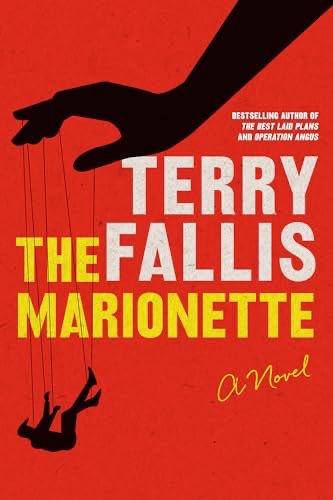
No one needed to recommend this book to me as I have read all seven of the Toronto author’s previous books and enjoyed all of them, some more than others.
In this one, there is more suspense with a far more complex plot than the previous ones. Although Angus McClintock, the colourful Scot of previous books is featured briefly, now as Minister of Public Safety, there is much less character development and much less humour, with an emphasis on Hollywood-style dramatic action of an unrealistic nature. It seems that Fallis has succumbed to the appeal of the Hollywood fast-action mystery, ignoring probabilities, perhaps hoping for a movie adaptation.
My favourite quibble: Forehead veins in upright men do not pulsate in response to emotions.
I will not reveal the very complex plot, but in short, this is my least favourite of the Fallis books, although I greatly admire his creative imagination.
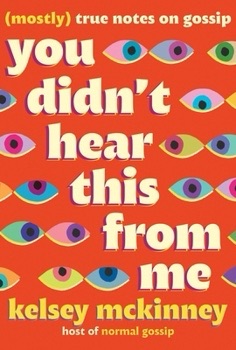
This Philadelphia journalist has made a name for herself investigating and writing about gossip. She is also the podcaster of Normal Gossip and is certainly a champion gossiper herself.
Documented with hundreds of examples, gossip, narrowly defined as someone talking about someone else without their knowledge, is certainly ubiquitous, often damaging and false, but usually self-serving, building up the self-esteem of the gossiper. She distinguishes gossip as distinct from lying or even urban legends. Social networks amplify the power of gossip, particularly when it is posted anonymously and there are endless quotes from sites and people I have never heard of. It can be educational or cruel and malicious.
Much of the content of this book is about the author’s own experiences, her insecurities, and self-doubts and bears little relevance to the purported subject. There is no doubt that gossip is universal and can be useful or very harmful.
This book Is not organized by any obvious plan, and very nebulous. I found little of lasting value in it.
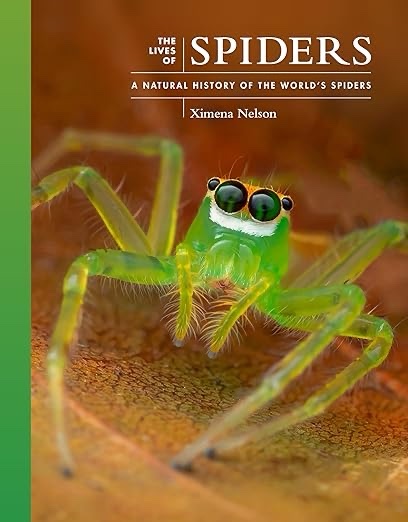
This could have been a great book. Loaded with information about spiders from around the world, the author, a professor of Animal Behavior at the University of Canterbury, shows an impressive knowledge of her subject. There are colour photographs or sketches of the lifecycle or anatomy of many of the thousands of species of spiders, many of them very confusing, but colourful, along with a miniature map of where they reside. Their predatory habits and their predators and intricate web weaving with many types of silk threads are discussed in great detail. Myths about their dangers are effectively exploded. Their usefulness as harbingers of ecological change and the potential to mimic them in medical sciences and engineering are carefully explored.
What spoils all of this for me is the layout, with much of the text barely readable in very fine and faint print, some of it on a coloured background that made it impossible to read without a magnifying glass. I have recently had my eyes checked ( 20/20, right eye, 20/30 on the left) so I cannot be alone in this complaint. After about 100 pages, I gave up reading the finer print and scanned only the bold bigger writing.
In an Oregon institution for the mentally ill, a group of men discuss their problem ad nauseum, as related by one of the Chronics, a half-Indian who seems to be delusional and hallucinates a lot. Their lives are controlled by Nurse Rachett and they get some respite by carefully assessing any new patients admitted as an acute case. The domineering Nurse Ratched tries to control every aspect of the men’s lives, and is in constant conflict with McMurphy, a devious but superbly talented psychopath. The use of punishment, electroshock therapy and even frontal lobotomy as control tools is frighteningly accurate, as I recall them, working as an orderly in a mental hospital in the early 70s.
This debut novel was made into a movie that I have not watched, but the reviews of it leave little doubt that the book is far better than the movie
The character development is superb and the fine line between sanity and insanity becomes blurred to the point of extinction. It can be very confusing to distinguish when the narrator is describing reality or a delusion or hallucination, but that is obviously intentional. The fishing expedition story is exceptionally entertaining.
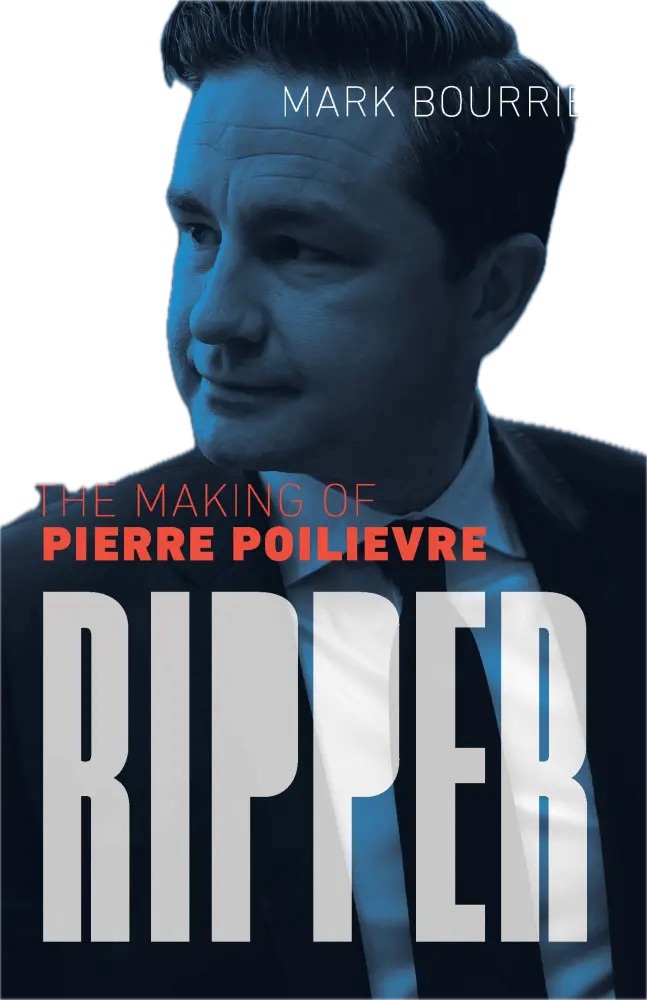
It is difficult to slot this Ottawa lawyer and researcher’s commentary into the political spectrum. He goes to some length in the beginning to argue that he is not opposed to the small c conservative agenda, but argues throughout the book against the agenda of all politicians with almost equally cynical biting invective. If I had to guess, I would place him in centre left field.
However, he pours particular scorn on Pierre Polievre, the « Ripper » of the title, as he abundantly documents his lightweight opportunistic, self-contradictory, Trumpian, style of speaking, writing and living. Published just before the 2025 election upset, some of the content now seems quaintly irrelevant, and one wonders why he was not willing to wait until the results of that could be taken into account.
He goes to great lengths to discuss the dumbing down of the media, as they blindly accept the many lies that angry politicians spout.
The overall tone is very negative with so many problems and so few solutions. But the author has profound knowledge of 20th and 21st centuary Canadian political history and I learned a lot (or recalled events that I had long forgotten.)
One problem: the author seems to accept that Jack Layton died of prostate cancer, although Jack himself made it clear that, although he had prostate cancer, he was dying of an unrelated cancer of undisclosed origin.
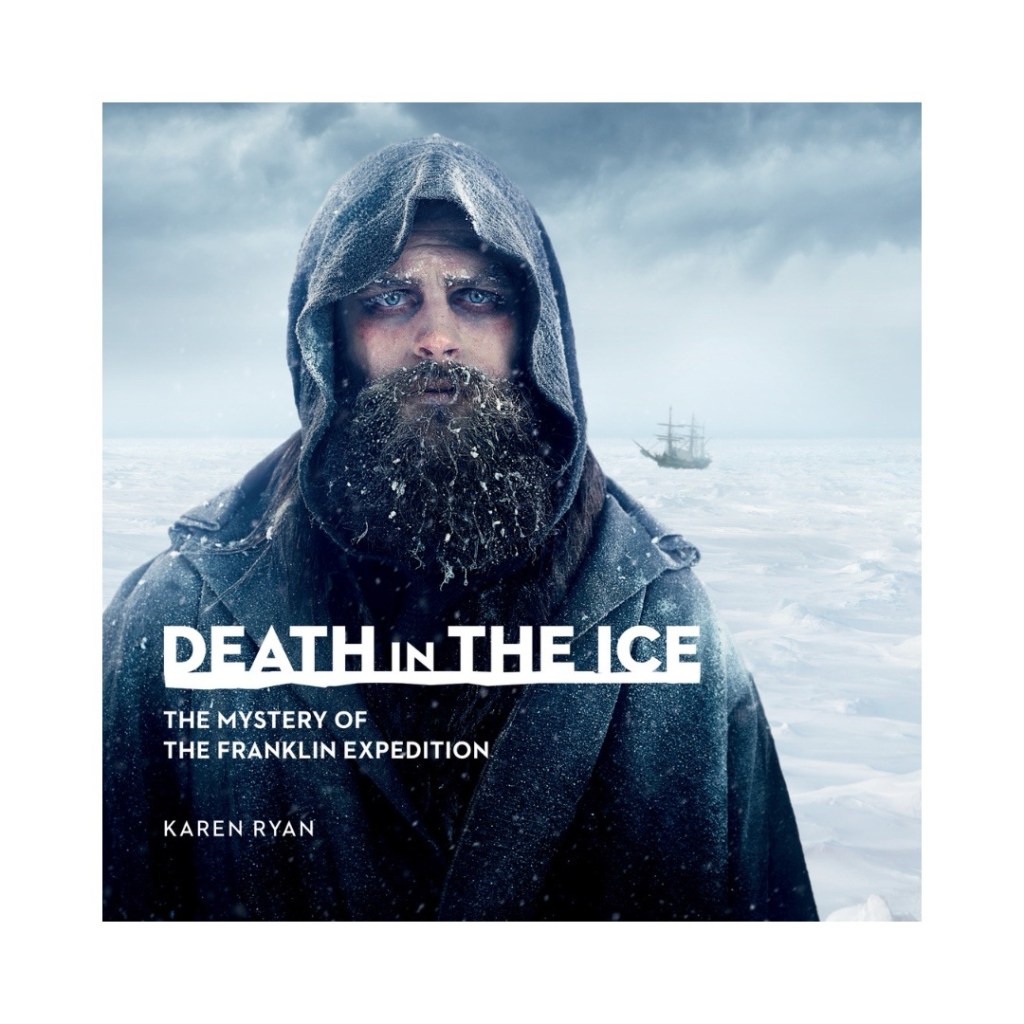
This historical documentary is more like a booklet than a book, with colour photos on most pages. For all that it is a great lesson in Canadian history, outlining the fate of the long lost Franklin expedition seeking a path through the Northwest Passage in 1845. When the Erubus and the Terror were eventually found in 2015, sunk in Arctic ice, the crew was also partly found far from where the ships were, with evidence of starvation, scurvy, tuberculosis and cannibalism. This was facilitated in part by Inuit oral folklore passed down through many generations. Reproduced letters to relatives in England vividly depict the lives of these brave men
An interesting quick read, but when I finished it I checked and the one Tony recommended is totally different « Death On the Ice » by Casey Brown.
It is hard to assign a genre to this book or even a primary author. Although Douglas Abrams organized it, much of the text is just conversations between the late Archbishop Desmond Tutu, and the Dalhi Lama, the leaders he, an American Jewish journalist and film maker, brought together over a week, in a remote part of India.
There are endless, aphorisms and self -evident common sense truths about suffering, compassion, looking beyond oneself and generosity, and development of mental immunity to suffering. The commonalities of Buddhism and at least parts of Christianity are emphasized. The remarkable Anthony Ray Hinton, who wrote The Sun Does Shine, a wonderful story about forgiveness after spending 39 years on death row for a crime he did not commit is quoted at some length.
I greatly admire both men for their intelligence, altruism and idealism. But I have some criticisms as well. Popular psychology and neuroscience is detailed when it strengthens their argument, but ignored in other places, such as when they perpetuate the myth that stomach ulcers are caused by stress. There is no acknowegement that at least 95 % of adult worldwide religious beliefs originate in childhood indoctrination, not in universal truths. Richard Dawkins has called this the worst form of child abuse. And there seems to be the tacit assumption that the mind is separate from the brain, and enters some kind of nirvana or heaven at the time of bodily death, with no evidence.
Much as I would like to believe in the power of prayer, and the benefits of Buddhist meditation, I am skeptical of both.
This book is unnecessarily long, ethereal, nebulous and idealistic.
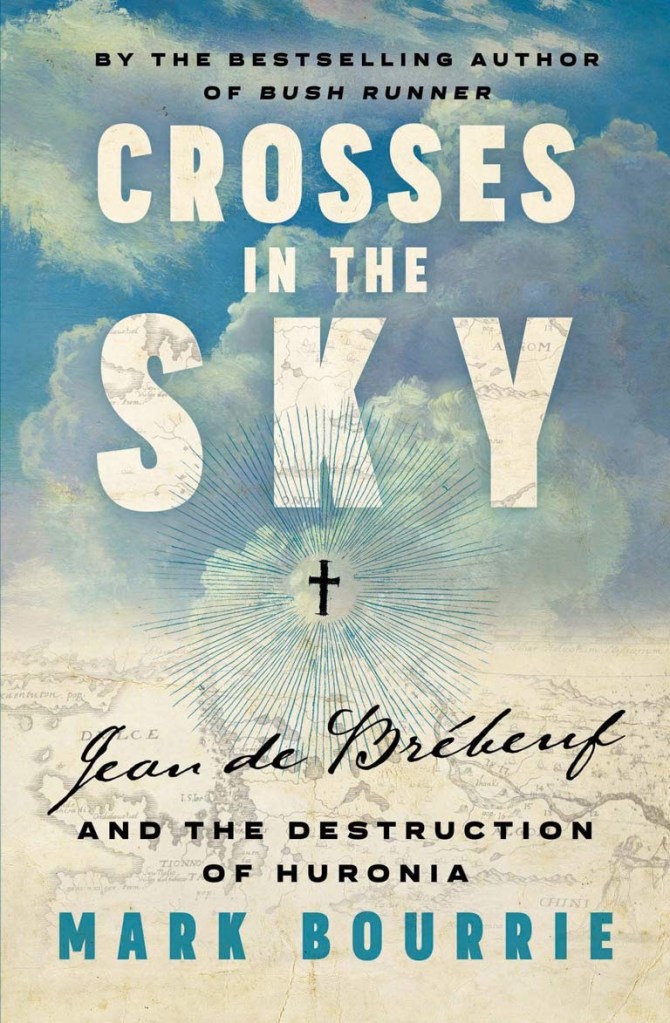
This history covers the fraught multidimensional relationships between the British, French, and Dutch colonists, the many and constantly changing Indigenous nations of what is now mostly Ontario and New York State, and the fraught battle to convert the Natives to Catholic Christianity between 1620 and 1650, with peak success, and then utter failure.
The central character in much of the story is the lauded Father St. Jean de Brebeuf, a dedicated but highly controversial priest, now a saint, but also a delusional hallucinating individual who might be considered a schizophrenic. His weird visual hallucinations were only outdone by the even weirder beliefs and visions of the native Hurons of southern Georgian Bay and Saint Mary’s.
The various Native nations seemed to compete with each other to invent ever more ingenious methods off torturing their opponents, mainly with axes and fire, but also by scalding with boling water that mocked the baptisms that priests insisted were essential to avoid eternal hellfire, and were widely applied to dying children. The plagues of smallpox and influenza that was blamed on the priests decimated the native populations. The widespread pracice of cannibalism of tortured enemy bodies was never condemned even by the Christians.
There are hints that some writing was assisted with AI with such nonsensical sentences as « If he leaned backwards, he his chest was scorched, » and. « ….the Neutrals appeared to be taller and better proportioned that the Hurons. »
Some of the description of torture defies logic with exaggeration. How could anyone still be alive after having been scalped, both hands and feet cut off, and still crawling and shouting at his tormentors?
In our high school history classes, the very simplistic teaching was that the Hurons, the Chippewas, Senecas, and the Oneidas were friendly pleasant people while the Iroquois and Mohawk were hostile, primitive cruel warriors. There was no discussion of the shifting alliances and ever changing names of umbrella organizations that continue to confuse me, nor any detailed revelations of the territories they occupied.
I found the maps confusing and unhelpful in spite of being reasonably familiar with most of the
territory. And the hundreds of foreign long names of natives were equally confusing.
Only dedicated scholars of the history of Ontario will find this book even remotely useful.
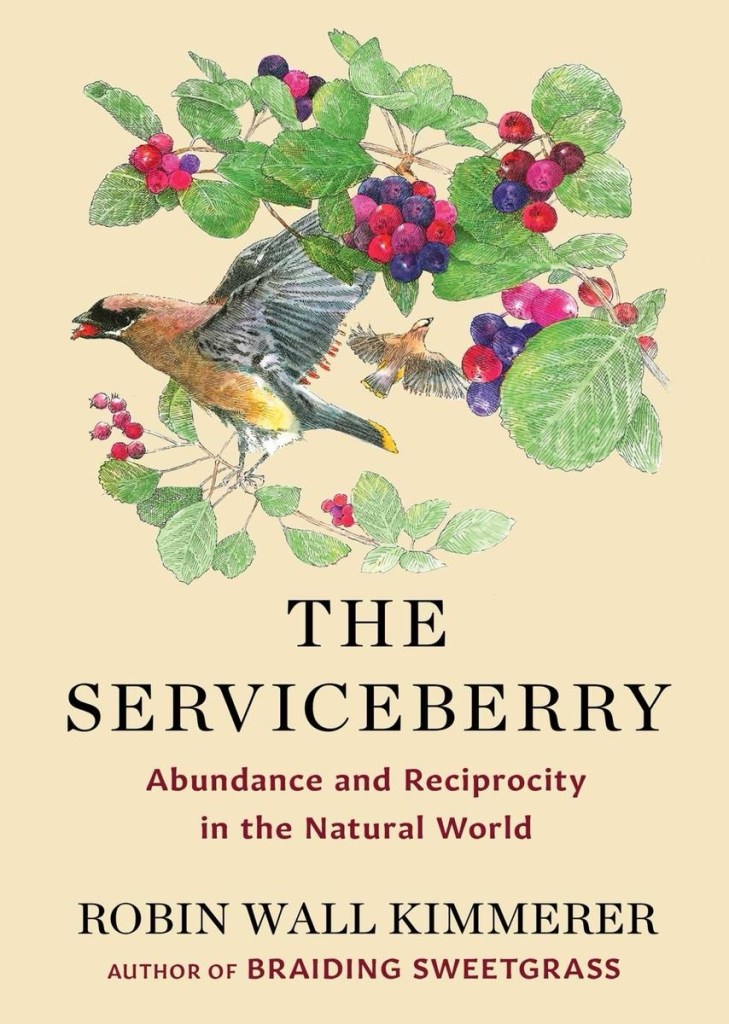
The native professor at SUNY who wrote the delightful 2015 book Braiding Sweetgrass, is back with this short rambling book about the Gift economies, in part based on her experience with Serviceberries, otherwise known as Saskatoon berries. She contrasts the extractive unsustainable selfish economics of Adam Smith and his so-called rational man with the giving economy in which communities share whatever they need with each other and with nature as a part of a whole community.
« Continued fealty to economics based on competition for manufactured scarcity, rather than cooperation around natural abundance is now causing us to face the danger of producingreal scarcity, evident in growing shortages of food and clean water, breathable air and fertile soil. »
There is little here that is not duplicated in more detail in Braiding Sweetgrass, which I think overall is a better read, but both seem hopelessly idealistic to this pessimist. But this one is also interesting and has the added benefit of brevity.
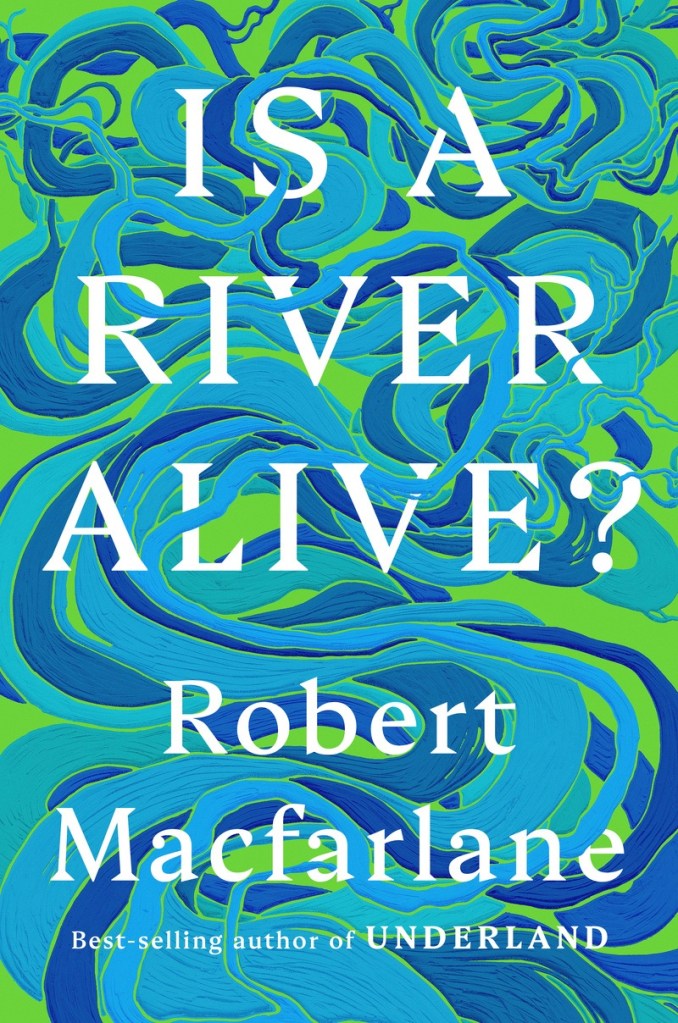
This British author visits river systems in Ecuador, India, England and Quebec, tracing the movement to grant natural systems like rivers and mountains legal status as living beings with rights. As such, this is in some sense an autobiography. The Rights of Nature movement has become a powerful force with some remarkable successes as an antidote to extractive exploitation and pollution, as he documents.
There are many references to native cultures with the tacit assumption that Natives always protect the environment because they believe their ancestors become a part of it in some ethereal manner. This is certainly non-science if not nonsense, and it is not at all clear that the natives always knew or could know what to prioritize in a constantly changing environment. The damming of rivers for hydroelectric projects is repeatedly condemned, but no alternative realistic plans for electricity production are offered.
It takes considerable linguistic gymnastics to accept rivers as living beings in the usual sense of the word ´living’ without any nucleotides or cell structures.
A long quote may give readers a sense of some of the vagueness of parts of this book: «Rivers flow through Rita’s poetry…. She is both water-thought… and water bodied, (free to feel the water in my veins). She speaks of the sky as her father, the river as her mother. She figures poetry itself as a river. There is a powerful sense throughout her work that she is speaking with- being flowed through by- natural forces greater than her individual self: indeed the sense that the idea of the individual as an island or singular unit is irrelevant, even deceitful. In Rita’s poetry, humans are part land (my heart is made of pine branches) and subject to sudden transformation; to skin -slipping and shape shifting (I will become salmon). … the rivers, the land and their beings speak. Caribou listen and addressed the reader. A bear is a grandfather, and wolves are great-uncles. Streams whisper, the sky utters, and rivers murmur the name of an Elder who has passed away. »
My all time favourite singer and song is Paul Robson’s rendition of of Old Man River, with its emphasis on the almost complete irrelevance of an individual human life in the grand scheme of the universe. I do value conservation and preservation, but as a scientist I believe it needs to be done in a careful and at least semi scientific manner, not by blindly following some creed of dubious value.
I only borrowed this book from the OPL because I have been an avid, but mediocre, curler at many different rinks for 40 years and have watched many professional games on TV. I have never been a Jones fan, my favourite teams being Rachael Holman and Brad Gushue.
In this autobiography, the author details her life as a professional curler from Manitoba, winning the Canadian championship many times and the Olympics once. Her life as a corporate lawyer is mentioned but clearly always was of secondary importance. And her children born before she married fellow curler Brent Laing clearly complicated an already complicated schedule.
She provides several contradictions. In the same paragraph she claims “ All I ever wanted to be was a Championship curler then says “I also wanted to be a mum.” She seems to also want to be loved by everyone, a sure impossibility, and is introspective and claims to have dozens of best friends, an absolute contradiction. Is ‘ best’ not a singular adjective?
The platitudes about team work and the psychology of the game become a bit excessive.
There is justified criticism of the inane rules and restrictions of the Canadian Curling Federation, particularly as they apply to women.
There is no discussion at all of her sexuality, political allegiances, or religion, things that could have added spice and some depth to the book.
I am unsure who her target readership is, if she had one in mind. Some non-curlers will be lost in the intricacies of the game; others may appreciate that as I did.
Overall, I was disappointed in this superficial and self centred book.
This book by the Carlton University white writer without Indigenous roots holds special meaning for me since I spent one long summer at the Camp Ipperwash Army Camp in my teens, very homesick, and completely oblivious to the history of it.
A sketch or several sketches of the area with the Kettle Point and Stony Point reserves shown, the Army base and the Provincial Park outlines would have been very helpful. Even having spent two months there, I had difficulty visualizing some of the roads and the limits of the Army Camp. I was told this morning as I was nearing the end that there are maps included with the book Our Long Struggle for Home, that I should probably have read first, but I probably won’t.
In this book, the author ruminates endlessly about her right to even speak to or for the Aboriginal tribes that were displaced when the colonialist white men displaced the Natives and took over the area for an army cadet camp during WWII, suppposedly on a temporary basis. Even words like Aboriginal, Native and First Nations are fraught with the potential to offend. The walking-on-eggshells narrative becomes a bit excessive as the author lives in fear of offending someone and questions her right to write a book about the ongoing tragedy and the duplicity of her colonial ancestors. She never mentions that the Natives probably do not always agree amongst themselves about what should be done to fully rectify this past and continuing unconscionable injustice.
The tragic treatment of the culture of the Nishenaabe people is clear, but the solution will involve much more than is offered in this book. The relatives of Dudley George, shot and killed by police in 1992, are growing old and time is running out.
I found the writing to be exessively tentative and self deprecating, but I cannot fault her good intentions to try to make amends for past crimes, as that is what it was.
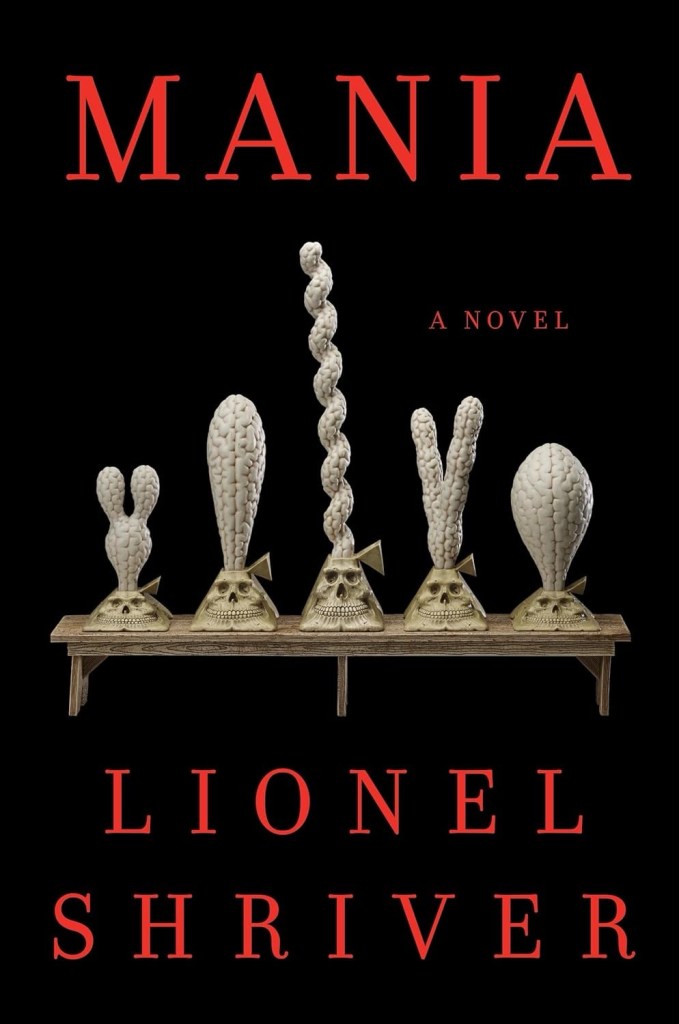
This prolific American/Portugese author offers a frightening novel about the dumbing down of American society with the Mental Parity dogma becoming all-powerful in 2012 and suppressing any spoken or written comments that might offend, with the all consuming assumption that everyone is equally intelligent. The result is a lowering or abandonment of all standards and exams and the rise of unqualified people to the top in every field from medicine to engineering, teaching law and politics with disastrous consequences. Books such as Dostoyevsky’s The Idiot and many movies are banned because they portray differing levels of intelligence, and cannot even be mentioned.
Then a backlash develops with I.Q. tests reinstated and they are and used to determine who can vote, after a constitutional amendment.
Satire often requires exaggeration, and this book is no exception. Lifelong friendships are shattered because one person mentions something that is taboo, people lose their jobs and families and become homeless, and their children are removed for the same reason.
The writing about growing up in an isolated Jehovah’s Witness family and then being ostracized and disowned by them when she defies their world view is so detailed and insightful that it made me wonder if this was in part autobiographical. “When you are perfectly trapped within a bubble, there is no bubble.”
This is a frightening and grossly exaggerated book that is very well written and touches a sensitive nerve about the very real problem of political correctness.
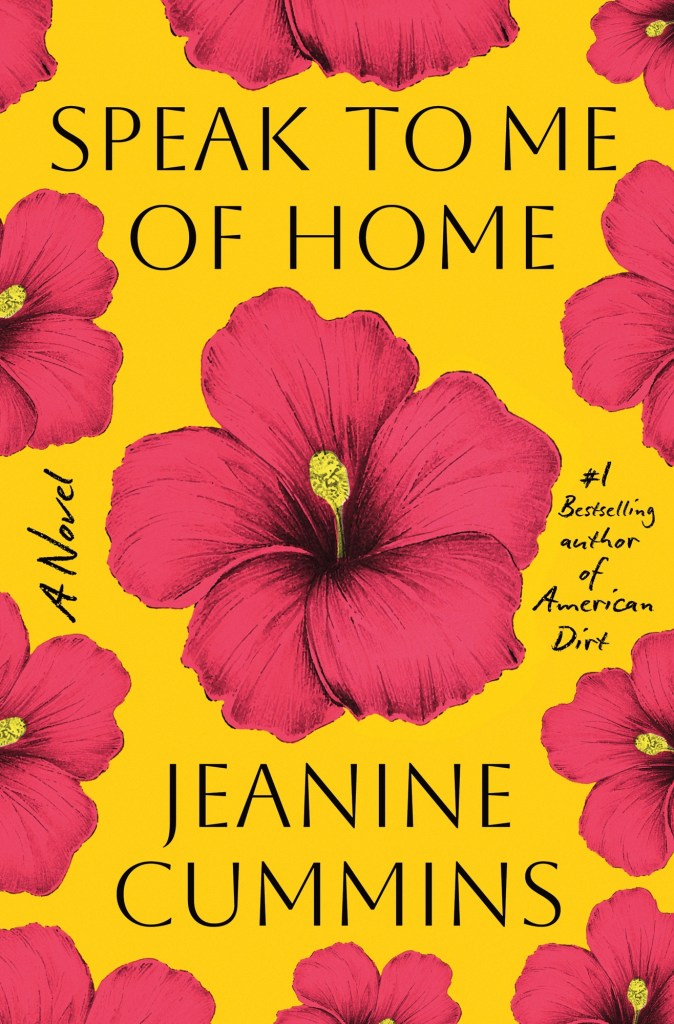
Unlike this American novelist’s much lauded American Dirt which followed a rather straight geographic and time line, in the first 30 pages alone of this one, the reader is introduced to several families over three or four generations, in three widely separated sites. Chapters skip backwards and forward in time and sideways in space.
In an 18 page chapter, a 20 year old girl goes through endless debates with her introspective self about which of two boys she should get serious about, complete with «ribs quavering under her skin. » In another place the same girl «could hear their hearts skidding and thudding in an attempt at silence. »
The overt racism of some of the characters causes family animosity, and the idiotic complexity of American health care insurance schemes is discussed in a realistic way. There is the inevitable révélation of an unsuspected paternity, a seeming necesssity in modern novels.
The overarching message is a homage to the simpler lifestyles of the author’s native Peurto Ricans, compared that in New York, New Jersey, St. Louis, Missouri, and even Trinidad.
The excessive emotionality of all the characters and the physiologically impossible reactions to those emotions spoil this book for me. It is much inferior to American Dirt in my estimation.
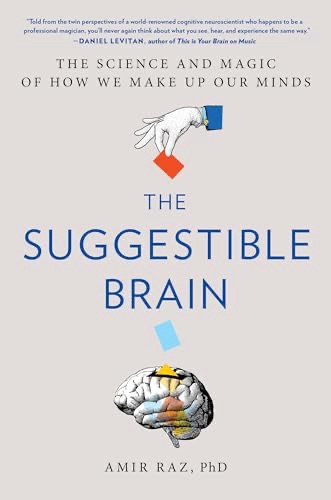
This interesting scholarly science book was written by an unusual man with an unusual background. Of Israeli/American/Canadian origin, he has been a lifelong magician but is also a PhD psychologist currently working on the neuroscience of hypnosis and deception, including the placebo effect at McGill.
The interaction of suggestion and real physiology is extensively documented with numerous experiments. These include treating effectively the effects of pollens on allergy sufferers, the gastrointestinal upset of lactose intolerance, the intractability of seizure sufferers, and the phenomenon of mass hysteria. Even false pregnancy is associated with real observable physiological effects such as breast enlargement, amenorrhea, and pigmentary changes. The variable susceptibility to conspiracy theories and fake news is extensively documented. The striking placebo effect is noted in many domains, most notably in the treatment of depression. Standard antidepressant therapy is belittled to some extent. No one is immune to suggestions, but some are more susceptible than others.
This book is well-written and totally engaging. It should not be hard to follow even for non scientists. My only criticism is that there is just a whiff of smug self-congratulation as he emphasizes the powerful potential of suggestion and cites work from his lab extensively.
This short old illustrated classic by the late American author is listed as a children’s novel, but is an absolute delight for anyone. A young girl saves a runt newborn pig from execution and nurses him to maturity. The talking animals and insects that constitute the fanciful plot include sheep, geese, cows and most importantly a spider named Charlotte, who is vital to the plot, weaving complex messages to humans in her webs.
One quote from Charlotte: “…what is a life anyway? We’re born, we live a little while, we die…. By helping you, perhaps I was trying to lift up my life a trifle. Heaven knows anyone’s life can stand a little of that.”
I usually don’t like fantasy stories but this one is loaded with deep meaning that can be appreciated by children and adults alike.
This is the very dense attempt by a Johns Hopkins classics professor to help the reader understand modern theoretical quantum physics, with all the nonsensical implications of what that entails, such as the deduction that if the moon is not seen, it ceases to exist.
The pages are almost equallly divided between the German existentialist philosopher Immanuel Kant, the Argentinian poet/philosopher /activist Jorge Borge, and the German theoretical physicist Werner Heisenberg. In spite of reading three of his books, I have to confess to still finding Kant unintelligible, but I did get a little closer to understanding the Heisenberg uncertainty principle. I did not understand much of Borge’s contribution to the field.
The discussion is not confined to those three and includes many others including ancient philosophers such as Plato and Anticus Beothius, contemporaries like Neils Bohr and Erwin Shroedinger. Theology is not neglected with discussion of the nature of the trinity in the Niceane Creed, and of course Albert Einstein contributes in a major way. Free will à la Sam Harris’s is trashed.
The complex density of this book is best illustrated by a couple quotes:
« .. the circumference of a circle first increases with the radius, until the circumference of the universe is reached and it gradually decreases thereafter for increasing value of the radius until it reaches zero.. »
« To be ultimately responsible for how one is in any mental respect, one must have brought it about that one is the way one is in that respect. One must have consciously and explicitly to be the way one is in that respect and one must have succeeded in bringing it about in that respect. » Confused yet?
I gave up on understanding particle entangelment but sorta , kinda understand the theoretical concept of multiverses. I may have understood 10 % of the rest of this book.
1.5/5
Thanks, The Economist and Goodreads.
« …the circumference of a circle first increases with the radius until the circumference of the universe is reached and then it gradually decreases to zero for increasing values of the radius. »
« To be ultimately responsible for how one is in any mental aspect, one must have brought it about that one is the way one is in that respect. And it is not merely that one must have caused oneself to be the way one is in that respect. One must have consciously and explicitly have chosen to be the way one is in that respect, and one must also have succeed in bringing it about that one is that way. » Confused yet?
The lives of the principle characters are interesting and I now vhave a partial understanding of the uncertainty principle now, but I would never claim to understand more than ten percent of this book, and entanglement of Particles is away beyond my comprehension.
This is a Virginia novelist’s debut tale, all composed of letters composed between friends, family members, strangers and even famous writers over the period between 2012 and early 2022, some of them never sent. The central character is an adopted married and later divorced American law clerk with a troubled past and two living children, one deceased one and one of the living ones is estranged from her. Interpersonal conflicts abound.
The quest for her past leads to an analysis of her DNA with far-reaching consequences, as she connects to her birth mother’s other child. It is vital for the reader to pay close attention to the dates, senders, and recipients of various emails and letters of the characters to keep them straight.
There is a lot of nostalgia and self-flagellation on the part of the main character particularly as she takes undeserved blame for her son’s sudden death, her divorce, and various other sundry other events in her life.
I found nothing very unrealistic in this tale, but the nostalgia and self-examination seemed to me to be a bit overdone. I suspect this novel will be more appreciated by women than by men. But it also gave me many suggestions of books that I have not yet read.
This duel biography of the pioneer surgeons Wilder Penfield and Wm. Cone by the award winning Montreal journalist is his debut book. He outlines in great detail the Midwest U.S. background and the very different personalities of the two before their later falling out after they had made the Montreal Neurologic Institute world famous for the groundbreaking mapping of the functions of various parts of the brain, largely by stimulating the various areas in conscious patients with epilepsy. The outgoing Penfield and the introspective workaholic almost forgotten Cone could not have been more different, although they were very fond of each other, and shared many goals.
The book also details the unique culture of the 1940s and 50s Montreal with language barriers, extensive political corruption, and church domination of every aspect of life. The Royal Victoria Hospital is described as “A sprawling complex of stone buildings in the Scottish Baronial style… that said ‘I have money and power but nothing so frivolous as taste’. ” The key role of rich anglophone donors to the institute includes mention in several places of Izaak Walton Killam mentioned here only because we live in a Killam apartment complex.
There are a couple of obvious mistakes that proof readers should have caught. The brain does not receive a litre of blood every time the heart beats-perhaps every minute the heart beats.
Cone’s bout of jaundice in 1943 was almost certainly not because of his workload.
The writing is straightforward and easy to understand even as it deals with the extremely complex human brain and questions of whether or not there is a separate soul or mind unconnected to the neurons.




 The Passionate Reader