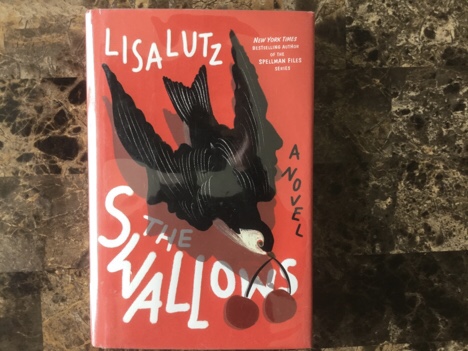
A friend of mine refuses to read any novels by women, claiming they are all pathologically obsessed with sex. He could well use this novel as an example. The tenth of the author’s books, this is set in a coed prep school in the fictional town of Lowlands, Vermont in the fall of 2009. Sexual shenanigans abound not only within the school student body of libidinous teens but within the faculty, and between faculty and students. A group of boys keeps a secret coded computer file rating of the girls facility and skills in providing oral sex, awarding a ‘Dulcinea prize’ to the best girl at fellatio. The new faulty teacher, with a dark background of her own, and a group of disillusioned, sexually frustrated girls eventually break the code of the ‘Darkroom’ boys and sabotage their sick enterprise. The uproar destroys reputations far and wide, and the prep school itself, with dire consequences for some.
In the age of the Me Too movement, there may be an important message about the imbalance between the ability of males and females to find sexual fulfillment, even in modern societies in this tale. If so, that message is obscured by the sheer volume of pornographic description and detail. There are some interesting literary twists and insights. One of many good quotes: “Some people count sheep. What finally sent me to sleep was cycling through possible job alternatives, in alphabetical order. For soporific purposes, you can’t leave anything off the table. I fell asleep sometime after carpet installer.”
I am no prude and do not object to use of ‘course language’ and explicit sexual descriptions in the dialogue of characters in novels, if there is an important underlying message, but I tried and failed to find that message in this novel. And it seems a poor substitute for subtlety and imagination when used by an author in narrating his or her story.
For younger readers who perhaps enjoy reading about the graphic details of the sexual exploits of others, this may be an interesting read, but this old curmudgeon did not enjoy it.
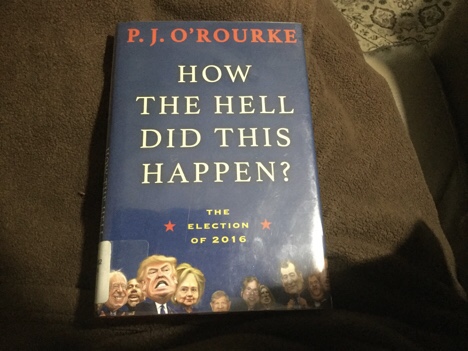
I picked this book up at the Beaverbrook Branch library, along with several others, the day before it closed to promote social distancing, hoping to gain some insight into the fiasco of the 2016 American election. The author, a prolific American political satirist, and former editor of National Lampoon, wrote most of the short essays as that election approached. He employs clever sarcasm, wit, humour, and cynicism to mock all of the candidates for office from both parties. As a self-proclaimed libertarian, his most biting characterizations are reserved for liberal and progressive candidates on the so-called left of the political spectrum. He clearly has a talent for detecting inconsistencies, banality and silliness in the process of political campaigning. His Glossary of Punditese Words and Phrases with Their Meanings Given in English is a witty, but cynical, guide to interpretation of mainstream political writing.
I appreciated the witty turn of phrases and insights for about the first half of the book, but they gradually became stale, and then grating. It is not clear when he is offering serious commentary and when he is just showing off his talent for lampooning everyone and everything about American political life. It is also not clear what makes him an authority on anything, other than his self-assertion of expertise. Much of the commentary degenerates into silly slapstick comedic dismissal of serious issues that deserve to be debated with more gravitas. For example, he denigrates proposed plans for universal health care with supposedly careful economic calculations that fail to take into account off-setting savings and the success in other jurisdictions where it actually works reasonably well.
As I read on, the overriding impression I developed was of an arrogant know-it-all who considers himself to be an expert on everything from politics, economics, and health care to criminal justice. He seems to even think he is an expert haberdasher, critiquing the wardrobes of all the candidates debating serious issues.
The inconsistencies in his own assertions, the increasing pressure of speech, his flight of ideas and the non sequiturs made me wonder, as I tried to put the random rants in chronological order, if when and when he had stopped taking his lithium.
There are a few good quotes. “Consistency is not a hallmark of American politics, but exceptions are made when the constant is stupidity.”
“Elites are self-righteous, self-regarding, self-serving and smug.” An accurate description of the author.
I cannot recommend this book to anyone, unless you are in desperate need of memorable barbed put-downs to use in some debate.
This new history book, the second of my peeks into the murky world of psychiatry in a week, is written by a professor of the history of science at Harvard. With 77 pages of notes and a 22 page index, it is certainly scholarly. As the subtitle suggests, it is also a story of failures, false hopes, and a divided and dysfunctional profession at war with itself, right up to the present.
There is an abundance of historical detail, much of it not at all flattering to the professionals who like to consider themselves as being guided by scientific principles. Charlatans, egotists, and mercenaries seem to find comfortable niches for themselves in the world of mental health care. Egan Moniz’s 1949 Nobel prize for pioneering lobotomy in 1949 is still an embarrassment to the whole profession. Other equally unscientific and ethically dubious treatments such as electroconvulsive therapy, insulin shock therapy, hormone ‘conversion’ therapy for homosexuality, and involuntary sterilization of institutionalized schizophrenics, persisted long past the era when other branches of medicine had embraced at least basic scientific principles in research. In the 1960s an influential dissident psychiatrist, Thomas Szasz, aligned his movement with the distinctly nonscientific dianetics practices of L. Ron Hubbard’s Church Of Scientology.
The conflict between the Freudian psychoanalysts and the biological-oriented researchers who hoped to find an anatomical or biochemically basis for mental illnesses continues, with the repeated failures of the latter, including the glaring inconsistencies of the heavily marketed “chemical imbalance” theories promoted by pharmaceutical companies to promote sales of various antipsychotics and antidepressants that are only marginally more effective than placebos. Blind faith in pet theories led the Canadian psychiatrist Humphrey Osmond at the Weyburn Psychiatric Hospital to the false claim to have found the mediator of psychosis (adrenochrome), and to treatment of ‘cerebral pellagra’ with megadoses of niacin. His experiments with LSD along with Aldous Huxley, Timothy O’Leary and Alan Ginsberg, then led them to deny the existence of psychosis as an illness.
Many of the drugs discussed, from chlorpromazine to all the modern antidepressants and ‘atypical antipsychotics’ were familiar names to me from my days living in the now defunct London Psychiatric Hospital and in a medical practice that included a wide range of mentally ill patients. But their route to discovery as carefully detailed here were not as familiar. Among the most unlikely of those routes is the serendipitous discovery of lithium carbonate, once an ingredient in 7-Up, as an effective treatment for bipolar disorder. With the expansion of the number of mental illnesses in the DSM-5, (what is “Disruptive mood dysregulation Disorder?) it seems anyone can qualify for some psychiatric label, even as big pharmaceutical companies abandon attempts to find new treatments, frustrated by the stringent requirements for demonstrating safety and efficacy imposed by regulators.
The decline in institutional care of the mentally ill in the 1980s left the care of many needy patients to inadequately funded community centres, families, and prison guards.
One minor editorial quibble. “(See Chapter 4)” is in the middle of Chapter 4.
This is a comprehensive and engaging, but somewhat depressing history that should interest anyone dealing with mental health issues themselves or in relatives or working in the field, which probably includes just about everyone. But my take on it may be biased- no one has ever accused me of being sane.
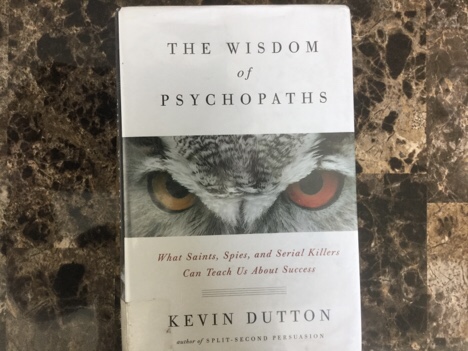
All the usual tropes of modern psychology are here including the Stanford prison experiment, the runaway trolley car thought experiment, and numerous studies dreamed up by psychology professors, often using their students as research subjects. Perhaps I have read about these too many times to be impressed, but there was enough intriguingly different about some of the findings and speculations here to keep me interested, and the title alone is enticing. And I have dealt with enough criminal psychopaths in my professional past to keep me interested in the field.
I have to relate one such encounter. A itinerant, very charming man flagrantly flirted with my secretary at each appointment. He had never kept a job for more than a few months and had a long rap sheet but called to cancel a followup appointment, telling my secretary that he would call back to rebook. The next morning, while listening to the six a.m. news, I recognized his name. There was a Canada-wide warrant out for his arrest!
The whole concept of psychopathy and personality disorders is a twentieth century phenomenon, driven by psychiatry’s need to categorize and fit personality types into arbitrary slots. But many studies have shown that the tools such as the Hare Psychopathy Checklist-Revised, the Psychopathy Personality Inventory and the Levenson Self-report Psychopathy scale do quantify personality traits along a continuum. That continuum can then be arbitrarily chopped into categories to facilitate social science studies, treatment trials, and research.
Dutton documents the counterintuitive fact that many, and perhaps most psychopaths, are not ruthless serial killers or rapists but are high functioning societal and business leaders, military heroes, religious leaders, and political operatives. He discusses the probability that Jesus, St. Paul, Steve Jobs, almost all military special unit members and the fictional James Bond would score in the psychopathic range if the modern tests could have been applied to them. Their shared traits of fearlessness, charisma, nonconformity to societal norms, narcissism, short term perspective, assertiveness, and lack of remorse can be useful traits for everyone- in small doses. I would include persuasive salespeople- I once knew a teen who sold a Greenpeace membership to a guy sitting in a Hummer.
The neurological basis for psychopathy is discussed with documented genetic contributions and fixed anatomical brain differences between control and psychopathic subjects. The most interesting revelation is that it is possible, in a laboratory, to temporarily produce the mental and physiologic characteristics of a psychopath in normal individuals using carefully focused transcranial magnetic stimulation, as convincingly documented by applying this technique to the author.
Without exception, all the psychopaths studied or discussed were male, but there is no discussion of any possible reasons for the male predominance. Where are the Karla Homolkas and Terri-Lynn McClintics of the world. Granted, they were accomplices of male psychopaths.
A great quote from an institutionalized criminal psychopath: “But what if you don’t need courage? What then? If you don’t have fear to start with, you don’t need courage to overcome it, do you?”
For fun, I took the online revised Hare Psychopathy Checklist and completed the answers to the Levenson Self-Report Psychopathy scale. I think it would be very easy to game these questionnaires to come up with any conclusion you wanted, but I answered honestly. Seems I failed both if the aim is to self-diagnose psychopathy, but the latter concluded that I was at 60% on the scale for a “general personality disorder.” As they are in the business of selling counselling services, I don’t take their ratings very seriously.
This book was interesting, but not essential reading unless you work in the mental health field, or have developed serial killer instincts during your corona virus quarantine.
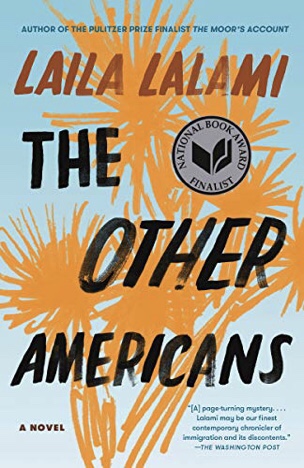
This was a random pick from the New Books shelf of the Beaverbrook library while looking for something else.The author, born in Morocco, came to the U.S. on a student visa and was allowed to stay to become a citizen, now living in California. The central character seems to share many features of her life story, enduring racial profiling and discrimination along with a variety of other characters who are either immigrants or belong to minority groups. The theme of this injustice is carefully explored, although none of The Other Americans are portrayed as faultless and they all have deep character flaws. The strained life of people from diverse backgrounds trying to get ahead in small town California is entertaining and realistic.
Another musician with synesthesia, shows up, here overtly labelled as such, seeing music as shades and shapes. Both of the novels I read this week feature characters with this sensory phenomenon. Is it more common in artistic types, or only in novels about them? And is it an affliction or a talent to hear colours, see sounds, or taste coldness?
This is another novel that could benefit from a reference list of main characters for those of us whose old brains can’t keep them straight. Although all the short chapters are headed and narrated by a named character, the unstated times and places shift back and forth from Morocco to various points in southern California and from the 1980s to recent times, which still made it confusing to me, particularly in the first half. The hit and run victim killed in the first chapter shows up to narrate several later chapters. There is a late unpredictable plot twist that partially clarifies some of the earlier confusion, but this is not a whodunit mystery story.
For future readers, I composed a partial list of characters as a reference.
Nora, single daughter of Maryam and Mohammed Driss Geraoui, musician
Jeremy Gorecki, ex-marine, cop in Joshua Tree,California.
Driss and Maryam Geraoui, immigrant Californian restauranteurs, from Casablanca.
Efrain Aceves, Mexican immigrant.
Coleman, black female detective in the police department of Joshua Tree, from D.C.
Anderson Baker, Mojave, Vietnam war veteran, bowling alley owner in Yucca, California.
A.J., Anderson Baker’s son.
Salma, Nora’s married sister, dentist in San Bernardino.
I recognized Lalani’s name from her essay The Unfulfilled Promise of American Citizenship, exploring the same theme, in the April 2020 Harpers which I read just after finishing this book. Her latest novel Conditional Citizens, isto be published next month, by Pantheon. Although The Other Americans was a very good read, I am not sure I would enjoy more on the same theme, even though she is a very talented and imaginative writer.
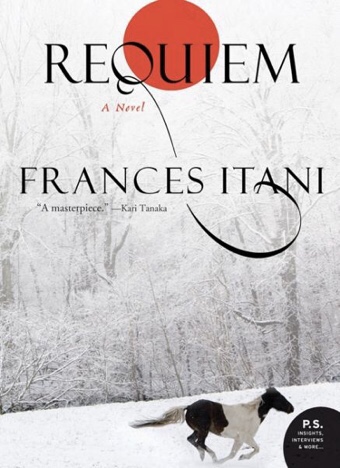
This one of several novels and histories dealing with the shameful relocation of thousands of Japanese citizens from west coast areas to interior prison camps following the bombing of Pearl Harbour. This is narrated by a young boy whose family was broken up and moved to a small community on the Fraser River, then moved again. Chapters detail these events from the boy’s recall of that trauma at the time and from the longer remove of his life as a successful print artist in Ottawa in 1997.
Apt descriptions of this story by critics and reviewers include ‘lyrical’, ‘poignant’, ‘wonderful’, ‘masterfully sustained’, and ‘brilliantly lucid’. I would add ‘carefully integrated’- there are few plot surprises or loose ends. The plot, broadly predictable from early on, is secondary to the characters, developed with the aid of numerous reminiscences and flashbacks. The narrator’s recurring musings about and obsessions with the imagery of animals, water, and the life and music of Beethoven add a unifying symbolic, almost existential quality to the story. His ability to see music as colours as well as hear it suggests that he has the neurological condition known as synesthesia, which is possibly most common in artistic individuals. Only a nature artist and musician would ever think up this description: …”the wind swayed and rocked the trees as if they were outdoor instruments being finely tuned.”
The political message of the cruelly and injustice of the relocation programme is powerful but is balanced with abundant local colour of places featured across Canada, as well as some snippets of dry humour.
In my estimation this story is not quite on a par with this Ottawa novelist’s 2014 Tell, but is still a very good read and a sobering reminder of an embarrassing episode in Canadian history.
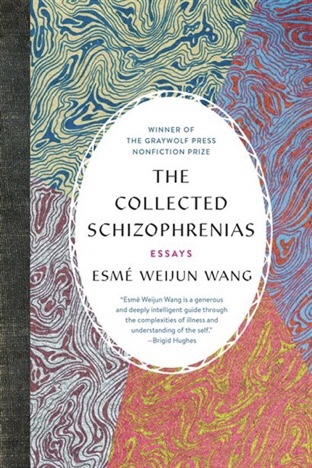
I am not sure who, or what review, persuaded me to read this mysteriously titled autobiographical series of essays about living with serious mental illness, variously labelled as bipolar disorder, schizophrenia, schizoaffective disorder and PTSD. The married, Taiwanese-American author now living in California was educated at Yale, Stanford and the University of Michigan. In the first few chapters she absolutely shatters the stereotypical image of psychosis and those suffering from it. The first chapter on the vagueness and arbitrariness of the DSM-5 criteria used for all psychiatric diagnoses is hardly new to anyone interested in the field, but her personal experiences with mental health practitioners in various states and institutions convincingly illustrates that arbitrariness, vagueness, and lack of scientific rigour in the field.
Her first experience of mental illness occurred before entering Yale as an teenage undergraduate. She was then abruptly and arbitrarily removed from Yale in midterm, and even forbidden to visit the campus, after a hospitalization for delusions and hallucinations. Wang’s later application for readmission to Yale was denied in spite of the provisions in the Americans With Disability Act. As an old Yalie, I am disappointed that only Stanford accommodated her with her illness and let her enrol, although it seems that the only degree she holds is a MFA from the University of Michigan. Obviously highly intelligent, articulate, and knowledgeable in many fields, she quotes scholars, thinkers, and philosophers I have never heard of.
She eloquently argues for avoiding use of ‘schizophrenic’ as a depersonalizing noun, rather describing herself as ‘a person with schizophrenia.’ But I am uncertain about the value of this politically correct semantic distinction. People with diabetes and those having had an amputation are not diminished in stature by calling them diabetics or amputees, and schizophrenia commonly takes over more of a sufferers’ persona than does diabetes.
Many of the antipsychotics that she was prescribed on a trial-and-error basis were familiar to me, having prescribed them, often on the basis of little more than a hunch that they might work.The discussion of insanity as a defence of criminal activity is superficial and not very helpful. Her hesitant, anguished decision to forego having children is poignantly justified with careful logic- she was fearful of producing another mentally ill human.
In the best chapters, on violent dystopias as portrayed in movies like The Matrix, Blade Runner and A Clockwork Orange, realistic 3-D horror movies, and childhood fantasy animations, Wang seems to suggest that increasing exposure to these modes of blurring the distinction between reality and fiction may make it difficult for some vulnerable individuals to avoid delusions and hallucinations, an interesting hypotheses. They certainly seem to be triggers for psychotic episodes of departure from reality for the author. With a White House leader with delusions of grandeur blatantly blurring the line between reality and fantasy, this should be a concern for everyone if such exposures are common triggers for psychosis.
A great quote: “….a primary feature of the experience of staying in a psychiatric hospital is that you will not be believed about anything. A corollary to this feature: things will be believed about you that are not at all true.” This is in keeping with the famous David Rosenhan 1972 experiment “On Being Sane In Insane Places” in which all twenty ‘pseudo-patients’ falsely complaining of hallucinations were admitted to psychiatric hospitals, retained for an average of 19 days, and 19/20 were diagnosed as having ‘schizophrenia in remission’ on discharge.
Unfortunately, in the last few chapters, rather than advocating for more rigorous scientific studies of psychiatric illnesses and their treatments, Wang descends into uncritically endorsing and trying a great variety of complementary and alternative treatments. These include treatments for chronic Lyme disease, which she probably did not have, Reiki, IV infusion of ozonated saline, eye movement desensitization and reprogramming therapy, luminal experiences with use of talismanic chords, divination, pilgrimage to El Santurano de Chimayo, and Tarot card reading. All that these treatments have in common is practitioners who, whether they have delusions about the effectiveness of their therapies or are just callous scammers, are dedicated experts at separating you from your money. The mentally ill have no monopoly on delusions. My questions for her: if one of these works, why did you have to try so many of them and how do you know which one works if you use them simultaneously?
She states in the final chapter that she has been free of hallucinations and delusions for four years, at the time of writing, and is only taking two medications. Whether this improvement is because of the placebo effects of her quack treatments, escape from the effects of earlier poly-pharmacy, natural fluctuations in the course of her disease, or some other factor is not clear.
I have mixed feelings about this book. The first half provides an interesting peek into the life of a brilliant woman’s undeserved suffering in a society still stigmatizing mental illnesses; the second half just annoyed me, as a lost opportunity.
If this old classic novel, first published in 1826, had not been on the agenda for my book club, I would probably never have picked it up, and certainly would not have slogged through it to the end. Set in what is now upstate New York, it centres on the seemingly endless and barbaric battles between different Indian tribes, the French interlopers from the North, led by Montcalm, and the British and Dutch pioneers trying to bring civilization as they understood it, to the frontier, during what was known as the French and Indian War.
There are many editions and adaptations of this. I read the Penguin paperback edition of 1962. I found it confusing and wordy with all the literary flourishes and long descriptions of the scenery and characters typical of writers of that era. Why use a few words to convey an image to the reader when long convoluted descriptions of nonsense can be deployed as in this quote: “The solitary and arid blades of grass arose from the passing gusts fearfully perceptible: the bold and rocky mountains were too distinct in their barrenness, and the eye even sought relief in vain, by attempting to pierce the void of heaven which was shut to its gaze by the dusky sheet of ragged and driving vapour.”
A modern publisher would do readers a big favour to include a map of the settings and a list of the main characters with their numerous aliases. As I struggled to keep the characters straight and to recall whom was allied with whom, I wondered if others had greater mental capacities to retain and organize the complexity of the plot. If this story was meant to be allegorical or metaphorical, that interpretation was totally lost on me.
There are various very unrealistic twists to the plot including warriors disguised as a bear or a beaver being able to deceive the very perceptive natives. The dead and the slightly wounded warriors are described in detail, but no one seems to be severely wounded in battle but still alive, a more common outcome of almost all wars.
I eagerly await enlightenment from the book club member who recommended this book, but cannot myself recommend it to anyone.
The one dubious merit of this story is that it unapologetically, and in great detail, depicts the bigotry of a wealthy misogynistic privileged early 17th century white male American settler with a town named after him. Hurons, Iroquois, Delaware’s and all the other natives are uniformly shown as war-mongering scalpers. Women are shown as feeble-minded creatures of beauty to be coveted only for their ability to produce future warriors.
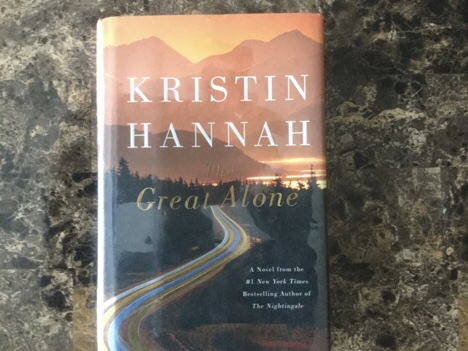
The title of this new novel from the writer of the acclaimed The Nightingale comes from Robert Service’s name for Alaska. Set largely in the 1970s and 80s, with the pioneering families escaping the turmoil of the lower states, like the author’s family, the wild beauty, but also the formidable challenges, of living in the last frontier are on full display. Intertwined with the outer challenges of survival in the harsh unforgiving environment are inner challenges of overcoming nightmares of the Vietnam War, poverty, domestic violence, tragic premature deaths, and adapting to the quirky personalities of their fellow frontiersmen.
The complex plot has many ingenious, unpredictable twists, and some of the characters are realistic, charming, and lovable eccentrics like Large Marge, the black exNew York cop who owns the general store. Others are detestable paranoid recluses preparing for the apocalypse, who cannot adapt to any change in their primitive way of life. The struggle to escape from the abusive violent Vietnam War POW veteran with what would now be called PTSD reminded me of the numerous books, some novels and some biographies, about escape from restrictive religious cults e.g. Tara Westover’s Educated.
Like some of Hannah’s earlier novels (by reputation-I have not read them), the romance between Leni and Matthew descends into Harlequinesque sappiness, that was not a feature at all in The Nightingale. There is also far too much melodramatic emotional self-analysis and introspective pathos here for my taste. At the risk of being accused of gender stereotyping, I note that all the gender-identifiable reviewers who rave about this book on the jacket are female. This is no The Nightingale, a novel that I loved. I prefer the Alaska as portrayed by James Michener in his epic classic by that name.
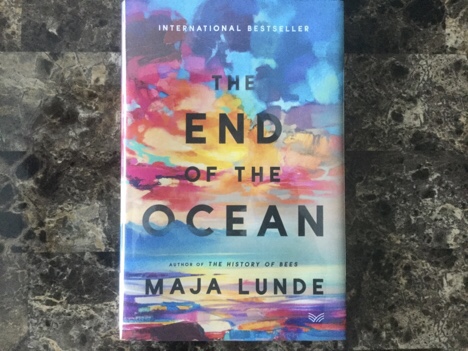
In this remarkable story, alternating short chapters are narrated by Signe, a single Norwegian environmental activist and journalist and by David, an unemployed former desalination plant worker in northern France. The settings are respectively in Rigfjorden and Eidesden, in the beautiful pristine fiords of Norway starting in 2017 and in a refugee camp in the north of France in 2041. There is no hint of what connects Signe with David and his young daughter, Lou, until late in the second half of this dark story. The latter are in danger of dying of thirst and starvation, languishing in a filthy French refugee camp, fleeing from drought and fires devastating Southern Europe. It is like reading two parallel novels until the connection between them is revealed near the end of the story. Although they never meet, the connecting thread (limited life-sustaining potable water) is symbolically powerful.
There is abundant drama and uncertainty, particularly with Signe alone in the stormy North Sea in a battered old sailboat, and in the filthy refugee camp. Very timely commentary with balanced viewpoints deals with the ethics of responding to peaceful but unlawful civil disobedience, and the conflicts between economic development and preservation of a way of life and of the environment. Families disintegrate over differing beliefs about the need to address the serious consequences of man-made climate change. There are no heroes or heroines; all of the characters are realistic flawed human beings. But Lunde, like John Irving, has a knack for making the reader like even the scoundrels. There are no easy answers to the big questions and Signe’s repeated reference to feeling as though she is stuck in a frequently agitated snow globe is a beautiful apt analogy that could be applied to the whole species.
David’s sexual exploits with equally filthy Margarette seem unrealistic for a stinking, starving unwashed refugee who claims to love his missing wife and infant son, and don’t add anything to the story. If fact, in my humble opinion they detract from the stark realism of the rest of the story. But many authors espouse the advertising mantra: “Sex Sells.”
The uniting theme of the urgent need to deal with looming climate change is a stern warning to all readers. I am in no position to judge whether or not Lunde’s predicted dire consequences of our collective failure to do so are realistic or not, but the danger should certainly be taken seriously.
One great quote relating to Signe’s parent’s dissolving marriage: “Nothing is uglier than something that was beautiful.”
This is a very modern novel just translated from the Norwegian last month, and one of the best and most timely that I have read in a long time, with cleverly crafted prose, even in translation. I highly recommend it. It is guaranteed to generate lively and possibly contentious discussion in any book club.
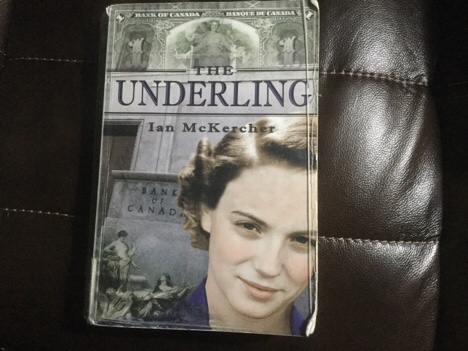
This historical fiction, far more fiction than history, is set largely in Ottawa and deals with the establishment of the Bank of Canada. If you think that a novel about banking can’t be a fun read, think again. The author incorporates abundant local colour around his and my adopted second home of Ottawa as it was in the 1930s, and taught at Glebe Collegiate until he retired. The central character, Frances McFadden, is a teenage tech school dropout who nevertheless parlays her typing skills and smarts into a major role in the planning and establishment of the central bank. As World War 2 looms, the story veers into the genre of an international spy thriller with enough suspense to satisfy David John Moore Cornwall a.k a. John Le Carre.
This is McKercher’s first novel with two sequels and an unrelated story now in print. It was published by the then Renfrew-based General Store Publishing House (GSPH) that was one of the rare publishers that would accept books written by unknown first time authors including yours truly. (GSPH published my first book, Medicine Outside The Box, in 2011, and contracted to publish my mere mortals novel, but then was forced out of business before fulfilling the contract.) Tim Gordon, the GSPH owner has now reestablished a publishing house in Burnstown, up the valley, that has published McKercher’s other stories. Small independent publishers are a dying breed and I wish him well.
A good quote: “Part of being an adult, Frances McFadden, is living with some things we don’t like. About ourselves. About others. About life.”
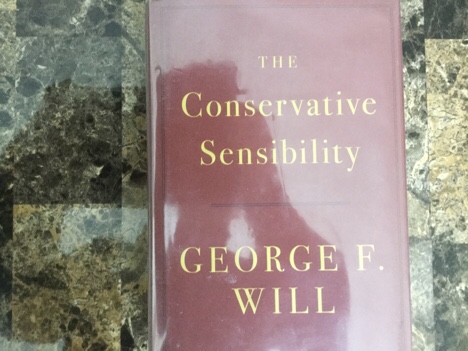
As soon as I noticed that this political tome was dedicated to the memory of Barry Goldwater, I realized that I would have difficulty overcoming my biases and keeping an open mind about its contents. But I’ll try to give it an honest review.
George F. Will is the elder doyen of American Conservatism, at least as he defines it, an Oxford and Princeton graduate, a Pulitzer Prize winner and, a syndicated columnist for The Washington Post, once owned by Rupert Murdock, now by Jeff Bezos. This, his fifteenth book, is the only one I have read.
First the positives.
1) There is much to admire in the clarity which Will brings to the differences between what he calls conservatism and progressivism in conceptions of the proper role of government in a free society. Based on his almost worshipful admiration for the Founding Fathers, the Declaration of Independence and the American Constitution as the unerring literal last words on how to organize a democratic society, he makes a very strong case for a minimally interventionist small government that exists only to protect the rights and liberties of individual citizens. He sees those rights and liberties as innate unchanging features of human nature rather than being granted by a government.
2) The whole book is chock full of interesting historical anecdotes and facts, e.g. Hitler was not an ethnic German (Austrian), Napoleon was not French (Italian), and Stalin was not Russian (Georgian). There are many counterintuitive perspectives that are difficult to disagree with.
3) After heaping supreme praise on the founding documents, Will fills hundreds of pages documenting the many problems with American government and society as it has evolved since. His ridicule of regulatory capture by rent-seeking special interest groups, the abdication of responsibility of Congress to the executive branch, the explosive growth of self-serving bureaucracies, and judicial failure to rein in creeping central government restrictions of citizens’ liberties as defined in the Founding Documents – these are all spot on. Why should government dictate the price of pressing men’s pants, or restrict the right of anyone to become a flower arranger? The best summary of his complaints is this quote: “Government power is increasingly concentrated in Washington. Washington power is increasingly concentrated in the executive branch, and executive power is increasingly concentrated in agencies that are unconstrained by legislative control.”
4) The deep philosophical musings in the chapter Welcoming Whirl on the role of religions and modern sciences in a democratic society is respectful of differing beliefs, detailed, interesting and thought-provoking. The conclusion that it is not essential to believe a religious creed to be moral and to be awed by nature is one I have come to accept as a card-carrying humanist. In discussing neuroscience, Will skids close to denial of the existence of free will. Pardon the pun.
Obviously, Will is very knowledgeable in the fields of political science, history, economics and philosophy (there is a 37 page introduction, a 19 page “Selected Bibliography”, 23 pages of Notes, and a 15 page Index, not included in the page number I noted above). Few others have such extensive experience and knowledge in this field, leaving little room for counterarguments unless one refuses to accept his basic unstated assumptions about human nature, the wisdom of the Declaration Of Independence and the Constitution, and the unique virtue of American exceptionalism, as I do.
Now the negatives.
1) The writing is humourless, dry, and pedantic, with many examples of distinctions without a difference, (one of the author’s favourite phrases), and the reasoning often seems convoluted, though to be fair, the factual knowledge is encyclopedic in its scope.
2) Both the underlying assumption that human nature is immutably fixed and that this confers natural rights to liberty and the pursuit of happiness are untestable philosophical assertions that are suspect. I doubt that the historian/philosopher Yuval Noah Harari (Sapiens) would concur with the former assertion, nor the political scientist Francis Fukuyama (The Origins of Political Order) with the latter. My “human nature” has nothing in common with that of concubines who willingly were buried alive with their Chinese emperor.
3) The much lauded statement that all men are created equal is one of the silliest assertions ever enshrined in an historical document, very different from the indisputable moral assertion that all men (and women) should be granted equal rights and privileges. The Founding Fathers obviously didn’t put into practice their assertion of inalienable equal rights when it came to blacks, women and Natives whom they slaughtered with abandon. Will seems to excuse this as an example of “presentism”- the application of today’s moral standards to previous generations.
4)The American boosterism becomes grating. Will describes the second paragraph of their Declaration of Independence as “ the most important paragraph in humanity’s political history.” What makes it more important than parts of the Magna Carta?
“[Americans] correctly believe that its political arrangements, its universal truths and the understanding of the human condition that those arrangements reflect are superior to other nations’ arrangements.”
“America, the first and most relentlessly modern nation….”.
5) If the pursuit of happiness is, as asserted, a uniquely American goal, why is America ranked #19 out of 156 countries in the well-validated 2019 U.N. Index of National Happiness, behind all the socialist Nordic countries, Canada (#9), and Costa Rica (#12)?
6) There are several simple factual errors. America is not the only country with an exact date of origin, as asserted. Humans are not the only species who can experience melancholy, and/or boredom, as any dog owner can attest.
7) Although written, or at least published, in 2019, the name Trump is never mentioned and there is no discussion of the role of American conservatism in the rise to dictatorial power of this rogue Constitution-ignoring egotist, though in an interview with Peter Wehner in The Atlantic, (July, 2019), Will thoroughly castigates Trump. I think it must have been that review that persuaded me to slog through this book, as no true friend recommend it to me.
I see that I have listed more negatives than positives-perhaps not fair as I did gain a lot of insight into the mindset of American conservatives from this book. But it is not for everyone and if you are a liberal minded non-American with high blood pressure, reading it could be lethal.
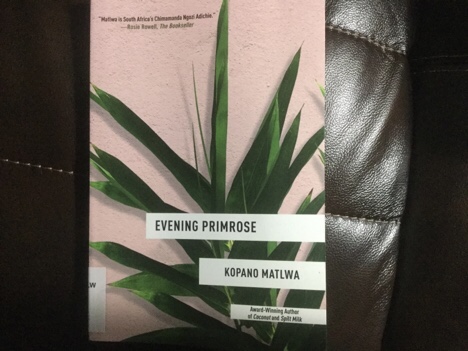
I was not familiar with this black South African physician-novelist until I saw this short story at the library, while looking for anything worth wasting time on. This, her third novel, is written as a cri du coeur journal record of the uncertainty, anguish, and self doubts of a deeply religious new medical graduate doing an internship in post-apartheid Pretoria. Many of the journal entries are direct questions to her God about the unfairness of the world in which her teen brother has committed suicide, she fights violent xenophobic black nationalism, is gang raped, and deals with her own descent into psychotic depression, guilt, and sense of worthlessness.
She exposes the cognitive dissonance of believing in an all-loving God who nevertheless never seems to answer her prayers or come to her assistance. Although she never directly questions the existence of God, she doesn’t hesitate to accuse him of favouritism and desertion. In many ways, this a modern day Book Of Job without any definitive answers to the many deep philosophical questions raised. Or perhaps more like the Old Testament book of Lamentations- dark and disturbing but thought-provoking.
Written in very short phrases or sentences, with frequent quotes from the Bible, this is an easy read, but raises profound questions that defy any easy answers. I got a very different take from this read than most of the reviewers on the jacket who concentrate on its political and racial context. Although it is set in South Africa sometime around 2010, it deals with meaty universal issues that should be of interest to a wide readership. It is far from clear to me to what extent this is autobiography.
Speaking to God: “I don’t know why I speak to You. You never speak back. Your silence is everywhere. It’s thick and plugs up the air.”
Alan Turing works on Artificial Intelligence in his lab in 1983 even though he committed suicide in 1957. In the same year, Britain loses the Falklands War to Argentina, with heavy losses, Margaret Thatcher’s government loses the election to the Labor Party, Jimmy Carter begins his second term as U.S. president, having defeated Ronald Reagan, British electric cars go 1000 miles on a single charge, and the first person singular narrator of this sci-fi tale reads the news on his iPhone. A computer company has developed and sold 25 programmable humanoid companions that pass for true humans, spouting poetry, with greater memory capacity than the usual human, and conversing with their owners. These obvious deliberate distortions of history must serve some deep literary or philosophical purpose that is far from clear to me. Why is the possibility of beings developed in computer labs that rival Homo sapiens not set at some future time with truly fictional characters? Perhaps the author wishes to convey the ideas that in some sense Alan Turing is still alive and that history is largely a fiction that we are forced to believe because of our limited intelligence? I am just guessing.
I read this book as an ebook, borrowed from the library, because it is on the agenda for my book club. The characters are realistic and there are enough surprising plot twists to keep me intrigued.
A couple good quotes: “But a mood could be a roll of the dice. Chemical roulette. Free will demolished, and I was here feeling free.”
Alan Turing describing the human brain. “A one-litre liquid-cooled three-dimensional computer. Unbelievable processing power, unbelievably compressed, unbelievable energy efficiency, no over-heating.The whole thing running on twenty-five watts-one dim lightbulb.”
I generally dislike sci-fi, but for fans of the genre this will be a gem and it is now being presented as a television serial. And I can accept that beings created in labs from Artificial Intelligence algorithms may at some future point pose a threat to the earthly supremacy of our species, but not in my lifespan. I still prefer McEwan’s Saturday.
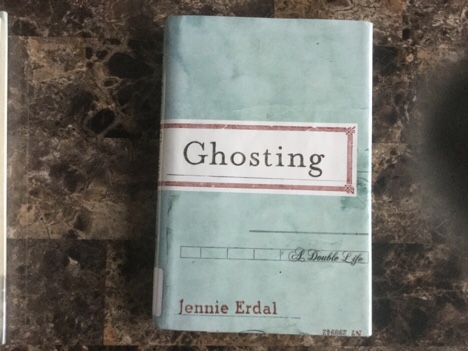
“Autobiography is unreliable. A lot what we remember is designed to shield us from painful truths.” There is no recognition of the irony in this statement in this autobiography of this Scottish polyglot writer. Educated in languages and classics, she fell into a job as a ghostwriter for a rich, flamboyant, egotistical, tyrannical, obsessive compulsive London publisher whom she names Tiger. She never reveals his real name nor the publishing house he owned, probably because he is still alive at age 89, so I will not either, although those details can be readily found. This is Erdal’s first book under her own name, although she ghostwrote several books that were published under Tiger’s real name, along with many newspaper articles, book reviews, and short biographies. Tiger had access to many members of British high society, spent lavishly and was an uncompromising control freak who could make the lives of his employees, mostly young beautiful women, pure hell.
Much of the writing is consumed with what it means to be a writer, the love-hate relationship between the ghostwriter and the putative author, and the construction of fictions, both in writing and in memories. The discussion of the almost infinite ways to relate sexual encounters in works of fiction is superb and nuanced. Many of the disagreements between the female twice married ghostwriter and the married male putative author relate to this difficult area. Should it be explicit, mechanical and pornographic or more subtle, leaving details to the imagination? I may be called prudish, but I prefer the latter, especially if the book is to be discussed or read in mixed polite company. There is no suggestion that their relationship was in any way sexual, although they spent weeks together away from their respective spouses, and often swam together in the pool at his isolated French mansion, au natural. Tiger’s wife is only mentioned tangentially once in the whole book, attending a high society party. Perhaps this is due to his non-British societal misogynist background.
There are hilarious recollections of Erdal’s early childhood in a strict parochial Scottish Presbyterian family, and her gradual discovery of the outside world including that of sex. And there are eternal and insightful reflections on the meaning of loss- of a parent, a loved one, a marriage, even a favourite dog.
A great quote on self presentation and self image: “We all wear masks; it’s just that some masks are worn so tightly that they begin to consume the face behind them.”
I enjoyed this book, as will anyone who is even peripherally involved in the world of books and publishing.
Thanks to fellow blogger Simon Thomas (Stuck In A Book).
these are just a few of the adjectives from the first half of the alphabet that came to mind as I read this short but weighty book. Add ‘opaque’.
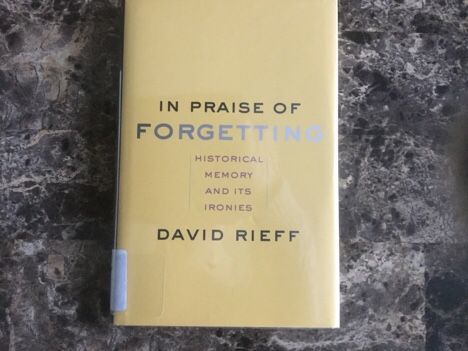
With wide-ranging quotes from philosophers, historians, politicians, writers and social scientists there is no doubt that Rieff, the son of Susan Sontag, is a knowledgeable deep thinker. But either his ability to put his thoughts and arguments into plain easily understood language or my comprehension is deficient. He seems to assume that all readers are familiar with the arguments and counterarguments of the often obscure (to me at least) people he quotes.
The only quote I chose (below) is one of the more easily understood sentences and may be the best summary of the thesis of the whole book. But why use short words and simple sentences when long words and convoluted sentences can convey the ideas almost as well?
“…far too often collective historic memory as understood and deployed by communities, peoples, and nations- which again is always selective, more often than not self-serving and historically anything but unimpeachable- has lead to war rather than peace, rancour and resentment (which increasingly seems to be the defining emotion of our age) rather than reconciliation , and to the determination to exact revenge rather than commit to the hard work of forgiveness.”
Even though I accept that its central thesis, that it is often better in the context of historical wrongs for individuals, societies, and nations to forget than to remember may be valid, I cannot recommend this book to anyone. I conveniently have forgotten where I saw or heard the review that induced me to get it from the library.
This Alberta novelist describes a wide variety of very realistic characters with all their flaws, in 49 titled chapters, and straightforward third person narrative. The story covers about 10 months in about 2000 in the aftermath of a Saskatoon collision of two cars carrying passengers who have absolutely nothing in common. She largely relies on character development rather than sudden plot twists to keep readers engaged, and certainly succeeds. She even manages to get into the heads of three small children and see the world through their eyes.
The central character, a long-divorced introspective female insurance broker questions the meaning of her unfulfilled life following the accident that she caused and vows to become a positive force in the world. But her good deeds are under-appreciated and at times she feels used rather than useful. Existential questions about what it means to be good resonate in the musings of a variety of colourful characters, surrounded by the evil unappreciative players they try to help. There are no definitive answers provided to the enigmatic questions raised about what it means to be good, to do the right thing, and no definitive outcomes for any of the characters.
At times I found it a bit difficult to keep track of some of the peripheral characters, but on the whole, this was not a major problem. The description of the complexity of hospital life and the life-threatening cancer treatment one lady undergoes is spot on, even to the point of documenting an allergy transmitted to the recipient of a transplant, something I have observed in three patients, but is not a widely known phenomenon.
One of many great quotes, this one from the musings of a poetry-spouting, doubting, childless Anglican priest in a marriage that is about to dissolve: “The proximity of death makes us remember our own insignificance, that no one will remember us, that we are animate atoms, at most; our lives don’t matter. But the children do. If there are any children. A chicken: an egg’s way of making more eggs.”
This is one of the best novels I have read in a long time-and it is distinctly Canadian. I highly recommend it, but can’t recall who recommended it to me.
This detailed modern history lesson by an Assistant Professor of History at the University of Chicago ties the increasingly organized development of the U.S. white power movement in its various forms to the return of disappointed and frustrated veterans of the Vietnam War, and the later gulf wars. She convincingly shows that this diverse group, which she refers to as white power advocates rather than as racists, Neo-Nazis, white supremacists or anti-semitics was and is much more coordinated, united and dangerous than is commonly appreciated. A large percentage of them are veterans who were poorly appreciated and poorly rewarded for their efforts on behalf of Uncle Sam. The author attributes their adoption of radical racist ideology and advocacy of violent overthrow of the government to this disappointment. But she never mentions what must be even more important- the general lack of education and job training of military recruits. The average age of Vietnam war era draftees was 19, and they were taught how to kill, often indiscriminately, but were untrained in any skills useful in peacetime. To me it seems that she identifies hundreds of trees, but not the forest.
There are constantly changing alliances between groups such as the branches of the Klu Klux Klan, the Order, the Posse Comitatus, the Aryan Nation, the Sword and the Arm of the Lord, the White Patriot Party, The Covenant, United Citizens for Justice, United Racist Front, The Mountain Church, Patriots Defence Foundation and CMA (Civilian Military Assistance). Some are allowed to receive tax-deductible donations as religious organizations or charities. They often recruit active military personnel, steal heavy arms and ammunition from military bases ( especially in North Carolina) and train in secret paramilitary camps. Many are aligned with violent millennialist religious fanatics. Their increasing militarization is paralleled by the militarization of law enforcement with armoured personnel carriers stockpiled on both sides. Lawyers for the extremists ensure that juries are sympathetic to the extremists, often portrayed as patriots and protectors of white oppressed women. True believers in the conspiracy theory of a Zionist Occupation Government (later dubbed The New World Order), many also are dedicated survivalists preparing to outlive those of us left behind at the coming Apocalypse.
All writers about contemporary societal threats need to emphasize the danger to sell books. But this scholarly treatise (851 notes) convinced me that the threat from those extremists is very real and more serious than is generally appreciated. But it is also as dry as the current Australian desert and my high school history texts, and much more detailed than necessary to make that case. And the documentation stops in 2006 with the execution of Timmothy McVeigh, except for a few meaningless words about Donald Trump in the last three pages with the weak excuse that the effect of his blatant racism is too contemporary to analyze in a work of history. That is unforgivable. A knowledgeable scholar like this author could afford to provide us a useful, if only tentative, perspective of where we are now.
This book by the Cape Town writer is called a novel, but thoroughly blurs the distinction between fiction and biography, relating as it does to the life, travels, and writings of Edward Morgan Forster. It could, perhaps more accurately, be described as an embellished biography although there are several older extant biographies of E.M. Forster. The title allegedly was considered by Forster for an novel he was planning.
It is clear that E.M.Forster led a troubled life, related in large part to his secret homosexuality at a time when openly gay relationships were rare and despised. Forster never acknowledged his sexual orientation to his family although he had both casual and deeply loving relationships with several men, at least two of whom were married with children, and one was an ex-Muslim. He, or at least the character portrayed in this ‘novel’, seems to have had a very wide ranging emotional scale ranging from deepest despair to sublime elation, combined with
profound self-doubt and constant introspection. Is the ability to experience emotions on a very broad scale a trait that is more common in homosexuals?
The detailed description of sexual encounters in many novels generally disappoint me. Call me a prude, but I don’t think that graphic descriptions of deployment of a wide variety of combinations of appendices and orifices in pursuit of thills is necessary or contributes much to the literary value of novels generally. I would rather those combinations whether heterosexual or homosexual be left to my imagination than be described in great detail as occurs here. Younger readers may well disagree. But there is a very important and under-appreciated vast difference between yielding to hormonally-driven lustful momentary urges and the far more complex interplay between sexual activities and what is called love, and that distinction is made very clear in this account. The protagonist was capable of both activities, including sadomachoism, but certainly never confused them, and the depiction of the strong emotional bonds between men in this book-those bonds that have little to do with genitalia- rival those of the great romance novelsj
A couple of good quotes
“He had learned to distrust purity- or the idea of purity, rather because the real thing didn’t exist. Everybody was by now a blend; history was a confusion; people were hybrids.”
“A failure to decide is a sort of decision.”
This book will be greatly enjoyed by anyone in a sexual minority, and many straight people as well. My only real criticism is the overemphasis on sex generally and the unnecessarily detailed description of the mechanics of copulation. For some readers, that may be its big attraction.
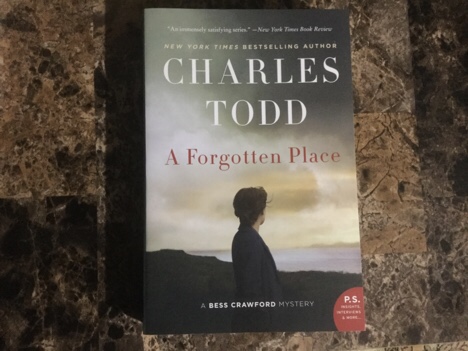
The latest, or one of the latest, in the long series of Bess Crawford mysteries by the mother and son team known as Charles Todd, this one was another Christmas present. They apparently are all set during or just after WWI and star the fictitious British army nurse Bess Crawford. This one starts in December, 1918 in a field hospital in France, then moves to a field hospital for the returning soldiers in England and then to an isolated Welsh peninsula with a dark past and a population of poor hermits, misfits and unsolved crimes.
A la Sherlock Holmes, the narrator, Bess Crawford seems to have an uncanny ability to piece together far-from-obvious clues to solve the mystery of dead bodies washing ashore, strange beatings and the secrets known only to the residents who shun outsiders and any authorities. But Charles Todd is no Sir Arthur Conan Doyle. The pathos, hardship, and despair of the wounded is well described, and there are abundant surprise twists. But the weak attempts to build suspense include too many unlikely chance clandestine meetings and beatings of mysterious characters on dark and stormy nights to be believable. The geography of the peninsula and the sites of the meetings and beatings are poorly described and confusing, at least to me. It is almost beyond belief that the narrator could even survive the machinations of the locals determined to keep their secrets to themselves, let alone solve their mysteries.
This is a fun light read, but it failed to make me a fan of the heroic Bess Crawford. I will not be reading the nine other novels featuring her nor the twenty three other mystery novels by the same author. But I am not a generally a fan of formulaic mystery novels to begin with, and this did nothing to change that. Others may well relish this genre.


 The Passionate Reader