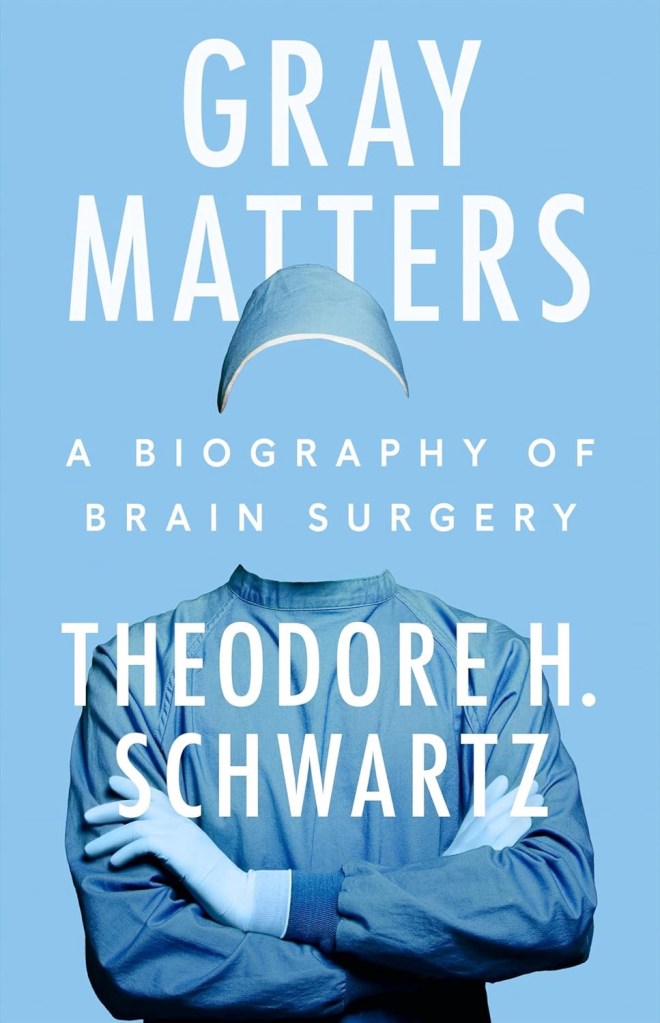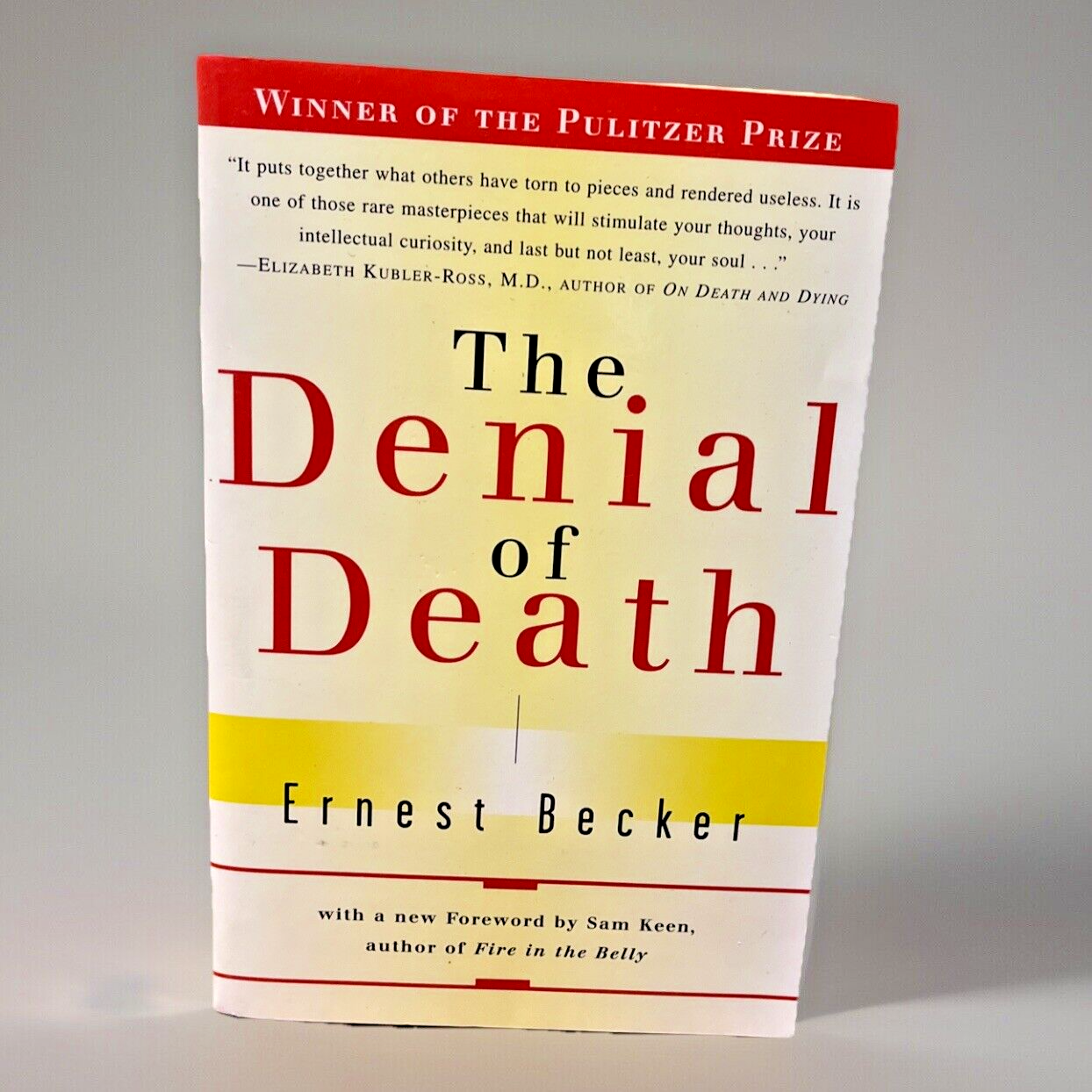
Gray Matters. Theodore H. Schwartz. 2024. 449 Pages. (Hardcover.).

A Cornell Weil professor of Neurosurgery in Manhattan details much of what is known about the working of the human brain and exactly how neurosurgeons try to help when it goes awry, whether from trauma or natural causes.

The neuroanatomy, the surgeon’s instruments and the site of pathology are laid out in helpful diagrahms that are generally readily understandable. The examples of famous people with major problems including JFK, RFK, Eva Peron, Phineas Gage, Rosemary Kennedy, Ted Kennedy, John McCain and a variety of famous neurosurgeons make the stories real. Late in the book, the rapidly developing field of brain computer interfaces is subjected to some rather far-out speculation that may well become a common reality.

Early on the author seems to be quite humble, but by half way through, he cannot resist touting his role in leading innovations and his sacrifices in getting to what he clearly considers to be the pinnacle of the pinnacle of medical professionals. He criticizes some collegues in the luxury world of New York medicine where second a third opinions seems to be the norm. He blatantly interfered with the local hospital routine in dealing with his father’s illness. A humble neurosurgeon may be an oxymoron, but I tire quickly of medical specialists, mostly surgeons, blowing their own horn in books that they write.

He seems to lack some pretty basic knowledge. Sap runs up a tree trunk not down it. The test for shifting dullness is used to to detect free fluid in the abdomen, not for appendicitis.

For the amateur trying to understand something about how the brain works, this is a good read.

3.5/5

Thanks, The Economist.

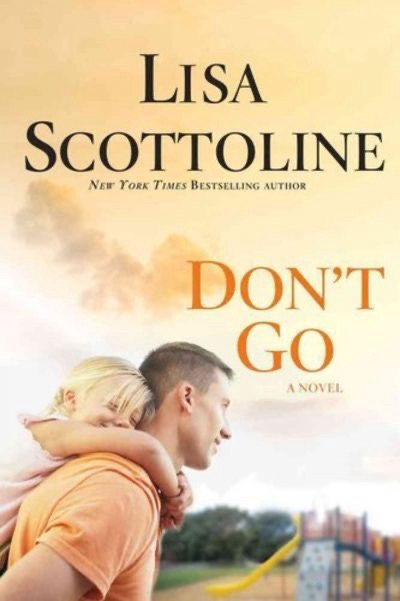
Don’t Go. Lisa Scottoline. 2013. 11 Hours, 22 Minutes (Audiobook on Libby.).

In this murder mystery thriller, the Pennsylvanian lawyer/author relates the complex story of a U.S. army orthopod, (referred to as a podiatrist) in Afghanistan whose wife dies at home, leaving a infant. That is not the murder, but her friend and confiant is later stabbed to death. As usual in such books, the motive, and the identity of the perpetrator is at first obscure.

A very long emotionally-charged custody court battle, a opiate addicted would-be father, PTSD, alcohol abuse, a disabled veteran, more than one sordid secret affair, and a late-developing romance round out the complexity, with resolution of all the issues only in the last few pages. Nothing is as it seems on first presentation, but to be fair, all the issues are wrapped up in the end.

The female voices seem appallingly foreign and male in the dialogue of the audiobook.

This is not my favorite genre, and this one has even more soppy pathos than most, but for fans of the genre, this may be as good any.

3/5

Thanks, Book Browse

I Heard There’s A Secret Code. Daniel J. Levitin. 2024. 291 Pages as ebook on CloudLibrary.

I am not sure whether this author should be listed as American or Canadian as he has appointments at both McGill and Stanford universities, But he was born in the U.S. and refers to travel from his home in Montreal. He is a polymath/neuroscientist and musician and is known internationally for his studies of the responses to music using the fancy mapping techniques of modern neuroscience.

I am also certain that the lady who suggested this dry erudite book to me has not read all of it; perhaps she hoped I could explain it to her in simple language. If so, she will be disappointed.

In the first few chapters, the author outlines some characteristics of music such as pitch, melody, harmony, note duration, rhythm, meter, tempo, loudness and timbre, and tries to track each to the neurological pathways we use to enjoy music (with variable success.) The scattered sketches of neuroanatomical pathways involved and the later musical notations are labelled with impossibly small print and add nothing to the text.

Complex studies of subjects with William’s Syndrome and even attempts to define musicality left me confused. In successive chapters the author cites the supposed benefits of music therapy on a wide variety of populations such as those with movement disorders, Parkinson’s Disease, multiple sclerosis, trauma victims, mental illnesses, pain, dementia and stroke, again with variable success.

On the same page, the author claims that as a group, musicians are happier than the general population, but then “Yet statistics show that professional musicians experience greater incidence of alcohol and drug addiction, depression, poor health outcomes and higher mortality.”

While the author pays lip service to the gold standard of the controlled trial, and cites a few, he cites many more instances of anecdotal apparent benefits of music therapy and there is no doubt as a musician himself, he has a bias in seeing those benefits. As someone who never had an opportunity to learn to play an instrument or sing, and who listens mainly to classical music while exercising, and various artists when in the car (Paul Robson’s rendition of Old Man River never ceases to give me goosebumps), I can be accused of the opposite bias.

Linguistic pragmatics and situational contextual knowledge discussed ad nauseam in the penultimate chapter just confused me and I think of some future AI program choosing music for me, because it knows so much about me, as dystopian rather than utopian. Apart from repeating the old joke about Grover Cleveland and the rooster, there is no humour anywhere in this book.

The author bemoans the paucity of licensed music therapists in longterm care facilities and advocates for music as an alternative to medicines rather than a supplement to them.

In many places the text breaks what should be one word into two such as Environ mental, teste monial, typic ally, limit less, cere bellum, navi gating, cog nitive, Nat ural, reinvig orate, his torians, ness essary, pharmacol ogical, miti gate, Rehab ilitation, natural istic, Spot ify, oxygen ation, import ant and transport ation. I may be mistaken but this suggests to me that a crude AI assistant actually did much of the writing, or at least transcribed dictation without anyone spell checking.

I am sure that many amateur musicians will enjoy this book and understand it more than I did, but it left me cold.

1.5/5

Thanks, Michelle.

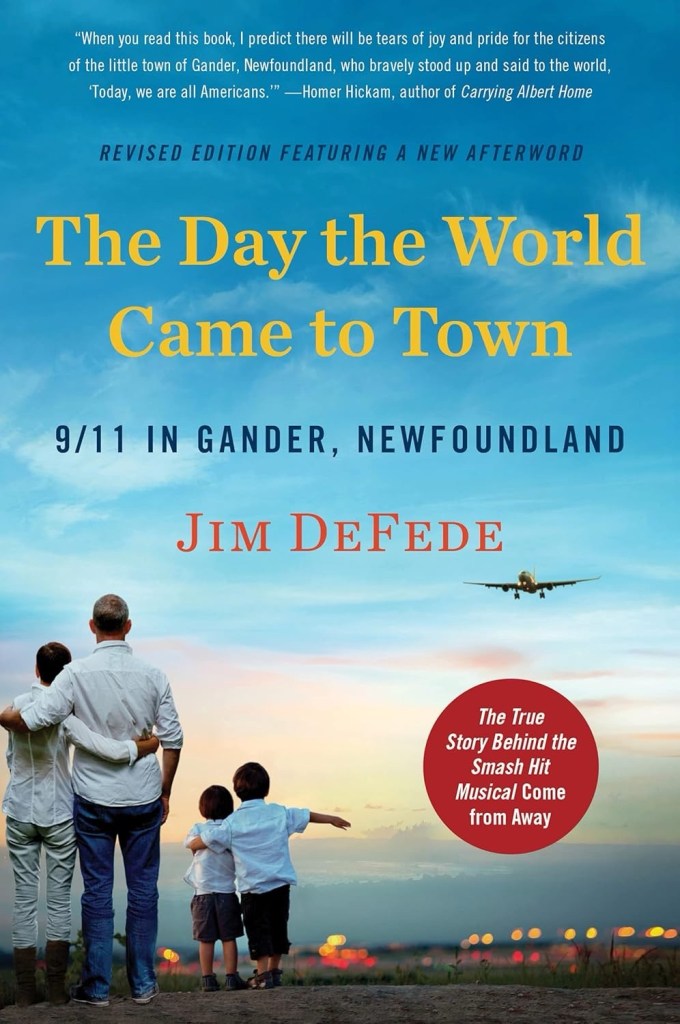
The Day the World Came to Town. Jim Defede. 2002. 6 Hours. 52 minutes as Audiobook.

A Miami journalist, documents this heart-warming book about the exceptionally kind and generous rececption the stranded travelers on 39 international flights received when they were rerouted to Gander, Newfoundland on 9/11. If you need something to convince you about the inherent kindness and generosity of most of mankind, or at least most Neufies, this is the book for you. I won’t reveal all the details but this book is bound to make you feel good and positive about the future even in the face of all the contrary evidence.

Much more detailed than the much later musical Come From Away, based on the same events, it is equally uplifting and a tribute to the people of Newfoundland. A truely enjoyable read.

5/5

Thanks, Janet.

Playground. Richard Powers. 2024. 360 pages as ebook on CloudLibrary.

I don’t recall anyone recommending this novel by the American writer to me, but I really enjoyed his «The Overstory » and «  « Bewilderment » although there is a fair bit of far-out pseudoscience in the latter.

But this book is disjointed in the extreme. Back and forth from the 1950s to the present, from the small island of Makatea in French Polynesia, to Montreal, to Chicago, Urbana, and Evanston, from the magical creation myths, the joys and discoveries of deep sea diving to game theory, chess and Go, to the deep philosophy of Russian thinkers, exploitive capitalism, and the problems of dealing with Lui Body dementia, nothing is connected to anything else.

The title is based on a mythical social network site called Playground. An AI machine does a masterful job of answering every question the 89 islanders put to it about proposed development. The AI system then becomes all powerful and all knowing beating a human genius at Go and threatening to extinguish Homo sapiens. The creator becomes a billionaire only to die of Lui Body Dementia before the development that he has proposed for the island becomes a reality.

To be fair, the description of the astonishing life forms in oceans is detailed and very interesting even if their interactions with humans is embellished. At times it seems the author is simply displaying his admittedly vast knowledge of that life and bemoaning its impending losses.

There is an attempt to tie up loose ends in the last few chapters, but it doesn’t quite work, with the time lines often confusing at least to me.

I have to acknowledge that the writing style is clear and engaging with usually short sentences in third person prose.

«Play was evolution’s way of building brains, and any creature with a brain as developed as a giant oceanic mantra sure used it. »

Of life in seemingly impossible places: «… life was never very good at obeying human logic. »

I was disappointed in this book.

3.5/5

Analysis of my book reading for 2024.

Total:102

Authors: Male/Female 54/48

Canadian:14

American: 61

British:22

French:3. Obviously there is arbitrariness

Vietnamese:1

Dutch:1. And overlap as people move

Russian:1.

Science fiction: 4

Philosophy: 4

Social commentary:20. Again overlap with history and bio

History:18.

Bio/Autobiography:13

Sciences:26

Fiction:

Nonfiction

Historical fiction: 5

Humour: 2.

Longest: The Earth Transformed. 667 pages

Shortest : Held: 118 pages.

0ldest: Sunshine Skerches of a Small Town 1906.

Newest: Heretic 2004.

So I have to update . The newest is gprobably The wandering Ghosts although many are from 2024.

Analysis of my book reading for 2024.

Total:102

Authors: Male/Female 54/48

Canadian:14

American: 61

British:22

French:2. Obviously there is arbitrariness and overlap as people move

Dutch:1.

Russian:1.

Vietnamese:1

Nonfiction

Sciences:26

Social commentary:20. Again overlap with bio and history.

History:18.

Bio/Autobiography:13

Philosophy: 4

Fiction:

Science fiction: 4

Historical fiction: 5

Humour: 2.

Longest: The Earth Transformed. 667 pages

Shortest : Held: 118 pages.

0ldest: Sunshine Skerches of a Small Town 1906.

Newest: Heretic 2004.

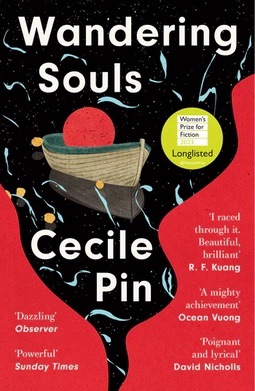
Wandering Souls. Cecile Pin. 2023. 189 Pages. (Ebook on Libby.) (7 Hours, 55 Minutes.)

The plot of this French/English author’s debut novel is quite simple- after the Americans leave Vietnam to the communists, a large South Vietnamese family plan to escape to America, but only three adolescences make it even as far as a refugee camp in Hong Kong and eventually to Britain, not the U.S. But that is just the skeletal plot as the emotional trauma takes its toll, and the reflections on remorse and grief and the musings about the deeper meaning of life move to the forefront.

Most of the writing is straightforward narrative of the three surviving family members, but there is also a lot of history including the racism of Thatcher’s Britain. There is also fanciful thoughts of the deceased ghosts, and a few musings that seem to be those of the author, reflected in first person singular narrative.

“ ‘There is a tradition in the Vietnamese culture’ he said. They believe that you need to give your dead a proper burial in their hometown. If not, their souls are cursed to wander the earth aimlessly as ghosts.”

The life in crowded refugee camps is described in detail.

“As they grew older, the lack of privacy was becoming more burdensome; they could hide nothing except their thoughts and sometimes even those seemed to be on display.”

The grieving process is analyzed in some detail.

“ There is a proper way to grieve in the eyes of others…. But there is a part of grieving that occurs behind the curtains, a part that is just for us and the deceased…. It is in this private communion that we can find solace.”

Racism is still very much in evidence during the Covid endemic as the Vietnamese are looked at with derision.

“She didn’t steal anyone’s job and she didn’t get in trouble with the law. She had followed all the rules and been a model citizen. Yet when people looked at her, all they saw was otherness.”

A remarkable realistic and sober well-written book.

4.5/5

Thanks Jean.

Kingmaker. Sonia Purnell. 2024. 447 Pages. (Hardcover.)

This third detailed biography of the late (1920-1997) controversial aristocratic British/American courtesan (a euphemism for a high-end prostitute) written by a British journalist and writer is extremely laudatory, unlike the earlier two.

Born to the family of a British baron, she became intermittently wealthy, but spent lavishly on jewelry, art, endowments, New York and Washington homes and travel on private planes.

Never well-educated but apparently beautiful and charming, she used those traits to seduce at least dozens of men, if not hundreds, most of whom I could not keep track of. It seems that their marital status was of no concern to her, and she only married three, Randolph Churchill, LeLand Hayward the theatre producer, and Averill Harriman, divorcing Churchill and and outlasting Hayward an Harriman. Those marriages did not stop her from bedding others, including Edward R. Morrow, Greek shipping magnets, the heir to the Fiat empire, numerous Hollywood stars including Clark Gable, and Gianni Agnelli, and perhaps most notably, Ali Khan who is said to have taught her how to better satisfy men in bed.

It seems that wealth and influence in the circles of power were of some major consideration, and her intermittent wealth became suspect with multiple family feuds and lawsuits.

To the author’s credit, none of the sexual liaisons are described in pornographic detail.

It seems that most of her family and friends among the rich and famous also regarded marriage vows as mere suggestions, and l lost track of the number of extramarital liaisons described, many of them not at all secret, among the glitterati that she travelled with.

There is no doubt that she was bright, energetic and influential, obtaining a posting to Paris as U.S. ambassador late in life where she may have been critical in persuading Bill Clinton to intervene to the the Serbian war. But I suspect that most of her political influence was simply bought, and probably exaggerated.

I learned as much about the lives of the (totally foreign to me) numerous rich and famous jet setters as I did about the individual of the title from reading this book, and it is not at all reassuring.

The author errs in at least two minor respects, Harriman’s leg fracture was undoubtedly a pathological one due to his known metastatic prostate cancer, and not ‘bone cancer”. And I doubt that any head trauma in her youth lead to a lifelong streak of white hair, that does not show up in the jacket photo.

The writing at times is tedious and wordy. I thought on first reading that she had died of a heart attack until she showed up again a few pages later. On rechecking the heart attack was Mary’s but the wording is ambiguous.

4.0/5

Thanks, Andra.

Heretic. Catherine Nixey. 2024. 279 Pages. (Hardcover.)

This British journalist and scholar delves deeply into the many different theologies that characterized the Christian Church in the early years, mostly up to about 400 A.D., but with some discussion of the Crusades and modern times as well.

There were many almost unbelievable atrocities committed in the name of Christ and extensive borrowing of mythological events from other extant religions of the area, mostly Europe and North Africa. I am amazed at what impossibilities otherwise quite rational people are prepared to believe when religion is involved.

The inventiveness of cruelty to dispatch perceived enemies sometimes makes the gas chambers of the Holocaust look unimaginative. Once Constantine endorsed Christianity, intolerance of even minute doctrinal dissidence was a reason enough to kill with abandon.

A couple quotes may give you a sense of this erudite book.


“The Infancy Gospel of James or The Infancy Gospel of Thomas, were routinely ignored by scholars well into the second half of the twentieth century. … It is understandable that some Christian may have wished to ignore them- but is intellectually indefensible to do so. Do so, and you are not writing history but theology with dates.”

“… to try to understand Mithraism from the few scraps of writings and archeology that remain is.. like attempting to understand Christianity by reading a single atheist magazine and looking at the ground plans of a church.”

39 pages of bibliography, 32 pages of notes and an extensive index testifies to the scholarship involved in producing this book, if real scholars of religion need more ammunition. I am not one of them.

3.5/5

Thanks, Andra.

A Walk In The Woods. Bill Bryson. 1997. 581 Pages. (As ebook on Overdrive.) (12 Hours, 46 minutes).

Perhaps best known for his light and often silly humour this New Hampshire author includes an abundance of that but includes a serious, detailed history of icons of American history like Stonewall Jackson, and Harper’s Ferry, as he hikes parts of the Appalachian trail with a quirky friend. Included is the sad history of coal mining and oil drilling in Pensilvania and the sarcastically described destruction of forests by the United States Forestry Service, in the pocket of lumber companies, and of biodiversity by self-serving developers. The Army Corps of Engineers is scorned for their keenness to build poorly designed dams on pristine rivers.

Centralia in Ohio was a smouldering fire for 30 years due to an underground coal mining explosion and a desolate landscape in a nearby town is described vividly. There is a plethora of U.S. history and geography although Bryson denies being a geologist.

The many trials of hiking the full 2,200 miles of the Appalachian Trail eventually proved too much for the pair, but their reflections of harrowing narrow passes, getting lost in a snowstorm and wildlife encounters gives the book an adventure quality and keeps the reader engaged.

My only experience with anything remotely similar was in 2017, when my daughter took me to Tierra del Fuego for a one day hike. The bus took us considerably further than planned and we then hiked for what seemed like an eternity back to where we were to meet the bus, over rocks, ice, tree roots, and hills in freezing rain and snow. We missed the bus by hours and I was in agony with my patellofemoral syndrome.

4.0/5

Patriot. Alexi Navalny. 2024. 474 Pages. (Hardcover.).

The tireless late Russian anti-corruption lawyer, protester, and would-be president starts this memoir with the harrowing experience of being poisoned by nerve gas and his slow recovery from that in hospital in Berlin. He then backtracks to his early life and proceeds in largely chronological order, detailing his life, documenting his efforts to improve the lives of ordinary Russians, and the many arrests and convictions, on trumped up charges, and the harsh life in prisons that he experienced, the last in remote Siberia.

“it is a banal thought, but the human brain is designed in a way that means you return in memory only to what was good in the past. Those who are nostalgic for the U.S.S.R. are in reality nostalgic for their youth-a time when everything was in the future.”

“Here in prison any psychologist would have a ball. You could write a hundred dissertations on the amazing capacity of human beings to adapt and derive pleasure from the most trivial things.”

One aspect of his very detailed recollections from his two weeks in coma troubled me a bit as a practitioner. It is well known that when someone is in a coma, they invariably experience ‘retrograde amnesia’ i.e loss of memory for events before the coma for a similar period of time as the coma. Yet he relates great detail of just such events. I can only conclude that these details must have been provided to him by friends.

The whole book may be interpreted by some as simply self-righteous justification for his actions, but to me he comes across as a brilliant, and indeed a righteous, altruistic, patriotic, humble, self-assured man. In a country run by ruthless autocrats, those traits eventually cost him his life. He even quite cheerfully, with his wife, predicted accurately that Putin’s henchmen would eventually kill him, urging others to continue his work.

But patriotism is, in some ways, simply the belief that your country is the best in the world because you were born there, usually a delusion. I am not sure he chose the name for the book as it is often the last decision to be made when writing a book.

A sobering important great read.

4.8/5

Thanks, Goodreads, The Economist.

The Backyard Bird Chronicles. Amy Tan. 2024. 312 Pages. (Trade Paperback.)

This richly illustrated book by the Sausalito author of The Joy Luck Club and The Bonesetter’s Daughter has coloured lifelike drawings of birds on almost every third page except for the Foreword and Preface. This is accompanied by quirky imaginative questions and assertions in Amy Tan’s distinctive style, as she observes them from the window or porch. Each observation is dated from September 2016 to December 2022, with cryptic cursive notes about them, often attributing in a tentative anthropomorphic way, some explanation of what their songs and actions may mean.

I have long enjoyed watching birds but am terrible at identifying them. From my earliest memories of watching barn swallows flitting in and out of the stable, finding killdeer nests in the pasture, robin’s nests in the crooked rail fence, raising a great horned owl fledgling to maturity, and studying penguins in Antarctica, I have appreciated the complexity of avian life, never more than when I read Jennifer Acerman’s The Genius of Birds and What an Owl Knows. And this book was a pure pleasure to read and a valuable addition to those books.

Not for list keepers who want to claim to see the most diversity of birds, but for those more interested in understanding the behaviour of about 60 particular species, Tan speculates extensively about what their songs and actions may mean and how they learn new skills, often without coming to any firm conclusions. Her obvious love of all things avian is highly infectious.

My only criticism of this book is that I had some difficulty imagining the layout of her backyard and the placement of her many feeders and bird baths. A sketch of the area would have been very helpful.

4.5/5

Thanks, Alana.

Say More. Jen Psaki. 2024. 5 Hours, 54 Minutes. (Ebook) (246 pages as Hardcover.)

For the former press secretary for Joe Biden and a variety of other jobs dealing with the public, this is in part autobiography. She refers to the title as saying things with more impact, not necessarily with more words, i.e. communication skills.

She deals with what to say and what not to say in a job interview, the most impactful use of hands and body langage, and how to deal with misinformation. The linguistic gymnastics some politicians are masters of, to avoid answering a question, often amaze me.

Perhaps the most difficult task for a dedicated public speaker is when dealing with personal attacks as happened when Russian propaganda attacked her to divert attention away from her message about the war in Ukraine. She discusses knowing your audience and tailoring the message to their level, criticizing medical specialists who use too much medicalize. The selective use of humour is a particularly difficult skill for public speakers to master, that can easily backfire.

I didn’t learn much that will help me with my limited communication skills by listening to this book, but it was a light and enjoyable session. I recall a colleague who, when asked a question, would pause, and then answer in a long grammatically perfect paragraph.

3.5/5.

Life As No One Knows It. Sara Imari Walker. 2024. 274 Pages. (Hardcover.).

This professor of astrophysics and astrobiology at Arizona State University, has produced one of the deepest densest scientific and philosophic books that I have ever struggled through. I only persisted by looking ahead to Chapter Four and hoping it would become at least somewhat understandable when she got around to discussing aliens. Before that, I attempted to grasp what it means to a physicist to be alive, to see the world entirely as controlled by the laws of physics and chemistry, and largely failed. She quotes some colleagues who deny the existence of life, discusses free will only to dismiss its existence, and distinguishes life as being different than being live. She tries but fails to delineate the borders of life. I would be lying if I claimed to understand more than small portion of the this book. And it becomes even more confusing (to me at least) later when she introduces assembly theory, the warping of space time and a variety of other concepts unique to the world of astrophysics and astrobiology.

Amid the esoterica, I was struck by one trivial feature of nature that astounded me. If you nick a deer’s antler at a particular site, the next one that replaces it after it has been shed will have the same defect! However, the explanation of this with electrical storage in the deer’s skull seemed unsatisfactory to me.

“The boundary between the phenomena we want to think of as life, and not life, is fuzzy and may not exist at all.”

“ The trouble with recognizing alien life is that we do not know what it means to be alien or to be life.”

“…we might describe life as deep stacks of causation of objects making other objects because for any complex object to exist the memory, or constraints, if you prefer, to generate it must also exist embodied in another body.”

“We cannot see ourselves clearly because we have not built a theory of physics yet as inside the universe they are describing: that understanding is muddled across seemingly disparate concepts we refer to as ‘matter’, ‘information’, ‘causation’, ‘computation’, ‘complexity’ and ‘life.’ Assembly theory is an attempt to see all these as the same thing.”

She rejects the RNA hypothesis as being unique to living organisms, and never mentions Avi Loeb’s Extraterrestial, which almost convinced me, invoking Occam’s Razor, that we have been visited by aliens, if only briefly.

I deeply admire the intelligence of this author, but am too far removed from her erudite world to ever understand much of it.

2.5/5

Thanks, Goodreads.

Autocracy Inc. Anne Applebaum. 2024. 4 Hours, 49 Minutes. (Audiobook.). (224 Pages as a paperback.)

“Democracy is the worst kind of government except for all the others.” Winston Churchill.

I always appreciate the articles by this American journalist and author in The Atlantic, and learn a lot about international relations. She starts this litany with a long list of increasing countries ruled by autocrats, including Venezuela, Zimbabwe, North Korea, Saudi Arabia, Russia, and China, among others, and contrasts them with liberal democracies.

With her rapid-fire staccato voice, and in mostly short dry assertive sentences she first documents a frightening trend with massive money laundering all over the world including Russian oligarchs indirectly buying Trump properties through shadow companies that are difficult to trace.

There is no mention of Malal, nor of Nelson Mandela, but the author documents Alexi Navalni’s, death and the sabotaging and hiding his funeral to avoid protesters, and also mentions the lies about Khashoggi’s death.

Global in scope, this small book seems depressing, but it goes a little way to explain Donald Trump’s friendship and backing of Putin.It is light on means of countering the prevalent increasing damage that autocrats achieve until the Epilogue, and makes one wonder how anyone can ever be confident about any news, given the massive use of not only money laundering but also what the author calls “information laundering.” There are few suggestions about what any one individual can or should do to improve the situation.

A very informative little dry gem, but the overall effect is a bit frightening. With what is coming with Donald Trump is it already too late?

4.5/5

Revenge of the Tipping Point. Malcolm Gladwell. 2024. 8 Hours, 26 Minutes. (Audiobook.)

I have greatly enjoyed all of this New Yorker’s often counterfactual discourses on a wide variety of social issues and trends, so when this came out on the 25th anniversary of his first book, The Tipping Point, I delved right in.

In this book, he delivers his usual insights into a few new areas, and does not disappoint, although I had some difficulty relating some to the original book. This includes discussion of the massive culture of Medicare fraud in Miami, and its surprising acceptance by the Florida population at large. The magic third is treated as a universal law when it comes to representation of women on corporate boards and more generally on acceptance of women as equals, and the acceptance of Blacks as neighbours in suburbia, with sometimes counterfactual results.

The discussion of sports in the Harvard and several other university’s admissions policy, with reserved places for athletes, alumni and donor children, and faculty member’s families makes a mockery of any claim for meritocracy as the main criteria.

The tipping point is clearly relevant when it comes to the belated acceptance and discussion of the Holocaust, and the slow acceptance of gays as equal members of society.

The Biogene meeting in Boston that did much to introduce Covid 19 into the U.S. seems a bit out of place in this discussion

Triplicate prescription laws for narcotics and the states that did or did not enact them lead to a widespread discrepancy in the rates of narcotic abuse and overdose deaths. The nefarious marketing of narcotics by Perdue Pharmacy is well known, but the author’s counterfactual argument that its downfall lead to thousands of extra deaths from overdoses is compelling and new.

The role of television viewing of popular programs in shaping societal opinions is extensively addressed and the dangers of monoculture, is addressed by reference to cheetahs with susceptibility to feline corona virus and to the seemingly ideal and conformist town of Pleasant Grove with its exceptionally high rate of suicides.

“Epidemics love monocultures.”

I enjoyed this book, with the author’s unique insights although he seems at times to exaggerate the counterfactual. Perhaps not quite as good as the original “The Tipping Point”, or “Blink”, but better than “What the Dog Saw” or “Talking to Strangers.”

4/5

The Last Chairlift. John Irving. 2022. 889 Pages. (Paperback.)

The only son of an expert single skier and ski instructor, growing up in the 1940s and 50s New Hampshire, the first person singular narrator of this tale is parented mainly by his aunts. But he hates skiing. He is 14 as the novel starts in the 1950s, and is an aspiring writer. Later he becomes an expert wrestler and snowshoer at Exeter boys school, in New Hampshire.

While there are many references to classical novels, the writer is so obsessed with sex as to be nauseating. When not describing explicit, unrealistic, casual, sexual encounters including some involving underage children, with everything from fisting, and bestiality to what amounts to much of the Kama Sutra, incest and cross-dressing, he sees ghosts of his deceased demented grandfather crawling around in ill-fitting diapers. There are few pages without the foulest language imaginable, in the first 200 pages. And there is more vulgarity in latter chapters. The grandfather’s is not the only description of scattered excrement, nor of seeing ghosts.

I am not sure how much of this is autobiographical as it does feature New England schools where he grew up, New York, and the Iowa Writers Workshop, which he attended and where he taught.

The 30 page screen play included in the first part of Act III, is total nonsense. The historical record of the anti-war protests opposing the Vietnam War may be accurate but seem disconnected to the story if there is a story at all. The East Village hippie generation experimentation with production of pornographic movies also seems unconnected.. And what is a calf fracture?

Dozens of movies are rated by the outliers, most of them unfamiliar to me. I read almost to the half-way mark, a total of 410 pages of this door stopper, long enough to learn who the father of the narrator is, but by then I had had enough of this nonsense. Glad to see that the Economist magazine was ready to be downloaded, I will not finish this book, will not rate it, and will not count it among the 97 or so books I have read this year. This was very disappointing as I did at least somewhat enjoy one of this American/Canadian writer’s books, ie. Last Night in Twisted River, although the next one was also quite disappointing.This nonsensical one is going to the William’s Court Lending library.

Thanks, Alana.

The Booklover’s Library. Madeline Martin. 2024. 384 Pages. (Paperback.)

A WWII historical novel by a Nottingham, England writer, this novelist has to choose between sending her only daughter to a safer but unknown place for the duration of the war or keeping her with her and risking her life. The bond between mother and daughter is strong as the single mother has already lost her widowed father who owned the Tower bookshop where she worked, before it burned down, killing him. Her problematic husband also has died in a motor vehicle accident. The upshot is that the mother finds a job in the Boots Book-Lovers Library working under an alias as married women with children were not allowed to work outside of the home. As for the daughter, after two stints in safer homes, one very abusive, the eight-year old returns to live with her mother, then is taken to her less-than friendly in-laws, runs away and at one point seems to have been killed.

The characters are easy to keep straight and the writing flows smoothly. There is a lot of mental anguish as families are torn apart, some members showing up later after being presumed dead. The love of books with many old classics cited is what unites the characters. The scene of men returning from Dunkirk is touching and scary as they seem to be losing the war.

But none of the characters are what they seem to be when first introduced, and most seem too good to be true when their background is slowly revealed.

Not to belittle the emotional anguish that the war wrought, the extreme pathos became a bit excessive for this reader who was throughly indoctrinated into never showing any emotion.(The day my mother received the telegram stating that her favourite brother had been killed, she proceeded to cook supper for the threshing crew, never mentioning it until later.) Nevertheless this is a good read.

4.0/5

Thanks, Barb.

Until You Are Dead. Julian Sher. 2023. 600 Pages. (Paperback.)

The brutal slaying of an innocent girl, a carefree boy, a bicycle, a dispute over times and distances, a bunch of children testifying without knowing their rights, a biased judge and jury, and a small town in shock all combined to condemn Steven Truscott to hang in 1959.

For me this was a reread, having read it when it first was published. But that was the 2001 edition, published before his final long-delayed 2007 exoneration in the Ontario Court of Appeal. This was instigated long after he had been released on parole and had worked as a mechanic, married and become a father and grandfather. The justice system had disappointed him so often that he was reluctant to appeal to it one final time but his never-tiring wife was determined to clear his name once and for all. She was greatly assisted in that final push by the AIDWYC, The Association in Defence of The Wrongly Convicted, now renamed Innocence Canada, which had already aided in exonerating several others, including Paul Morin, David Milligan, and Donald Marshall.

This is not a fun read but an important reminder that our justice system is fallible and sometimes deliberately distorts facts to obtain a conviction. It is a documentation of how seriously it can go awry when there is public pressure to find a criminal to convict and the police deploy tunnel-vision, even when there is another known far more likely suspect.

I am the same age as Truscott and also grew up not far from where Lynne Harper was brutally killed, and knew the area and several of the witnesses, including Dr. John Penistan, whose deeply-flawed testimony was crucial in Truscott’s hasty early trial. I am glad I was not closer to the scene or it could have been me that spent years as a convicted murderer. This book also amply details the pseudoscience of much of psychiatry- as many as 14 psychiatrists attached various mental health labels to Truscott, while those who knew him best, including fellow inmates and prison guards instinctively knew that he was and is a remarkably stable, calm, and stoic gentleman who they knew was incapable of doing anyone harm.

There are those who will still believe that Truscott is guilty- such is the nature of those who have to believe something. But for me, this deeply researched book is absolute proof of his innocence.

4.5/5