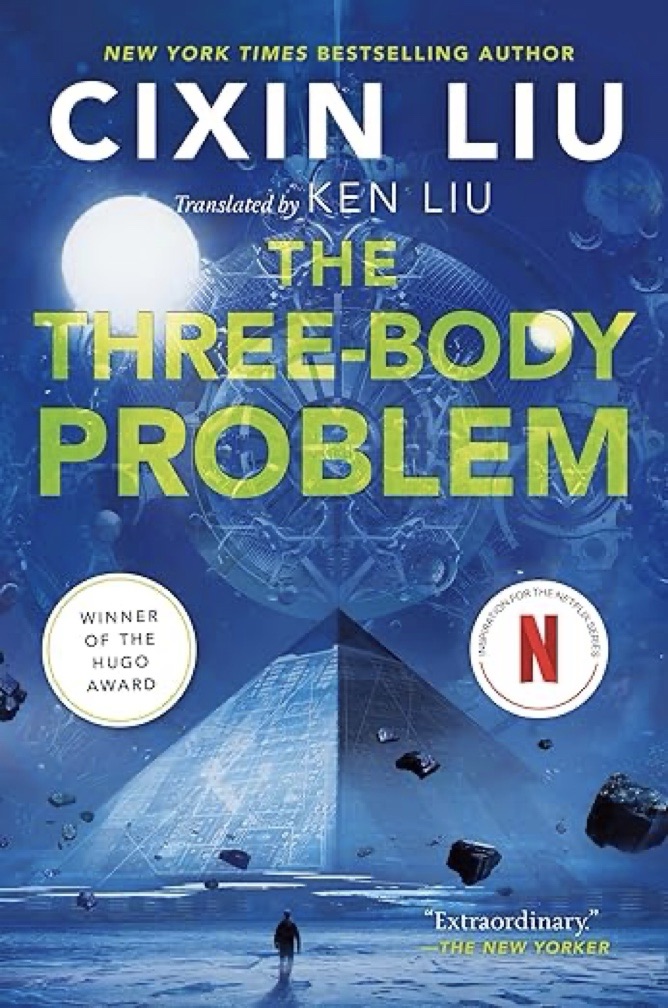
The Three Body Problem. Cixin Liu. 2006. 387 pages. ( Hardcover.)

A really bizarre science fiction story set in the background of Mao’s paranoid cultural revolution, this long story totally lost me.

At Tsinghua University in Beijing in 1967, a group of academics is brutally attacked by the armed forces, because of their scientific view of the world. They work in cosmology, theoretical physics, and nanotechnology, with interference from an alien society that Ye Winjie secretly communicates with. The author, then abandons this setting until returning to it late in the story.

In this world, the universe begins to flicker in line with an unsolicited Morse code delivery.

Alternatively, “The universe is a hollow sphere floating in a sea of fire. There are numerous tiny holes in the surface of the sphere, as well as a large one. The tiny ones are stars and the large one is the sun.” A modification has two spheres, one inside the other. This is even more bizarre than standard cosmology. People are dehydrated with loss of all of their water and then later revived in a different civilization. Einstein and Copernicus converse on the steps of the U.N. building where Einstein is playing the violin as a beggar. Two protons sent to earth by the Trisolarian aliens planning to invade are able to block all scientific progress for years.

The title is based on the three suns model of the universe leading to either a Stable Period or a Chaotic Period.

This book is so bizarre, disjointed,dry, and dystopian that I cannot give it a rating above 1, and it was a total waste of time as far as I was concerned. Perhaps my profound ignorance of telecommunications technology, theoretical physics, string theory, cosmology, and my general low opinion of science fiction did not help, but that does not explain a lot of my disappointment. It does not even qualify as good science fiction.

1/5

Thanks, Alan, but no thanks.

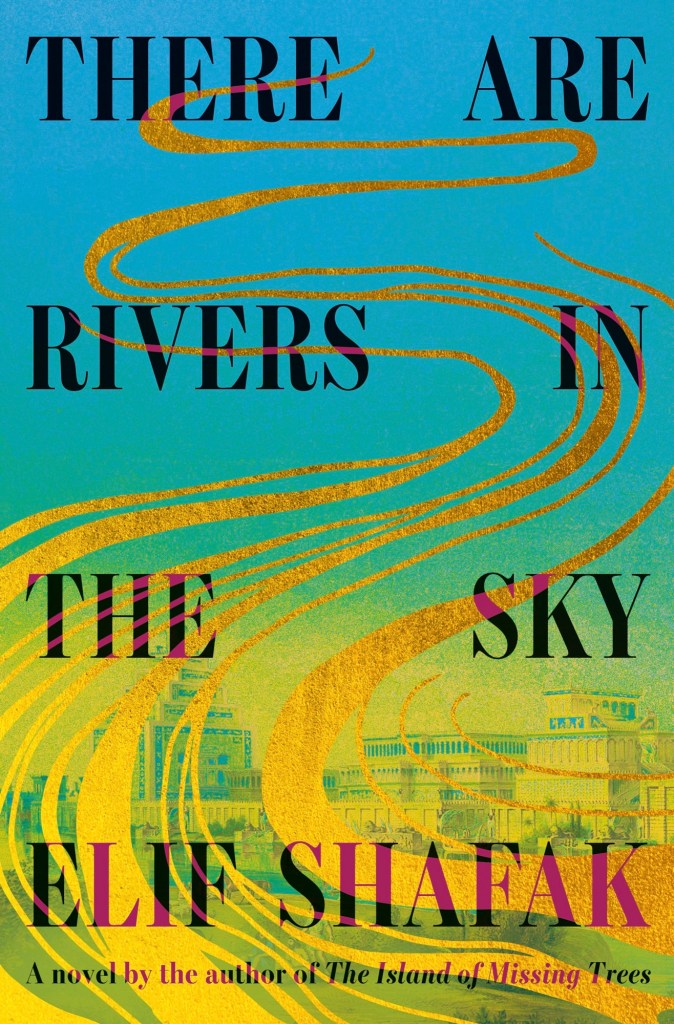
There Are Rivers In The Sky. Elif Shafak. 2024. 436 Pages. (Ebook on CloudLibrary.)

The self-exiled British writer of of Turkish origin who authored The island of Missing Trees, which I greatly enjoyed, is back with this deeply researched historical novel about the longstanding persecution of the Yizidis of northern Iraq, Iran, and southern Turkey.

Single raindrops are endowed with emotions, purpose, planning, and memory, and she somehow makes this seem entirely normal. By halfway through the book she has almost convinced me that it is a reasonable scientific hypothesis.

Synesthesia rears it’s head, although not so named: one character smells certain words.

The cholera epidemic of 1864 and the role of water from the Broad Street pump is recounted in detail, as in The Ghost Map by Steven Johnson, with Dr. John Snow as the hero.

I can relate to the publishing house woes of Charles Dickens that are detailed; the author’s racist views of society and his love affair are also recounted.

The Gilgamesh poem and the ancient city of Nineva feature prominently throughout the book. There are only three main characters; an 1850-76 precocious slum boy with a special talent, a young modern Yazidi girl whose baptism in the Tigris River is interupted by development, and a modern female hydrologist in London, each with a complex background, and very different agendas.

Numerous mythologies and tales of the Mesopotamian diverse population pervade the narrative, as does the brutal genocidal destruction of the Yasidi population by the ISIS Caliphate.

The trafficking of organ donors was apparently a real practice in that troubled part of the world, even recently.

I risk sounding petty, but forehead veins do not pulsate in sorrow.

A few quotes to give you a flavour of the book:

«Water hardens in adverse circumstances, not unlike the human heart. »

«The doctor, his face barnacled with moles »

«It is an odd thing to lose faith in the beliefs you once held firmly. How strange it is to have carried your convictions like a set of keys, only to realize that they won’t open any doors. »

This is a beautiful, evocative, superbly written historical novel that I greatly enjoyed.

4.8/5

Thanks, Jean.

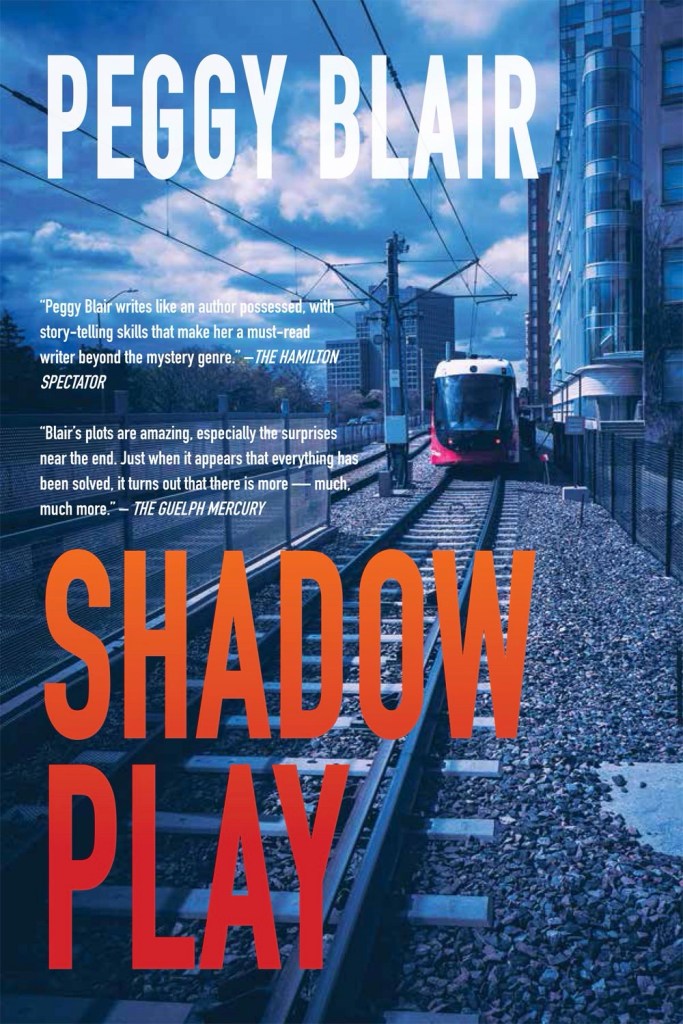
Shadowplay. Peggy Blair. 2023. 322 Pages. (Paperback.)

The Ottawa lawyer and real estate agent here leaves Inspector Ramirez behind to detail a story with lots of local colour for denizens of Ottawa, with complaints about the landscape, the public Transportation with the dysfunctional LRT, the Freedom Convoy and more; everything locals love to complain about.

A fat Afghanistan coroner, an indigenous cop on homicide duty, the fiasco of the Freedom Convoy Protesters blockade of downtown Ottawa streets in 2022, an hallucinating female detective with a troubled background, synesthesia, a trans murder victim, the mayor of Ottawa involved with kickbacks and a troubled marriage, and a homeless kind man all contribute to make this story interesting. To top it off, a Russian hitman arrives only to find that the victim has already been shot.

By page 200, it seems obvious who hired the contract hitman, but the details of the motive are still a bit fuzzy, and a second missing person has arisen and then a third.

I found only one problem with the complex plot: the anatomy of the victim which would not easily facilitate an affair with a supposedly straight man.

There is also one unsolved minor loose end. What became of the long lost biological brother of the troubled female detective?

As murder mysteries go, this is better, in my opinion than Amy Stuart’s A Death at the Party

4.0/5

Thanks, Kit?

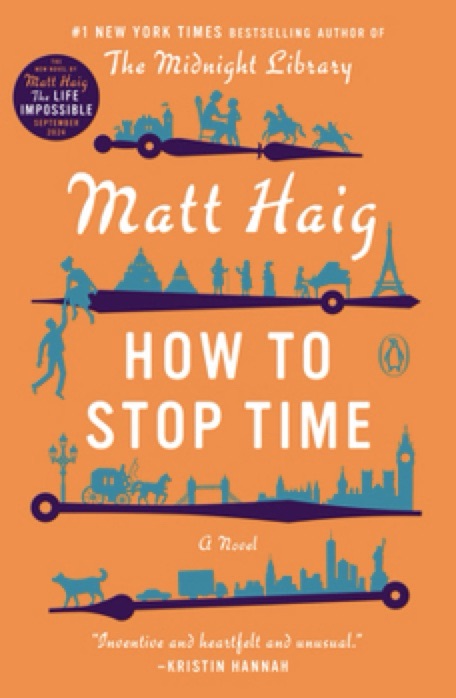
How to Stop Time. Matt Haig. 2018. 323 Pages. (Paperback.)

This Sussex,England prolific author of both fiction and non fiction here develops the story of a man who has lived for 439 years. He has a rare condition that they name anageria, the opposite of progeria, a real genetic disease of premature aging. Eventually he finds others with this condition, and form a society they call the Albatross Society, as opposed to the short-lived Mayflies. This becomes a dangerous condition and he is forced to change his name, identity, and job every eight years.

He and his mother were Huguenotsc, chased out of France by the Catholics in the 1500s. His daughter shares the trait but is lost to him for centuries. In the course of his life he meets Shakespeare and has long conversations with him in the Queen’s pub and plays the lute in the Globe theatre. He converses with F. Scot Fitzgerald in a Paris pub. These are by no means the only celebrities he meets and befriends, including Captain Cook.

Eventually the founder of the Albatross Society is exposed as a egotistical self-centred individual willing to sacrifice its members. Inevitably the first person singular protagonist is reunited with his daughter after centuries of separation.

I have mixed feelings about how to rate this book. The central thesis of time travel and anageria is preposterous but ingenious and there are astute observations about what it means to be human including this:

“This is the chief comfort of being 439 years old. The main lesson from history is: humans don’t learn from history.”

Or this: “Music doesn’t get in. Music is already in. Music simply uncovers emotions you didn’t know you had inside you and runs around waking them all up. A rebirth of sorts.”

4.0/5

Thanks Barb.

A Death At The Party. Amy Stuart. 2023. 287 Pages. (Paperback.)

The Toronto-based murder mystery novelist and hockey enthusiast, friend of Matt Sundin, is supposedly having this one adapted for the screen. ( I will not bother watching it.). Murder mysteries are not my favorite genre and this one is not as good as some.

There are actually two unexplained deaths at two parties, exactly 30 years apart although the story is largely confined to one day of preparation for the second party, and the actual drunken party, in a mythical city in modern times. When I was exactly half way through the story which is told in the first person singular, I thought I had figured out who the killer of the first victim 30 years prior was, but I was wrong. The second killer is obvious from the first chapter and the motive becomes clear long before the deed. With a juvenile diabetic in the plot, it is clear that insulin will be involved.

The party is to celebrate the 60th birthday of a poor writer of murder mysteries, with secrets of her own, who suddenly and unrealistically becomes famous and rich. This rags-to-riches myth of novel writers is all too common, and even the rare ones who make it rich are not feted as lavishly as displayed here. Most novelists don’t even break even.

The characters are not too numerous or difficult to keep track of, although the relationships become a bit confusing and it is not always clear why Nadine, the narrator, is always stressed out with virtually every conversation.

Once again I have a pet peeve: the basement floor is obviously concrete, not cement.

2.5/5

Thanks, Rhynda.

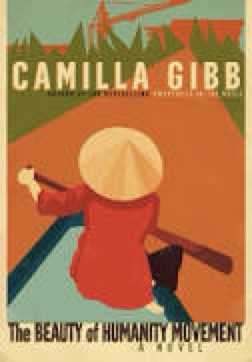
The Beauty Of Humanity Movement. Camilla Gibb. 2010. (Ebook on Libby, 10 hours, 40 minutes.).

This is from a Toronto-based English anthropologist and fiction writer of at least four novels, and some poems, this being the latest that I could find.

This one is based largely in Hanoi, and is written in the present tense, covering more than three generations of residents in 28 chapters. Hung’s Pho, a complicated multistage broth with fish, rice, meat, and spices figures prominently in the story as he makes it daily and distributes it to his clients from his rundown shack. The work of Vietnamese artists also becomes integral to the story, even if their value in capitalist terms seems to be exaggerated. They highlight protests in the struggles for liberation from the Japanese, the French, and the Americans, with brief allusion to that of the Chinese in the 15th century, causing further cruel repression from the communist leaders. Art and literature are seen as liberators with some characters having returned to Hanoi after being evacuated to Minnesota when the Americans withdrew, bringing with them ideas of capitalism. The title refers to an organization of protesters of the Communist regime .

For those like me who have difficulty keeping the names of characters in many novels straight, it would have been of immense help if the author had included a list of the main characters and their relationship to one another. I might then have been less confused by unfamiliar names such as Dao, Hung, Lan, Tu, Binh, Maggie, Phuong, Viet Ming, Truong, Khai, Amie, Pham Khoi, Van, Paul Nguyen, L’y Van Hai, Phuo ng, Mr. Vo, Bui Xuan Phai, Thuy Doc, Anh, Henry Thanh, and Phuc Li. I did include such a list with my much simpler novel Mere Mortals to avoid such confusion among readers.

A pet peeve: one character is described as having a throbbing vein on his forehead. Arteries throb, not veins.

As an introduction to various aspects of Vietnamese culture of the 20th century, this is a great start.

4.0/5

Thanks, Michelle.

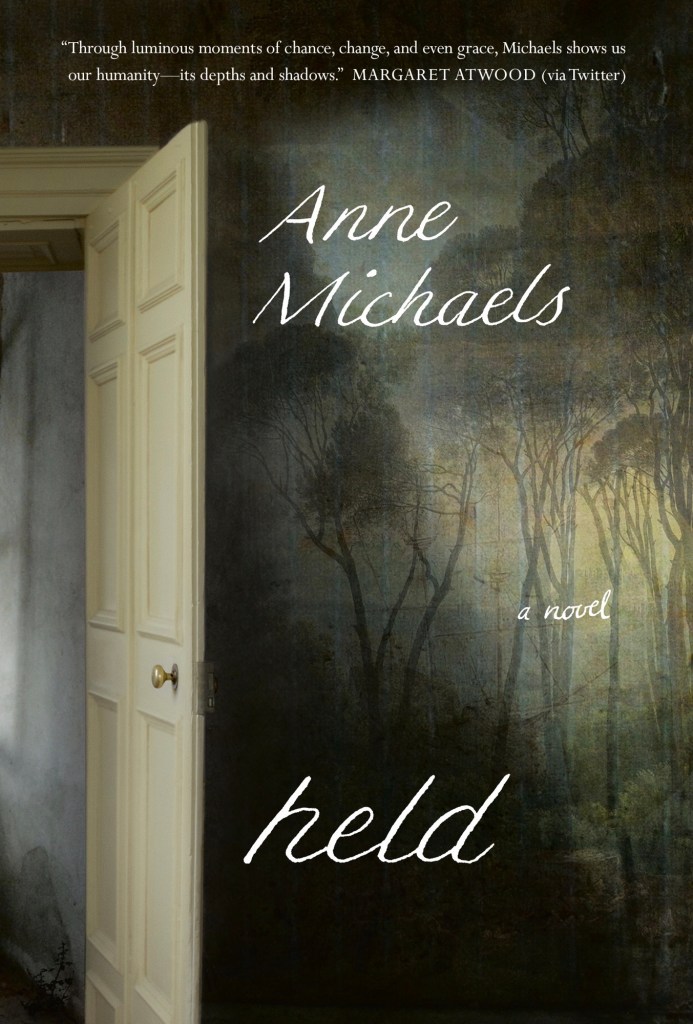
Held. Anne Michaels. 2023. 118 Pages. (Ebook on Cloud library.)

This Canadian novelist and poet’s work is obviously popular with some reviewers and award committees having won many prizes and been translated into many languages. This is her latest novel. I sometimes think, however, that my personal enjoyment and appreciation of books is inversely related to their popularity with such reviewers, as was the case here.

This book spans the time from 1910 to 2025, with chapters that appear in no logical chronological order that I could discern. If there is a unifying plot, I completely missed it. What there is are scattered observations mostly of a philosophical nature, about what it means to fight wars, be human, and to love and be loved.

A few ethereal quotes may demonstrate why this concrete thinker found this mercifully short book, confusing and disappointing. I recognize that for some others this aspect of it may be what they enjoy and appreciate.

“To visit Helena and his mother on leave and then to return to duty was a transition so unreal it should have turned him mad; it would have been better to lose one’s mind than to retain that residue, enough left of oneself to spatulate and sift the madness, like a chemist frantically seeking the antidote to his own poisoning.”

“Is that not what the human body is, is that not our own kind of photosynthesis-are we not chemistry that transforms light?”

“ In Maria’s experience, the supernatural was purely the presence of good, the love that burns free of the corpse; always love that tries to escape the human error.”

My recommendation: ‘Don’t waste your time.’

1.0/5

Thanks Din.

The War We Won Apart. Nahla. 2024. 374 Pages. (Ebook.)

This detailed, intricate, and extensively researched story by the Canadian host of CBC’s Radio’s Ideas, provides exquisite detail of the lives of two Canadian Special Operations Executives during the Second World War.

Sonia Butt, and Guy Artois were daring heroes who worked behind enemy lines in France, just before and after D-Day. They were immensely influential in providing radio communications to London and leading sabotage of German operations, often at great peril to themselves. It was only much later that they received any recognition for their major roles.

Guy was born in Richmond, Quebec and joined the Canadian Army as a paratrooper. But he was also an charming natural leader and adventurer and after the war, served in the Korean War, and lived a military life, travelling around the world, often away from his family for extended periods.

Sonia Butt was born in France, then moved to England and later to Canada. Before women were allowed into regular combat roles, she joined the Women’s Auxiliary Air Force and was also parachuted into France behind enemy lines. She married Guy shortly before they were separated to run different operations and did not know each other’s fate for more than two years. She had a brief affair with a British officer, which Guy forgave her for when they reunited. After the war they raised six children in a variety of military homes across Canada, mostly in Quebec.

The horrors of the war are described in heart-wrenching detail and were not limited to the Nazis, with cold- blooded shooting of hundreds of men line up against a wall by the SOE. In my mind, there is little more cruel than threatening to take the lives of innocent relatives of enemy operatives, a widespread practice of Nazis.

Not familiar with much of the geography of France, I found some of the description of operations in small towns and villages confusing.

4.0/5

Thanks, Michelle and Rhynda.

Health for All. Jane Philipot. 2024. 218 Pages. (Ebook.)

This book by the U.W.O. graduate general medical practitioner, and former federal health minister is part autobiography, part political campaign rhetoric and part suggestions to make access to health care available to all Canadians. I found the suggestions for the latter to be a bit nebulous but certainly worth considering.

Back when Bob Rae was premier of Ontario, I wrote that we should consider amending the B.N.A. Act to make health care a federal rather than a provincial responsibility. That would eliminate 11 Colleges of Physicians and Surgeons, with their significant bureaucracies, with licensing and disciplinary authority, and replace them with one albeit larger federal one. The author never seems to have considered this, but it would at least eliminate the interminable squabbling between provincial authorities.

The author also never mentions the tragedy of hundreds of foreign-trained doctors driving cabs or flipping hamburgers, because the provincial Colleges delay or deny them licensing to practice in Canada. Most of them are probably as competent as domestic graduates.

There is no mention of the overuse of imaging techniques and overprescribing, in place of old fashioned physical examinations,and discussions largely driven by patient expectations and fear of being sued.

The chapter on Hope as an essential ingredient of mental health incorporates a wishy-washy amalgam of the author’s Presbyterianism and First Nations vague and flexible beliefs that I found to be unhelpful, but at least she acknowledges that other belief systems can also provide hope.

The short chapter on Belonging is mostly common sense to address the epidemic of loneliness. But by putting it into the context of health care, the author expands the reach of medicine that already is stretched thinly dealing with more and more diseases. Some purists would consider this to be to be a societal rather than purely medical problem.

The chapter on Meaning is full of extreme pathos as she describes her two year old daughter’s sudden death from meningococcemia, on the way to the hospital in Niger, where she and her husband lived while working for Doctors Without Borders for nine years. But Meaning from this??

The author bemoans the lack of training in social determinants of health in Western’s medical school curriculum without any consideration of whether or not that is the best or most appropriate place for it to be addressed. The curriculum is ever more crowded as it is with ever expanding medical knowledge; would it not be more appropriate to include it into, say, political science, or law teaching for those who could actually do something about those determinants- future politicians? The chapter on the shameful care provided to indigenous children and the author’s role in trying to change that bears little direct relationship to “health for all.”

There is no doubt about the author’s diligence dedication, intelligence, idealism, altruism, and hard work. In spite of my negative comments about this book, were she ever to run for political office again, I would probably vote for her, if she were in my riding and maybe even campaign on her behalf.

2.5/5

2.5/5

Knife. Salman Rushdie. 2024. 209 Pages. (Paperback.)

This recounting of the nearly fatal stabbing of the famous author is the latest of his fifteen books, mostly novels. I have only read one, The Moor’s Last Stand, and found it confusing with a lot of magic realism. But I enjoyed reading his earlier autobiography Joseph Anton, which documentshis early life in India, then in England and the United States, and the trails and threats, he endured after the1988 publication of The Satanic Verses. He has long been a vocal advocate for free speech, an atheist, and a critic of all religions.

On August 12th, 2022, a young radical Muslim stabbed him 15 times in front of ten thousand people in Chautauqua, New York, blinding him in one eye and leaving him critically injured. This book traces his life from that point, with a flashback to when he met and married his faithful new wife in 2021, the latest of five.

The book is full of reminiscences of how the attack changed him, with many references to literati friends that I had never heard of and to literature that I was equally ignorant of. But his views of religion and politics seem to largely reflect my own humanist instincts (for religion, believe whatever you want in private, but do not impose those beliefs on others) and are laid out very specifically. The wounds and their complicated treatment are described in detail from a medial viewpoint, and seem realistic, even if described in convoluted sentences, some going on for half a page. His surgical treatment was flawless, but some problems seem to have been needlessly over-investigated.

There are several good quotes: “If you are afraid of the consequences of what you say, then you are not free.”

“A poem will not stop a bullet. A novel will nor defuse a bomb, Not all our satirists are heroes.

But we are not helpless. Even after Orpheus was torn to pieces, his severed head, floating down the river, Hebrus, went on singing, reminding us that the song is stronger than death.”

The imagined conversation with his assailant is, in my opinion, the weakest part of this gruesome documentary.

3.5/5.0

Thanks, The New Yorker

James. Percival Everett. 2024. 302 Pages. (Hardcover.)

Based on the timeless story of Mark Twain’s Adventures of Huckleberry Finn and his slave Jim, this novel by the USC professor of English dramatizes the life of the slave, Jim. Down and back up the Mississippi River, Huckleberry and the runaway slave lose each other several times, only to be reunited in unlikely ways.

The author uses the delirium of a rattlesnake bite poisoning to introduce a conversation with Voltaire, Rousseau, and Locke about slavery and equality. The conversations are riddled with the illiterate slang of the southern negro, sometimes deliberately contrived.

Parts of the story accurately reflect the horrid reality of being a slave in the antebellum south in the 1850s-always in hiding, fearing lynching or hanging, starvation, near-drowning on makeshift rafts, and subsisting on catfish and berries. The geography can be confusing if one is not familiar with the earlier story, but such places as Jackson Island are real, and it is not really necessary to have read or recall the earlier classic.

There are some great quotes. “It is a horrible world. White people try to tell us that everything will be just fine when we go to heaven. My question is, Will they be there? If so, I may make other arrangements.”

“I ain’t never seen two fellas talk so much and say so little.”

Of Norman, a man of ambiguous colour, “He had been able to speak slave, but it was possible a crazy white man could have learned it. Then it hit me that it didn’t make any difference whether he was white or black, and what did that mean anyway.”

Jim’s intelligence, cunning and wit shines through in this telling of his story, and makes a mockery of any anti-black racism.

4.5/5

Thanks, Din.

The Roosting Box. Kristen Den Hartog. 2024. 241 Pages. (Paperback.).

This new peculiarly-named history by the Toronto native is well-researched, beautifully written and full of surprises.

The name seems to be based on the roof-top of the now defunct Dominion Orthopaedic Hospital on Christie Street in Toronto, used extensively for rehabilitation of war-wounded in World War I and to a lesser extent, those from World War II. Sun-bathing on the rooftop was standard therapy for tuberculosis of the spine, often acquired or spread there in the trenches. With chapters titled Legs, Arms, Spines, Faces, Lungs, Minds, and Bellies, the injuries range from amputations to para- and quadriplegia, faces torn apart, shell-shock, brain injuries and multiple infections including the devastating 1918-1920 influenza epidemic. The nurses are lauded as the heroes and sometimes romantic partners of patients, but the hospital also was the origin of the subsequently regulated professions of Occupational Therapy and of Dietetics.

This book will not appeal to some readers, but for others it is a valuable reminder of the sometimes primitive and sometimes startlingly innovative history of medicine in the early to mid- twentieth century. And of the appalling conditions and inevitable results of war.

The appalling conditions of the men in the trenches are described in excruciating detail, and the lives of individuals are followed for years as Christie Street became the permanent home for many before it closed in 1949, with the transfer of the patients to the new Sunnybrook Hospital.

The writing is flawless, but wanders a bit beyond the titles of each chapter, including discussion of A.Y. Jackson’s war art and the discovery and early crude uses of insulin. The few black-and-white photographs are helpful.

4.5/5

Thanks, Tom.

Long Island Compromise. Taffy Brodresser-Akner. 2024. 352 Pages. (Ebook.)

Lavishly praised by a variety of reviewers, including the New Yorker, The New York Times, Oprah, and The Atlantic, this novel by the staff writer for The New York Times Magazine, is based on a novel kidnapping of a rich descendent of a Jewish immigrant, Zelig Fletcher. I humbly disagree with their assessment.

The plot becomes complex and none of the characters could possibly be considered normal. While the main characters, Carl Fletcher, his wife Ruth, his mother, Phyllis, their three children, Nathan, Beamer, and Jennie, and cousin Marjorie are relatively easy to keep track of, the same cannot be said of the dozens of secondary characters.

The starting point of the family fortune is the theft of a boat pass and documents from a fellow Jew to escape the Nazis. And the factory that is the source of their wealth produces heavily polluting carcinogenic byproducts of styrofoam, with no effort to mitigate this.

The sexual immorality of all of the family members makes a mockery of marriage vows and is described in very foul language. The Slave and Master antics of the psychotic drug-dependent Beamer in particular is described in revolting unnecessary detail, and foul language is not confined to the conversations, but is used liberally by the author as well.

There are a lot of conversations that I found to be unrealistic and stilted. None of the family members ever get along with each other.

I suppose that as a mockery and cynical commentary of rabid capitalism and of the wealthy lifestyle, this book has some merit, but Thorstein Veblem did a far better job of doing that, in The Theory of the Leisure Class, 125 years ago.

The author has not done her homework with respect to medical science adequately. Animal fat does not congeal perceptibly in veins, and the amygdalae are not in the back of the brain.

1.0/5.

Thanks, The New Yorker. But no thanks.

The Kappillan of Malta. Nicholas Monserrat. 1973. 457 Pages. (Paperback.)

This old story by a British naval officer is mainly about a devout Catholic priest mininstering to the besieged citizens of strategically placed Malta, then under British control, during the Second World War. But it includes stories told by Father Salvatore about the long and troubled history of Malta from the attack of the Phoneciains in 1500 B.C.E, the Romans in 60 A.D. the Turks in 1565, and the Italians in 1940-43.

There is a lot of interesting history, although it is not called an historical novel. There is no doubt that the Maltese were and still are an interesting and fiercely independent people.

There are endless battles described in excruciating detail, mostly at sea or in the harbour, a few unlikely romances, and conflicts and jealousies within the Catholic heirarchy as Father Salvatore is exiled to a monestary in the nearby island of Gozo. And doubt develops in Father Salvatore, about some of the more bizzare tenets of his faith. His own family is shamed by the betrayal of his bother-in-law to the Italians.

I suspect that anyone who has visited Malta would find this book very interesting. I have not, and as I read it I changed my tentative rating of it many times.

The copy that my friends loaned me was in very small print with insufficient margins between the writing and the binding making it needlessly trying. I realize that this is a problem attributable to the publisher, not the author, but a problem nevertheless.

I finally settled on 3.5/5

Thanks, Neil and Linda.

The Last Battle. Cornelius Ryan. 1966. 507 Pages. (Hardcover.)

I am often intrigued by the choices of books that friends recommend to me. I know some who only read fiction, or science-fiction, or magic realism. And some refuse to read anything by female novelists, claiming that they are obsessed with sex. Others read mainly science and still others almost entirely confine their reading to religious texts, biographies, or history. If one uses the analogy of medical specialists and sub-specialists, I am a general practitioner; I like a variety of different genres, although I prefer good science writing to all others. This detailed old account of the last few battles of the European part of WWII which a good friend who gave me is certainly a history for a sub sub specialist, as befits a secret intelligence officer, but he gives me far more credit for knowledge of old European geology, history and politics than is warranted.

The late writer, an Irish/American war correspondent for the Reader’s Digest among other publications, seems to assume intricate and detailed knowledge of the geography of not just Germany but most of Europe. And he also must assume a familiarity with many military terms and strategies as they then existed if this book is to make any sense. Maps included are of limited help although there are also several pages of black-and-white photographs. Although many names such as Churchill, Montgomery, Roosevelt, Truman, Eisenhower, Stalin, Hitler, Goebels, Goering, Speer, and other top Nazi staff will be familiar to most readers of a certain age and education level, others such as the hundreds of top military leaders are less memorable. The list of names under What they do today at the end of the book occupies 20 pages of fine print and must include at least one thousand names. Yet when I looked for a couple of names that were prominent in the narrative, they were not there.

When everything you have believed in and strived for becomes unattainable, suicide may be an acceptable option. However, the forced killing of dozens and perhaps hundreds of their own children and infants by cyanide is inexcusable, but was carried out by many dedicated Nazis as the regime crumbled.

The author had access to many fighters, and leaders, with extensive interviews reviewing their war diaries and archives. The constant tension between the British/American forces and those of Russia in the effort to get to Berlin first is detailed and was one feature documented here that had lasting consequences.

I just got frustrated by endless detail and cannot recommend this book.

1.5/5

Thanks, Maurice.

The Secret Life of the Universe. Nathalie A. Cabral. 2023. 264 Pages. (Hardcover.)

This is a well-organized esoteric account by the head astrobilogist of SETI (Search for Extraterrestrial Intelligence) in California.

I would be lying if I claimed to understand more than a small portion of the details of her quest, as she goes through first the theories of the origin of life on earth, and then expands on it to other solar system planets and moons and then to the whole universe. Along the way, there is discussion of panspermia, i.e. the notion that life on earth arose from primitive forms arriving from elsewhere on meteorites, asteroids or space debris. This is taken seriously here but dismissed by Andrew H. Knoll in his A Brief History of Earth. The conventional explanation of life arising from organic compounds in the primordial soup of oceanic hydrothermal, and terrestrial geothermal vents is also given due consideration.

The planned Dragonfly mission to Titan, with its sophisticated scientific equipment and monitoring systems, along with many other technical accomplishments, reads like pure science fiction, but holds out hope for discovering extraterrestrial life on that moon of Saturn.

I also cannot pretend to understand the Drake equation which purports to calculate the probability of life on extraterrestrial planets, moons and exoplanets. But the number of those exoplanets, with a supposedly habitable environment is astounding, with an estimated 300 billion in our galaxy alone. And the Hubble Deep Field image suggests that there are 125 billion galaxies in the observable universe. This makes the claim that we are alone in the universe a statistical absurdity- unless one invokes a non-scientific and non-testable claim to have a unique relationship with the Creator-who must relish wastefulness.

The long discussion of what life actually is, and what it means to be intelligent comes to no firm conclusion as far as I can tell, and the linguistics become confusing.

In the last part of the book, the author returns to describe the short time in geological terms that we have existed and the ecological challenges we face with climate change. This is important, alarming, and eloquent but wordy.

Perhaps the best quote of the whole dry book is: “In a twisted irony, the most advanced species on this planet is methodically cutting the branch it sits on, and knowingly destroying the environment responsible for its rise and its development.”

I admire the author’s obvious intelligence and perspective, but this is not a book meant to entertain or enjoy. Perhaps some people with a better understanding of astrophysics than I may appreciate this book, but I cannot recommend it.

2.5/5

Thanks, The New Yorker.

Foreign Agents. Casey Michel, 2024, 288 Pages. (Hardcover.)

This book by the Human Rights Foundation author bears some resemblance to the spy stories I have been immersed in lately. But the characters are not mostly cloak and dagger spies but well known public figures. It is the paper trail of who is footing the bill that is kept secret.

The book starts with the story of Ivy Lee who in the 1930s was paid handsomely to dress up the opinion of the new Nazi regime in Germany within the U.S. The resulting Foreign Agent Registration Act was good on paper but has a long history of weak to totally absent enforcement. The book proceeds from there to the long and checkered history of Paul Manafort, as he worked to install Yanukovych at the behest of the Kremlin to lead anti-democratic Ukraine; among many other countries, he worked for Guatemala, the Philippines and some Arab states; the money was often filtered through shell companies and third parties.

No one escapes the scorn of the author for double dealing, including the Clinton Foundation and the late Robert Dole, but Manafort, Trump, and many of his cabinet members come in for the harshest assessment. It is enough to make one question whether there are any true charities. I once was invited to speak at a pan-Arab conference in Doha, Qatar and did a short locum there. On returning I praised the apparent impartiality of the journal Al Jezerra, without realizing the despotic cruel dictatorship they represent. But I was paid a pittance compared to the millions paid to foreign agents touting the virtues of Qatar. When we set out to establish on a charity as a tax break, we decided to call it the Ghent-Simon Foundation, with all revenue directed to Doctors Without Borders, which seems to be safely nonpolitical, although where they decide to work may be influenced by political factors.

The foreign agents featured include many universities which are paid handsomely to burnish the reputation of despotic foreigners, NGO charities, and notorious Washington think tanks that have a constant revolving door of former government officials working for them, without revealing how they are funded. And at least two senators were found to be on the payroll of foreigners.

Completely banning foreign agents has been thought to be unconstitutional by the U.S. courts, but enforcement of registration needs to be greatly beefed up.

This book made me despair of the fate of democracy, with few workable solutions suggested to counteract the allure of secret money.

4/5

Thanks, The Economist.

A Body Made Of Glass. Caroline Crampton. 2024. 283 Pages. (Hardcover.).

Recurrent Hodgkin’s lymphoma in her late teens, ultimately treated with a stem cell transplant taught the author, a London U.K. native too well to pay close attention to her body, resulting in what she later recognized as hypochondria. “It feels at times like having cancer for real was the training I went through so that I could have a dozen other illnesses in my imagination. I am now very good at being unwell. I’ve had a lot of practice.”

The list of sufferers from hypochondria as she defines it is long and includes John Donne, Lord Byron, Glen Gould, Charles Darwin, Phillip Larkin, Elizabeth Barrett Browning, Howard Hughes, James Madison, Virginia Wolfe and Susan Sondheim among others. The long chapter on the history of hypochondria was, for me, unhelpful and wordy with quotes from Donne and Robert Burton’s poems, that I just found confusing.

The World Health Organization has replaced the word “Hypochondria” with “health anxiety” emphasizing the arbitrariness of many diagnoses. Although the author uses “hypochondria” throughout the book, she recognizes the fuzzy borders and the significant overlap with obsessive compulsive disorder and hysteria, now known as conversion reaction. I do not know when talking about concern about health issues becomes excessive and becomes a disease. I do know some close relatives who move in the opposite direction, concealing a serious debilitating disease, fearful that they may be considered disabled.

The ease of finding information about diseases in the Internet age has probably contributed to all kinds of health anxiety, that I can readily relate to. When my phone tells me that I walked less this week than last week, it would be easy to convert that into anxiety if I had no better explanation ,such as fewer trips to the library.

The 40-page chapter “The rise and rise of the Quack” makes for very interesting reading about the ability of someone with a superior bedside manner to cure or at least treat effectively the diverse illnesses of the hypochondriac, and the past and somewhat still present ability of medical boards and regulators to weed them out. I once was caught in this deception by a man purporting to be a physician, albeit in the relatively harmless field of pathology.

I do not know what is the right balance between anxiety-Inducing health-seeking behaviour and relaxed nonchalance.

This wordy text is interesting but I cannot relate at all to parts of it.

3.5/5

Thanks, tithe New Yorker

The Book of Eve. Constance Beresford-Howe. 1973. 211 Pages. (Paperback.)

In this second novel by the late Montreal writer, it’s 1970 in Montreal and a 70 year old woman named Eve, without notice, leaves her loveless marriage and ailing husband of 40 years for no apparent reason, to live a life of poverty, hiding, and communicates only with her son. As I can find no reference to a husband, one can speculate about how much of this first person singular account is autobiographical. She was, after all, almost the same age as the fictional Eve.

Anyway, the fictional Eve, living in a boarding house with a lot of very eccentric people, waffles endlessly about her decision, the morality of various relationships and her new life of austerity. There is no deep philosophical discussion about the meaning of life, but how to experience a good life is included in her musings. Her self-questioning is accompanied by a host of changing psychosomatic symptoms. « Wrestled out the cork, a long struggle that made me sweat, and took a large swallow without the formality of a glass. The stomach took this surprise with consternation, but after a brief hesitancy decided to accept it. » There is more than a hint of early feminism.

The characters are certainly not hard to keep straight and the writing is down-to-earth and delightful. The question about whether or not she will return to her secure but boring life with her husband permeates the whole book. I will not divulge the answer.

A very enjoyable read.

4.5/5

Thanks, Vera.

The CIA. An Imperial History. Hugh Wilford. 2024. 313 Pages. (Hardcover.).

This is one of many books about the Central Intelligence Agency, this one by a University of California professor of history.

In the first 68 pages, there are a lot of generalities of recruitment and deployment over the history of the forerunner of the CIA, the Office of Strategic Services. Lawrence of Arabia and Rudyard Kipling are discussed in detail and it seems the prototype agent was a white Protestant male of privilege, educated at Groton and Yale. Generally they worked for the commercial interests of the U.S., in the guise of promoting democracy. Graham Greene is frequently quoted in this part as he was a famous writer as well as a British spy. I enjoyed reading his The Quiet American, and The Third Man many years ago without appreciating that they were based on real characters.

There follows a chapter on the sometimes covert and sometimes blatant efforts to overthrow governments and install new ones more suited to U.S. interests, even toppling democracies in favour of puppet dictatorships.

The long section detailing the many feats of Ed Lansdale in the Philippines just confused me- far more than I ever needed or wanted to know. And his efforts to support Diem of South Vietnam in the mid 1950s to establish a true Vietnamese independent state, with the help of police forces from midwestern states, among other U.S.and French personal segued imperceptibly into the undeclared disastrous Vietnam War.

In the chapter on counterintelligence, I once again became confused, in no small part because of the extensive discussion of imperialism and empire building without ever defining what the author means by imperialism or empire.

After reading the 50-page discussion titled “Publicity”, I was left with wondering if there is any organization that is not a secret front for some other, with funding channelled through several intermediaries. The many acronyms are impossible to remember without reference to the two page list of them, but the very conservative AEI (American Enterprise Institute) stands out although not included in the list. The degree to which these fronts in fact alter public opinion about various issues is obviously variable but must foster skepticism in the public at large when the real organization behind a story is revealed. What is believable? Who can you trust?

The next chapter on unintended consequences addresses that, with documentation of many instances which resulted in the opposite effect to the one intended, such as the proliferation of conspiracy theories, that depict the CIA in an unfavourable light.

Many paragraphs start with the qualifier “That is not to say…” or the opposite “That is to say…” and in the whole book I found absolutely no humour. Although I learned a lot, I have had enough reading about the world of spies trying to convince me that nothing is as it seems, and cannot seriously recommend this book. Time for something lighter.

2.5/5

Thanks, The New Yorker.