Described as semi-autographical, the first part of this debut novel by the Canadian author is set in the developing coal mining town of New Waterford, Cape Breton pre-WWI and extends to the Great Depression. The prominent role of the Catholic Church, the poverty, and the limited role of women is fully described. This must be based loosely on some family history. By page 110, the horrors of trench warfare are depicted in gruesome detail.
The plot, although based on the lives of two families of Scottish and Arabian origin, becomes impossibly complex by the third generation, as they reproduce like rabbits. Furthermore, the narrative jumps around in time and space with as many as nine times and sites mentioned in a few pages. The language is flowery and poetic, and there are some inventive poems. But it is difficult to distinguish between what children are imagining or dreaming and what is really happening.
By far the best part of this book, in my opinion, is the 81-page diary of one of the main characters, Kathleen who has moved to New York in 1918 to train as an opera singer and describes the vibrancy and dynamism of the war-obsessed city.
The language is flowery and poetic. “She sings like twelve saxophones and a freight train; she wears about a pound of gold. The band tries to keep up with her. She is no lady. Her songs are unbelievably unhappy or lewd. It is called the Blues.” Unfortunatately, it is also where Kathleen gets pregnant by a soldier departing for the war. The diary morphs into a monologue interspersed with the travels of Lily on foot from New Waterford to Manhattan. She and Kathleen experience the New York music scene, with Blacks singing the early Blues, racism, gays, lesbians, and the impoverished. There are many premature deaths. I was confused as Kathleen relates that she had her period, after having sex with the departing sailor, the only heterosexual encounter described by her but then gets pregnant after becoming a lesbian, and dies trying to deliver twins. This is not the only loose end that left me confused.
I have read two of this Israeli’s previous books loaded with contrarian viewpoints-Sapiens and 21 Lessons For The 21st Century.” But somehow I had skipped this one. It is somewhat similar with a pile of insights of this futurist that almost seem like science fiction, but need to be taken seriously. He distinguishes between a soul, which he does not believe exists and a mind which he insists we share with many animals. In discussing the neuroscience of consciousness, he comes close to denying the existence of free will but does not use that term here. In a later Part 2, 21 page chapter, he emphatically denies its existence. After predicting elimination of war, (written before the Ukrainian and Gaza wars), famine and death, it seems he is predicting a fanciful utopia. But this is only Part I.
In a much darker Part 2, he relates many cautions and experiments that largely destroy this vision. “The sacred word ‘freedom’ turns out to be, just like the word ‘soul’ an empty term that lacks any discernible meaning. Free will exists only in the imaginary stories we have invented.” Then there is the problem of what we will do when sophisticated algorithms replace, doctors, lawyers, landlords and musicians. (For musicians, algorithms, already produce music indistinguishable from the classics.)
So many great quotes:
“ For the average American or European, Coca-Cola is a far more dangerous threat than Al Qaeda.”
“ …the single greatest constant of history is that everything changes.”
“The Bible could not imagine a scenario in which God repents having created Homo sapiens, wipes the sinful ape off the face of the earth, and then enjoys watching the antics of ostriches, kangaroos, and panda bears.”
“ We always prepare for the previous enemy, even when we face an entirely new menace.”
“ During our infinitesimally brief stay on our tiny speck of a planet, we fret and strut this way and that, and then are heard of no more.”
“ The greatest scientific discovery was the discovery of ignorance.”
One of the densest books about a wide range of topics from the nature of consciousness and the mind to the threats of AI to the biological sciences, this is nevertheless less an enjoyable read. The author challenges almost everything including the philosophy of Daniel Dennett, the humanist creed, and Sam Harris’ beliefs. It needs to be read with some skepticism and a grain of salt.
In 22 chapters, these well-known authors give a generally laudatory account of the Sin City, and its many attractions. I guess it appeals to a certain personality with a lot of ambition, drive, and a love of the extravagant and spectacular. They do briefly relate the seamier side including the flourishing sex trade, even though prostitution is illegal there. The Whales who gamble millions of dollars and fly private or corporate jets and the chefs who boast about the best dining experiences in the world are seen as exemplary and the text is rife with celebratory names, and superlatives.
There is absolutely no mention of the hordes of people who become addicted to gambling and require treatment or commit suicide, and little acknowledgment of the pervasive and continuing influence of organized crime. I have some difficulty accepting that the helicopter yoga guru Dray was cured if a cyst in his lower spinal column with yoga or that it also caused seizures. And if he truly has seizures why is he flying a helicopter out to a deserted desert to teach yoga?
My own experience in Las Vegas is limited to two brief oconference trips there. In one, with an evening off, I was determined to lose $40 on the slot machines and was amazed at how long it took to do so. In the second in 1993 or so, my wife and I spent a very enjoyable evening at the Cirque de Soleil performance of Mystère. But my appetite for such spectacular performances is limited, unlike the culture of Las Vegas which thrives on superlatives and excesses.
The only other book by this Chinese American novelist that I have read is The Tea Girl of Hummingbird Lane which I quite enjoyed. This latest historical novel is set in China in the 15th century, a cultural immersion that is completely foreign to me. With foot bindings by girls, cultural status determined by closeness to the emperor, arranged marriages set by age 15, several concubines, sometimes bought by wives, and the status of women always inferior to the men, even when they are doctors practicing a form of medicine based almost entirely on folklore, there is little that I can relate to. The constant reminder of the yin and yang and the qi are just confusing and the foreign names become complex. The obsession with menstruation, pregnancy and who is allowed to attend a birthing doesn’t help. The numerous ranks and rigid hierarchy limit what anyone can do, and the bizarre treatments are usually based on folklore although the is just a hint of some science as in the variolation to prevent smallpox used by the travelling smallpox master.
Told in the first person singular, the narrator is the insecure girl whose mother dies of a foot binding infection, but then marries into a wealthy family, becomes a doctor, and has a difficult delivery of an infant girl. Her postpartum problems are treated with a wide variety of medicines, including drinking wine mixed with a boy’s urine. This is just the start of endless concoctions of ancient Chinese medicine.
A typical description of diagnosing and and treating of a patient without the bother of seeing or examining her in 15 th centuaryChina is shown best with this quote: “Widow Bao, I believe that your daughter is suffering from a type of qi deficiency we call damage from weeping. You tell me your daughter was once quick tempered. This is caused by qi constraint that leads to Heat in the Liver, which in turn fires up Blood, which must be expelled by coughing. I don’t have a full pharmacy here but let me write some prescriptions for you to take back to Nanjing. The first remedy is Beautiful Jade Syrup in which one of the ingredients- Honey- is strained through raw silk. The second remedy is more complex, combining the Décoction of Six Gentlemen and the Décoction of Four Gentlemen. And the third I write a order for Calm The Spirit Pills to cool the Blood and help her sleep.”
There are lot of trite aphorisms As the plot progresses there is a disputed paternity in a rigid hierarchy and intrigue that becomes quite complex.
This book would be quite alarming with nonsense medical treatments if it were not that it is based, at least loosely, on careful research by the author of many antique documents. Lady Tan was a real person with a real influence on traditional Chinese medicine.
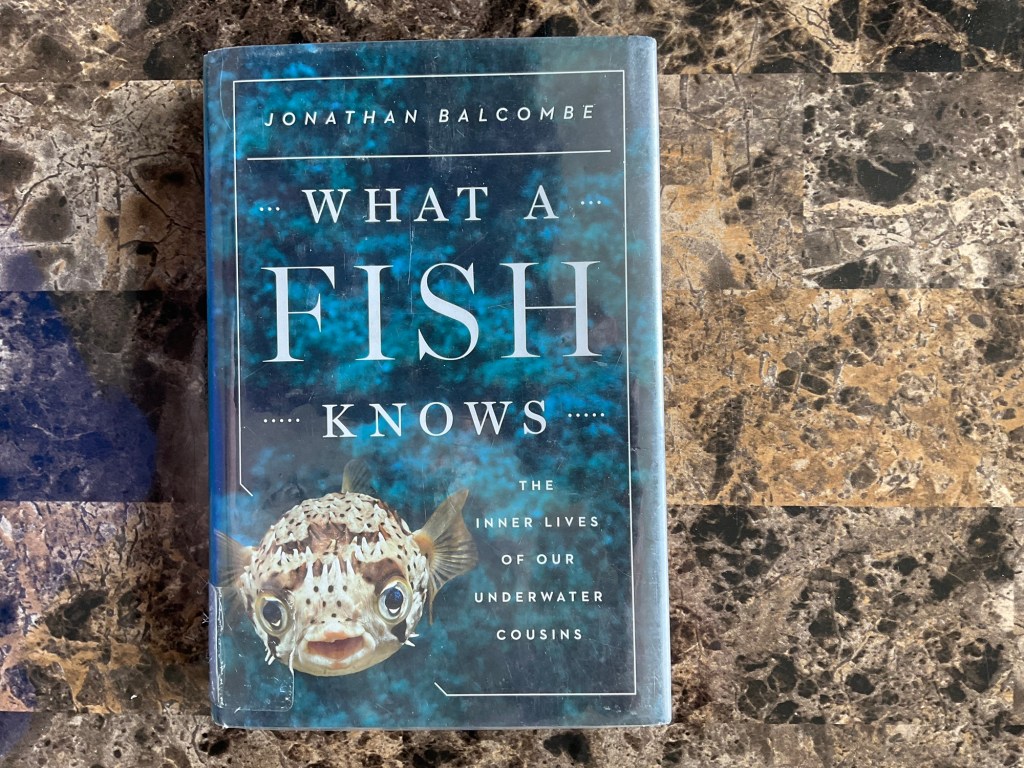
This American marine biologist provides startling revelations about the life of fishes (and many other species along the way) on almost every page of this documentary. Many of the species are unknown to me but the activities are related in a way that makes it easy to understand.
The chapter on the cleaner fishes and their clients is simply amazing with complex signalling, imposters, cheaters and some sense of justice and rule enforcement. Likewise, the chapter on fishes’ sex, with 32 different mechanisms, many deceptions, and oral sex in which a female swallows a mouthful of sperm for a rapid transit though her gastrointestinal tract while releasing eggs en route, producing a unique form of (transient) internal fertilization. Many, mostly male fishes raise their young in their mouths while coming close to starvation.
The problematic rise of fish farms is very depressing to read about, with many infections, a dependency on other fish for food and the artificiality of the environment.
His plea to cease recreational fishing seems to me to be the least compelling, perhaps because I enjoy it immensely. I only fly fish and almost always catch and release. I like to think that any pain a fish may experience on being caught is a lesson well learned and is compensated for by the relief of being set free.
“When fishes outperform primates on a mental task, it is another reminder of how brain size, body size, presence of fur or scales, and evolutionary proximity are wobbly criteria for gauging intelligence. They also illustrate the plurality and contextuality of intelligence, the fact that it is not one general property but rather a suite of of abilities that may be expressed along different axes.”
This book should be of interest, not only to fishermen, but to anyone who appreciates the extreme complexity of living nature.
This is the debut autobiography of a Columbia Presbyterian heart surgeon. Unlike many surgeon/writers this is full of humility, self-doubt and self-deprecation. But I have known surgeons who were perfect considerate humble gentlemen outside the operating room, but tyrants hurling invective at everyone in the OR.
Much of the narrative like the description of working in a coal processing plant and as a linesman for a telephone company before entering medical school has nothing to do with medicine or science. The description of the storied Balto diptheria delivery to Nome has little to do with the author’s life although I presume it is meant to be some kind of analogy.
The author became bored with doing heart and heart-lung transplants and delegated that to others, to pursue other innovations. The description of weekly Morbidity and Mortality rounds is easy to relate to as others seized the opportunity to point out my errors or my oversight.
The discussion of the effects of hospital mergers and remuneration schemes for doctors will be of interest mostly to doctors and health economists. His musing about the drastic effects of Covid-19, the many false claims of benefits and the anti-vaccination scene are spot on. He dose not hesitate to praise the other health care workers who endured hardship throughout it.
The writing is generally easy to follow although the details of working in a coal processing plant and as a linesman for a telephone company were a bit challenging.
The discussion is centred on the flawed U.S. health care system, with little acknowledgement of it’s shortcomings.
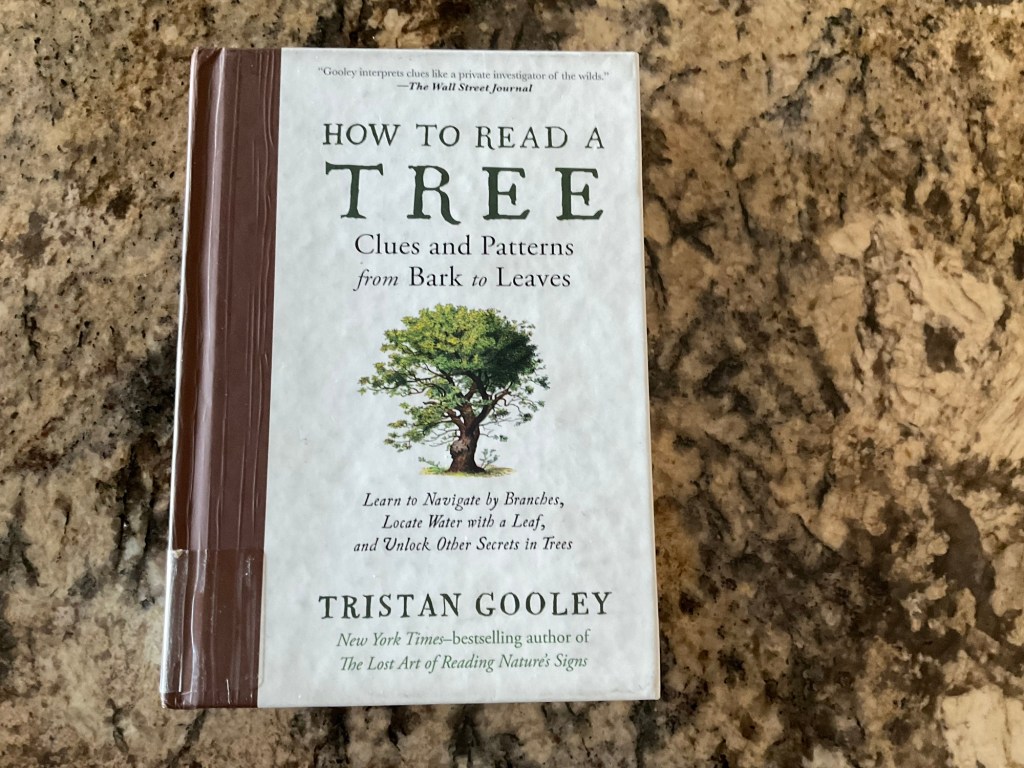
A British naturalist /outdoorsman/adventurer, takes the reader on an adventure to identify, get directions from, and learn about the intricacies of trees in this enjoyable book. There are endless bits of information that will ensure that you will never look at a tree the same way that you did in the past. The author personalizes trees as though they are sentient reasoning beings.
There is less hard science here than in Susanne Simard’s Finding the Mother Tree, but the devastating effect of human activities on trees is similar to that documented by Henry Gabor in Paved Paradise. The author’s love of the outdoors is infectious. A few notable quotes will illustrate this.
“Large leaves that look shiny and feel waxy are wearing sunscreen and a raincoat at the same time.”
“Nature does not brim with gratitude.”
“…the leaves of both young trees turn to the bark and say ‘ Mate, will you lend us a hand and photosynthesize a bit? Its only for a few seasons. Once we have grown a bit taller you can get back to your main job of protecting the trunk and branches.”
I am not sure how this self-taught tree guru would fare in an advanced botany course exam, but I somehow doubt that he would ace it.
The reporter for The Daily Beast reports on the history and the frightening effect of the believers in a flat earth. It is not new but appears to be growing with one survey reporting that 3 % of Britons believe that the earth is flat, although many are closet Flat Earthers, to avoid ridicule. The most frightening aspects of this is that it is not confined to the uneducated but is espoused by some doctors and pharmacists, and the willingness to believe other conspiracies that it’s paranoia promotes.
The author, a nonreligious Jew, points out the natural skepticism of authority that are a part of some religious beliefs and the many other nonscientific beliefs that are integral to most religions. In this sense, perhaps a majority of us harbour irrational beliefs. This skepticism leads naturally to many other conspiracy theories, including the antisemitism that has multi-millenial history, the QAnon conspiracy theory, the 9/11 conspiracy theory, the many dangerous lies of Trump, the hoax of the moon landing and the various theories about the origin of Covid-19.
Rather than ridicule Flat Earthers, the author recommends a kind and understanding approach to try to get them to see the usual multiple cognitive dissonances in their beliefs- but we all probably have some.
There is nothing here about the reasons for increasing polarization of beliefs, nor anything about the neuroscience that underlies the phenomenon of such polarization, and willingness to believe silly conspiracies.
The author advocates stricter monitoring and control of social media postings, within the limits of free speech laws, while recognizing that their platforms depend on sensational postings.
The author, a professional biographer, trailed Elon Musk for two years. Although he claims that Musk did not ask to, nor read the book prior to its publication, I still wonder if the author did not feel some obligation to portray him in what is generally an admiring and laudable light, perhaps out of fear of being sued for defamation.
The product of an abusive, conspiracy-toting estranged father and a Canadian beauty queen author, Musk enrolled in physics at Queens University but then transferred to U. Penn, graduating in physics and business. On the autism spectrum, he is obsessed with science fiction, particularly Douglas Adam’s’ The Hitchhikers Guide to the Galaxy. He has become obsessed with the fate of humankind, enthusiastically espousing space travel, colonization of Mars, the development of electric cars with driverless features, the risks of misinformation, and the need for more children. Disdaining regulation and government oversight, he made his first million at a Silicon Valley company writing code to digitize the Yellow Pages. Then the venture capitalists came knocking and he never looked back, becoming the boss of Tesla, a rocket launch company, a human-computer interlink, and then Twitter, and the richest man on earth.
Demanding and driven are gross understated adjectives when applied to Musk. He sets many unrealistic deadlines and to his credit often achieves them working incessantly, simplifying designs and ignoring government regulations. The overriding theme of all his efforts, at least as portrayed here, is an attempt to save humankind from extinction. He fires people frequently, goes on temper tantrums like a two year old, yet has met and helped many politicians, including Obama, Macron and Zelenskyy.
“Musk’s push to move faster, take more risks, break rules and question requirements allowed him to accomplish many feats such as sending humans into orbit, mass produce electric vehicles, and getting homeowners off the electric grid. It also meant that he did things- ignoring SEC requirements, ignoring California Covid restrictions that got him into trouble.”
“ A lot was hitting him that week. He was scheduled to give depositions in the Delaware court seeking to force him to close the Twitter deal, an [sic] SEC investigation, and a lawsuit challenging his Tesla compensation. He was also worried about controversies over the use of Starlink satellites in Ukraine, difficulties in reducing Tesla’s supply chain dependence on China, the launch of a Falcon 9 carrying four astronauts to the International Space Station, a West Coast launch the same day of a Falcon 9, carrying 52 satellites, and sundry personal issues regarding children, girlfriends and former wives.”
His conversations with the author and many other conversations are laced with unnecessary obscene words.
One obvious typo that I cannot now find is in relation to the in-vitro fertilization where an egg is referred to as male!
Has my opinion of Musk changed after reading this wordy long book?
I will give him some credit for trying to do the right thing, but I lack the imagination to see how colonizing Mars could ever become feasible.
There is a new countervailing view about the damage done by smart phones for kids in the May issue of The Atlantic. In it, Candice L. Odgers directly refutes almost all the arguments made by Johnathan Haidt in The Anxious Generation. But she does not address the individual age specificity discussed by Haidt, nor the compelling evidence that there has been a dramatic increase in teen mental illness and suicides. Now I am a bit confused; perhaps there is some reason for optimism, but I think Haidt would win the argument if it were a debate topic.
This bio of Trump would be either very funny or sad depending on your viewpoint, if it were not that he wields tremendous power. The sports reporter and avid golfer documents how Trump sees almost everything from international relations to day-to-day life through the lens of golf and how it impacts his game that he excels at cheating in.
He sees no contradiction in calling climate change a hoax while building a tall 800 meter wall to protect his Irish golf course from rising sea levels to the devastation of local farmers.
The recurring theme in all of Trump’s boasts about his 18 golf courses is his use of superlatives to describe them, his cheating whether or not he is caught and his latent lies about his scores. The author traces this back to his childhood and the imperative of always being first. His financial dealings also come under fire as he blatantly lies about their exclusivity. Even his relationship with women is tied into the world of golf as he arranges to have only beautiful young women working at his resorts and clubhouses.
Stiffing almost every contractor he ever employed, it seems ironic that he may finally meet justice for actually paying for a service that was provided at his Florida course, that of Stormy Daniels.
“ ‘ Discrete’ and Trump go together like ‘gasoline’ and ‘soup’.”
The Trump on display is an egocentric, amoral, totally self-centred psychopath. It would be easy to ignore such individuals except that he also wields unprecedented power. It is hard for me to understand why millions of otherwise rational U.S. voters cannot understand that, to the peril of all of us.
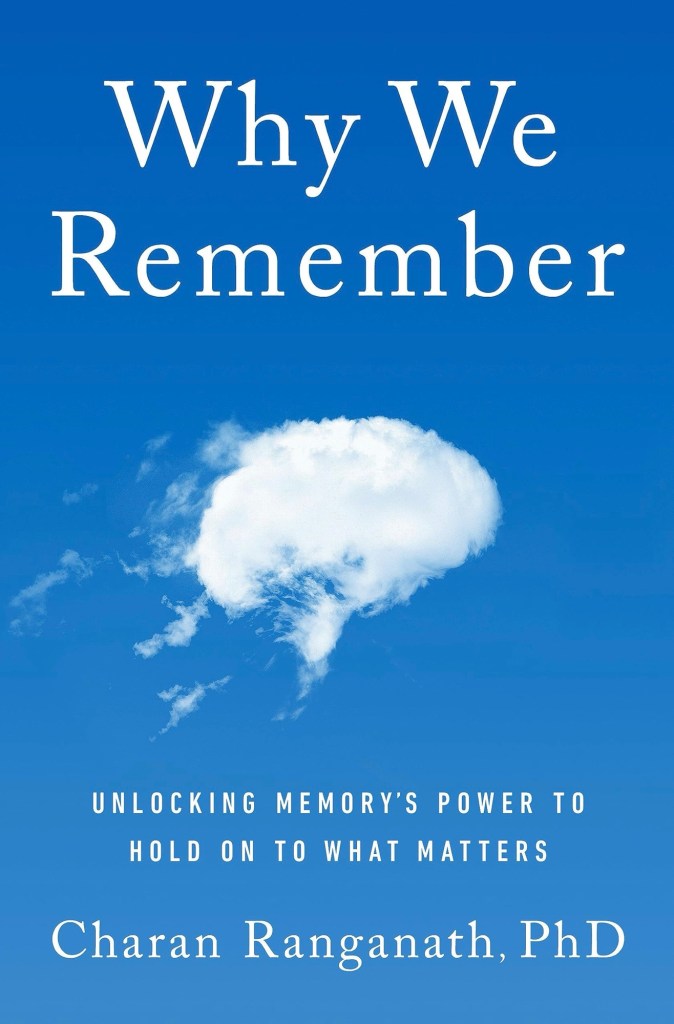
The University Of California, Davis, Professor of Philosophy and Neuroscience, weaves personal stories of his trips to his homeland of India, and as a parent, an amateur surfer, and musician, into this attempt to explain why we remember. From my perspective it would be more appropriate to title it How We Remember, as there are intricate details of neuroanatomy, neurochemistry, and neurophysiology that are shown to be involved in our often faulty attempts to remember. At times he skates close to the deeper philosophical question of whether or not we have free will. He never addresses this question directly but certainly seems to take a mechanistic view of the problem of remembering (and forgetting), as though there is no mind or soul, separate from the brain.
The difference between episodic and semantic memory, the role of the prefrontal cortex, the hippocampus, and the cingulate gurus, H. M of damaged hippocampus fame, contextual setting, infantile amnesia, the reminiscence bump, event schemas, the Default Mode Network, reality monitoring, synesthesia, collaborative facilitation, and social contagion are all detailed. In some of these, a researcher making an observation in experiments on college undergraduates, often using functional magnetic resonance imaging, comes up with a new name for the phenomenon as though that is sufficient to explain it. In forensics, a note of caution is sounded with examples of the falsely convicted based on faulty memories. This is hardly news. There is an excellent discussion of the brain’s busy schedule in prioritizing memories as we sleep.
Although the day-to-day examples of problems with memory that we all can relate to are great, there is more neuroscience here than most readers need or could appreciate.
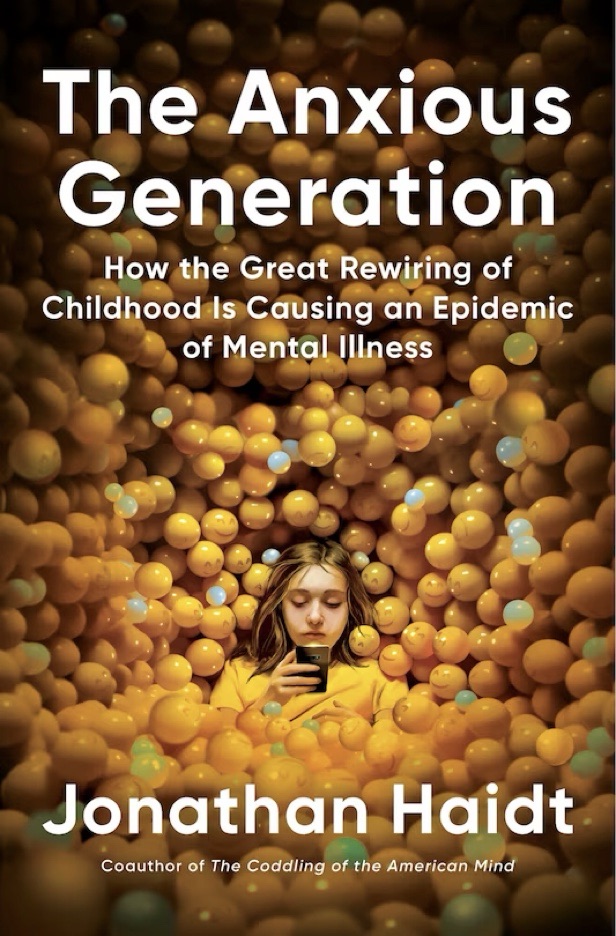
In this modern book, the New York University psychology professor makes a very convincing, but dry, very scholarly erudite case for limiting youngsters access to the internet while increasing their exposure to risks in nature and the outdoors. He calls the problem of excessive personal use of smart phones and the internet “the great Rewiring” and shows the deeply disturbing effects on the mental health of teenagers, particularly girls. An atheist, he nevertheless recommends the practice of meditation, developing a sense of awe at the wonders of nature, and then comes up with suggestions for how governments, schools, and parents can lessen the impact on vulnerable youths.
Replete with graphs and theoretical concepts, he provides a point form “In Sum” at the end of each of the detailed 13 chapters that is a good summary of points made in the chapter for those readers who do not want or don’t have the time to read the entire book.
The most specific recommendations include prohibiting social media accounts before age 16, banning use of phones completely in schools, and allowing and encouraging more face-to-face interactions and “free-range” group activities without adult supervision, including more risk-taking.
“…we are overprotecting our children in the real world while under-protecting them online.”
“The advertising-driven business model turns users into the product, to be hooked and reeled in.”
There is considerable overlap with the content of Leonard Sax’s Why Gender Matters, in discussion of how boys and girls at various ages differ remarkably in use of social media.
As I read this, I recalled my very ´free range’, childhood and felt very fortunate, although at times we took risks that were pure madness, such as during spring breakup, riding down the swollen South Saugeen River on an ice flow from one bridge to the next one although none of us could swim.
Abundant good advice for parents, schools and politicians, much of this is common sense, which seems to be quite uncommon. It is also unnecessarily wordy and repetitive.
In this, the second edition of this book (first published in 2005) this Maryland family doctor draws on 18 years of practice as well as visiting at more than 400 schools around the world and an extensive literature review to support the conclusions he comes to. This goes a long way to disprove the popular and growing assertion that gender is a social and cultural construct, without a scientific basis. He addresses such issues as why computer science is dominated by men whereas the arts and biological sciences are dominated by women.
In the second chapter alone he shows convincingly that women’s sense of smell is more acute than men’s and that it improves 1000- fold with repeat exposure whereas men’s do not, and explains the anatomical basis for this. (This may explain why my wife frequently orders me to take a shower.) Girls also see things differently using bright colours and soft objects when asked to draw anything, whereas boys typically draw moving objects and violent confrontations. This too seems to be hardwired. And girls have better hearing than boys over a broad range of frequencies, that also appears to be innate.
The chapter on sex is perceptive in teaching boys how to be sensitive and nonviolent in their relationships (and less violent and risk taking in general, although he recognizes the peer pressure to generally take more risks than girls do, and does not condemn that.) Much of this chapter’s observations, although not its recommendations, can be summed up by Billy Crystal’s astute observation that “Women need a reason for sex; men just need a place.”
In later chapters, Sax discusses exceptions to the general tendencies, including atypical male “sissies”, “tomboy” girls, gays, lesbians and transsexuals, all in a non-judgemental way, for example, by comparing gay men to being left-handed.
“The explosion in the proportion of people who believe that they are transgender may well represent a failure to understand that gender is two-dimensional, not one dimensional. If you are a man who has some (or many) feminine qualities, or a woman who has some (or many) masculine qualities, it doesn’t mean that you are transgender. It means that you are a human being.”
“Sex differences in childhood are more important than sex differences in adulthood.”
This great advice for parents came too late for me as my children are now mature adults, but fortunately they seem to have survived and thrived in spite of the many mistakes I made.
In the first section (70 pages) the native Cree, born in 1977, follows a common path into a life of violence, abuse, theft, prostitution, alcoholism, and debauchery as his single mother moves from the reserve in northern Manitoba, to Winnipeg, Brandon, Dawson Creek, Spirit River, and, Terrace B.C. By the time he turned 17, he had served time, and become a house guard for the Manitoba Warriors, a criminal gang that even intimidated the Hells Angels.
There is a lot of perhaps justified finger-pointing at the colonists who disrupted the lives of the Natives, confined them to Reservations, and separated families by forcing children to attend abusive residential schools and unashamedly practiced systemic racism. But there is no recognition that the much later programs to reeducate aboriginals in their former cultures, though often lead by aboriginals, were usually funded by federal white politicians, albeit belatedly and under pressure. Throughout the book, there is abundant very foul language, which, to me, usually indicates a paucity of linguistic skills.
The fight over the Alberta tar sands provides some devastating data about how destructive they are. They have replaced 170 square kilometres of arboreal forest with toxic liquid waste that leaches 11 million litres into the Athabasca River every year. The author and many other Native leaders are leading the legal battle to put a stop to this, claiming violation of hunting and fishing rights.
His religion combines sweat lodges and Sundance lodges, ritual sacrifice, some vague belief in an after-life, at least occasional use of psychedelic drugs, and ancestor worship. He continued to drink, use cocaine and other drugs long after he was an ambassador change. These contradictions seem to combine with a strange form of Mormonism into which he was baptized, and is so puzzling to me as to become meaningless.
The Aboriginal culture is presented largely as a unity, while the reality is that there is frequent violent discord that continues, and infighting undermines their important message.
“Uncle Alex got two years in Stony Mountain for doing the right thing.”
“One of the mysteries of creation is how closely saving the world and saving yourself are linked.”
There is no doubt that his intentions are good. But the anger is all-consuming, and it seems at times that he protests for the sake of protest, without thinking through the consequences.
In the first half of this rant, the American/Canadian journalist documents in excruciating detail the massive wildfire that largely destroyed the city of Fort McMurray in 1917. Using the recollections of many people who experienced it, it was unprecedented at the time. He also details the background of the huge tar sands development extracting bitumen, covering many square miles from the green land, replacing it with a toxic wasteland. This had the enthusiastic support of the Bible-thumping Alberta premier, Ernest C. Manning, whose weekly radio broadcast Back to the Bible Hour I was subjected to for years as a child. Then he documents similar fires in Great Slave Lake and in Chisholm and similar fire in Australia. Tasmania and Greenland have experienced wildfires for the first time in the last few years.
There is a distinctly pessimistic and alarmist tone to this part, claiming for example, that the latter, at it’s peak, released more energy to the atmosphere and stratosphere per minute than did the Hiroshima bomb, and producing hurricanes. But perhaps we need to be alarmed to take appropriate action.
Then he steps back to reflect on mankind’s relationship to fire from its discovery and controlled use. What I found most interesting was that there were prescient warnings about the devastating effects of climate change as early as the 1950s, and those were acknowledged by such conservative politicians as Ronald Regan. But government support for the fossil fuel industry has continued apace. Our federal government spent $450 million to buy out the Kinder Morgan pipeline, while recognizing that the extraction from bitumen is the most inefficient and toxic means of obtaining crude oil. It ranks near the last of the OECD nations to divest from this industry, even while also recognizing that renewables, have been shown to be economically and environmentally cheaper and cleaner and providing some limited support. Many investment companies are now divesting themselves from the tar sands in particular and fossil fuels in general. But is it too little too late?
In many ways alarming, this is nevertheless an important work.
The writer in residence at New York University details an extremely vivid story of the lives of the mixed community of blacks, immigrants, and Jews in the fictitious Chicken Hill suburb of Pottstown, Pa., in the twenties and thirties.
The very complex plot with a host of characters with peculiar nicknames like Monkey Pants, Big Soap, and Fatty is unpredictable, but captures the life of the very diverse denizens of the small town very well.
With my limited ability to visualize described scenes, I had some difficulty visualizing the exact layout when the deaf child Dodo is watching, hidden from view, on the ladder to the cellar, as the dreaded Dr Roberts enters the store aiming to capture him and send him to the institution in Pennhurst, but other than that the narrative is reasonably straightforward and it is not too difficult to keep at least the main character straight.
A good quote among many will give you a sense of the abundant humour and the quirky characters: “ Nobody outside of Pottstown had ever heard of Antes, of course, in part because he wrote trumpet sonatas that nobody played, and in part because the John Antes Historical Society’s Cornet Marching Band, which was composed of forty-five souls -numbskulls, pig farmers, heavy smokers, bums, drunks, cheerleaders, tomboys, bored college students, and any other white American in Montgomery County who could purse their lips tight enough to blast a noise through a trumpet- sounded like a cross between a crank engine trying to start on a cold October morning and a dying African silverback gorilla howling out its last.”
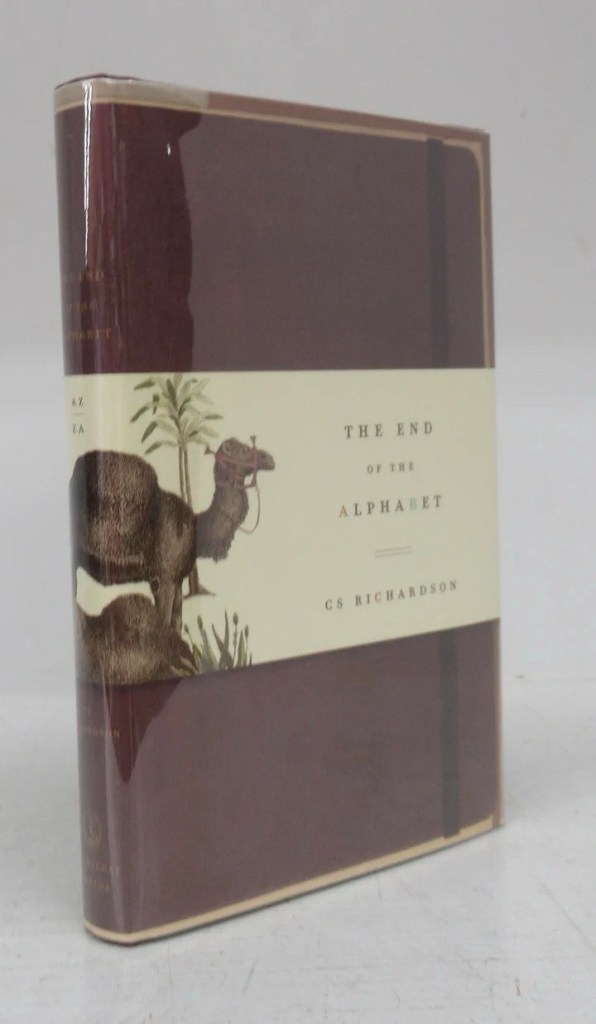
In this short fictional story by the Toronto native, Ambrose Zephyr an advertising agent of some ilk gets married to Zappora (Zipper) Ashkenazi, a part time writer and literary editor of a fashion magazine; they travel extensively together. Unanchored in either time or place, there are abundant non-sequiturs. The tense of many chapters changes and although there is a loose reference to the letters of the alphabet, many made no sense to me. Much of the book does not even consist of proper sentences, and a large portion of it consists of conversations, but there are no quotation marks.
This book won the Commonwealth literary prize, which serves to remind me of the vast chasm between what literary reviewers and many others appreciate and my very limited literary tastes.
For me, the best feature of this book is it’s brevity.
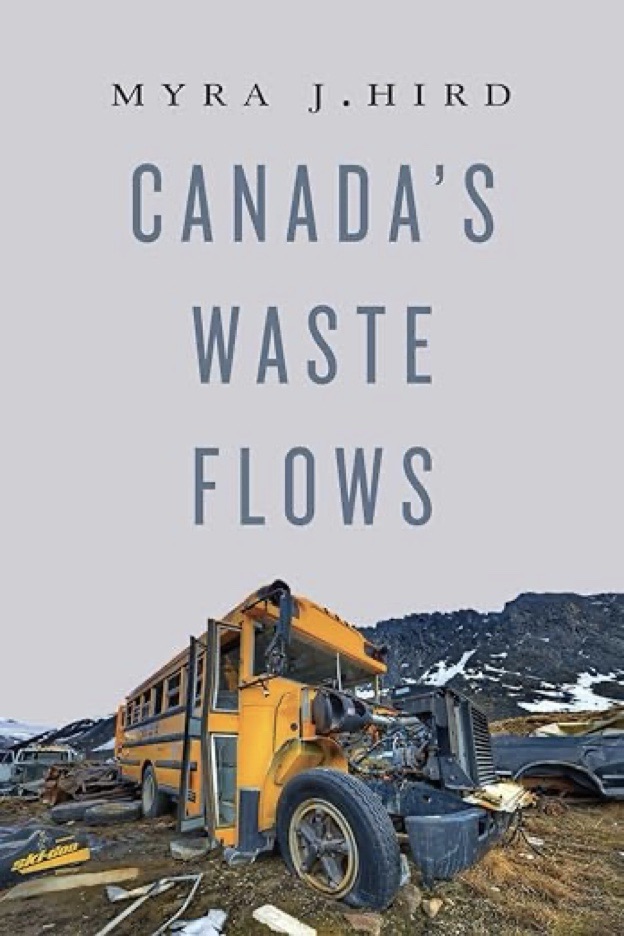
A few weeks ago, I listened to a talk at our weekly Friday Luncheon Discussion Club by this Queens University Environmental Studies Professor on the problem of microplastics, and was sufficiently impressed that I requested this book from the OPL.
In the first few pages alone, the reader learns several startling counterintuitive and iconoclastic facts such as that more than 98 percent of municipal waste comes, not from households, but from the manufacture of goods for those households, and that Canada leads the world in municipal waste production at more than two tons per capita annually. And that is just the starting point.
The example of Kingston’s waste management is used extensively to great effect, as it is representative of a bigger problem. When they recycle, much of it travels to North Bay via fossil-fuel burning trucks, where it is compressed, and from there to Korea; much of it is then delivered to landfill sites or made into such consumer goods as picture frames and then shipped back to Canada. This has lead to what she refers to as the recycling cult. Recycling paper involves using toxic chemical like chlorine to remove the ink, which contaminates the water and paper can only be recycled once or twice. It also produces “sludge that it more difficult to remove than paper.” One of my books is on recycled paper. Several private companies make a handsome profit along the way, while emitting greenhouse gasses to transport it with perverse incentives to increase rather than than decrease the supply of garbage to be recycled.
A long list of chemicals is listed as the legacy of the DEW (Distant Early Warning) military establishment in the far north when they began to close sites over many years, and that contaminated manny rivers and lakes. Most notable are high concentrations of PCBs. The Giant Gold Mine near Yellowknife produced 237,000 tons of very toxic arsenic trioxide that is still just sitting there, leaking into groundwater. But the author does not provide much advice about solving this problem. And while the treatment of the native Inuit culture and their animals, is deplorable, it doesn’t fit easily into any discussion of the big picture when it comes to waste management.
In the next section, Hird waxes philosophical with a metaphysical discussion of landfills and other forms of waste in the bigger picture of the Anthropocene era, and our relationship to bacteria and other forms of life. This left me feeling even more insignificant than usual. The later part of this chapter left me, as a concrete thinker, confused, puzzled, and scratching my bald head.
In the penultimate chapter, Hird returns to Iqaluit for a very enlightening discussion of the spontaneous fire at the overfilled local landfill; that spewed dioxins and furans into the atmosphere and Frobisher Bay in 1995. There is a unacceptable double standard for those in the north with levels that are considered safe twice as high as in southern Canada. Throughout the book there is harsh criticism of a” neoliberal, capitalist economic and political system” and experts such as public health authorities and fire chiefs.
Years ago, I read somewhere that there are several practices that we should give up. One was mandating bicycle helmets because it leaves the impression that biking is dangerous and therefore fewer people take up biking. Another was curb-side recycling, pointing out that the city of Houston has only one truck pick up garbage, (once every two weeks) with workers doing the sorting at the dump or landfill; one fossil-fuelled truck rather than three prowling the streets. But even that is a minuscule solution to the bigger problem of ever increasing upstream overproduction of consumer goods.
In the Epilogue the author remains pessimistic but emphasizes that to meaningfully at least reduce the problem, we need to address the upstream capitalist efforts to forever increase production, accept zero or negative economic growth, and pay more attention to how what we really need is packaged.
This book is full of insights that run counter to everything that we are taught by governments and private enterprises alike. Parts of it are superb, but in other places I was completely lost.
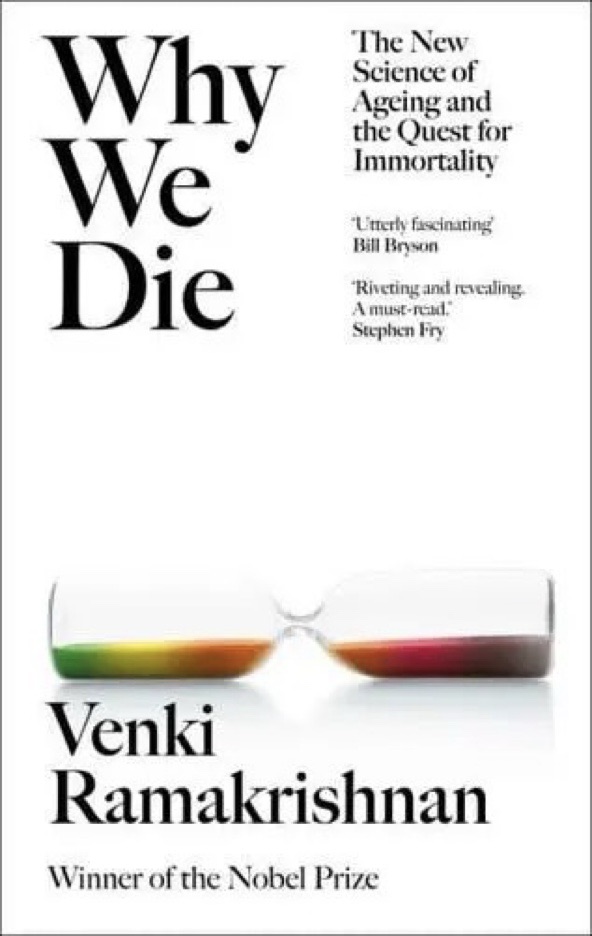
This scientific exploration by the Cambridge Nobel laureate molecular biochemist is not a duplication of Sherman Nuland’s 1993 classic How We Die, although there is considerable overlap. Citing Gompertz’s Law that probability of mortality increases exponentially with age and the relationship of body size to longevity across species, he focuses early on on exceptions. The question as to whether or not there is an inevitable upper limit to human longevity is bitterly disputed.
The author uncritically accepts that Jeanne Calment was the oldest documented human at 122, but a detailed study in The New Yorker in 2022 concluded that her daughter Yvonne assumed her identity when she died in 1934. And they are not alone.
The very detailed discussion of DNA, chromosomes, mutations and the tumour suppression gene p53 and their roles in aging were just understandable to me with a scientific education, but will probably just confuse those readers from the arts. And considering a gene as a sentient being that senses and believes is a poor metaphor, but perhaps necessary. I was aware of the role of telomere shortening in cell senescence, but not the science of trying to lengthen it with the attendant increased risk of cancers, at least experimentally. And I was aware of DNA methylation as a means of turning off expression of genes, but not of the largely reverse effect of histone acetylation both seemingly important determinants of aging and modifiable by environmental factors.
The chapter on cellular debris recycling is easier to understand with its very apt metaphors about personal and municipal recycling. The author is more cautious about recommending any of the various intermittent fasting regimens to prolong life than many others, pointing out that what we eat, when we eat, maintaining a healthy weight, exercise, and how well we sleep may be more important. The convoluted and confusing study of rapamycin and its possible effect as an anti-aging agent confused me even as one who prescribed it extensively to inhibit organ rejection. The supposed benefits of metformin in non-diabetics as a life prolonging agent seems iffy. There is no mention of the possible beneficial effect of supplementing the amino acid taurine to improve quality and possibly quantity of life, in spite of some strong hints that it may do so. Confession time: I do consume supplements of taurine, even though there is no hard evidence of benefit. It is cheap and at least it seems to be harmless, and it was recommended by a friend and former colleague, whom I trust. If nothing else, it is a safe placebo. It would be easy to do a large double blind study of it’s effects, but no big pharmaceutical is likely be interested as it is unlikely to be profitable. Similar claims, with what seems to me to be less evidence, are made by the thriving health food industry for a huge number of other supplements, including nicotinamide ribose.
The chapter on worms as a fit subject to study aging and longevity is confusing with only tentative conclusions, particularly about the touted benefits of resveratrol found in red wine. There is nothing here to hint at the possibility of immortality. Likewise, the chapter on reactive oxygen species, antioxidants and free radicals, along with the role of decreasing mitochondrial damage and repair is confusing and beyond comprehension for many readers, including me, and ends up with no firm conclusions.
The chapter on cryogenics and trans- humanism is refreshingly clear and trashes a huge amount of dreamy research. “These enthusiastic rich billionaires are mostly middle-aged men (sometimes married to younger women) who made their money very young, enjoy their lifestyles and don’t want the party to end. When they were young, they wanted to be rich, and now that they are rich, they want to be young. But youth is the one thing that they cannot buy, so, not surprisingly, many of the celebrity billionaires – such as Elon Musk, Peter Thiel, Larry Page, Sergei Brin, Yuri Brenner, Jeff Bezos, and Mark Zuckerberg, have all expressed an interest in anti-aging research. And in many cases they are funding it. The one exception is Bill Gates, who realistically believes that the best way to improve overall life expectancy remains addressing the serious health care inequalities in the world.”
It was disappointing to note that we are still increasing the period of morbidity before dying rather than decreasing it. I have no wish to obtain immortality but to paraphrase the anti-aging guru Rick Klausner, I would like to die young in my sleep after a long life, perhaps at 95 or 100. But that seems increasingly unlikely- I am much more likely to have a long period of severe morbidity, before welcoming death.
In the last chapter, Ramakrishnan carefully documents the major downsides for society if we were to achieve anything approaching immortality. Ultimately it is a selfish goal.
This book documents an active area of research, but is dense and loaded with scientific data that many readers cannot realistically be expected to understand.





 The Passionate Reader