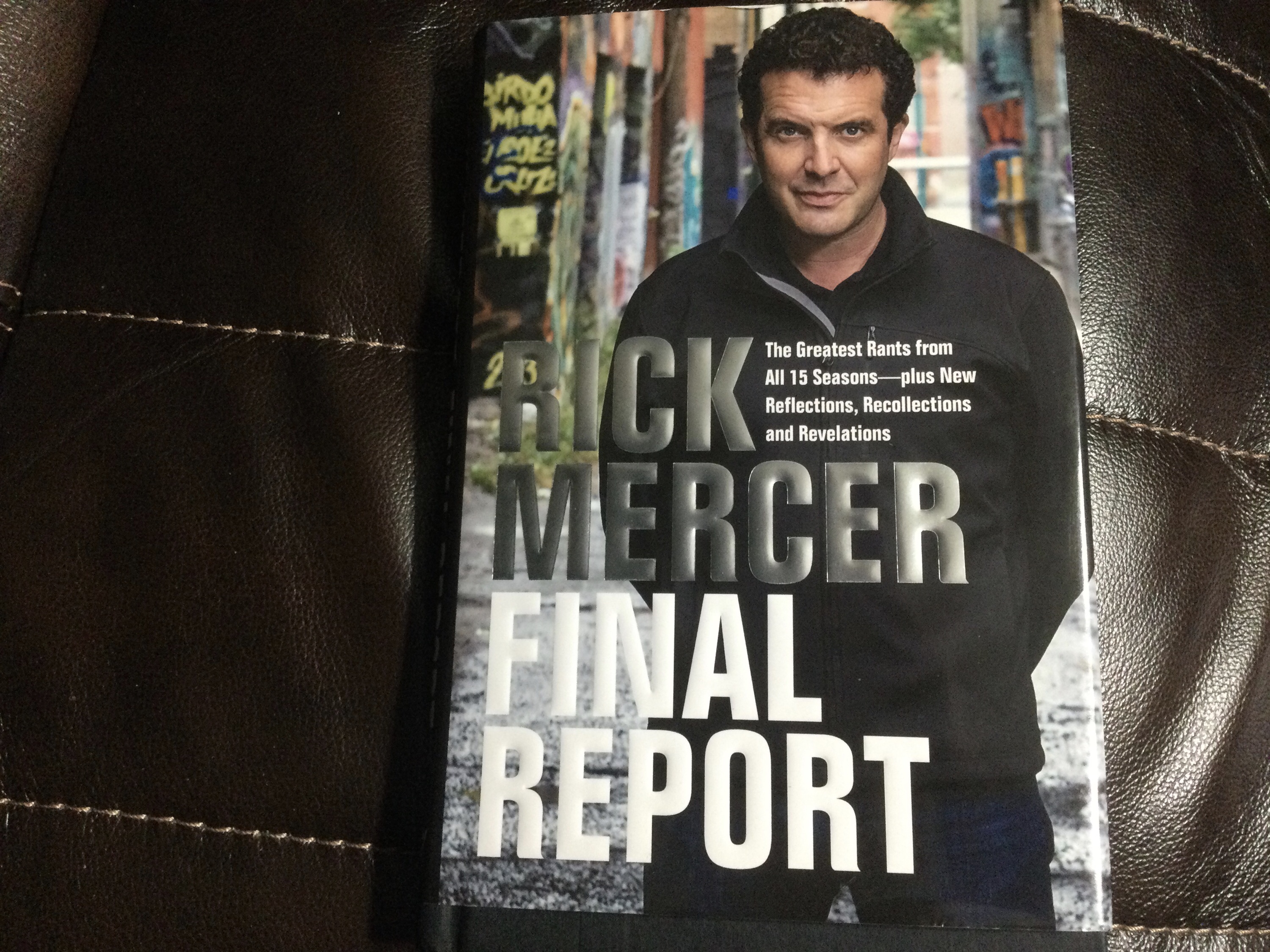
Final Report. Rick Mercer. 2018. 231 pages.

I had forgotten how much I enjoyed watching and listening to Rick Mercer on CBC television until I picked up this reprint of 130 rants and five new commentaries when I found it abandoned in the mailroom of our apartment building. Some of his adventures were silly or scary, but the weekly rants delivered in clipped sentences or phrases with biting sarcasm were always barbed and witty. They were also also great lessons in the often-forgotten minutia of recent Canadian history and political shenanigans.

In these carefully chosen rants from between 2004 and 2018, Mercer slings his sharpest arrows at what he seriously perceived to be the undemocratic, devious, and dangerous moves of Stephen Harper and company, but no politician or party escapes unscathed from his pointed criticism. His separate commentaries provide great insights into how the crew of the RMR worked.

This is a great read and an easy way to recall some of the highest and lowest points in recent Canadian politics. For those too young to have appreciated the CBC program, this and his three previous books based on the show or his equally acerbic dialogue in Talking to Americans would make great companion volumes to any course on Canadian history and culture of the era. Keep a copy of this in the rack in the guest loo. I miss his unique satire.

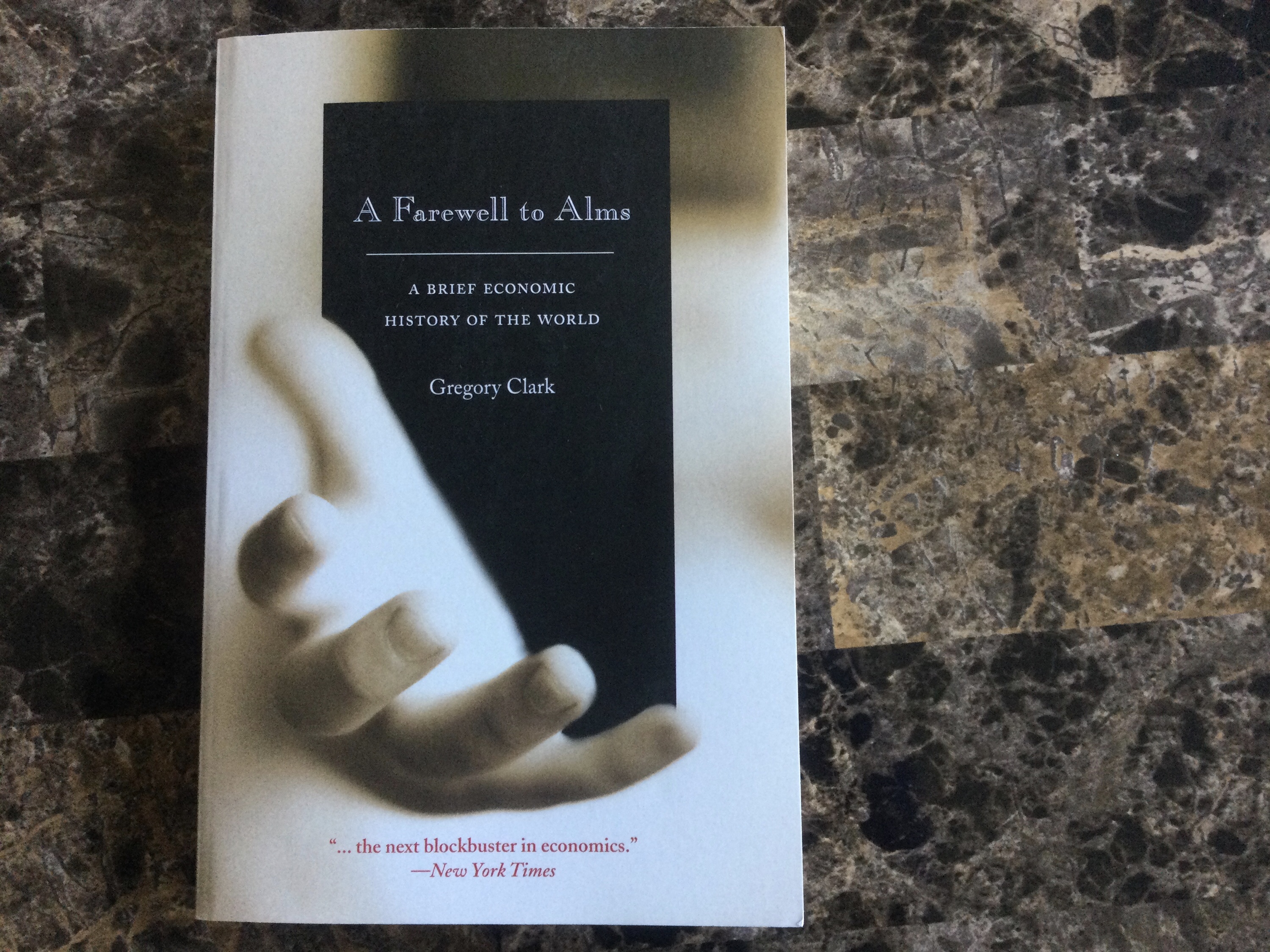
A Farewell to Alms. Gregory Clark. 2012. 377 pages.

Perhaps as a way to help the old man develop at least a rudimentary understanding of her chosen field of study, my Professor of Economics daughter sent me this book for my birthday. Or perhaps she just wanted to humble and torment me, knowing that I would read all of any gifted book. She succeeded if the latter was her intention, but not if it was the former.

The arrogant claim in the Preface to be as important as The Wealth of Nations, Das Kapital, The Rise of the Western World, and Guns, Germs, and Steel and the equally self-promoting wording on the author’s website ( “ I am a distinguished Professor..”) is off-putting, as is the very frequent references to his earlier publications in the footnotes.

If I even dimly understand where Clark differs from other economic historians it is in his emphasis on social Darwinism (survival of the richest) accelerating British fertility in leading to the Industrial Revolution, which was also much more gradual than commonly portrayed. And he lays claim to the assertion that it is primarily inherent inefficiencies in labor capital utilization that has lead to the modern great divergence in economies since the 1800s, with the attendant explosion of wealth inequality.

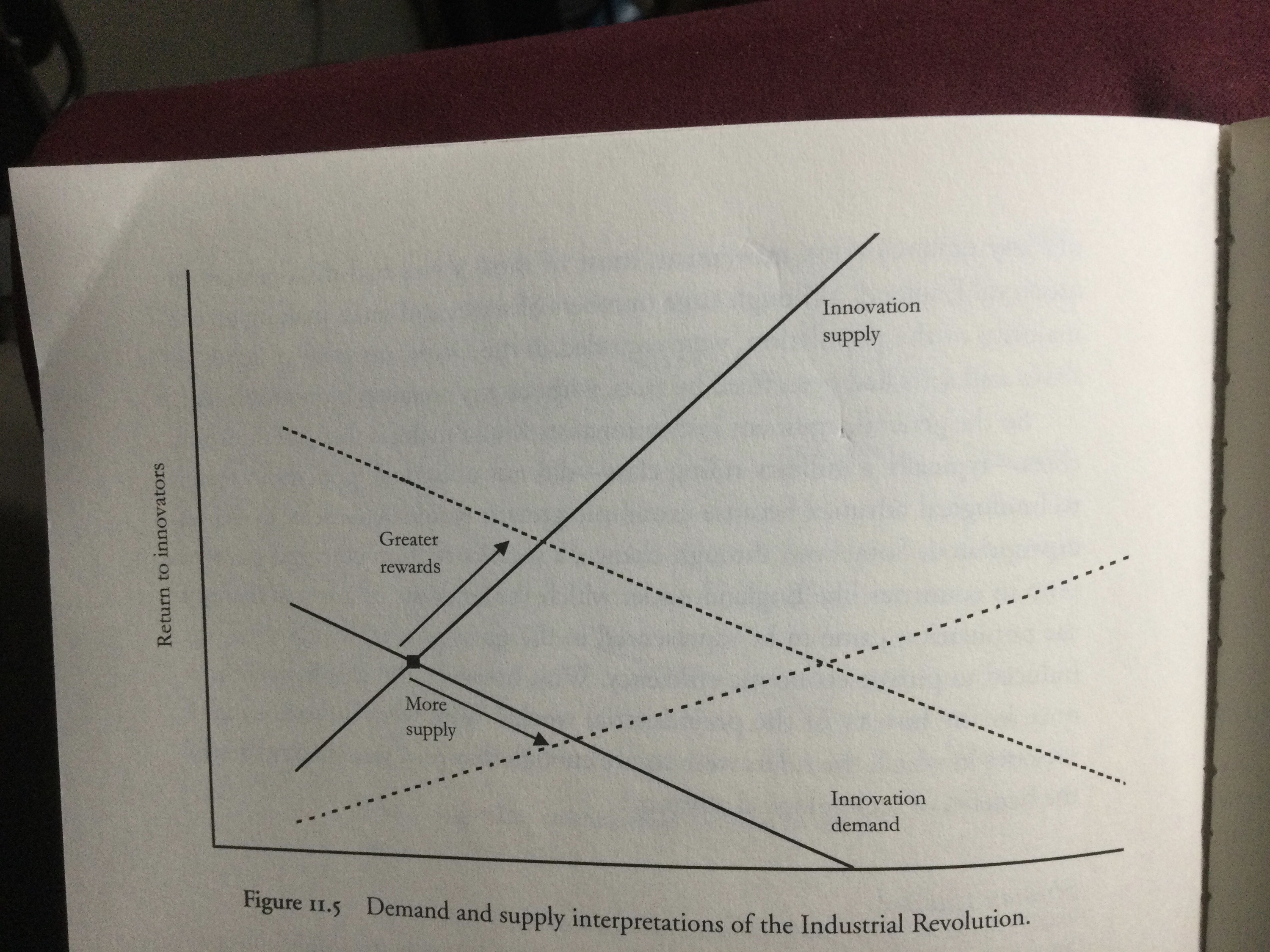
I have never been very adept at mathematics and never studied calculus, nor did I ever gain much understanding of actuarial science. When doing research I usually relied on professional statisticians to calculate statistical significance. But I recognize pseudoscience when I see it. Here I encountered dozens of charts and graphs that are purportedly important yet are unaccompanied by any measures of statistical significance, obviously equate correlation with causation, and were just plain confusing, as the one I chose to reproduce here shows.

What can this obfuscation possibly signify? There are apparently arbitrarily selected bits of sociological data from arbitrary time periods to reinforce what seem like arbitrary forgone conclusions.

Clark heaps scorn on the policies and actions of economists at the World Bank and the International Monetary Fund, apparently solely able to see the right way forward. And ironically his distain extends to academic economists although he is the Chair of the Department of Economics at USC, Davis. But like almost all economists, the holy grails that he never questions are the imperatives of productivity growth, consumerism, and ever more resource extraction, which is not compatible with our longterm survival in the age of global warming. GDP is apparently the only deity worthy of any worship.

For dedicated students of cultural anthropology, this could be considered a reasonable complementary document to Jared Diamond’s Guns, Germs and Steel, Noah Harari’s Sapiens, and Francis Fukuyama’s The Origins of Political Order, all of which I enjoyed reading, if it were not riddled with personal biases and criticism of previous works.

There are probably some profound insights and truths here that I failed to grasp, and it would be extremely presumptuous of me to dismiss this work entirely or to pretend that I understood most of it. To be fair, the references to other researcher’s findings is vast. The abundance of revelations of interesting, often counterintuitive historical facts was enough to keep me engaged. But I am sure that I flunked if this was my Introduction to Economics course.

Nuclear Folly. Serhii Plokhy 2021. 370 pages

By way of background for those youngsters who were not terrified by the newscasts at the time, in October, 1962, in the midst of the Cold War, the Americans discovered that the Soviets were secretly delivering missiles of all kinds, including nuclear ones, and setting them up all across Cuba, 90 miles from the coast of Florida. This frightening historical account by a Harvard professor of history was touted by The Economist book reviewer as the definitive account of that crisis and gives a detailed account of how close we came to being thrust into a world-ending nuclear war between the U.S.A. and the U.S.S.R. as a result. The author’s research is exhaustive, based in part on recently declassified archival material.

The details of how close we came to that mutual assured destruction are truly frightening. Over the course of four weeks, mutual distrust, paranoia, misinterpreted communications through intermediaries, and the blinkered world views of Nikita Khrushchev, JFK, and Fidel Castro all contributed to the dangerous brinkmanship. Some of the details of the eventual trade-offs that averted disaster were concealed for years.

Khrushchev, although verbose, mercurial and indoctrinated with Communist ideology, actually presented a strong case for setting up nuclear weapons in Cuba, pointing out that Americans and NATO allies had long had more powerful weapons of mass destruction poised on or near the USSR’s border in Turkey and Italy. Only the mutual recognition that pushing the nuclear button would destroy both nations and much of the rest of humankind prevented the tragedy, but both leaders came close to losing control of their decision-making to military hawks. At least two planes were shot down contrary to the explicit orders of superior officers.

Modern leaders cancelling the nuclear weapons limitation and test ban treaties seem to have ignored the lessons from this near disaster. The willingness of both superpowers to disregard the sovereignty of smaller nations such as Turkey and Cuba is striking, and has persisted.

I was struck by the vast number of precision weapons available at that time, and the hugh waste of resources in the building up of military forces and weapons. The delays in communication caused by manual translation and telegraphy through embassies don’t apply in the modern era, but instant communication among political hotheads does not necessarily reduce the danger and may increase it if emotions come to take precedence over slow deliberation.

For a civilian scientist, the most interesting story is the inadvertent wandering of an American U2 recognizance plane into Soviet air space in the far north because the pilot got lost. Unable to use usual navigation instruments between the magnetic and true North poles, he relied on old-fashioned sextant and stars but was led astray by a vivid display of the northern lights.

As a striking reflection of the times, no woman’s name appears among the hundreds of senior decision makers in America, Cuba or the Soviet Union. The only women even mentioned by name are JFK’s duped trophy wife, Jacqueline, his 19 year old secret lover Mini Alford (one of many), the wife of John McCone, the Director of the CIA who kept him away from an important meeting because they were on their honeymoon, and the terminally ill wife of a Soviet apparatchik. It may seem out of place for this western male, but I can speculate about what would have happened had half the players in this drama been female. The situation might not have developed into a crisis at all, and it would probably have been resolved more quickly and equitably.

There are hundreds of long, foreign, unpronounceable names of people and places, and military acronyms for fleets of ships and planes- sometimes as many as a dozen introduced on a single page-far too many for any casual reader to keep track of.

Dedicated historians, military planners, political leaders, and senior government bureaucrats may enjoy and benefit from reading this dry , account, but for ordinary citizens, it is best used as a bedtime sedative taken in small doses, although it might induce nightmares. But the relevance to our current situation with the risk of accidentally triggering a devastating nuclear war is undeniable as political leaders still deal with biased world views, missing or erroneous information, and irrational reliance on military might.

Flight Behavior. Barbara Kingsolver. 2012. 433 pages.

This beautiful novel can be interpreted in two ways. In one, it is a passionate, desperate plea from the author to every reader to take the climate crisis seriously and to do whatever one individual can do to reduce the effects of global warming. On another level, it is a charming fictional account of the life of a simple, impoverished, uneducated southern Appalachian Kentucky farmer and mother thrust into the world of ecological disasters by factors beyond her control as she discovers a huge collection of endangered Monarch butterflies who have gone astray because of global man-made changes to their migration routines.

Along the way there are important insights into the conflicts between commercial developments and ecological preservation and between a world view based on religious beliefs and that of a secular humanistic outlook. The turbulent family dynamics of the impoverished Turnbow clan, struggling to survive in the hollers of Appalachian Kentucky are typical of those in many disadvantaged southern states. The quirky characters are realistic and believable. The innate reproductive instincts of sheep, butterflies and humans are described in language appropriate for any ten year old.

The writing is lyrical (an overused word, but nothing describes it better) with hundreds of apt metaphors, similes and vivid descriptions of scenery, dialogues and interesting diverse characters.

One very nit-picky criticism. “ ….this was a living flow, like a pulse through veins”. Why do novelists insist on pulses in veins, rather than in arteries?.

I had previously read and reviewed Kingsolver’s Unsheltered, which is probably why my daughter sent me this one for my birthday. Although I enjoyed Unsheltered, this earlier nuanced fiction is a far better story. Highly recommended.

Thanks,

Alana

Commanding Hope. Tom Homer-Dixon. 2020. 374 pages.

Canada’s foremost deep thinker about global issues offers his unique take on the climate crisis, geopolitical instability, inequality, and our psychological adaptation to current threats, from his perch as a professor of Environmental Science at the University of Waterloo. He provides wide-ranging references to historical events, classic literature (his discussion of and analogies to J.R.R Tolkien’s Lord of the Rings are delightful), social science’s insights, and politics as well as environmental threats.The interspersed personal revelations about his past working in the oil patch and travelling throughout Europe, Asia and Africa and the sometimes profound questions of his young children are welcome diversions from the heady discussions. With collaborators, he has developed ‘tools’ such as the Worldview-Institutions-Technology loop, the ideological state-space concept, Mindscape, and the Cognitive-Affective Map to analyze our responses to various threats and what we can do as we face an uncertain future. Some of these concept tools required rereading for me to get my head around, as they seem like arbitrarily derived insubstantial dissection and reassembly of personalities and outlooks on first reading. It is easy to get lost in the deep philosophical discussions about the nature of time and the boundaries of moral honesty.

The almost universal assumption of economists about the necessity and desirability of growth is brought into question and the prevalent consumer society culture with the view of humans as ‘little more than walking appetites’ with a need for more of everything, is trashed. The need to claim agency as citizens of the world to unite for needed changes in spite of our vast political, cultural, religious and philosophical differences is emphasized.

Referring obliquely without names to Peter Theil’s plan to escape from climate disasters to a vast safe estate in New Zealand and Elon Musk’s equally selfish hopes of escaping to Mars, Homer-Dixon writes: “Being at the end of the lifeboat furthest from the leaks doesn’t mean winning the game; it just means having more time to observe the horrible process of loss before one is engulfed in turn.”

What Malcolm Gladwell calls tipping points, Homer-Dixon calls multipliers or ‘social earthquakes’. He holds out little hope for any rescue from our plight by Silicon Valley types with their blind faith in technology.

I am slightly more optimistic than him about the abilities of techno-optimists to at least go some way to mitigate some of the most challenging problems we face. I have a recurring fantasy of mass-producing, with an international crew of bright biologists, engineers, and materials scientists, some genetically-engineered chlorophyll-like organic compounds that will snag gigatons of carbon dioxide out of the air and, using only the sun’s energy, convert it into potable water, usable energy in the form of glucose, and oxygen. I imagine these being deployed on rooftops around the world and on the surface of vast arid deserts. Or sometimes in my dreams we are using huge vats of cultured chlorophyll-containing Cyanobacteria to do the same thing. My son suggests that using drones to precision-drop billions of weighted tree saplings on to clear-cut forests would do the same thing more naturally, albeit with more delay.

With a much more scholarly approach and rigorous analysis, the message from this book is similar to that from Seth Klein’s A Good War. They make good companion reads. Although this is a sobering, important and challenging message, it is somehow an upbeat optimistic assessment of possibilities for united action. Highly recommended.

Thanks, Pat.

.

The Phone Booth at the End of the Earth. Laura Isai Messina. 2021. 257 pages.

This short story is even shorter than the number of pages would suggest, being divided into seventy four chapters, some consisting of just a few words or an image. The title is based on the real Bell Gardia Wind phone booth on a hillside near Otsuchi on the Pacific shore of northern Japan. Survivors of the March 11, 2011 typhoon and tsunami from all over the nation come to converse on the phone with their dead or missing loved ones who were washed out to sea, their conversations being carried on the high winds. The symbolism of the “edge of the World” as the end of life on earth is hard to miss.

Each of the few characters grieves in their own way, but they all seek relief from deep nostalgic longing as they yearn for a connection to the dead by talking into the unconnected phone. The transition into acceptance and getting on with their lives is painful but touching.

A traumatized preschool girl who lost her mother in the tsunami is mute until she visits the phone booth; a young radio talk show host takes a long time to recover from the loss of her mother and daughter in the sea, visits the phone booth regularly, and eventually screws up the courage to talk on the phone; details of exactly what she hears from her dead mother and daughter remain unrevealed, but she gradually comes to terms with her loss thereafter.

The whole story is suffused with the rites and customs peculiar to Japanese society and the Shinto religion with vague hints of a belief in an afterlife. There are far too many names of unfamiliar Japanese foods and customs for this unilingual anglophone.The author is an Italian, now living with her Japanese husband in Tokyo and the book was originally written in Italian.

The writing is engaging and poetic, rich in symbolism and mysticism. Perhaps the most concrete statement in the book is “Tsunamis had to exist for a reason too. They stirred up the cosmos, just like earthquakes, floods, landslides and avalanches. All that was a disaster for mankind, all that killed, burned, drowned, or displaced, protected the earth’s equilibrium.”

A short great story.

Thanks, Book Browse (the online site where I first read about this story)

The Echo Maker. Richard Powers. 2006. 451 pages.

Set largely in sparsely populated rural Nebraska in 2002 and 2003, this epic tale is centred on the life of a young single meat-packing plant worker who is severely brain damaged in a car accident. But the undercurrent of the harm that humankind is doing to the environment, in particular that of the Platte River wetlands and the migratory route of the Sandhill cranes is never far from the surface.

When the accident victim emerges from a coma, he has developed the rare Capgras syndrome, refusing to recognize his beloved visiting worried sister, believing her to be a planted substitute sent by evil forces to harm him. This morphs into Fregoli syndrome and then Cotard’s syndrome in which he insists that he is dead. He develops very elaborate explanations, believing that the caring distraught sister is an imposter, and expansive paranoid delusional conspiracy theories for everything that is going on around him. The contradictions and cognitive dissonance of these absurd beliefs mimic those of many apparently otherwise sane individuals and fringe religious cultists in our present society.

When the distraught sister persuades a famous New York neuroscientist (clearly modelled after the late Dr. Oliver Sacks) to assess her brother, he gets too involved, doubts the value of his previous popularization of modern neuroscience discoveries and sinks into depression and self-doubt. The mishmash of rare brain disorders readers are introduced to via his musings and lectures include hemispatial neglect, agnosia, prosopagnosia, asomatognosia, hypnopomia, Fregoli syndrome, Anton’s syndrome, reduplicative paramnesia, Charles Bonnet syndrome, pain asymbolia, ideomoter apraxia, and Cotard”s syndrome. I was aware of some of these, but not all, having researched aphasia, neologistic jargon, and echolalia in stroke patients early on in my medical residency. I was a bit surprised that the misphonia that one of my granddaughters has and that affected Winston Churchill was not included. And it seems to me that the not-very-rare synesthesia, wherein people see sounds, hear colours and taste shapes would be a great tool for any imaginative novelist to use.

The eternal conflicts between nature conservation and urban development are artfully exposed and explored as romantic entanglements develop between various individuals on different sides of the conflict. Deep philosophical questions about the nature of consciousness and what the word self means are discussed peripherally but, per force, remain unanswered.

The writing is engaging with vivid imagery, (“quivering like a Parkinson’s guy on stilts in an earthquake”), although the scattered nonsense neologistic jargon words in the opening paragraphs of early chapters, (seemingly designed to mimic the chaotic thought processes of the brain-damaged victim) may just be confusing to some readers.

When the Sandhill cranes are descending to the river at dusk. “ Another thread floats down on the still air. Then another. The fibre of birds catch and join, an unravelled cloth coming back together.”

The deceptive “By the author of The Overstory” on the cover invites a comparison. This is a shorter good read, but neither the plot nor the characters are as realistic as in that later (2019) opus magnum, one of my all-time favourite novels.

Thanks, Alana.

Figuring. Maria Popova. 2019. 545 pages

Delineating intimate connections between a great variety of arts and sciences, and the often neglected or forgotten luminaries in diverse fields from poetry to astronomy, the best description of this scholarly book is exquisitely erudite. Cosmic in scale, timelessly relevant information is related from deep research into the lives of lesser known leaders in a great variety of fields, many of them being eccentric misfits not remembered by the mainstream writers of what is considered to be history. “History is not what happened but what survives the shipwrecks of judgment and chance.”

It would help immensely to enjoy this book to be thoroughly familiar with the biographies and works of, in no particular order, Johann Wolfgang Goethe, Lord Byron, Henry David Thoreau, Alexander von Humboldt, Mary Somerville, Elizabeth and Sophia Peabody, Horace Greeley, Elizabeth Barrett Browning, Walt Whitman, George Sands, William Channing, Mary Wollstonecraft, Florence Nightingale, Henry Fox Talbot, John Herschel, Samuel Clements (a.k.a. Mark Twain), Harriet Hosmer, Hans Christian Andersen, Emily Dickinson, Oscar Wilde, Rachael Carson, and Maria Mitchell, she of ‘Battle Hymn Of The Republic’ fame, among others. I suspect that I completely missed much of the buried symbolism, including that of the title.

A question that I cannot answer but someone no doubt can, is why, even allowing for a possible selection bias on the part of the lesbian author, there are a disproportionate number of gay men, bisexuals, and lesbians among the leading lights in all the arts and sciences. At least she spares readers the details of their bodily expression of passions. But the inclusion of dozens of all-consuming gushing poetic love letters between such couples as Nathaniel Hawthorne and Herman Melville, Ralph Waldo Emerson and polyamorous Margaret Fuller, Emily Dickinson and Susan Gilbert and her husband Stan, and Rachael Carson and Dorothy Freeman becomes a bit boring for those of us who are strict heterosexuals. The tangled romantic relationships of the Emile Dickinson household particularly defy and make a mockery of the conventional models of heterosexual monogamy and marriage. It seems that the binary nature of gender was questioned by many long before the modern discussion of it. And it seems to me that there is a little-acknowledged vast difference between limerence, a word coined by Dorothy Tennov to denote the psychological state of being ‘in love’ regardless of the gender of the loved one, often without reciprocal passion, and the purely biologic and selfish innate urge to copulate.

The long-lost habits of keeping diaries, self-directed journals and writing long love letters, extensively quoted here, allow the reader a peek into inner lives of these leaders. “The stories we tell about our own lives, to others but especially to ourselves, we tell in order to make our lives liveable.” The difficulty of truly knowing the inner life of another, related in endless introspective musings by both the author and the subjects, filled with allegories and metaphors is extensively explored.

One needs a broader and deeper education in history, sciences and literature than I ever attained to fully appreciate this tome. And it is not one to read while being distracted by any other activity, such as listening to music; full concentration is needed. But, part history, part science, part art, this is still an enjoyable and educational read.

Thanks, Pat.

Be Near Me. Andrew O’Hagan. 2006. 278 pages.

This novel by a Scottish writer who now lives in London blurs the artificial distinctions of genres of fiction. Presented in the first person singular voice of a Scottish Catholic priest assigned to the small town of Dalgarnoch, after spending most of his life in England, at an unspecified time around 2000, it is chock full of disconnected ethereal musings about his faith, the purpose of his life, and the trials he endures as he seeks to be accepted by his parochial parishioners.

None of the characters are innocent except for the dying housekeeper, and the priest’s engagement with two teenagers into thievery, illicit drugs, drunkenness and heavy smoking is a bit of a stretch. Romance and sexuality is presented mainly by oblique inferences, not explicit description, but foul language is pervasive. The priest says Mass and hears confessions without any deep sense that any of the rituals matter.

The plot is quite simple and the characters are few in number but some seem like caricatures.The writing style is expressive, with many allusions to British history and classical literature that I found to be confusing, as the author seems to take for granted that all readers know the details of Oxford history and the writings of Marcel Proust. That doesn’t describe me.

Two quotes will suffice to give a taste of the style. Bishop Gerard “…sat at the table, using his hand, as usual, to weigh the words he spoke, fondling the air in front of him, shaping their rhyme and reason.”

“Mr. and Mrs. Poole appeared to live together in a state of settled resentment.”

I kinda, sorta, enjoyed this story, but it is not very memorable.

Thanks, Din.

She Come By It Natural. Sarah Smarsh. 2020. 120 pages.

No fan of country music or Dolly Parton, I read this biography by an admiring Kansas contemporary from a similar background, hoping to enlarge my horizons and maybe revise my low opinion of Dolly. It had a great review in the New Yorker. My objectives were not fulfilled. The author liberally intersperses distracting autobiography, and references to hundreds of music pieces that I never encountered or enjoyed.

Unabashedly laudatory of Dolly, the disjointed account of her career is loaded with attempts to justify her many contradictions and inconsistencies. They do not quite work.

One needs to admire anyone who rises from abject rural poverty to become a very wealthy cultural icon and a generous philanthropist dedicated to helping those who are trapped in the circumstances of her youth, and there is no doubt that Dolly Parton is kind, altruistic and sincere. But there is little depth to her intellectual rationalization and an overriding need for public adulation and monetary gain let her simultaneously flaunt herself as a sex object and a promoter of women’s causes. And her abundant use of plastic surgery speaks of a vanity and refusal to accept the natural effects of aging, not justified by her assertion that she needs it for her work. Her superficial understanding of her Christian faith apparently does not include any need for modesty.

I did gain more respect for some of the positives of Parton’s efforts on behalf of others, but I am a bit concerned that philanthropy and advocacy at the hands of poorly educated cultural icons and pop stars has more potential for abuse and negative consequences than that provided by the likes of Bill and Melinda Gates.

The writing is rambling and inconsistent in both chronology and topics covered. The author is adept at man-bashing and seems keen to take offence at any criticism of herself, Parton, or country music, implying that criticism or expressing dislike of country music is unacceptable discrimination, and rude. I would prefer to be thought of as discriminating in my music tastes.

The best feature of this book is its brevity.

Extraordinary Canadians. Peter Mansbridge. 2020. 291 pages

This is a most peculiar book by the well-known now retired CBC journalist and newscaster. Written in the first person singular, in the form of seventeen brief autobiographical snippets, the monotonously uniform writing style indicates that the words were actually written by the author. He must have used a lot of liberties to then create extensive questionable dialogue and present the perspectives of the subjects as accurate self-revelations.

The “extraordinary Canadians” featured are certainly an accomplished lot, whose contributions to our culture should not to be overlooked, ranging through the modern day politically correct fields of advocacy for Aboriginals, minorities, and mental health services to animal rights, social services, and unusual political leaders. But how they were chosen from among the thousands of “extraordinary Canadians” who could have been featured is never discussed. In many of Mansbridge’s later interviews as a journalist, I noted a tendency for him to preface his questions with long expressions of his own opinions on the subject, leaving the interviewee with only one acceptable answer. The same process may have entered his choice of subjects to interview for this book.

Some of the self-revelations are cloaked in false modesty and assertions of altruistic motives that are easily seen through as really just reputation polishing. The only bio that I really enjoyed was that of the remarkable selfless Rabbi Rueven Bullard who at one point granted me an hour-long interview on his radio talk show. The Saskatchewan politician Pat Atkinson’s assertions of enjoying political life hide an overgrown ego and need for public praise; the vegan fashion designer Manny Kohli assertions of no monetary motives disguise boosterism for his multimillion dollar company and the animal rehabilitation worker Hope Swinimer overemphasizes the ultimate importance of her work simply because she enjoys it. The featured Nadine Caron, the first Canadian Aboriginal general surgeon, for all her wonderful accomplishments, seems to think, like many surgeons, that only surgeons are worthy of accolades among medical professionals. “I didn’t just want to be a doctor; I wanted to be a surgeon.” Or was it Peter Mansbridge that has the subconscious bias to worship surgeons? As a retired sub-specialist in Internal Medicine, I could take that choice as the kind of insult she decries in others, if I chose to, but I do not. Most of us lesser minions in the medical hierarchy are used to the haughty attitudes of many surgeons who disparage their colleagues in other specialties. But why not feature the equally accomplished Dr. Marilyn Cook, who earlier was the first Aboriginal family physician in Canada?

In many ways, this book is a deceptive way for Mansbridge to present his own slant on the discussions of our social, cultural and political life. Don’t waste your time on it.

Silent Spring. Rachael Carson. 1962. 297 pages.

This richly documented influential environmental science screed has never been out of print since its publication 59 years ago. I recently read the 1992 edition, with a long introduction by Linda Lear, in my attempt to make up for my neglect of classics in my previous life.

Rachael Carson was an American-trained marine biologist who never had a long-lasting institutional affiliation; her earlier writing earned her enough to allow her to pursue her broad interests in sciences independently. Her knowledge of entomology, chemistry, physiology, radiation science, and ecology was astounding and is presented in well-organized, logical segments, (but sometimes with biting sarcasm when discussing the then-burgeoning powerful chemical industry producing tons of toxic insecticides and herbicides). She had contact with leading environmental scientists, biologists, and entomologists from around the world and quotes them liberally.

The cozy relationship described between lobbyists for the chemical companies and the U.S. Department of Agriculture seems analogous to that described between Big Pharma lobbyists and the FDA in Gerald Pozen’s Pharma in more recent times.

Emphasizing the delicate balances in nature, the case for using natural products for control of both vegetable and animal pests seems compelling. The examples of the law of unintended consequences are numerous. The cited examples of toxic and at times fatal effects of synthetic pesticides, in many species, including Homo sapiens, are shocking. Carson’s documentation of these ultimately kickstarted the environmental movement that lead to actions such as the banning of DDT and the delayed establishment of the Environmental Protection Agency in the U.S. Yet almost 60 years later, the defoliant in Agent Orange is still readily available to spray, wherever you please, as Killex. It seems we are all slow learners when it comes to sharing nature with other species.

The introduction of foreign species to control native pests, which Carson advocates with some caveats, has a long history of problematic unintended results, witness the devastation wrought by rabbits and cane toads deliberately introduced into Australia. The whole concept of foreign invasive species is a bit problematic- in many places Homo americanus is the main foreign invasive species and from a broad Gaia perspective, Homo sapiens is the most destructive invasive foreign species on earth.

The discussion of cellular respiration and the effect of toxins on cellular respiration took me back more than 50 years to the painful introduction to the Krebs cycle in biochemistry class.

It seems that no one ever refuted any of the hundreds of science claims presented here, although the book was scorned by those in the powerful chemical industry.

Two quotes will suffice to demonstrate Carson’s wisdom as well as her vast knowledge. “By their very nature, chemical controls are self-defeating, for they have been devised and applied without taking into account the complex biological systems against which they have been blindly hurled.”

“The ‘control of nature’ is a phrase conceived in arrogance, born of the Neanderthal age of biology and philosophy when it was supposed that nature exists for the convenience of man.”

This is a great educational read, as relevant today as it was 60 years ago. Unfortunately, Carson died shortly after this book was published, denying her the accolades she deserved and us of more of her brilliant insights.

The Book Woman of Troublesome Creek. Kim Michelle Richardson. 2020. 294 pages.

The sparsely populated eastern Kentucky Appalachian mountains and valleys in 1936 is the setting for this engaging novel by a native Appalachian Kentuckian.

The single dirt-poor daughter of an ailing coal miner suffers from the prevalent discrimination and misogyny of white folk because her rare inherited methemoeglobunemia makes her skin blue. Eking out a living by joining the Pack Horse library program of the Works Progress administration to deliver library services to the colourful backward independent hill people, she meets and befriends a diverse mixture of misfits, delivering library books, magazines and newspapers on her ornery mule Junia.

Encountering lawlessness, corruption, illiteracy, inbreeding, misogyny racism, and starvation was part of the everyday life for the very real Kentucky Pack Horse librarians. But there are also acts of generosity and heroism. The poignant symbolism of the semiliterate starving school boy, Henry, who nevertheless gives Cussy Mary his single Lifesaver candy in gratitude for her delivery of children’s books is very touching. The decision of Cussy Mary to discontinue the new treatment that makes her a beautiful white woman speaks to the importance of acceptance of who one really is, and not yielding to conformity. The abusive lawlessness of the anti union coal company is startling but realistic. The backward starving hill folk who refuse to accept any aid simply because it came from the government via Roosevelt’s WPA program reminded me of modern day Republican states’ refusal of federal aid because it was part of Obama’s Affordable Care Act.

The complex plot unfolds slowly but, for the most part, unpredictably and the first person singular narrative is loaded with southern idioms and figures of speech. There are no loose ends and the reader is left to guess the fate of ‘Cussy Mary’, the narrator, until close to the end.

A couple quibbles. The need for a wedding and a traumatic death to round out the story becomes predicable well before they happen in the last few of the 47 short chapters. And one incongruity: it is said to be pouring rain on a “cloudless day”, probably a computer spellchecker typo not corrected by a human one.

Having visited my daughter who lives and works in eastern Kentucky (at one time in Hazard), I can just begin to understand the uniqueness of the regional culture although it is no longer as backward as it once was.

This is a beautiful well written story. Highly recommended.

Thanks.

Vera and Alana.

The Lost City of the Monkey God. 2017. 324 pages.

Because of a chance 1996 meeting of the prolific novelist with a scientist exploring ancient ruins, he joined a 2015 motley crew of archaeologists , anthropologists, photographers, film artists, and adventurers to explore the ancient buried city rumoured to be the home of an extinct Honduran people deep in the jungle of the Mosquito region. His previous writings include articles for The Atlantic, The New Yorker, and Harper’s, as well as dozens of novels, most featuring the FBI agent Sargent Prendergas.

The harrowing adventure, working with the changing unstable Honduran political regime eventually lead to what they claim to be the long-lost City of The Monkey God in the world of narcotic traffickers, infested with killer snakes, poisonous vegetation and deadly insects. Their discovery, the exact location of which they try to keep secret to prevent looting of priceless ancient artifacts lead to controversy and scorn from parts of the academic archaeology word, some of it no doubt driven by professional jealousies and shifting political allegiances in the unstable corrupt world of Honduran politics.

The science of mapping the vast area aided by helicopter-mounted Lidar (Light Detection and Ranging) technology is interesting. The explorers almost all got infected with some form of the potentially lethal protozoan, Leishmania, from sand-flea bites, requiring treatment with the toxic drug Amphotericin B. But this did not stop some of them from returning for more artifact recovery.

Although the civilization uncovered may have rivalled that of the Mayan prior to 1500 A.D., it quite suddenly disappeared shortly thereafter, likely largely because of smallpox introduced by Spanish explorers.

The speculations about the meaning of the suddenly destroyed ornate artifacts, and the religious rites of the people, including human sacrifices, are confusing even to expert archaeologists, and will be of little interest to most English bibliophiles. And there is far too much hype in the description of the findings as the author gets caught up in his own enthusiasm. Incredible, outstanding, of supreme importance, astoundingly, staggering, breathtaking, and spectacular, are just a few of the overworked descriptors. The maps and photos at the back are far to small to be of much use. The description of the vastly overgrown city reminded me of what Alan Weinstein described in The World Without Us, and in many ways vindicates his predictions in that book.

By far the most interesting and immediately relevant part of this account is Preston’s thoughtful prescient analysis of the eternal risks to humankind from pandemics, written before the outbreak of COVID-19. He is particularly concerned that the combination of increasing population density, travel, and global warming has lead to deadly variants of leishmania spreading around the world in both humans and animals. And there is no prospect for a vaccine for this deadly infection.

This is an interesting travelogue by a dedicated adventurer that is also a good history lesson and a stark prediction about the future of our battles with dangerous infections.

Thanks, Isla

The Inevitable. Katie Englehart. 2021. 284 pages

This very modern treatise on dying was reviewed in the March 20th issue of The Economist. As a physician who has seen too many people die, I was anxious to read what modern experts had to say about the process. The young British/American journalist travelled the globe over several years to interview dying adults of all ages, their caregivers, and both proponents and opponents of laws governing medical assistance in dying. Divided into chapters titled Modern Medicine, Age, Body, Mind, Freedom, and The End, she provides multiple interesting philosophical, ethical and societal perspectives on the ultimate fate of all human beings.

The mishmash of laws concerning medical aid in dying around the world are all far too liberal for many religiously-oriented people, but far to restrictive for many frontline healthcare workers and many of the enlightened public, some philosophers and even a few liberal religious leaders. The most liberal laws are in Holland, Belgium and Switzerland and those few enacted in some of the states are vague and very restrictive. In the U.S., the decisions of the terminally ill are very frequently determined by financial considerations because of their ridiculously dysfunctional restrictive health care system. The limitations in the treatment of the mentally ill are discussed with great sensitivity.

The concept of a completed life, originating in Holland, can lead to the belief that it is perfectly reasonable for an elderly but not terminally ill individual to request medical assistance to die. But widespread acceptance of suicide as a rational end to a completed life is also problematic as most suicides are impulsive acts that should be discouraged in the interests of individuals and society at large. The concept of rational suicide is rejected by most self-serving psychiatrists who insist that anyone committing suicide must be mentally ill. But psychiatrists in the Covid era are now hardly underemployed.

Medical assistance in dying has been practiced for centuries, although usually covertly. In the 1980s, Dutch prosecutors quietly stopped pursuing charges against doctors who openly obeyed terminally ill patient’s requests for assistance in shortening their miserable lives. Such practices were always widespread, with the charade of treating pain with prescriptions of enough narcotics to be fatal if taken as one dose. But there was always lingering concern about possible prosecution for murder. In my Exits chapter in Medicine Outside The Box, (2011), I acknowledged having hastened patient’s demise in the process of relieving their pain, as have many other honest physicians treating the terminally ill. But the charade did feel dishonest and at times was shattered as both I and the patient knew what was really happening.

“If I give you enough pain-killers to relieve your pain, you will die.”

“I know that.That is what I want.”

This was always in hospitalized patients with at most few days to live, unlike those poor souls who potentially face months or years of torture if not provided with help to exit. Nevertheless I was chastised in print by a freelance journalist who questioned my motives. Can anyone fully determine their own motives for such actions, let alone those of others?

In Being Mortal, Atul Gawande expresses concerns about relying on laws as an alternative to improving palliative and hospice care and this seems quite a legitimate concern to me. “Death with dignity laws codify the ‘better dead than disabled’ mindset and may make the disabled feel guilty about hanging around.”

In discussion of dementia, Englehart writes – “ …why should we privilege the critical judgements of a being who effectively no longer exists over the expressed desires of a person who is with us here, now? Why not instead think of the person with dementia as a new person, unconstrained by the choices of a past self?” At first glance this seems like a profound insight but it is problematic. With the insidious, unpredictable progression of dementia, when does the old me cease to exist and the new befuddled me become the one to express valid wishes? And who should determine the time of the switch? Certainly not politicians, lawyers, philosophers, ethicists or doctors. And family members may well have a financial conflict of interest. I personally think that dying with a loved one holding one’s hand is overrated. Given a choice, I would prefer to take my last breath all alone or in the care of a dispassionate capable caregiver.

Organ donation is barely mentioned and the accepted practice of organ donation after cardiac death, in which a patient who does not fulfill criteria for brain death becomes a donor immediately after the heart stops beating when life-support is withdrawn, is not mentioned at all.

This is a well-written (with a few grammatical errors) balanced discussion of profound enigmas. But be forewarned, the personal stories related are generally tragic, and there are no easy answers.

The Catcher In The Rye. J.D. Salinger. 1951. 227 pages

Probably too late to benefit, but trying to at least partially compensate for my deficient knowledge of classic English literature in my circumscribed youth, I recently read the e-edition of this old standard novel. I suspect that the abundant foul language, irreligious and sacrilegious focus and and references to ‘deviant’ sexual practices kept it on the censored list of books we could study in my high school days, in the WASPy puritanical rural Ontario of the 50s and 60s.

Narrated in the first person singular voice of the immature, impulsive New York City teen, Holden Caufield, it’s staccato declarative musings and observations are related in the crisp short vernacular slang and profane sentences of the 1940s. There is no flowery poetry here, and the writing is reminiscent of the sparse language favoured by Ernest Hemingway.

Ageless issues of teenage insecurity, angst and rebellion, exaggerated cynicism about everything adult, and prevalent self-doubt and self-loathing, are fully explored. The narrator has an extremely flighty short attention span, remarkable emotional lability and cannot seemingly form durable emotional bonds with anyone. It is as if this was an early description of what later became medicalized as ADHD, with a pinch of Asperger syndrome thrown in for flavouring. And there are some hints of what later became known as post-traumatic stress disorder for which Salinger had been hospitalized not long before writing this story, after fighting on Utah Beach on D-Day and helping to liberate German concentration camp victims. This seems to complete the recipe of psychosocial ingredients for this novel- combine ADHD with Asperger syndrome and PTSD.

This is the most famous of J.D. Salinger’s works and he admitted late in his life that it was semi-autobiographical. Growing up in the 1920s and 30s New York city culture, he failed to fit in, left several schools without completing required coursework, and was always somewhat of a misfit, becoming a reclusive Vermont backwoods hermit for the last thirty years of his life. Although he married three times, his relationship with women was always strained, and his search for meaning in his life lead to obsessive Zen Buddhist practices and endorsement of Scientology at different times. One gets a picture of an author as troubled and mentally unstable as his fictitious subject, Holden Caufield.

As a throughly urbanized teen’s account of coming of age a decade or two before my coming of age in an totally rural environment, there is little in this story that I can relate to on a personal level. But at least I can now discuss Holden Caufield with my urban neighbours without displaying complete ignorance.

White Fragility. Robin DiAngelo, 2018, 177 pages

I was intrigued by this title mentioned en passant in an Atlantic article, so I downloaded it from the library. Written by a female American white workplace diversity trainer who gives talks to institutions, company employees, and academics, this screed is a distressingly detailed damnation of the history of race relations, and the pervasive if mainly inadvertent ways that we white people maintain our place in the pecking order of societies around the world, but mainly focused on relations between whites to people of colour in the United States. No white person can escape from the collective responsibility for the continuing deeply-rooted racism. Race based on skin colour is a non-biologic construct that is nevertheless widely accepted.

The author distinguishes between the prejudices everyone has in their heads and discrimination based on actions. “People who claim not to be prejudiced are demonstrating a profound lack of self-awareness.”

Any white person will be uncomfortable with some of the assertions here but there is no escape. No excuses based on individual experiences are deemed legitimate, and even silence on the part of white folk when it comes to discussing racial issues is roundly condemned. The strident black advocate for reparations, Ta-Nehisi-Coates, is extensively quoted and accusations of using ‘the race card’ in debates are condemned. “… unequal power relations cannot be challenged if they are not acknowledged.”

Reading this very perceptive condemnation of white supremacy and privilege made this privileged white male uncomfortable, but perhaps that is the author’s intent. Every argument to justify my world outlook is answered convincingly. I never became acquainted with anyone of non-European, non-white origins until after high school, and was aware of their existence only in such settings as those portrayed by Mark Twain and Harriet Beecher Stowe or by missionaries returning from attempts to ‘civilize’ and convert black Africans. I have probably inadvertently insulted many nonwhites over my lifetime and plead guilty to disparaging the current political correctness movement. I have probably been far too willing to believe that some members of minority groups are looking for excuses to be aggrieved, although that characteristic is widespread irrespective of skin colour.

Humbling but thought-provoking, this book is an important addition to the voluminous literature about how we all relate to one another.

The Remains of The Day. Kazuo Ishiguro. 1989. 172 pages

This old British classic novel, set largely between WWI and WWII, is narrated entirely in the first person singular voice of the butler of the English country estate, Darlington Hall, owned and run by the controversial real Lord Darlington. Typical British restraint, propriety, dignity, equanimity, class-consciousness, and understatement in a rigidly stratified, very patriarchal, hierarchy, are displayed almost but not quite to the point of stereotyping, and caricature.

Mr. Stevens, the narrator and head butler, and Miss Kenton, the head maid, maintain a stiff and at times contentious relationship, never even addressing the other by first names, while remaining absolutely loyal to Lord Darlington as he entertains senior aristocrats and politicians, including anti-semitic Brits and senior Nazis in ill-conceived, naive, and wrong-headed, but sincere efforts to avert WWII.

This is novel whose appeal is largely based on character development and eloquent prose rather than a complicated and twisted plot. The musings of Mr. Stevens repeatedly revolve around what it takes to be dignified and a great butler.

The 1993 Hollywood adaptation starring Anthony Hopkins and Emma Thompson turned it into a story of unrequited love, which is certainly there in the background in the book, but is not a prominent feature. I have not seen the movie and am not sure I want to, but critics have raved about it.

One great quote among many: “….when with the benefit of hindsight one begins to search one’s past for ‘turning points’, one is apt to start seeing them everywhere.” The musings about the remains of the day as an analogy for the remains of ones life after retirement are quite profound.

The latest novel from Ishiguro, who has a habit of switching genres regularly, features a human-like robot and does not seem as interesting to me. But this one is an enjoyable period piece refreshingly devoid of any graphic sex or obscene language. I quite enjoyed it.

Rage. Bob Woodward. 2020. 387 pages

The longterm Washington Post investigative reporter who has uncovered or covered the shenanigans of seven presidents tackles the reign of Donald Trump for the second time in this exhaustive documentary based on seventeen interviews with the president and a lot of inside-the belt information gleaned from his many other sources. If there are any rational human beings who still believe almost anything that Donald Trump ever said, reading this work should set them straight. The fact that Trump agreed to the interviews at all, in spite of Woodward’s negative portrayal of him in his earlier book Fear, is a testament to his delusional egotistic hubris.

The extensively verbatim transcriptions of the conversations reveal fragmented, diversionary, self-congratulatory paranoid non-answers to questions, laced with lies and superlatives applied to himself and invective applied to almost everyone else. Non-sequiturs abound and at times the answers reminded me of the neologistic jargon of a stroke patient with damage to speech areas of the brain.

The inner workings and chaos of the Trump White House are described in far more detail than anyone other than a dedicated political junkee would ever enjoy or need to get the central message. The labyrinth of acronyms especially in the senior cabinet level personnel and the military is confusing. The quoted exchanges of insincere, mutually flattering love letters between Trump and Kim Yong Un of North Korea would be laughable if the world’s peace did not depend on their interaction. As it is, they are just nauseating.

It is striking that only three of the twenty eight people whose photos appear in the book are women, all in rather minor roles in the background.

Woodward, perhaps because of his longstanding Washington insider status with almost unlimited contacts to the rich and powerful (the president always returned his phone calls) seems a bit restrained in his criticism, but comes across as also arrogant and self-important, deeming it appropriate for an unelected reporter to advise the president on both domestic and foreign affairs.

This is far more documentation than any reader should need to conclude that Donald Trump was and still is a dangerous force in the world. Unfortunately, the people who should read this book are the least likely to do so.

The Tattooist of Auschwitz. Heather Morris. 2018. 220 pages.

This is a peculiar amalgam of the biography of an Auschwitz surviver as told to the younger Australian author, and fiction. The historical authenticity has been challenged by such organizations as the Auschwitz Memorial Society, but memories are never entirely accurate, and the author never claims that every detail happened exactly as related. The title alone may be a turn-off for those looking for an upbeat tale to survive Covid with an intact psyche, but it could also be viewed as confirmation that the problems we face are, in comparison, miniscule. Originally planned as a screen script, the book is based on first-hand accounts of the horrific true experiences the Slovenian Lala Sokolov’s for three years in the Auschwitz-Birkenau concentration camp.

The reader is spared no details of the graphic horrors of the camps and the agonizing moral choices the prisoners were forced to make to survive, knowing that with one wrong choice they would join the ranks of the randomly shot. The love story of Lala and Gita whom he first met when forced to tattoo her to identify her as a Jew is touching if a little overdone as a not-entirely convincing tearjerker.

The physical layout of the massive camps is poorly described and confusing and a plot diagram and a sketch map of wartime Europe would have been helpful for geographically challenged readers like me.

On the one hand, this is a real downer as a reminder of the unspeakable horrors that human beings are capable of inflicting on each other. On the other hand, it is a testament to the resilience and power of the human spirit in the face such cruelty. Not very enjoyable but inspiring and educational.