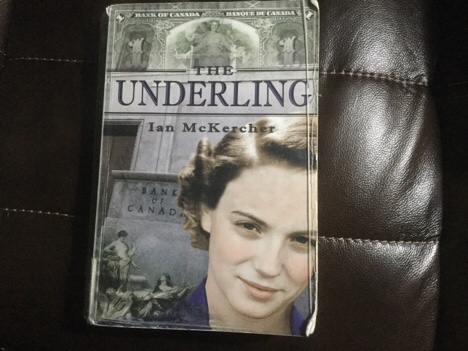
This historical fiction, far more fiction than history, is set largely in Ottawa and deals with the establishment of the Bank of Canada. If you think that a novel about banking can’t be a fun read, think again. The author incorporates abundant local colour around his and my adopted second home of Ottawa as it was in the 1930s, and taught at Glebe Collegiate until he retired. The central character, Frances McFadden, is a teenage tech school dropout who nevertheless parlays her typing skills and smarts into a major role in the planning and establishment of the central bank. As World War 2 looms, the story veers into the genre of an international spy thriller with enough suspense to satisfy David John Moore Cornwall a.k a. John Le Carre.
This is McKercher’s first novel with two sequels and an unrelated story now in print. It was published by the then Renfrew-based General Store Publishing House (GSPH) that was one of the rare publishers that would accept books written by unknown first time authors including yours truly. (GSPH published my first book, Medicine Outside The Box, in 2011, and contracted to publish my mere mortals novel, but then was forced out of business before fulfilling the contract.) Tim Gordon, the GSPH owner has now reestablished a publishing house in Burnstown, up the valley, that has published McKercher’s other stories. Small independent publishers are a dying breed and I wish him well.
A good quote: “Part of being an adult, Frances McFadden, is living with some things we don’t like. About ourselves. About others. About life.”
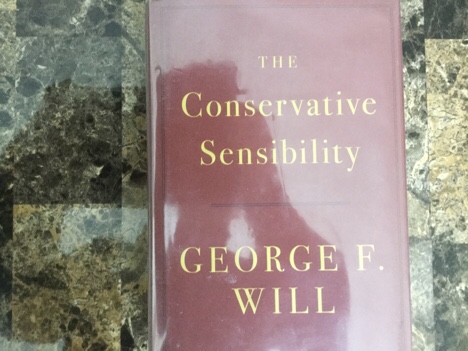
As soon as I noticed that this political tome was dedicated to the memory of Barry Goldwater, I realized that I would have difficulty overcoming my biases and keeping an open mind about its contents. But I’ll try to give it an honest review.
George F. Will is the elder doyen of American Conservatism, at least as he defines it, an Oxford and Princeton graduate, a Pulitzer Prize winner and, a syndicated columnist for The Washington Post, once owned by Rupert Murdock, now by Jeff Bezos. This, his fifteenth book, is the only one I have read.
First the positives.
1) There is much to admire in the clarity which Will brings to the differences between what he calls conservatism and progressivism in conceptions of the proper role of government in a free society. Based on his almost worshipful admiration for the Founding Fathers, the Declaration of Independence and the American Constitution as the unerring literal last words on how to organize a democratic society, he makes a very strong case for a minimally interventionist small government that exists only to protect the rights and liberties of individual citizens. He sees those rights and liberties as innate unchanging features of human nature rather than being granted by a government.
2) The whole book is chock full of interesting historical anecdotes and facts, e.g. Hitler was not an ethnic German (Austrian), Napoleon was not French (Italian), and Stalin was not Russian (Georgian). There are many counterintuitive perspectives that are difficult to disagree with.
3) After heaping supreme praise on the founding documents, Will fills hundreds of pages documenting the many problems with American government and society as it has evolved since. His ridicule of regulatory capture by rent-seeking special interest groups, the abdication of responsibility of Congress to the executive branch, the explosive growth of self-serving bureaucracies, and judicial failure to rein in creeping central government restrictions of citizens’ liberties as defined in the Founding Documents – these are all spot on. Why should government dictate the price of pressing men’s pants, or restrict the right of anyone to become a flower arranger? The best summary of his complaints is this quote: “Government power is increasingly concentrated in Washington. Washington power is increasingly concentrated in the executive branch, and executive power is increasingly concentrated in agencies that are unconstrained by legislative control.”
4) The deep philosophical musings in the chapter Welcoming Whirl on the role of religions and modern sciences in a democratic society is respectful of differing beliefs, detailed, interesting and thought-provoking. The conclusion that it is not essential to believe a religious creed to be moral and to be awed by nature is one I have come to accept as a card-carrying humanist. In discussing neuroscience, Will skids close to denial of the existence of free will. Pardon the pun.
Obviously, Will is very knowledgeable in the fields of political science, history, economics and philosophy (there is a 37 page introduction, a 19 page “Selected Bibliography”, 23 pages of Notes, and a 15 page Index, not included in the page number I noted above). Few others have such extensive experience and knowledge in this field, leaving little room for counterarguments unless one refuses to accept his basic unstated assumptions about human nature, the wisdom of the Declaration Of Independence and the Constitution, and the unique virtue of American exceptionalism, as I do.
Now the negatives.
1) The writing is humourless, dry, and pedantic, with many examples of distinctions without a difference, (one of the author’s favourite phrases), and the reasoning often seems convoluted, though to be fair, the factual knowledge is encyclopedic in its scope.
2) Both the underlying assumption that human nature is immutably fixed and that this confers natural rights to liberty and the pursuit of happiness are untestable philosophical assertions that are suspect. I doubt that the historian/philosopher Yuval Noah Harari (Sapiens) would concur with the former assertion, nor the political scientist Francis Fukuyama (The Origins of Political Order) with the latter. My “human nature” has nothing in common with that of concubines who willingly were buried alive with their Chinese emperor.
3) The much lauded statement that all men are created equal is one of the silliest assertions ever enshrined in an historical document, very different from the indisputable moral assertion that all men (and women) should be granted equal rights and privileges. The Founding Fathers obviously didn’t put into practice their assertion of inalienable equal rights when it came to blacks, women and Natives whom they slaughtered with abandon. Will seems to excuse this as an example of “presentism”- the application of today’s moral standards to previous generations.
4)The American boosterism becomes grating. Will describes the second paragraph of their Declaration of Independence as “ the most important paragraph in humanity’s political history.” What makes it more important than parts of the Magna Carta?
“[Americans] correctly believe that its political arrangements, its universal truths and the understanding of the human condition that those arrangements reflect are superior to other nations’ arrangements.”
“America, the first and most relentlessly modern nation….”.
5) If the pursuit of happiness is, as asserted, a uniquely American goal, why is America ranked #19 out of 156 countries in the well-validated 2019 U.N. Index of National Happiness, behind all the socialist Nordic countries, Canada (#9), and Costa Rica (#12)?
6) There are several simple factual errors. America is not the only country with an exact date of origin, as asserted. Humans are not the only species who can experience melancholy, and/or boredom, as any dog owner can attest.
7) Although written, or at least published, in 2019, the name Trump is never mentioned and there is no discussion of the role of American conservatism in the rise to dictatorial power of this rogue Constitution-ignoring egotist, though in an interview with Peter Wehner in The Atlantic, (July, 2019), Will thoroughly castigates Trump. I think it must have been that review that persuaded me to slog through this book, as no true friend recommend it to me.
I see that I have listed more negatives than positives-perhaps not fair as I did gain a lot of insight into the mindset of American conservatives from this book. But it is not for everyone and if you are a liberal minded non-American with high blood pressure, reading it could be lethal.
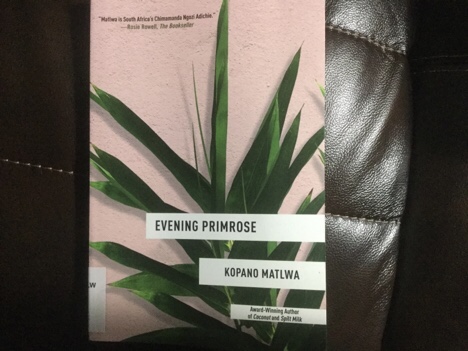
I was not familiar with this black South African physician-novelist until I saw this short story at the library, while looking for anything worth wasting time on. This, her third novel, is written as a cri du coeur journal record of the uncertainty, anguish, and self doubts of a deeply religious new medical graduate doing an internship in post-apartheid Pretoria. Many of the journal entries are direct questions to her God about the unfairness of the world in which her teen brother has committed suicide, she fights violent xenophobic black nationalism, is gang raped, and deals with her own descent into psychotic depression, guilt, and sense of worthlessness.
She exposes the cognitive dissonance of believing in an all-loving God who nevertheless never seems to answer her prayers or come to her assistance. Although she never directly questions the existence of God, she doesn’t hesitate to accuse him of favouritism and desertion. In many ways, this a modern day Book Of Job without any definitive answers to the many deep philosophical questions raised. Or perhaps more like the Old Testament book of Lamentations- dark and disturbing but thought-provoking.
Written in very short phrases or sentences, with frequent quotes from the Bible, this is an easy read, but raises profound questions that defy any easy answers. I got a very different take from this read than most of the reviewers on the jacket who concentrate on its political and racial context. Although it is set in South Africa sometime around 2010, it deals with meaty universal issues that should be of interest to a wide readership. It is far from clear to me to what extent this is autobiography.
Speaking to God: “I don’t know why I speak to You. You never speak back. Your silence is everywhere. It’s thick and plugs up the air.”
Alan Turing works on Artificial Intelligence in his lab in 1983 even though he committed suicide in 1957. In the same year, Britain loses the Falklands War to Argentina, with heavy losses, Margaret Thatcher’s government loses the election to the Labor Party, Jimmy Carter begins his second term as U.S. president, having defeated Ronald Reagan, British electric cars go 1000 miles on a single charge, and the first person singular narrator of this sci-fi tale reads the news on his iPhone. A computer company has developed and sold 25 programmable humanoid companions that pass for true humans, spouting poetry, with greater memory capacity than the usual human, and conversing with their owners. These obvious deliberate distortions of history must serve some deep literary or philosophical purpose that is far from clear to me. Why is the possibility of beings developed in computer labs that rival Homo sapiens not set at some future time with truly fictional characters? Perhaps the author wishes to convey the ideas that in some sense Alan Turing is still alive and that history is largely a fiction that we are forced to believe because of our limited intelligence? I am just guessing.
I read this book as an ebook, borrowed from the library, because it is on the agenda for my book club. The characters are realistic and there are enough surprising plot twists to keep me intrigued.
A couple good quotes: “But a mood could be a roll of the dice. Chemical roulette. Free will demolished, and I was here feeling free.”
Alan Turing describing the human brain. “A one-litre liquid-cooled three-dimensional computer. Unbelievable processing power, unbelievably compressed, unbelievable energy efficiency, no over-heating.The whole thing running on twenty-five watts-one dim lightbulb.”
I generally dislike sci-fi, but for fans of the genre this will be a gem and it is now being presented as a television serial. And I can accept that beings created in labs from Artificial Intelligence algorithms may at some future point pose a threat to the earthly supremacy of our species, but not in my lifespan. I still prefer McEwan’s Saturday.
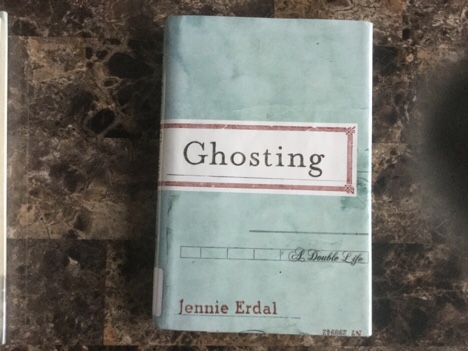
“Autobiography is unreliable. A lot what we remember is designed to shield us from painful truths.” There is no recognition of the irony in this statement in this autobiography of this Scottish polyglot writer. Educated in languages and classics, she fell into a job as a ghostwriter for a rich, flamboyant, egotistical, tyrannical, obsessive compulsive London publisher whom she names Tiger. She never reveals his real name nor the publishing house he owned, probably because he is still alive at age 89, so I will not either, although those details can be readily found. This is Erdal’s first book under her own name, although she ghostwrote several books that were published under Tiger’s real name, along with many newspaper articles, book reviews, and short biographies. Tiger had access to many members of British high society, spent lavishly and was an uncompromising control freak who could make the lives of his employees, mostly young beautiful women, pure hell.
Much of the writing is consumed with what it means to be a writer, the love-hate relationship between the ghostwriter and the putative author, and the construction of fictions, both in writing and in memories. The discussion of the almost infinite ways to relate sexual encounters in works of fiction is superb and nuanced. Many of the disagreements between the female twice married ghostwriter and the married male putative author relate to this difficult area. Should it be explicit, mechanical and pornographic or more subtle, leaving details to the imagination? I may be called prudish, but I prefer the latter, especially if the book is to be discussed or read in mixed polite company. There is no suggestion that their relationship was in any way sexual, although they spent weeks together away from their respective spouses, and often swam together in the pool at his isolated French mansion, au natural. Tiger’s wife is only mentioned tangentially once in the whole book, attending a high society party. Perhaps this is due to his non-British societal misogynist background.
There are hilarious recollections of Erdal’s early childhood in a strict parochial Scottish Presbyterian family, and her gradual discovery of the outside world including that of sex. And there are eternal and insightful reflections on the meaning of loss- of a parent, a loved one, a marriage, even a favourite dog.
A great quote on self presentation and self image: “We all wear masks; it’s just that some masks are worn so tightly that they begin to consume the face behind them.”
I enjoyed this book, as will anyone who is even peripherally involved in the world of books and publishing.
Thanks to fellow blogger Simon Thomas (Stuck In A Book).
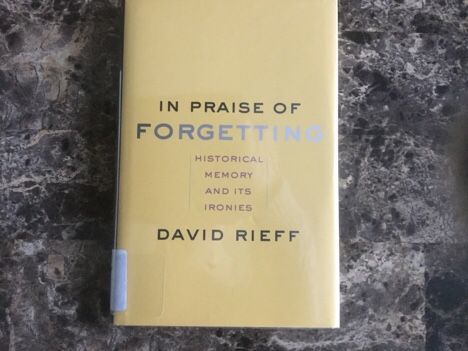
these are just a few of the adjectives from the first half of the alphabet that came to mind as I read this short but weighty book. Add ‘opaque’.
With wide-ranging quotes from philosophers, historians, politicians, writers and social scientists there is no doubt that Rieff, the son of Susan Sontag, is a knowledgeable deep thinker. But either his ability to put his thoughts and arguments into plain easily understood language or my comprehension is deficient. He seems to assume that all readers are familiar with the arguments and counterarguments of the often obscure (to me at least) people he quotes.
The only quote I chose (below) is one of the more easily understood sentences and may be the best summary of the thesis of the whole book. But why use short words and simple sentences when long words and convoluted sentences can convey the ideas almost as well?
“…far too often collective historic memory as understood and deployed by communities, peoples, and nations- which again is always selective, more often than not self-serving and historically anything but unimpeachable- has lead to war rather than peace, rancour and resentment (which increasingly seems to be the defining emotion of our age) rather than reconciliation , and to the determination to exact revenge rather than commit to the hard work of forgiveness.”
Even though I accept that its central thesis, that it is often better in the context of historical wrongs for individuals, societies, and nations to forget than to remember may be valid, I cannot recommend this book to anyone. I conveniently have forgotten where I saw or heard the review that induced me to get it from the library.
This Alberta novelist describes a wide variety of very realistic characters with all their flaws, in 49 titled chapters, and straightforward third person narrative. The story covers about 10 months in about 2000 in the aftermath of a Saskatoon collision of two cars carrying passengers who have absolutely nothing in common. She largely relies on character development rather than sudden plot twists to keep readers engaged, and certainly succeeds. She even manages to get into the heads of three small children and see the world through their eyes.
The central character, a long-divorced introspective female insurance broker questions the meaning of her unfulfilled life following the accident that she caused and vows to become a positive force in the world. But her good deeds are under-appreciated and at times she feels used rather than useful. Existential questions about what it means to be good resonate in the musings of a variety of colourful characters, surrounded by the evil unappreciative players they try to help. There are no definitive answers provided to the enigmatic questions raised about what it means to be good, to do the right thing, and no definitive outcomes for any of the characters.
At times I found it a bit difficult to keep track of some of the peripheral characters, but on the whole, this was not a major problem. The description of the complexity of hospital life and the life-threatening cancer treatment one lady undergoes is spot on, even to the point of documenting an allergy transmitted to the recipient of a transplant, something I have observed in three patients, but is not a widely known phenomenon.
One of many great quotes, this one from the musings of a poetry-spouting, doubting, childless Anglican priest in a marriage that is about to dissolve: “The proximity of death makes us remember our own insignificance, that no one will remember us, that we are animate atoms, at most; our lives don’t matter. But the children do. If there are any children. A chicken: an egg’s way of making more eggs.”
This is one of the best novels I have read in a long time-and it is distinctly Canadian. I highly recommend it, but can’t recall who recommended it to me.
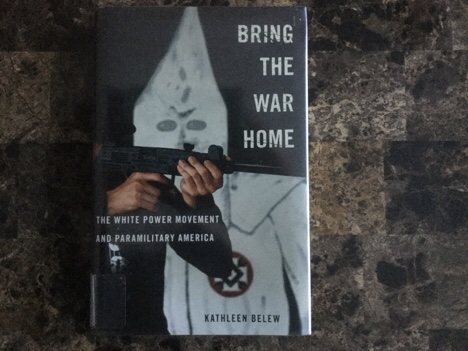
This detailed modern history lesson by an Assistant Professor of History at the University of Chicago ties the increasingly organized development of the U.S. white power movement in its various forms to the return of disappointed and frustrated veterans of the Vietnam War, and the later gulf wars. She convincingly shows that this diverse group, which she refers to as white power advocates rather than as racists, Neo-Nazis, white supremacists or anti-semitics was and is much more coordinated, united and dangerous than is commonly appreciated. A large percentage of them are veterans who were poorly appreciated and poorly rewarded for their efforts on behalf of Uncle Sam. The author attributes their adoption of radical racist ideology and advocacy of violent overthrow of the government to this disappointment. But she never mentions what must be even more important- the general lack of education and job training of military recruits. The average age of Vietnam war era draftees was 19, and they were taught how to kill, often indiscriminately, but were untrained in any skills useful in peacetime. To me it seems that she identifies hundreds of trees, but not the forest.
There are constantly changing alliances between groups such as the branches of the Klu Klux Klan, the Order, the Posse Comitatus, the Aryan Nation, the Sword and the Arm of the Lord, the White Patriot Party, The Covenant, United Citizens for Justice, United Racist Front, The Mountain Church, Patriots Defence Foundation and CMA (Civilian Military Assistance). Some are allowed to receive tax-deductible donations as religious organizations or charities. They often recruit active military personnel, steal heavy arms and ammunition from military bases ( especially in North Carolina) and train in secret paramilitary camps. Many are aligned with violent millennialist religious fanatics. Their increasing militarization is paralleled by the militarization of law enforcement with armoured personnel carriers stockpiled on both sides. Lawyers for the extremists ensure that juries are sympathetic to the extremists, often portrayed as patriots and protectors of white oppressed women. True believers in the conspiracy theory of a Zionist Occupation Government (later dubbed The New World Order), many also are dedicated survivalists preparing to outlive those of us left behind at the coming Apocalypse.
All writers about contemporary societal threats need to emphasize the danger to sell books. But this scholarly treatise (851 notes) convinced me that the threat from those extremists is very real and more serious than is generally appreciated. But it is also as dry as the current Australian desert and my high school history texts, and much more detailed than necessary to make that case. And the documentation stops in 2006 with the execution of Timmothy McVeigh, except for a few meaningless words about Donald Trump in the last three pages with the weak excuse that the effect of his blatant racism is too contemporary to analyze in a work of history. That is unforgivable. A knowledgeable scholar like this author could afford to provide us a useful, if only tentative, perspective of where we are now.
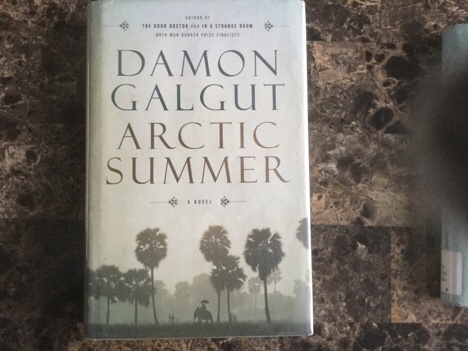
This book by the Cape Town writer is called a novel, but thoroughly blurs the distinction between fiction and biography, relating as it does to the life, travels, and writings of Edward Morgan Forster. It could, perhaps more accurately, be described as an embellished biography although there are several older extant biographies of E.M. Forster. The title allegedly was considered by Forster for an novel he was planning.
It is clear that E.M.Forster led a troubled life, related in large part to his secret homosexuality at a time when openly gay relationships were rare and despised. Forster never acknowledged his sexual orientation to his family although he had both casual and deeply loving relationships with several men, at least two of whom were married with children, and one was an ex-Muslim. He, or at least the character portrayed in this ‘novel’, seems to have had a very wide ranging emotional scale ranging from deepest despair to sublime elation, combined with
profound self-doubt and constant introspection. Is the ability to experience emotions on a very broad scale a trait that is more common in homosexuals?
The detailed description of sexual encounters in many novels generally disappoint me. Call me a prude, but I don’t think that graphic descriptions of deployment of a wide variety of combinations of appendices and orifices in pursuit of thills is necessary or contributes much to the literary value of novels generally. I would rather those combinations whether heterosexual or homosexual be left to my imagination than be described in great detail as occurs here. Younger readers may well disagree. But there is a very important and under-appreciated vast difference between yielding to hormonally-driven lustful momentary urges and the far more complex interplay between sexual activities and what is called love, and that distinction is made very clear in this account. The protagonist was capable of both activities, including sadomachoism, but certainly never confused them, and the depiction of the strong emotional bonds between men in this book-those bonds that have little to do with genitalia- rival those of the great romance novelsj
A couple of good quotes
“He had learned to distrust purity- or the idea of purity, rather because the real thing didn’t exist. Everybody was by now a blend; history was a confusion; people were hybrids.”
“A failure to decide is a sort of decision.”
This book will be greatly enjoyed by anyone in a sexual minority, and many straight people as well. My only real criticism is the overemphasis on sex generally and the unnecessarily detailed description of the mechanics of copulation. For some readers, that may be its big attraction.
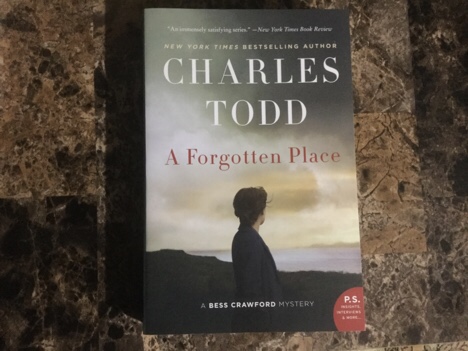
The latest, or one of the latest, in the long series of Bess Crawford mysteries by the mother and son team known as Charles Todd, this one was another Christmas present. They apparently are all set during or just after WWI and star the fictitious British army nurse Bess Crawford. This one starts in December, 1918 in a field hospital in France, then moves to a field hospital for the returning soldiers in England and then to an isolated Welsh peninsula with a dark past and a population of poor hermits, misfits and unsolved crimes.
A la Sherlock Holmes, the narrator, Bess Crawford seems to have an uncanny ability to piece together far-from-obvious clues to solve the mystery of dead bodies washing ashore, strange beatings and the secrets known only to the residents who shun outsiders and any authorities. But Charles Todd is no Sir Arthur Conan Doyle. The pathos, hardship, and despair of the wounded is well described, and there are abundant surprise twists. But the weak attempts to build suspense include too many unlikely chance clandestine meetings and beatings of mysterious characters on dark and stormy nights to be believable. The geography of the peninsula and the sites of the meetings and beatings are poorly described and confusing, at least to me. It is almost beyond belief that the narrator could even survive the machinations of the locals determined to keep their secrets to themselves, let alone solve their mysteries.
This is a fun light read, but it failed to make me a fan of the heroic Bess Crawford. I will not be reading the nine other novels featuring her nor the twenty three other mystery novels by the same author. But I am not a generally a fan of formulaic mystery novels to begin with, and this did nothing to change that. Others may well relish this genre.
I read this 140-year-old rant many years ago and greatly appreciated it then. It is so packed with thoughtful observations that I reread it this week as an ebook. It is as relevant to today’s society as it was in the 1880s. Robert Green Ingersol, although raised by a Congregationalist clergyman, came to be known as “The Great Agnostic”, fought as a Colonel for the Union in the Civil War, studied law and became a great orator in the age of great orators who made a good living touring the country giving speeches. He advocated for suffrage, women’s rights, abolition of slavery, democracy and above all, for critical thinking, scientific rationalization, and freedom from religious dogma and intolerance.
In this series of lectures made into a book, he exposes the contradictions, cruelty and impossibilities of the stories of the Pentateuch (the first five books of the Old Testament), with searing sarcasm, impeccable logic, wit, and a keen awareness of irony. He analyses the accounts therein in the context of scientific facts known in the 1800s. He points out that these books could not have been written by Moses as his death and burial is recorded in Deuteronomy 34:1-8, but, for convenience, agrees to call Moses the author. While some of the scientific data that he cites is in need of some minor revisions today, those errors are minuscule compared to those in the Bible. His knowledge of the Old Testament and nineteenth century science is impressive, and his insights into the implications of the cruel, inconsistent laws supposedly delivered by Jehovah to the Jews for all subsequent generations are contrasted with those of the secular agnostic freethinkers, of which he was one of the first in North America. His Victorian prudishness makes him unwilling to quote certain passages of the Bible, so he viciously condemned them with cute oblique references to obscenities in the holy book.
In the introduction, Ingersol urges the clergy ‘who are not allowed to think for themselves’ to use logic and reasoning rather than blind adherence to ancient dogmas- to free their minds. In the concluding chapter he passionately mocks those who choose to ignore the “Mistakes Of Moses” and lists off dozens of these that are more fully dealt with in earlier chapters.
There are so may good quotes that it is difficult to single out the best.
“Let us account for the things we see by facts we know. If there are things for which we cannot account, let us wait for light.”
“Theology is not what we know about God but about what we do not know about Nature.”
“Imagine the Lord God with a bone in his hand with which to start a woman, trying to decide whether to create a blond or a brunette.”
Years ago this book was one of several pushing me to become the secular humanist that I am today. Any clergy who read it need to be cautious lest their conscience then drives them from their only source of income, after considering its logic. Unfortunately, it is not very popular today in spite of efforts by various humanists such as Tim Page (What Has God Got To Do With It) to revive its timeless relevance. It deserves better, and should be widely read. And on Wikisource, last updated exactly one year ago, it is free! At least read the conclusion; it will free your mind to think for yourself.
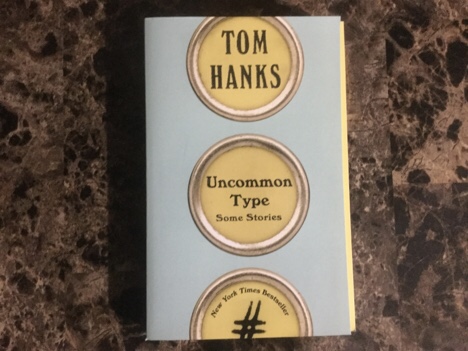
This collection of eighteen diverse short stories amply proves that Tom Hanks can not only deliver witty thought-proving lines, he can also write them. A touching fictional story about death and destruction on the front lines of WW II, a sci-fi trip around the moon on a homemade rocket, the perspectives of a ten year old boy growing up in small-town California in the 60s, the frustrations of a would-be actress in New York, a whirlwind romance between obvious misfits, the mundane existence of unambitious writers, an ace bowling champion, a stowaway arriving in NYC – they are all here and described in deliciously seductive prose. The chapter relating the future time-travel of the super rich back from sometime in the 2030s to the 1939 New York World’s Fair through a ripple in the space-time continuum is perhaps the weirdest, but the portrayal of the excitement and optimism of life in 1939 New York is detailed and memorable.
There is only one uniting feature – even the long script for a movie has a typewriter within the story, hence the title. I gather that Tom Hanks has an extensive collection of antique typewriters.
A surprisingly fun, mostly light read, as good as the author’s portrayal of Forest Gump.
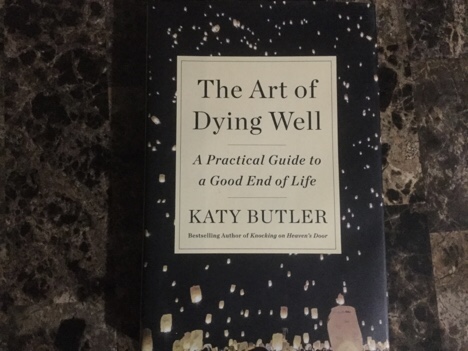
This screed, with a uniquely American perspective by a typically tunnel-visioned American journalist, was a Christmas gift from my uniquely American economist daughter. I keep hoping that she sent it my way because of my background and interests, and not because of some hunch about my near future. Like Atul Gwande’s Being Mortal and H. Gilbert Welch’s Less Medicine, More Health, Butler exposes the warped, fragmented, impossibly complex, and dysfunctional system called health care, more appropriately dubbed wealth care, in America. Based on free market economics, it prioritizes the fiscal health of practitioners, institutions, and pharmaceutical companies over true care, particularly for the elderly and debilitated. 1000 Washington lobbyists for pharmaceuticals and institutions push for ever more high tech interventions and costly toxic medications, but none advocate for discussion of realistic limitation of interventions toward the often miserable end of life. Oncologists are paid a percentage of the fee charged to the patient for their prescribed toxic medication of limited utility, but not for discussing the real futility of further chemotherapy.
The author divides the process of living and dying into seven arbitrary stages, while acknowledging that the time of anyone’s death is unpredictable. There is a lot of generalization and doctor bashing that seems to be very popular, but no acknowledgement of the fundamental flaws of a private health care system. The sacrilegious thought that any other country might have developed more compassionate fairer systems of health care apparently never crossed Butler’s mind. Thus, the generalizations are of limited applicability outside of the U.S. Even the terms ‘hospice’ and ‘palliative care’ seem to be defined differently in the U.S. than in the rest of the world.
The discussion of the pros and cons of dying at home, in a nursing home, or in a hospital is balanced and interesting. Dying is usually messy, smelly and stressful. I don’t care where I do it, provided those helping me know what they are doing and preferably are professionals and not already-stressed family members. And there are some positives to doing it alone, like the elderly Inuit nomads who can no longer keep up with the tribe and simply lie down in the snow to become bear bait, or Sir Robert Scott who sent his team on ahead and died alone after realizing that he would never make it back from the South Pole. The importance of various forms of advance directives is stressed appropriately. There is an abundance of data cited about causes of death, but I distrust much of it. Having filled out dozens of death certificates, the listed cause of death is often an arbitrary choice from the International Classification of Diseases, when several would be equally appropriate. ‘Dwindles’ is not acceptable to the keepers of Ontario Vital Statistics. Before electrocardiograms, many people died of ‘acute indigestion.’
There are also glaring deficiencies in this discussion. In spite of the abundance of deathbed humour in our culture, there is no leavening humour in this book. There is not a word about the ultimate altruism- organ donation, whether after declaration of brain death or the now accepted donation after cardiac death. The discussion of laws concerning assisted dying is limited by the complexity and limitations of these laws in different jurisdictions. There is little discussion about the value of carefully planned distribution of physical assets and real estate. My heirs will have no real estate to fight over, and I try to limit my physical assets to what is really important and useful to me. When a new item of clothing (usually courtesy of my wife) or a new book arrives, a similar older item goes to a charity or library. And my irrational fear of becoming dependent made me write my obit (just fill in the date and location) so nobody needs to dream up something positive to say about my life. The recommendation to join a support group for specific diseases can be problematic. In my experience, such groups often degenerate into little more that mutual self-pity societies.
The terminally ill Peter Schjeldahl (December 16 New Yorker) quipped that a major problem with dying is that one cannot get advice about how to go about it from anyone who has actually done it. Some people try.
This is an important, interesting book, but not particularly useful for non-Americans. The brutally honest late Sherwin B. Nuland’s How We Die is a better treatise on this grim subject, of wider timeless applicability.
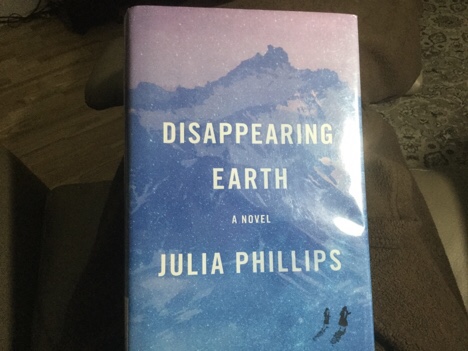
I do not remember why this book was on my reading list- perhaps a favourable review somewhere, or a friend’s recommendation. Petropavlovsk-Kamchatskly on the southeastern coast of the wild and isolated,1200 kilometre long, Kamchatka peninsula in far eastern Russia seems like a peculiar setting for this Brooklyn author’s debut modern novel.
The apparent kidnapping of two young girls by a mysterious man with a black SUV is introduced in the first chapter, then clues as to what happened to them are finally introduced in the penultimate chapter. Each of the ten intervening chapters covers events in consecutive months with the members of four families. Although the list of main characters at the front, and a map of the peninsula, are helpful, it is still difficult to keep the characters and locations straight, and much of the narrative seems unrelated to the main plot. That there is a main plot at all is far from clear, and there are so many loose threads that the fabric of the story is in danger of completely unravelling. The last four page chapter does nothing to tie the previous 252 pages together and can only be described as bizarre.
Some quotes may help me convince you about the abundant literary gobbledegook.
“That sick mix swirled in her chest.”
“Inside her was white and smooth, a frozen landscape, solid bone.”
“Her heart had been fragile, its chambers shifting as easily and dangerously as volcanic earth.”
“A cord of tension extended from Zoya’s eyes, her sinuses, the back of her throat, through her body, out her ribs, to the men.”
I should have suspected that this book would not appeal to me. The author is a graduate of a creative writing school, and the lavish “advanced praise” on the back cover is from seven other novelists not familiar to me and not identified as to affiliations or their own books. Is this some kind of incestuous cabal of elitist writers dedicated to promoting each other? Or am I becoming too cynical in questioning books with ‘advanced praise’? Or did I just miss the whole point of this story?
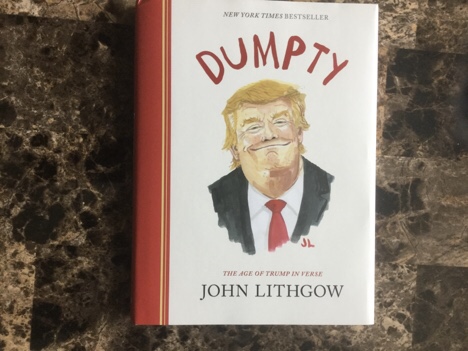
A Christmas gift, an author that needs no introduction, and a subject that everyone knows about, this short collection of poems and sketches made me break my unwritten rule to eschew poetry at all costs. When Dumpty breaks into “Some of my favourite lies” you have admire the clever adaptation from Mary Poppins.
For readers who wisely have stopped or never started keeping track of the latest Washington scandals and firings, a short explanation of the characters satirized is provided at the end of some poems. Several pages are just cartoonish sketches. The whole book can be read in under two hours even adding in some chuckle time. You should share this one by placing it in a magazine rack in the washroom.
I struggled through the first 250 pages of this Cambridge professor’s tome on espionage, counter-espionage, double agents, and military intelligence and was only up to the mid 1660s. I was ambivalent about continuing, but some of the later chapters looked interesting. The Ottawa Public Library made my decision easy by informing me that it was due, and could not be renewed as there were five ‘holds’ waiting for it.
What new information did I glean so far?
1) The classic military text The Art of War was probably not written by Sun Tzo, or any one individual.
2) Water boarding as a technique to squeeze information from captured enemies was not invented by Donald Rumsfeld’s sadists, but by the religious zealots of the Spanish Inquisition.
3) King Philip IV of Spain used Catholic Dutch-Flemish painter Peter Paul Ruebens as a go-between to obtain inside information from the English court of Charles I; by flattering the vain English king while painting his portrait, he secretly obtained information about the English intentions, during the Thirty Years War.
4) Richard Bissel’s bungled enlisting of the Mafia in an attempt to assassinate Fidel Castro is widely used as a classic example of the failure of military intelligence, not apparently as an example of any moral failure. (This information seems out of place in the otherwise chronological discussion.)
The chapter Renaissance Venice and Western Intelligence meanders through various European courts to Cortez and Pizarro in a disjointed discussion of the importance of decryption and spying interspersed with descriptions of incredibly cruel means of extracting information about the enemy intentions, during the Thirty Years War. I am left with the impression that being a royal during the 1600s was an inherently risky occupation, and can never remember who was allied with who in the constantly shifting borders and allegiances of Medieval Europe.
I may at some point return to this book to selectively read some of the later chapters on intelligence, e.g. weapons of mass destruction in Iraq, then again, I may not. Probably a great resource for serious historians, military strategists, foreign service agents, and for anyone feeling the need to spew obscure true historical anecdotes at a cocktail party.
By 1914, Sir Ernest Shackleton had assembled a crew of 27 handpicked men and financing for the Imperial Trans-Antarctic Expedition to cross Antarctica over the South Pole, from the Weddell Sea to the Ross Sea, having already lost the honour of being the first person to reach the pole. When the Endurance became stuck in ice and broke up in the middle of the 900,000 square mile Weddell Sea, Shackleton’s supersized ego combined with sublime optimism and leadership ability kept the disparate crew together for epic treks across ice floes and stretches of rough open water to ultimate rescue, while suffering frostbite, near-starvation, despair, and more shipwrecks.
I first read this tale of adventure and courage in 2016, partly while flying to Ushuaia, and then tried to finish it while being tossed around on a small repurposed NOAA research vessel crossing the Drake Passage, ‘the most dreaded bit of ocean on the planet’, to Antarctica, admittedly not the most relaxing place to read about being stranded on Antarctic ice floes. I reread it this week and enjoyed it as much the second time, but with perhaps a bit more skepticism about the hyperbole and some detailed descriptions that seemed to incorporate a bit of literary licence.
Shackleton made several near-fatal decisions including refusal to take along adequate seal meat and blubber at one point, leading to the need to kill half of their sled dogs at one point and the rest of them to be eaten a little later, but he commanded loyalty from almost all the imperilled men and he possessed an acute sense of responsibility for their survival. At great personal risk, and with what seems like incredible good luck, he ultimately did get them all to safety. It is a testament to the very human survival instinct that the men seemed to bond together when needed, and seemed to even enjoy their adventure. Sitting on a cracking ice floe, cold and wet, running out of provisions, one man wrote in his diary “It has been a lovely day, and it is hard to think that we are in a precariously frightening position.” The navigation by sextant and compass will be of interest to those dedicated sailors in my coffee clutch but was very confusing to me.
The author writes with a keen sense of the dramatic suspense, though most readers already know the unlikely but lucky final outcome. The maps at the front of the book are helpful, but even with these, and having visited several of the sites mentioned, I found the geographic descriptions a bit confusing. But I fondly recall encounters with crab-eater, elephant, Weddell, and leopard seals, as well as Adele and Gentoo penguins that were all staples of the stranded crew’s diet.
This is a leopard seal. We were warned as we passed by in a zodiac, that we should not put a hand in the water as he might be hungry.
First a note about the length of books. At 764 pages of text plus 84 pages of notes, an eight page introduction, and a 25 page index, this is one of the longest books I have read, perhaps outdone only by the King James Bible and Leon Tolstoy’s two volume War and Peace. I have been posting the number of pages in my reviews, as does The Economist, but The Atlantic, Harpers, Macleans, and The New Yorker do not. But the number of pages alone does not accurately reflect the length of a book. This definitive biography is published on 6’ x 9’ pages with narrow margins and average font size, few spaces, and no blank pages, and will take days to read. Perhaps the total word count, an estimated average reading time or actual listening time for audio versions would be more useful guides for potential readers. Is posting the number of pages useful at all?
Written by a Yale professor of American history, this is much more than a biography of the 19th century anti-slavery freedom fighter. It could stand alone as the reference work for a university semester-long course in Civics or American history, with striking relevance to the political and racial controversies endemic in the 21st century, usually with the roles of Democrats and Republicans reversed.
Frederick Douglass , born as Fred Bailey, sometime in 1818, to a Maryland slave mother, never saw her after he was six years old, and was never sure who his father was, although he was probably her slave master. Beaten as a child, he nevertheless showed so much potential that he was allowed to learn to read and write. Escaping to Lynn, Massachusetts, and then to Rochester, New York, he honed his oratory and writing skills to become the preeminent anti-slavery campaigner, touring tirelessly in the free states and in Europe. With frequent references to Old Testament prophets, biting satire, irony, and unrelenting consistency he exposed the cruelty of slavery, the hypocrisy of slave owner Christians and their clergymen, the folly of compromising black leaders, and the duplicity of corrupt politicians.
The history exposed in this exhaustive nonfiction is replete with names that many modern readers will recognize but not know details about. Douglass, once he became a freedman, interacted with five presidents, numerous other politicians, Harriet Beecher Stowe, Mark Twain, John Brown of the Harper’s Ferry raid fame, Stephen Foster, Robert Green Ingersoll, Susan B. Anthony, Elizabeth Cady Stanton, his eventual undisputed successor, Booker T. Washington, and a host of other familiar people. He made enemies with his militant rhetoric, not only in the Confederate states and with white supremacists but with many fellow freedom fighters because of his uncompromising insistence on total equality of the races and his reluctant eventual endorsement of violence as a tactic to end slavery.
Those who think that extreme political polarization, a politicized judiciary and ‘fake news’ are new phenomena should read about the lies and extreme politics in the mid 1800s, with the Dred Scott ruling of the Supreme Court and that court’s ruling in 1883 that the Civil Rights Act of 1875 was unconstitutional. Judicial interference or biases in determination of election results is not new either, witness the 1876 election fiasco. And although Abe Lincoln is remembered as the emancipator of slaves, few recall that he also tried to enact legislation to forcibly move blacks in the south en masse to Africa or Caribbean islands, refused to allow blacks a commissioned position in the Union Army or provide them with equal pay, and in his first term, continued to enforce the Fugitive Slave Act to return captured slaves to their owners. Both he and Douglass supported extrajudicial killing of captured Confederate soldiers in one-for-one tit-for-tat retaliation for the killing of Union soldiers. And the U. S. government and industrialists sabotaging their own diplomats is not new either as shown when Douglass was the ambassador to Haiti, late in his career.
Douglass’s life was plagued by financial difficulties, and a demanding, dysfunctional, continuously feuding extended family. Blight provides a vivid picture of the perils of daily life in an age when many children died before their parents, semi-starvation was common, and diseases such as consumption (tuberculosis) and malaria were endemic and untreatable.
No one’s life is without some inconsistencies, and Douglass’s is no exception. Although he may or may not have been sexually unfaithful to his illiterate black first wife, he certainly was emotionally unfaithful to her and, for intellectual stimulation and female companionship, relied heavily on two fawning educated white women who spent months with him, often in the Douglass home. The great orator and writer, suffragist, and advocate of black self- improvement never bothered to teach his wife to read or write. The fighter for black equality and rights mocked native Americans and Irish immigrants as inferior to the black slaves, and believed that it was appropriate to confine Natives to forests and reserves while blacks should have no such restrictions, and he scorned all Catholics. And he blatantly used nepotism in his role as the Marshall of the District of Columbia, to employ impoverished family members. His sarcastic dehumanization of enemy Confederate warriors and southern slaveholders, comparing them to animals, is an example of the necessary first step leading good people to become torturers and commit horrendous atrocities, as Philip Zimbardo has shown in The Lucifer Effect.
Blight does not measure up to Douglass’s writing skill, but this is nevertheless an enjoyable, educational, long read, and it provides insightful context to 21st century societal conflicts and politics. It is worth the time investment, especially if you are a retired history buff. Otherwise, be sure to read about the relevance of Frederick Douglass to the future of America by the same author in this month’s issue of The Atlantic
Thanks, Cal.
P.S. I will probably not post any reviews next week, as I have just started into an equally long epic- The Secret World. A History of Intelligence.
I can claim some connection to both books that I review this week, having met the author of of one and the title hero of the other one on different social occasions.
Set in the 1830s, the narrator for this story, George Washington Black, starts off his life story as an illiterate eleven year old orphaned Dahomey slave taken to a Barbados sugar cane plantation. With a knack for scientific sketching and a curiosity about everything biological or scientific, he helps the more tolerant of his twin brother owners design and then fly a dirigible off the island. Further travels include stops in Norfolk, Virginia, a remote Arctic outpost, Nova Scotia, London, Amsterdam, and Marrakesh. At times it seems that he is forever in a futile quest to escape his past.
The careful description of the sights, sounds and smells of the various places he escapes to evokes a time when those sensations were probably more important to survival than they are now with modern communications and much less contact with raw outdoor realities. His constant questioning of the meaning of his life without evoking any religious beliefs and his determination to contribute to the betterment of others are admirable qualities thwarted by his horribly disfigured face. And his yearning for recognition of his considerable scientific and artistic contributions is never satisfied by the end of the story, when he is only eighteen.
The story is tied together with some unlikely chance encounters, considering the limits of travel and means of communication in that age. But these provide just enough surprises to keep any lover of mystery novels engaged. Yet it seems to me that in 1836, even the most knowledgeable biologist would be unable to identify the limbic system in a cetacean brain.
I thoroughly enjoyed this novel that I picked up at the Kanata Grassroots Grannies book exchange and breakfast, although it somehow was already on my list to read. I have not read any of the Vancouver author’s previous works.




 The Passionate Reader