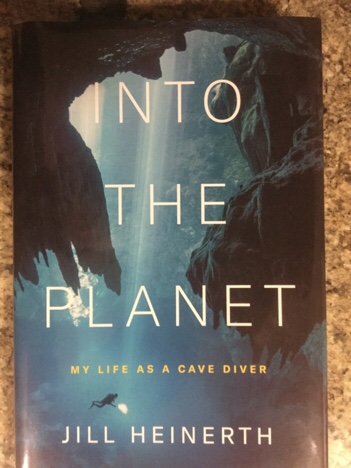
This autobiography presents a challenge to review objectively. The restless, Canadian-born, young adventurer, photographer, film-maker, scientist, and naturalist has made a career out of cave diving in some of the most remote challenging environments on earth, including under Arctic Ice, into deep unexplored Mexican underwater caves, and in clefts in huge Antarctic icebergs in the Ross Sea. She has won international acclaim for her contributions to the science of water conservation but really devotes little time here to that science. Her driving force always seems to be the need to conquer her fears and challenge herself to overcome ever increasing odds of dying by taking on new risky adventures. She describes at least a dozen situations where the odds of her survival were at best 50-50, unless she is grossly and consistently overstating the dangers. No one will ever sell her life insurance and she does not shrink away from discussing the very high mortality rate of the whole community of cave divers. Danger seems to be an addiction to many of them.
As a pioneering woman in a male-dominated world of adventure cave divers, she faces barriers that reflect common societal misogynist perspectives. She resents being considered as her husband’s ‘latest girlfriend’ and insists on being recognized for her own accomplishments. Some misogynists would describe her writing as showing neediness and insecurity, and her complaints about not being acknowledged for her work may seem a bit peevish. But there is a fuzzy line between insisting on acknowledgment of one’s accomplishments and being seen as a whiny egotist and I acknowledge that there is still a very real problem of male reluctance to acknowledge remarkable women’s accomplishments. Insistence on recognition of one’s accomplishments is entirely different than a sense of entitlement. Although ‘entitlement’ and ‘recognition’, are somewhat related, the former has some legalistic connotations that the latter does not.
In the next to penultimate chapter the author discusses the genetic basis of people’s propensity for taking risks. She implies that she carries the DHD4-7R allele of the dopamine receptor gene which has been linked to addictions, ADHD and risk-taking behaviours of all kinds. It has been dubbed ‘the Wanderlust Gene’ and it seems likely that this genetic trait has influenced her choices in life. This genetic trait may help to explain the risk-loving nature of people like the author, and Kate Harris who documented her love of risk-taking in Land Of Lost Borders. This raises again the thorny issue of nature vs nurture that I will not discuss further here.
The irony is apparently unrecognized when she preaches about knowing when the risks are too high to continue a pursuit but is herself the best example ever of ignoring that advice.
The description of the geography of the deepest canyons and rivers in Mexico were confusing, and I could not conjure up an imagine the terrain.
One great quote: “We decided that it was more important to live rich experiences than to get rich.” Advice that will stand the test of time, but is not very popular.
This book will appeal to anyone who has ever done any scuba diving, but describes a world that this risk-averse (at least relative to the author) landlubber has difficulty understanding.
Thanks, Michelle.

 The Passionate Reader